Last time we looked - very briefly! - at the geopolitical buildup to August 1914.
The tl:dr version is that: 1) Europe in the waning years of the 19th and the opening of the 20th Centuries was a cross-cutting tangle of alliances meant to reassure the major powers that they wouldn't be isolated in a Great Power war.
2) These included: a) Germany and Austria-Hungary, a peculiar and one-sided arrangement that seems to have persisted because i) Austria needed German economic and military strength, while ii) Germany needed SOMEbody to be their pals, and the Austrians were that desperate. b) Italy and the Ottomans were kind of strap-hanging on to the Austro-German alliance, but i) Italy was pretty much the definition of "not really a Power" AND pretty much hated the Austrians, while ii) the Ottomans weren't useful for much of anything in Europe AND were pretty much "The Sick Man" they're conventionally portrayed. c) On the "other side" were France and Russia, forced into an arranged marriage when Germany dumped Russia and France was looking for help to offset its economic and demographic weakness vis-a-vis Germany. d) Great Britain wasn't really sold on all this Continental dick-waving, but i) had patched things up with France because of concerns about Kaiser Wilhelm's idiotic Navy fetish, and ii) had an arrangement with Belgium, who, sensibly given the aggro dudebros all around, had declared their absolute neutrality on the whole Franco-German pissing contest.
3) When the political crisis in the Balkans that exploded at the end of June (and, remember, Franz Ferdinand was just the final spark; the problems between Austria-Hungary, Serbia, Russia, the Ottomans, as well as the Balkan minorities within and without the Austrian borders, had been festering for decades) the immediate military concerns of the various powers were (in alphabetical order):
Austria-Hungary: defeating Serbia before the Russians could mobilize and threaten the northern regions of Bohemia and Moravia (in what are now the Czech Republic and Slovakia) and Galicia (in modern Poland):
By ArdadN - Transferred from en.wikipedia to Commons., Public Domain, https://commons.wikimedia.org/w/index.php?curid=5867649
France: A German invasion (I know - it was that simple, but not easy...)
Great Britain: Kind of nothing, at first. France versus Germany? Not their problem, tho I'm sure Herb Asquith and Downing Street were giving the HochSeeFlotte the side-eye just in case...
Italy: Not happy to be dragged into a European war by the fucking Austrians (bastardos!) over some damn thing in the Balkans.
(This eventually led to Italian reneging on their Central Power-alliance commitment, BTW.)
Ottoman Empire: Kind of wanted to slap Russia, but the overall involvement was a fuckup. Turkish historian Kemal Kaspat summed it up as follows:
“Ottoman entry into the war was not the consequence of careful preparation and long debate in the parliament (which was recessed) and press. It was the result of a hasty decision by a handful of elitist leaders who disregarded democratic procedures, lacked long-range political vision, and fell easy victim to German machinations and their own utopian expectations of recovering the lost territories in the Balkans."
So, yeah, kind of a fuckup.
Russia: Fulfillment of promises to the Slavic nationalists in the Balkans, as well as a fear of Austro-German attacks from Galicia and East Prussia.
Great Power Chess: Germany Moves First
Of the Powers Germany was in what appeared to be the scariest military position.
Everyone else had a border to worry about, but Germany had two; in the East against Russia, in the West, France.
(Technically so did Austria-Hungary. But the Serbians were feisty, not insane, so they weren't coming at Vienna. Russia? Ohfuckyes.)
The Eastern German border around what is today Poland was 1) open geographically - rivers (and other water bodies like marshes and lakes) were the only real defensible obstacles - and 2) perfect for the "mass effect" of Russian attacks.
The whole "Russian Steamroller" was a thing for a reason.
German war planning, then, had to either figure out a way to fight a modern, dangerous French Army in the West while simultaneously facing a monster Russian invasion from the East, or...
Strike quickly and decisively on one front, defeat that enemy, then turn to the other side of Germany to beat the other.
Meaning that in the 1914 war chess game Germany was playing white and had to move first.
When you look up at the whole "Eastern border" description you can see why that move also had to be to the West. Russia had bodies and ground to lose and keep fighting; trying to force a Russian "Sedan 1870" was a mug's game. If beat along the border the Russians would just take their lickings and fall back into the vast expanse of western Russia.
France couldn't. Simple distances show why:
So prewar German planning (after the lapse of the Reinsurance Treaty pretty much ensured a two-front war) was based on: 1) German mobilization - both troop formation and rail transport to the forward railheads - running more quickly that either France or Russia's, 2) Fighting delaying actions in East Prussia, while 3) Attacking France and knocking it out of the war ASAP.
But.
How to do this?
Because the French knew what had to happen as well as Germany did, and had the advantage of knowing where it was coming from: the former pieces of France grabbed in 1871, Alsace and Lorraine.
Le système Séré de Rivières
After the debacle of 1870 the French Government formed a committee to develop a defensive barrier to the next foreign (presumably German) invasion. The Wiki entry has a nice summary of this:
"France created the Defence Committee (Comité de défense), which was active between 1872 and 1888, whose mission was to reorganize the defence of the French frontiers and coasts. It was necessary to compensate for the lost territories of the north-east; to modernise old fortifications, which had been shown to be wanting in the last war and to create new fortifications proof against modern weaponry using new and more powerful explosives."
This organization oversaw the creation of the fortifications known as the "Séré de Rivières" system after the engineer officer who ran the committee from 1874 to 1880.
These forts ran the length of France's northern and eastern borders, but were densest (and strongest) in the northeastern corner along the Franco-German frontier:
Note that this wasn't intended as a wall, but more like a sabo dam; separated blocking points with corridors between them that would funnel attackers (the green arrows in the cartoon above) where they could be engaged by the French maneuver forces and defeated.
Now...mind you, by 1914 this system had a big problem, and I do mean BIG...
The development of superheavy artillery like this Krupp 420mm howitzer meant that the forts couldn't defend themselves; typical fortress guns ran in the 75mm to 155mm caliber.
The 155mm 155 "L de Bange" design from 1877 was the heaviest artillery the de Rivieres forts mounted, with a maximum range of about 13,000 meters.
The superheavies' maximums ran from 8-9,000 meters up to 14-20,000, and they were semi-mobile (though slow to emplace and displace) which meant that even when they didn't outrange the fortress batteries they were difficult to hit without forward observation.
The forts had no such benefits.
Still, even outdated, the de Rivieres forts presented some difficulties to a German assault that depended on speed. The monster cannon meant that even the strongest fortification could be destroyed or taken. But that would take time, and time wasn't on Germany's side.
So we're back to where we were when we talked about sieges. The only ways to crack the walls was over - escalade - through - breaching or treachery - or under - mining. All took too much time or too many lives.
The alternative is obvious when you look at it.
Around.
If you attack where the forts aren't, they can't slow or stop you.
Which is where we meet this guy:
A Man, A Plan, A Strong Right Wing...Schlieffen!
Alfred von Schlieffen (1833-1911) was a Prussian of Prussia, son of a major in the 19th Century Prussian Army. The only unusual part of the junior von Schlieffen story is his choice to skip the more usual cadet school route to a commission for the University of Berlin.
Instead Alfred chose the Einjährig-Freiwilliger ("One-Year Volunteer") option, which the von Schlieffen Wiki entry kind of messes up.
The volunteer system - let's use the common shorthand "EF" for it - was a way for wealthy and/or aristocratic types to shortcut the officer training program. You came in like a regular draftee, but 1) only for one year as opposed to two or three, and 2) paid for everything yourself. The EF Wiki entry is much better at describing this:
"...would opt to serve a one-year term rather than the regular two or three-year conscription term, and who would be allowed a free choice of service branch and unit, but who were obliged to equip and support themselves at their own expense throughout. In today's monetary value this cost might equate to at least 10,000 Euros, which restricted the option to members of the affluent social classes, considered to be "officer material", who hoped to pursue a Reserve-Officer career path."
Instead of the reserves, von Schlieffen was tapped for a regular officer career and started the Kriegsakademie - the Prussian Sandhurst or St. Cyr - in 1858 and was commissioned three years later in the topographic bureau of the Generalstabs, the Prussian General Staff.
A very Prussian officer career followed. War service in 1866 against Austria (including the Battle of Koniggratz, which I should really write up someday) and in France in 1870.
Advancement through the ranks, although I get the sense that his superiors kind of saw him as a Big Military Brain - Schlieffen got a lot of staff postings under the Prussian (and Imperial German) flagpole - so more staff than troop unit time.
By 1886 he was a two-star Generalmajor, a three-star Generalleutnant by 1888 and in 1891 nicked the top Army job, Chief of the General Staff.
This meant von Schlieffen had tremendous influence on German military policy...but not alone. Ian Senior's 2012 work Invasion 1914 has a good breakdown of the forces in play in the Imperial war planning arena.
These included Schlieffen as Chief of Staff, but also the Prussian Ministry for War (Preußisches Kriegsministerium), the three-star corps commanders (all 23 of them), and of course the Emperor and the Imperial "War Cabinet".
You need to keep this in mind, because it plays a huge part in the "Schlieffen Plan" story.
Because there were plans, and then there were budgets, and though Schlieffen could make the former the Minister for War had control of the latter.
So a lot of Schlieffen's "planning" had to do with shaking Reichsmarks out of the Minister and the rest of the Imperial machinery, including the Emperor, the Cabinet, and the Reichstag - all of whom had their own objectives.
Ch-ch-ch-changes
When he set his ass behind the Chief's desk in 1891 Schlieffen inherited a general war plan that (to sum it up briefly) anticipated two fronts, Russia and France, and doped out a quick strike to the East that would catch the Russians still mobilizing and grab some land and cash to use negotiating a favorable peace.
In the West, though, the de Rivieres forts ruled out an aggressive move. The plans prescribed a defensive fight to pull the French Army out of their fortified lines where they could be counterattacked and defeated.
Schlieffen haaaated this, both because he was an aggro kind of guy and because he wanted to win outright rather than depend on the tricksy machinations of politicians and diplomats. Senior (2012) details his work through the process of changing up the general war plan between 1891 and 1906.
He changed to defense in the East, for all the reasons we've detailed (plus improvements in the Russian defense lines around East Prussia).
Then planned that the attack would come in the West, where the Rhine armies would be heavily weighted-up to include the new superheavy artillery to crack the fort problem. Schlieffen counted on a quick victory there (somehow) and then the efficiency of the German rail system to transfer forces East to hold off the Russian hordes.
But.
The fort problem in the West remained difficult. Senior (2012) explains: "...in 1894 he briefly toyed with the idea of outflanking the fortress belt to the north of Verdun while at the same time pinning down the French center by means of an attack on Nancy, but reluctantly came to the conclusion that he did not have enough men for both tasks...in 1897...he returned to the theme..."
The major problems with these schemes were manpower and movement. One solution was that Schlieffen wanted more maneuver forces, up to seven full Armeekorps. The Minister for War repeated replied not just no but fuck no.
The other issue was the rough and close terrain along the area along the Alsace-Lorraine frontier "north of Verdun"; few or no rail lines; small, narrow roads and not many of those. The area was okay for defense, not so much for a major attack.
That's probably what got Schlieffen thinking that the way to go was around, not through.
Specifically, around France through Luxembourg, Belgium, and (he'll get there) Holland.
This first emerged in the 1899 plan set.
The plan - and these things were called "Aufmarsch" (deployment) plans, more a general set of instructions for the who went where than what a modern GI would consider an "operations order" - called for a big right-wing swing up through Belgium, and Luxembourg. It was still relatively modest but you can see Schlieffen already thinking "big enveloping hook".
So that's where things still stood in 1904.
Then several pieces of news arrived. The French extended the fortress lines to the northwest, past the Franco-German border towards Belgium and Luxembourg.
Russia, meanwhile, was getting handed its ass by Japan.
That spring Schlieffen mounted up his boys for his semiannual "staff ride" along the Western frontiers. Apparently this was his thing; he'd trot around the prospective engagement areas, throwing out ideas and asking his staff pogues to snipe at them.
It sounds like it was all very taxing and saddle-sore-ass-wearying, but it was Schlieffen's way of testing his ideas.
The 1904 ride produced Aufmarsch I (West) in 1905; what we think of when we think "Schlieffen Plan"; big sweep - seven full Armies - through Belgium and the dangly bit of southeastern Holland. These heroes would strike west deep into central Belgium then hook back south and east into France to trap the presumed French offensive that would have rammed into the Metz/Rhine region of the Franco-German border.
This was the plan Schlieffen tossed out to his staff in his final staff ride, and invited three staffers to take swings at it. Senior (2012) discusses this ride in detail (p. 32-34), but the tl:dr is that in Schlieffen's mind, anyway, his "big sweep" plan beat the three opponents' rebuttals. It was a war-winner.
The "final version" emerged as what's called the "GroBe Denkschrift" ("Great Memorandum") distributed after Schlieffen's retirement, in January, 1906.
The basic idea was that a huge portion of the German Army would be committed to the West, leaving the East to a small defensive force to delay the (presumably lagging) Russian advance.
Then a huge portion of the Western force - 71 of a possible 81 divisions, including a ginormous assembly of Reserve ("Ersatz") Armeekorps to be raised on mobilization - would drive through the Dutch "Maastricht Appendix", Belgium, and Luxembourg, turning the French left and then looping in behind the Franco-German border - ideally west of Paris - to crush the French Army between the swinging German left wing hammer and the German right wing that would buttressed by the German border fortress belt anvil.
The "conventional narrative" then goes on to detail a series of gradual modifications to Schlieffen's original all-or-nothing left-wing sweep effected under the aegis of Schlieffen's successor, Helmuth Johannes Ludwig Graf von Moltke (usually referred to as "Moltke the Younger"), particularly:
1) Refusal to cross the Dutch border. (Moltke explained that a hostile Holland would close the Rhine ports, "closing Germany's windpipe", as well as possibly opening a debarkation point for British troops),
2) Strengthening the left wing by pulling one right-wing army out to double the size of the left, and then
3) Further weakening the right wing by pulling out more troops to reinforce East Prussia in 1914.
Supposedly these modifications collectively doomed the actual invasion by denuding the German right of enough force to accomplish its mission. Hence the repetition of the apocryphal Schlieffen deathbed admonition "Keep the right wing strong!" and the conventional "wisdom" that the unmodified Schlieffen Plan would have succeeded.
There's a good discussion of this "narrative" tradition in the "Civilization Fanatics Center" blog by someone named "Dachs" out of Russia.
(I know nothing about this guy, or his intent in posting the piece. It's still a useful analysis, so, spasiba.)
Apparently the "narrative" appeared in the early post-WW1 period, among historians and military theorists like Basil Liddell-Hart, and was amplified in the aftermath of WW2, principally in a 1958 book by Gerhard Ritter, Schlieffen Plan, Critique of a Myth.
The Ritter book centers on a series of previously unpublished drafts of the 1905 memo, and it reflected his take on Imperial German militarism, which "Dachs" summarizes as:
"Schlieffen's militarism precluded any discussion of whether invading Belgium and the Netherlands was morally or legally correct, and instead sent a million men headlong into infamy on the grounds of national interest and winning the war. His uniquely German sense of precision had timed the campaign so exactingly - down to the hour, as Ritter had it - and demanded that France be defeated in forty-two days, so as to turn on Russia before it could mobilize its own armies."
But.
"Dachs" then runs down the subsequent scholarship of the 1914 invasion, including the work of Terence Zuber's 1999 The Schlieffen Plan Reconsidered, which posited that the 1905 drafts Ritter relied on and the supposed "ideal" 1906 Denkschrift "plan" were, in fact;
"...relics of that omnipresent feature of army politics, a budget debate. Schlieffen wanted more troops and more money to hire them with, so he drew up the "war plan" employing a number of soldiers outlandishly higher than anything the Germans could employ in 1905 in order to demonstrate how kickass the German military could be if the Reichstag would but give it the cash necessary to implement Schlieffen's vision. Explaining it as an actual war plan, Zuber said, made no sense."
Among the other "Schlieffen skeptics" Martin van Creveld's work on the logistical issues which we discussed in the Battle of the Marne piece suggested that:
"...an attack through Belgium simply could not have incorporated the numbers of troops Schlieffen envisioned in Ritter's memo, even in peacetime...van Creveld argued that if Moltke had dispatched more men to the right flank, they would have just been an extra drain on already-overstretched supply lines, and the Germans might have run out of steam even before they reached the Marne."
In conclusion, "Dachs" says: "What does it mean for European diplomacy if Germany's war plan was not always predicated on a war with both Russia and France, or an offensive against France? The Sonderweg and the Griff nach der Weltmacht(NB: two schools of thought regarding the connection between German geopolitical thinking and the resulting aggressive military adventures) have been generally disproven, for various reasons (which I might go into in another history article). But that does not mean there is a dominant interpretation to replace them. So the state of historiography on the period today: many voices, but no chorus."
Okay, then...so what? What does all this mean?
So.
The bottom line seems to be that, regardless of the details of operations or the geopolitical intent, the German 1914 war plan called for 1) a defensive posture along the Franco-German border coupled with 2) a big hook through Belgium - with the implied acceptance of that triggering a British declaration of war and a British Expeditionary Force landing on the Channel Coast - to avoid the fortress belt and round the west end of the French (and British) defenses.
The right-wing armies would then "roll up" the Allied defenses from the northwest most quick smart, forcing evacuation of the Verdun/Toul/Epinal/Nancy fortresses and - presumably - capitulation.
To do that, the German reconnaissance elements had to be sure to find that open flank, while the security elements along the French border had to keep the Deuxeme Bureau from spying out weak points in the German defensive lines.
So cooked down to general mission tasks, based on the actual 1914 Aufmarsch, the job(s) of the German reconnaissance and security/counter-reconnaissance elements looked something like this:
1. Due west of the northern start lines - the central Belgian plateau from roughly the fringes of Antwerp to the areas around the French fortress town of Maubeuge - the primary mission was reconnaissance. The commanders of the German First and Second Army needed to know where their enemies were - and, even more importantly, weren't - to ensure the right wing sweep was wide enough to net their catch.
These areas were complicated by the "big-picture/small-picture" range of information needed. The overall German commanders - Moltke and the Emperor and his War Cabinet - needed long-range planning intelligence. Meaning well ahead of the forward infantry strength so those march columns could be routed or re-routed to envelop the Allied troop units.
The individual Army commanders (Kluck with First, Bulow with Second) also needed tactical intelligence, though, in order to figure out their most effective course of action for engaging those Allied units.
Overall, this was the trickiest and most recon-asset-consuming part of the theater.
2. To the southeast - west of Luxembourg, mostly in and around the Argonne Forest - the mission was more complicated. It still had a reconnaissance component, but that was more for the tactical and local needs of Third and Fourth Armies rather than the strategic recon needs of the first two armies.
And in that area the German cavalry and light infantry would need to screen out French (and/or British) recon teams to prevent the premature discovery of the "hinge" in the German line.
3. Furthest to the southeast - ahead of the Fifth, Sixth, and Seventh Armies along the Franco-German border - the primary task was screening, fighting off French cavalry and their light infantry recon units to mask any potential weak points in the German defenses and keep the anvil together until the hammer could strike.
We're going to get deep in the weeds of "who's doing all this stuff", be before that we're going to look at the Other Side of The Hill; France, and its war plans that all this strong-right-wing-ing was intended to unhinge and knock sideways.
This entry is a bit unusual in the "Battles" series, so let me take a moment to discuss my intentions.
The Beginnings:
The origins of this series go back over a decade, to the 2009 piece on the 1914 First Battle of the Marne.
In the course of researching and writing that article my attention was drawn to the tactical issues that arose from both combatants' mis- (or lack of) understanding of their opponents. A lot of the "whys" of the Marne ran directly from the failure of strategic and/or tactical reconnaissance.
To make a long story short (and for the long story the linked Marne piece is worth a look) German operational success required knowing where the left end of the Entente' line ended (in order to envelop it), while the Entente' needed to prevent that and to figure out where and what the German right wing was doing.
Neither side really accomplished either of their reconnaissance or security objectives, and the result was the chaotic collision that we call the Marne.
The question that I kept coming back to was...why not?
Was the problem baked into the larger operational or even the strategic planning?
Was this the result of both sides' failure to anticipate the tactical "facts on the ground" affecting reconnaissance and making plans that assumed conditions that no longer existed?
Or was it technical, the conditions themselves, that had changed beyond the ability of clever plans to account for them? Was the problem that the older means and methods of reconnaissance - horse cavalry and light infantry - and security were just no longer effective in the tactical environment of 1914, and the new techniques - air reconnaissance - un- or under-developed to the point where the commanders didn't receive (or were unable to process) the intelligence?
Those questions just hung out there, unanswered.
The Sequelae:
So for the following years I kind of kept this curiosity in the vest pocket, as it were. Both because I had other engagements I wanted to explore, and because it seemed like a massive and difficult task to research and write.
Slowly, though, I worked through the other "battles" pieces, to the point where I'm down to a mix of the "sort of peripheral interest topics" - that is, stuff I'm only vaguely interested in discussing, like Manzikert (important historically, fairly boring tactically) or Sekigara (important historically, more about treachery and clan rivalries that actual fighting) - or stuff like this, difficult and time-consuming.
I'm retired now, so the "time" component is kind of peripheral. I have the time if I want to use it for this.
And the difficulty?
Well...I decided to go ahead and tackle it, with the understanding that if I try and write this as a single one-off post it would be insane; I'd be writing it and you'd be reading it during the heat-death of the Universe.
So.
The Plan:
I laid this out in the last post. It's to:
Focus is on the reconnaissance and security aspects of the battle(s); specifically, 1)
What were the requirements for intelligence, from tactical up to
strategic intelligence, (that is, reconnaissance and
counter-reconnaissance) for the opposing sides plans to succeed. Or in
simple terms, what did each commander need to know about his opponent
(and need to deny his opponent knowledge of) to achieve their
operational objectives?, 1a) Which implies at least a brief discussion of the opposing plans and objectives, 2) What resources were available to the commanders to perform these recon and counter-recon tasks? 3) What recon/counter-recon operations were planned to use those assets in ways to accomplish those tasks, and 4) How well did the opposing organizations and commanders at crafting those plans, and carrying them out?
I'm still working up a frame for this. My guess is that it will include: 1a) a post on the general conditions leading up to August 1914 1b) a post on the German Army and the Revised Schlieffen Plan 1c) a post on the French Army and Plan XVII
2)
a post on the recon elements of the opposing forces; cavalry and air
assets - number, composition, organization, training and doctrine
3) a
post on the opening days of the war - from 1 AUG 1914 to about 21 AUG
and the performance of the recon/counter-recon elements during the
opening phases
4) a post on the actions on the central portions of the front (Battle of the Ardennes), 21-23 AUG
5) a post on the actions to the west (Mons/ Charleroi) during 21-23 AUG, and
6) a post on "The Great Retreat" and the lead-in to First Marne, 24 AUG-5 SEP.
This is Post 1a, then - taking us up to the plans of the opposing forces that kicked off in August 1914.
So...How DID We Get Here?
The Marne post is a good place to start as a tl:dr version of the lead-up to 1914. The diplomatic and political backstory pretty much comes down to:
1. For a huge portion of the late Medieval and early Modern periods France was the major continental European Great Power. The reasons - political, demographic, economic, and military - were many and varied, but the result was that if there was something going on in the European heartland France usually had a finger (or an arm, or it's whole ass) in it.
2) To the east of the Rhine France's monkey business typically ran into one or more of the German states; Austria first, in the 17th Century, then Austria and Prussia in the 18th, then Prussia in the bulk of the 19th.
3) By the late 19th Century France was the bogeyman and rival of the rising German power of Prussia. Otto Bismarck, the architect of German (as opposed to Prussian) nationhood, used that to herd the cats of the multifarious German statelets into a "German Empire"
4) This process led to war in 1870, and the resulting French debacle - which we discussed back in 2012 with the Battle of Sedan - and punitive diplomatic settlement of the Treaty of Frankfurt left Germany strutting as the Great Power of mittelEuropa and France stuffed with angry, bitter French itching for revenge.
5) This anger produced a series of French diplomatic maneuvers that forged new connections (with imperial Russia) and broke down old enmities (with Great Britain) that shifted the balance of European power and intensified the dangers of a general European war.
6) While the British were largely driven into the Entente by German naval ambitions (Bob Massie's 1991 work Dreadnought is essential for this) the autocratic imperial Russian government was willing to align with egalitarian republican France for several reasons, not all of them military.
Russian industrialization had been heavily bankrolled by German investment, which had fallen away as German industry, much of it military, absorbed more and more Reichsmarks. Thrifty France had francs to replace those marks.
As part of his diplomatic planning to keep Germany secure Bismarck had doped up something called the "Reinsurance Treaty" with the Russians (needed after problems between Russia and Germany's ally Austria-Hungary over fuckery in the Balkans had broken up the earlier German-Austrian-Russian Dreikaiserbund).
The treaty - which was kept secret from both the publics and the national legislatures - promised that the two Powers would stay neutral if the other got into a Great Power war (sorta - it was void if Germany attacked France or Russia attacked Austria-Hungary). Still; it secured much of Russia's western borders and kept the two from giving each other the constant side-eye.
When German Emperor Wilhelm II shitcanned Bismarck in 1888 Bismarck's successors didn't bother to renew the Reinsurance Treaty in 1890. This opened up a can of military and diplomatic worms that the Russians dealt with by looking to France for support, especially as things with Austria-Hungary in the Balkans got ever sketchier.
So as the 20th Century opened Europe had congealed into two major Power axes; one around France and Russia along with Britain - the "Triple Entente" - and the other around Germany and Austria-Hungary along with the Ottomans and notionally Italy, notionally the "Triple Alliance" but commonly termed the "Central Powers".
To me the oddest part of the run-up to war was the German attachment to the ramshackle Hapsburg empire. The German ambassador to Vienna summed up the problem: "...is it worth it to attach ourselves...to this state which is almost falling apart and...continue the exhausting work of pulling it along with us..?"
Because the two couldn't have been more unlike; powerful, efficient, militarized Germany, and struggling, haphazard, obsolescent Austria-Hungary. Why did the German government cling to the Austr0-Hungarians?
Strange Bedfellows
The problems with Austria-Hungary as an ally were; 1) It was a mess politically, a patchwork of ethnicity and polities pasted together by Hapsburg dynastic rule, militarily suspect - its army was likewise divided by language and ethnic incomprehension - and the product of generations of defeats by, most recently, the Germans themselves. The government in Vienna was antiquated and inefficient. But... 2) ...the Royal and Imperial ('konigliche und kaiserliche", usually abbreviated as "k.u.k.") regime in Vienna brought with it an ugly quilt of old quarrels and hostilities; with the small states of the Balkans, with Italy (much of which had been Austrian before unification), with the Ottomans, and with Russia.
The single biggest problem was that the k.u.k. was a 15th Century answer to the question of "how should a state be defined?".
In 1450 saying "By the ruling house" would have been accepted by the ruled - Hungarians and Croats and Slovaks and Poles regardless of from where that house arose, so for the k.u.k. congeries to exist because it had been a Hapsburg county or dukedom or electorship or bishopric for centuries was generally jake with the locals.
In 1914? No. Nationalism had been rising throughout the 19th Century, Czechs wanted to be Czech, Poles Polish, Bosniaks Bosnian, Hungarians Hungarian. The consensus that had kept the Royal and Imperial domains together was fraying.
So why did many German authorities - the Emperor, ministers, diplomats, politicians - persist in trying their rising power to the falling one?
I get the sense that it was mostly a "what we can get" rather than "the best we can get" sort of settling. Here's Tschirschky, the German ambassador from abive, continuing: "But I cannot see any other constellation that could replace the still-existing advantages in an alliance with the Central European power."
The problem with that was that the Austrians were not truly a particularly advantageous power and definitely not a controllable one. Germany's prewar Chancellor von Bülow said later that the crucial part of the alliance for Germany was: "...letting Austria drag us, against our will, into a world war."
Which, of course, it did.
Why?
As I've discussed repeatedly, the reasons for the decisions and acts that led to war are so complex and multivariate as to provide material for decades of academic study and volumes of popular prose, as far beyond the scope of this essay. Ambition, distraction, uglification...hubris, mistakes, fear, anger...and that is as nations, peoples, and governments, leaving out the influence of individual character.
But to me the single biggest factor was the failure - on all sides but particularly in Austria-Hungary - to recognize the changes in warfare that had been going on over the preceding century.
The industrialization and mechanization of combat, and the vastly inflated human and material needs that would demand, had made the artisanal warfare of the 19th Century as quaint and useless as a wooden gearbox inside a cuckoo clock.
All the major combatants underestimated the effects both on their tactics and strategies as well as their economies, but none so disastrously as Austria-Hungary.
The initial confrontation between Serbia and Austria surely looked to the k.u.k hierarchy like the same old damn thing in the Balkans they'd been doing like, well, forever.
But.
When Russia mobilized in support of Serbia - indeed, the very likelihood that Russia would mobilize - that should have given pause to the Austrians.
A war with Serbia was one thing (albeit one that went shockingly poorly for Austria, a reminder of how badly the k.u.k Generalstab had prepared for the war...), a war with Russia and, by implication, a general European war, was very, very much another.
The Austrians didn't get that. So, regardless of the danger, the combination of treaty obligations, political calculation, "national honor", error, and miscalculation, brought the major combatants to the start line on 1 AUG 1914, and from there across it into war.
And that's where we're going next; into the war plans of the three nations that were going to collide along the Franco-Belgian borders with Germany, beginning with the German scheme we know as the Schlieffen Plan.
Elli(Ναυμαχία της Έλλης, İmroz Deniz Muharebesi) 16 DEC 1912
Forces Engaged: Hellenic Royal Navy (Βασιλικόν Ναυτικόν, Vasilikón Naftikón)
The portion of the BN (as it was abbreviated in Greek) that took part in the engagement in December 1912 was a fairly significant part of the fleet.
In the Greco-Turkish War of 1897 the BN consisted of the three Hydra class small battleships (which we'll hear from again in a bit), a twenty-year-old French-built, sail-and-steam "cruiser" Ναύαρχος Μιαούλης (Miaoulis,
the Mayflower-looking scow in the picture),and several small ironclad vessels and gunboats even older than that.
This naval junk drawer did what it was sent out to do (the Ottoman fleet didn't leave their moorings, for whatever the reason) but both the BN and the Greek government were unhappy with its performance. The Greek Navy was clearly too small, too old, and too weak to meet a peer foe.
The BN wanted modern warships, and it acquired a bunch of them in the Oughts. The Greek fleet in 1912 consisted of the same three Hydra-class coastal defense ships, but now was screened by 12 relatively modern destroyers (or destroyer-equivalents).
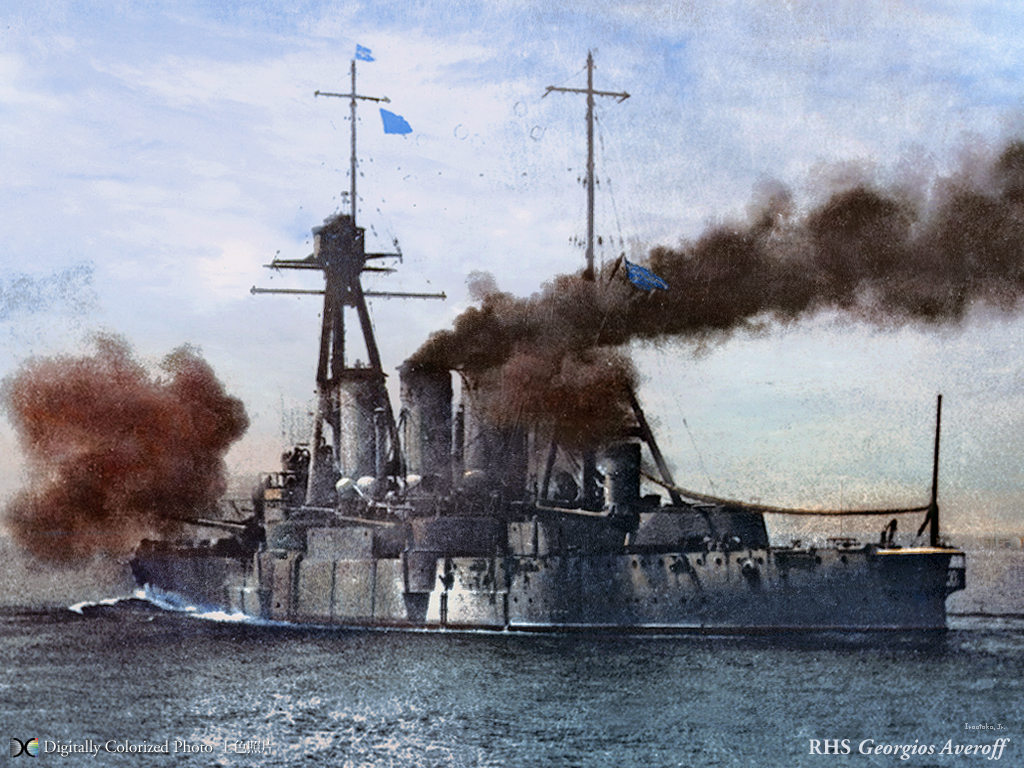
It carried the same old ash-and-trash of gunboats and armed merchantmen on the books it had had in the 1890s but - most importantly - also one spanking new armored cruiser; (θωρακισμένο καταδρομικό) the Georgios Averof (Θ/Κ Γεώργιος Αβέρωφ).
This vessel changed the power dynamic between the Greek armed forces and their Ottoman rivals to a ridiculously huge degree, and had an outsized impact not just on the meeting off Gallipoli in December of 1912 but on the entire naval part of the "First Balkan War".
With that, here's the BN squadron that sailed into combat that day:
HS (Hellenic Ship) Georgios Averof (Θ/Κ Γεώργιος Αβέρωφ) (modified Pisa-class armored cruiser)
4 × BL 9.2-inch Mk IX guns (2 twin turrets, fore and aft),
8 × 190 mm (7.5 in) guns (4 twin turrets, 2 each, port and starboard; yes, more damn wing turrets...),
(Note: the historical notes for the Averof all report that her armaments were British. This would lead to the suspicion that these secondary cannon were one of the BL 7.5-inch series, but which type I am unsure. The Wikipedia entry for the Mark I variant claims that "This gun was only mounted on Devonshire class cruisers commissioned in 1905, and was quickly superseded by the 50-calibre 7.5-inch Mk II gun."
The entry for the Mark II series says that: "Mark II guns were originally developed to suit India's coast defense requirements. During World War I several reserve guns made for India but still in the UK were employed as coast defence guns in the UK. They were scrapped or sent to India soon after the war. Marks II*, II**, and V were built and employed specifically as naval guns and were mounted as secondary armament as a heavier alternative to 6-inch guns on the...Warrior-class armoured cruisers laid down 1903–04...and the Minotaur-class armoured cruisers laid down 1905."
Based on this it seems likely that the Averof's secondary armament consisted of either the BL 7.5-inch Mark II*, the Mark II**, or the Mark V...but which one I cannot be sure. Any help with this would be greatly appreciated)
16 × 76 mm (3 in) guns in single mounts (both deck- and casemate-mounted positions),
4 × 47 mm (1.85 in) guns in single mounts, and
3 × 430 mm (17 in) torpedo tubes,
20 knots, compliment ~670.
I've discussed these "armoured cruisers" before, when we talked about Tsushima, and I don't think I can do any better than I did there, so:
"Armored" cruisers were the first attempt of ironclad navies to solve the "cruiser problem" that emerged with the explosive-shell-firing breechloading naval gun. Traditionally the lighter fleet units, brigs and frigates in the age of sail, were tolled off to remain outside the range of the battleships. With the increased range of the steel rifled cannon (and prior to the advent of reliable radio communications) the cruiser, successor to the frigate, could not stay far enough out of range to be safe from destruction while still remaining in communication with the admiral in his line-of-battle flagship.
The solution was to design a larger, heavier cruiser with an armored deck and "belt" - side armor designed to protect against flat-trajectory missiles.
The earliest of these appeared in the last quarter of the 19th Century (around 1860-1870) as a sail-and-steam warship and persisted up until the end of the First World War. In general the class was not successful; too heavy and slow to act as a true cruiser whilst still being insufficiently protected to lie in the line of battle."
That said, the position of Averof off the Dardanelles in December of 1912 was unique.
For the "big navies", the British and German (and to some extent those of France, Japan, and the USN), my description of the armoured cruisers was true; they were too big and too slow to be effective as counter-commerce-raiding-cruisers, but they were too small and too poorly defended to hang around where the big boys with the big guns - 11-inch and larger - were trading slaps. When they did, as at Jutland in 1916, they were hammered flat; three British cruisers (Defence, Warrior, and Black Prince) were sunk by main-gun fire without doing any sort of damage to German warships in return.
But the Aegean Sea in 1912 was a different matter.
There the Averof was the newest, fastest, hardest-hitting warship afloat and, where she wasn't, she benefited from having the better leadership. She was a game-changer in perhaps one of the most dramatic of fashions ever to have occurred in battle at sea, as we'll talk about in a bit.
HS Hydra (Θ/Κ Ὕδρα) (Hydra-class old battleship/ironclad/coastal defense ship)
This vessel (and her two sisters) were among the first pure steam warships purchased by the BN. They were French built, in the late 1880s and early 1890s, and their design reflects the odd flux of the naval design that era; no longer restricted to the old-fashioned broadside gunnery of the Age of Sail, but not yet the all-turret-mounted heavy cannon of the Dreadnought Era.
With their main battery divided between a single cannon in one of those gawky pre-dreadnought slab-sided cheesebox turrets, and the other two in a casemate-mounts the Hydras are "pre-pre-dreadnought" in cannon configuration.
The literature about these little "battleships" says that these main cannon were "Canet guns". The Canet gun Wiki entry doesn't show a Canet type of 274mm (10.8in) caliber, but the Hydra-class Wiki page includes a helpful scan from a Scientific American magazine of 1897 (pretty amazing what constituted "science" in the Gilded Age...) showing the 10.8-inch cannon mounted on the Hydras and calls them "Canet guns", so we'll take their word for it.
3 x 10.8-inch (274 mm) Canet guns (2 x L/34 in barbette mounts forward, 1 x L/28 in a single turret aft,
4 x 5.9-inch (150 mm) L/45 guns in casemate mounts (2 forward, 2 aft) with a fifth in a central casemate forward. My guess is that these were the Canon de 138 mm Modèle 1893),
4 x 3.4-inch (86 mm) L/22 guns,
4 x 3-pounder guns,
4 x 1-pounder guns,
6 x 1-pounder automatic ("revolver") cannons,
3 x 14 in (356 mm) torpedo tubes (2 broadside, 1 forward),
17 knots, complement ~400.
To me it's problematic what to call these things. They're not really "battleships", not in 1912; they're too small, and their main battery is too weak and too poorly arranged. But they're not really "ironclads", which carries the implication of a much older ship type, the steam frigates or, at best, the central battery ships of the 1860s and 1870s. I think the best term for the Hydras is "coastal defense ship". These were (from the linked website):
"...warships built for the purpose of coastal defence, mostly during the period from 1860 to 1920. They were small, often cruiser-sized warships that sacrificed speed and range for armour and armament."
That's a pretty good description for the Hydras.
HS Spetsai (Θ/Κ Σπέτσαι) - as Hydra
HS Psara (Θ/Κ Ψαρά) - as Hydra
The Greek capital ships were accompanied by four destroyers of the Aetos (Άετός) class. These ships were virtually brand-new, having been launched at the Cammell Laird yard at Birkenhead in October. They played no real part in the action; Cassavetti (1914) says that they were placed to the west of the Hydra-class battleline, probably because the BN couldn't afford torpedoes and without them the little ships were just targets in a capital ship engagement.
The Aetos were originally destined for the Argentine Navy, but the BN purchased them off the shelf when the Balkan War loomed large. They were sailed by the yard crew to Algiers where their Greek compliment met them; supposedly everything on board was written in Spanish, but needs must when the Ottomans drive, and their crews sailed them back to Greece to fight, presumably thumbing frantically through their Spanish-Greek dictionaries.
Destroyer Aetos (ΒΠ Άετός);
4 x EOC 4-inch 50 caliber guns in single mounts,
1 x QF 12-pounder 12-cwt gun,
3 torpedo tubes (but, as noted, the BN couldn't afford to buy torpedoes, so the mounts were unarmed).
31 knots, compliment 58.
Destroyer Ierax (ΒΠ Ιέραξ) - as Aetos.
I do want to note a kind of cute little story about Ierax. When the fight started at 0915 she was offside of the Ottoman squadron, on the west (port) side of the trail Hydra, Psara. According to Cassavetti, during the run to the north her commander dropped back, put his helm over, and fell into the back of the line of coastal battleships. There she blazed away with her little 4-inch gun, putting 65 projos downrange, before tidying up and returning to her position of safety in the cover of the larger warships, her day's work done.
Destroyer Panthir (ΒΠ Πάνθηρ) - as Aetos.
Destroyer Leon (ΒΠ Λέων)- as Aetos.
So; 1 armoured cruiser, 3 obsolete battleships (or coastal defense ships, or ironclads...), 4 destroyers (largely in reserve), roughly 2,000 Royal Hellenic sailors and officers under RADM Pavlos Kountouriotis (Παύλος Κουντουριώτης), CINC Aegean Fleet.
Ottoman Navy (Osmanlı Donanmasi) The squadron of the Ottoman fleet that sortied out of the mouth of the Dardanelles on 16 DEC was organized around the largest units in the organization, two predreadnoughts acquired from Imperial Germany.
Turgut (or Turgot) Reis (ex-Weissenburg, Brandenburg-class battleship) This vessel and her sister, Barbaros Hayreddin, were part of the first mature generation of pre-dreadnoughts laid down at the end of the 19th Century.
The biggest evolution in warship design that occurred in the transition from sails and timber to steam and steel came in the form of the way the cannons were arranged.
From the first real organized batteries of naval artillery in the 16th Century to the middle of the 19th, a warship carried its cannon along its sides; long rows of individual cannons pointing perpendicular to the axis of the ship.
This, in turn, created the naval tactics of the age of sail; long lines of warships firing "broadsides" at each other and attempting to place their side - where all the cannon were - across the front or back end of the enemy.
This "crossing the T" would put the cross-er in position to rain bloody death in the form of massed gunfire smashing down the length of the target ship, while the cross-ee was unable to return that fire, her fore and aft cannon limited to "chase guns", typically long-barreled, long-range, light artillery designed for pursuit of other vessels or discouragement of pursuit by others. This was naval warfare from almost the time of Lepanto to the middle of the 19th Century.
The problems with this were that it 1) required a ridiculous number of cannon that 2) had a ridiculously tiny arc of fire, and 3) was insanely labor-intensive in both manpower and Class IV (ammunition and propellant) demands. The ideal solution was a smaller number of cannon that could be pointed in any direction. You could do that with a free-standing sort of deck gun, but it would be exposed to God and everybody and in a gun duel everyone in the gun crew would die.
What you needed was some sort of protection for that rotating gun, and that arrived in the 1860s in the form of "barbettes" - a sort of open-topped armor bathtub - and, better yet, turrets.
The earliest turreted warships were the monitors of the mid-1800s. These were severely hampered by their low-in-the-water design.
The reason for this low freeboard being that putting a heavy steel turret far up above the waterline in a wooden warship raised the vessel's center of gravity dangerously high. True gun turrets had to wait for improvements in steam propulsion and all-metal ship construction that didn't arrive until the 1870s and wasn't mature until the 1880s. Even then, naval engineers had a hard time abandoning the idea of the broadside.
So first came the "central battery ship", which moved the cannon into a sort of metal fort in the center of the vessel.
This allowed for better protection and concentration of fires, but didn't solve the problem of the limited arc of fire of the individual cannon which meant that you had to have a crap-ton of guns to get any sort of weight of metal at any one point relative to the position of the warship.
Those innovations, in steam and steel, finally came together in the form of the British Devastation-class warships in the early 1870s. Here's the schematic...
...and here she is, HMS Devastation in 1871:
She's still pretty primitive, but she's recognizably what we'd think of when we think of "battleship"; metal construction, main guns in turrets, no big masts for sails. Her own builders took a while to recognize that; even though she looked and acted like what we today would think of as a "battleship" the Devastations were designated "oceangoing breastwork monitors" when they were launched, reclassified as "2nd Class Turret ships" in 1886, and not until the early 20th Century designated as "2nd Class Battleships".
Now compare the schematic above to this one:
That's SMS Weissenburg, the vessel we'll talk about here under her Turkish name, Turgut Reis.
The Brandenburgs were 20 years younger than the Devastations and their design shows it; in better armor (15 inches of steel compared to 12 of steel and 16-18 inches of wood) and armament (the 11-inch guns of the German warships could fire accurately out to 11km and potentially to 15km, while the British 13.5-inch cannon had a practical range of 6km; much of this improvement was due as much to better fire control gear as the guns themselves).
The Brandenburg class did good service for the Kaiserliche Marine through the turn of century, but by the latter portion of the Oughts was obsolescent, superseded as every other capital ship of the pre-dreadnought period was by the launch of that larger, faster, "all-big-gun" beast Dreadnought in 1906.
The German fleet had no further use for the old battleships and the Ottoman fleet was desperate for something - anything - to counter the threat of the new Averof.
Originally the Porte wanted to purchase a British capital unit, an armoured cruiser or an older battleship. The British offered two of the Royal Sovereign class, but the Ottoman delegation passed.
This decision kind of intrigues me because I'm not sure why the deal fell through. The Brandenburgs' main battery was slightly more powerful than the Royal Sovereigns; 6 x 11-inch cannon compared to 4 x 13.5-inch guns, but the secondary armament of the British vessels was significantly heavier.
Either would have, at least on paper, been more than a match for a Pisa-class armoured cruiser. The Ottoman Navy had long experience working with British advisors and British vessels. It seems to me like the Royal Sovereigns should have been a slam-dunk to be the future Reis and Hayreddin.
Instead, the ship-buying delegation give Britain the finger and went to Germany, and the result of the negotiations was that SMS Weissenburg was transferred to Ottoman service in September 1910.
The Weissenburg/Reis' main battery was somewhat unusual. She had three turrets, including one of those annoying midship-turrets what were useless firing either fore or aft. But in the Brandenburgs the midships turret had an additional quirk; it mounted a different type of 11-inch cannon, with different ballistic characteristics, than the fore and aft turrets, because the deck space was too cramped for the longer cannon used in A and Y turrets.
The forward and aft twin turrets mounted 4 × 28 cm (11-in) MRK L/40 caliber guns (muzzle velocity 715 m/s (2,350 ft/s), maximum range of 15 km (9.3 mi), while the midline turret housed 2 × 28 cm (11 in) MRK L/35 caliber guns (muzzle velocity 685 m/s (2,250 ft/s), maximum range of 14.45 km (8.98 mi). As a fire direction guy the very idea gives me the screaming fantods.
However, this wasn't as big a problem as it be for me, or even as it would have been for the Gunnery Officer in a contemporary dreadnought-type, all-big-gun battleship. The Brandenburgs pre-dated centralized fire control; each gun captain (or, at least, each turret captain) pointed their own weapon(s).
These guys are boresighting their cannon, but the two squids not peeking down the barrel are using the optical sights they'd use to point their gun in combat. In pre-dreadnoughts like Reis this would have been what every gun captain in every turret would have been doing.
Obviously this added to the inaccuracy of the ship's gunnery. While it might have been theoretically possible to have added some sort of color or dye to the explosive charge to distinguish the fall of individual rounds in practice, in the confusion and stress of live fire, it would have been nearly impossible for the gun-pointers to distinguish their shell splashes from near-misses (or flare from hits) from those of other guns, or other ships.
The mere existence of the mismatched main battery points out the "still figuring it out" nature of the period of the Brandenburgs' construction.
The secondary battery included
8 × 10.5 cm (4.1 in) SK L/35 guns, and
8 × 8.8 cm (3.5 in) SK L/30 guns, all in single casemate mounts.
Her 3 × 45 cm (18 in) torpedo tubes were probably distributed in the fashion seen in most capital ships, with one tube on each broadside and a third in the bow.
A Brief Digression on the Oddball Phenomenon of Battleship Torpedoes:
One of perhaps the oddest features of the pre-dreadnought battleship was the hull mounted torpedo tube.
These things seem to owe their existence to two factors. The first was the relatively short range of the early main battery cannon. A torpedo with a maximum running distance of, say, 5,000 meters (about 5,000 yards; 3 miles or so) wouldn't have been out-of-place in a main gun duel taking place at 5,000 to 8,000 meters.
The second was the effectiveness of torpedoes relative to aerial projectiles like shells and bombs. The torpedo-bomber crews' slogan was "If you want to fill a ship with smoke, hit it with a bomb; if you want to fill it with water, hit it with a torpedo." Torpedoes could hit a ship below the armored belt or armored deck, and, because they were effectively "tamped" by the water around them, would direct more of the force of the explosion into the enemy hull and less into the air around it.
Capital ship torpedo launchers came in two flavors; above and below the waterline. The door in the bow of the USS Indiana shown above is a typical above-the-waterline tube. The torpedo room in the top picture in this section - from USS Oregon - is a below-the-waterline variety.
One major problem that capital ship broadside-mounts had was the force of the ship's wake rushing past the open tube door. Several navies, including the USN and the Kaiserliche Marine had an ingenious "guide bar" or tube that extended from the outer door to get the fish past the shearing force of the water moving past the outer hull; here's one from SMS Ostfriesland.
The difficulty of trying to hit another capital ship with a torpedo was ridiculously huge. Imagine trying to fight a heavy gun ship while putting it in a position to shoot a torpedo, all the while under enemy shellfire and maneuvering around friendly capital ships, and friendly and enemy light units. It would be the naval combat equivalent of an infantryman trying to pitch a grenade into a half-open window while shooting on the run.
The practicality of naval design intervened (along with increasing main-gun ranges), and after about 1920 the capital ship torpedo was as dead as the sail and the carronade.
I should pause here and note that all observers of the maintenance conditions aboard the Turgut Reis in 1912 reported them as appalling: "...the ships were too complicated and logistically were not up to European standards. Rangefinders and ammunition hoists were absent, telephones did not work, pump piping was corroded, watertight doors could not be closed, and the boilers needed extensive work." (Darr, 1998).
Her nominal compliment was roughly 570; 530 odd ratings and 40-some officers. Turgut Reis' rated speed was 16 to 17 knots, but she is reported to have had such serious steam condenser problems that she seldom achieved more than 8 to 10 knots in Ottoman service.
Barbaros Hayreddin (ex-Kurfürst Friedrich Wilhelm, Brandenburg-class battleship) - as Turgut Reis.
Mesudiye (or "Mecidiye", or "Messoudeih" - remember, these are English phonetic translations of Turkish names - "old battleship"/light cruiser/???)
This ship was one hell of a weird vessel.
First, she was old, as in REALLYold, in 1912. Mesudiye was built as a "central battery ironclad" in 1871. She looked like this when she came off the ways at the Thames Ironworks:
and was armed with 10 x 10-inch RML "18-ton" rifled muzzle-loading cannon in a central armored casemate. She was obviously useless by the 20th Century, so in 1899 she was completely rebuilt at the Ansaldo yards in Genoa. Here's the description of her refit, from her Wiki entry:
"...the bow and stern were cut down to make room for a pair of gun turrets, each mounting a single 230 mm (9 in) 40-caliber gun manufactured by Vickers. A battery of twelve 150 mm (5.9 in) 45-caliber QF guns was installed in place of the old rifled muzzle-loaders, and sixteen 76 mm QF guns were added in an upper battery...ten 57 mm (2.2 in) guns and a pair of 47 mm (1.9 in) guns.
A large superstructure was built amidships, with a new conning tower, which was given 200 mm (7.9 in) of armor plating. Displacement rose to 9,120 t (8,980 long tons; 10,050 short tons) normally and 9,710 t (9,560 long tons; 10,700 short tons) at full load. The ship's propulsion system was also completely replaced. Two triple-expansion engines were installed, along with sixteen coal-fired Niclausse boilers. The two screw propellers overlapped, so the port side screw was placed slightly ahead of the starboard one. Performance improved to 11,000 ihp (8,200 kW) and 17 kn (31 km/h; 20 mph). Her crew increased to 800 as a result of the modifications."
Here's what she looked like afterwards:
So when she's called a "pre-dreadnought battleship" in her Wiki entry, or an "old battleship" in the Wiki for the battle of Elli, that's pretty close, right? A couple of 9-inch cannon and a heavy secondary battery?
But.
I left out a critical part of the Wiki rebuild description above: "The turrets had 230 mm thick armored faces, though they never received their guns; wooden dummy guns were installed in their place."
These Quaker guns were still reported there in 1914.
At this point I'm just gobsmacked. With 9-inch cannon and nearly 9 inches of armor on turret faces and belt Mesudiye would be a fairly dangerous heavy cruiser, at least.
But with a wooden "main battery" and nothing more than 6-inch cannon? She's barely a light cruiser, and an old, slow 17-knot-light cruiser, at that. Whatever Mesudiye was on 16 DEC, an "old battleship" she was not.
And she sucked up 800 Ottoman swabs - the largest crew of any of the combatants at Elli - doing whatever the hell useless thing she was doing. The thought alone just pisses me off. That's an utter waste; the sailors would have been more useful peeling spuds at the depot back in Istanbul.
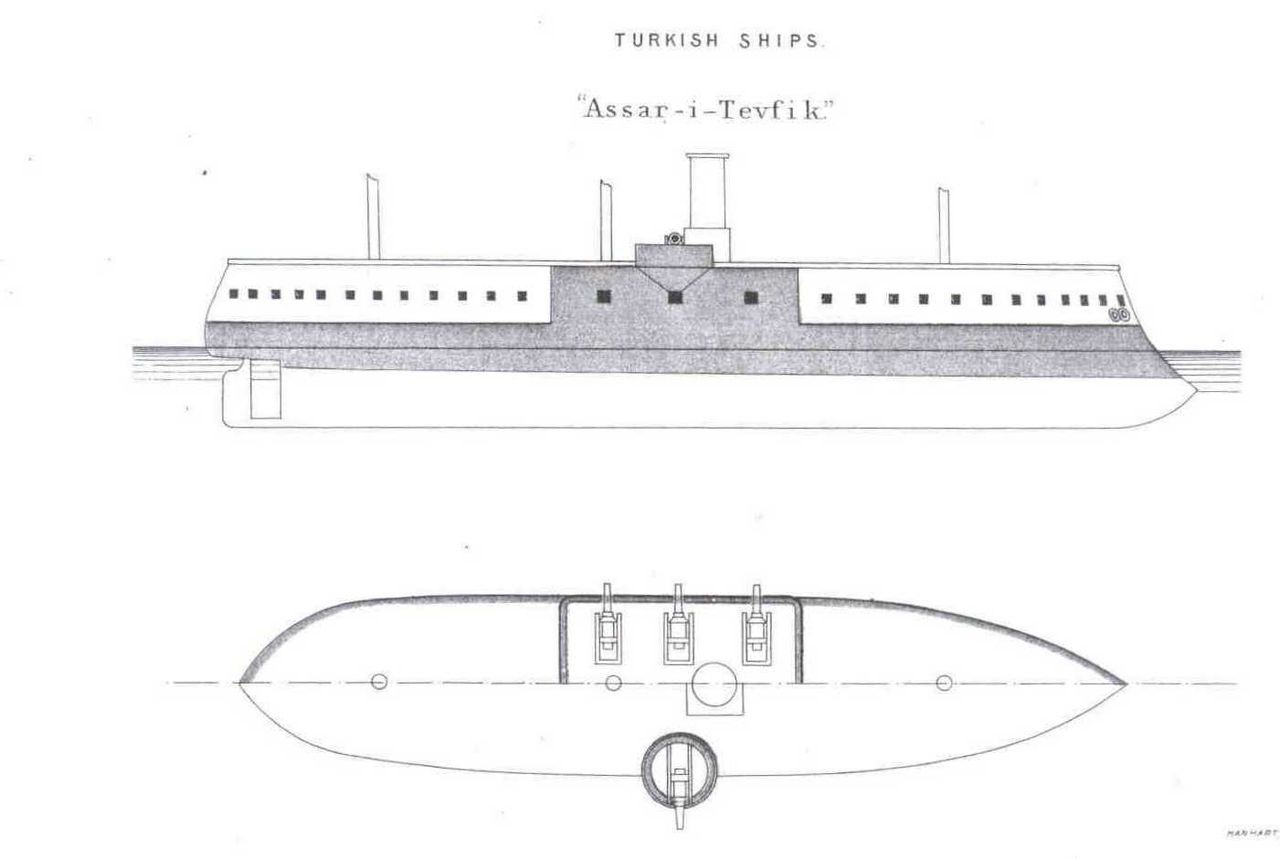
Asar-i Tevfik (sort-of-light-cruiser)
This vessel was even older than Mesudiye, built in 1868 as another one of these central battery ships at the Société Nouvelle des Forges et Chantiers de la Méditerranée yard near Toulon.
Also like Mesudiye, she was more-or-less completely rebuilt in the first decade of the 20th Century, only at the Germaniawerft shipyard in Kiel.
The story of Ansar's rebuilt is a tale unto itself. The Porte repeatedly refused to pay for anything, including the Ottoman sailors who had brought her there from the fleet anchorage in the Golden Horn. The crew of Ansar was reduced to begging and things like selling their uniforms and kit for food while the German and Ottoman governments (and Krupp and Germaniawerft) dickered over the price.
Finally the German yard got some of its money (not enough - the cost still exceeded what the Ottomans paid) and the original 10-inch muzzle-loading cannon were replaced with lighter guns and her outline changed from the "ironclad frigate" configuration above to this:
Her armored belt remained 6 to 8 inches thick, so she was decently protected for a cruiser, but she was painfully slow; her rated speed is given in most sources as 13 knots, but contemporary reports state that maintenance problems and neglect left her unable to make more than 8 to 10 knots.
Her battery after the reconfiguration included:
3 × 150 mm (5.9 in) 15 cm SK L/40 cannon in three single turrets; one forward, and two wing turrets either side of the bridge,
7 × 120 mm (4.7 in) guns. I'm purely guessing on the configuration of these weapons based on what photographs I've seen; it appears that the largest secondary batteries are located in casemates on the upper hull, three to each side. If that was six of the seven, and there was no main gun aft it'd make sense that 4.7-in mount #7 was a single deck mount on the quarterdack...
The tertiary battery consisted of 6 × 57 mm (2.2 in) guns (presumably actually the 5 cm SK L/40 gun), and 2 × 37 mm (1.5 in) guns. All of these were presumably scattered about the upperworks in single deck mounts as anti-torpedo-boat weapons.
Ansar retained her 8-inch thick belt and 6-inch thick armored central casemate. She added a 3-inch thick armored deck and a conning tower protected by 6-inches of steel.
Her compliment was about 320, and her rated speed after reconstruction about 13 knots, although presumably she suffered from the same powerplant issues the other Ottoman warships did.
The Ottoman squadron also had four escort vessels. These did not take part in the action but I've included them to give you a sense of what the Ottoman Fleet had for light warships.
The best of the four there that day was the small destroyer/large torpedo boat Muâvenet-i Millîye.
Muâvenet-i Millîye (ex-Große Torpedoboote S165)
Built by the Schichau-Werke in Elbing and launched in 1909, Muâvenet was one of four German "large torpedo boats" purchased by the Porte in 1908. She was the most modern (and most effective; her officers and crew were among the sharpest in the Ottoman Fleet) warship that sailed out of the Dardanelles on that December day. Muâvenet's armaments were the standard outfit of a big German torpedo boat; light cannon and torpedoes.
2 x 8.8cm SK L/30 cannon in single deck mounts, and
3 x 450mm TT, also in single deck mounts.
Compliment ~90, 26 knots
We've run into these kinds of German light warships before, and in case you don't remember...
"Unlike many other Western navies, Germany did not choose to upsize their light escort vessels in the first decades of the 20th Century. Most of their potential enemies, in particular the British, discarded the original "torpedo boat" designs in favor of what was originally laid down as an anti-torpedo-boat or "torpedo-boat-destroyer". The Royal Navy, among other services including the USN, discovered that these "TBDs" were effective torpedo-launching platforms and had far superior sea-keeping qualities than the small, low-freeboard torpedoboats.
Germany didn't buy that. The Reichsmarineamt continued to design torpedoboats that still looked like torpedoboats though these things tended to get bigger and bigger. The 1913-class "large torpedo boats" were destroyers in all but name.
Eventually the reality - that there is such a thing as too small and too cheap - sunk in; the smaller German torpedo boats were just too small for big seas and outclassed technically and tactically by destroyers. By 1917 Germany was no longer building any of the older type."
Yadigar-i Millet (ex-Große Torpedoboote S166) - as Muâvenet-i Millîye
Taşoz (Samsun-class destroyer)
This little vessel was constructed at the Schneider & Cie yard at Nantes and launched in 1907. She and her three sisters were almost identical to the French Durandal-class only with 450mm (18-inch) torpedoes in place of the smaller 380mm (15-inch) fish fired from the Durendals.
Otherwise she mounted
1 x 6.5cm L/50 cannon in a single deck mount, and
6 x 47mm L/50 quick-firing guns
Complement of 67, Rated at 27 knots when she came off the ways, by 1912 she could only do about 20 knots for all the usual Ottoman reasons.
Basra (Samsun-class destroyer) - as Taşoz but built by SA Chantier et Ateliers de la Gironde of Bordeaux
These two vessels interest me primarily for the question of what to call them. Most of the reference I can find to both the French Durendals and the French-built Ottoman Samsuns call them "destroyers"; indeed, the Wiki entry for the Durendal-class states flatly that "These vessels were France's first true destroyers rather than torpedo boats."
The distinction appears to be based purely on size, because the Durendals have the same low-freeboard, turtleback-foredeck as their "torpedo boat" predecessors. But the TBs are typically about 40m (120 feet) long - the last of the vessels typically called "torpilleurs", the Mistral-class of 1901, displaced 180 tons on a 45-meter (135-foot) length-overall (LOA). The Samsuns, however, displaced over 300 tons and measured 57 meters (188 feet) LOA. So whilethey look like torpedo boats and act like torpedo boats, it appears that for being a destroyer as opposed to a torpedo boat, size does matter.
So 2 pre-dreadnought battleships, 2 (what were for all practical purposes) obsolete light cruisers, approximately 2,300 officers and crew, all under the overall command of RADM Ramiz Naman Bey.
The Sources: Another 20th Century engagement fought by two literate combatants serving in industrial organizations, Elli is covered by all the usual sources including Greek and Turkish naval records and newspaper accounts. Well documented - although I'll note that the quality of the secondary sources can be iffy.
Several secondary works cover the period of the First Balkan War and the engagement off the Dardanelles in December, 1912. One of the most useful is Bernd Langensiepen and Ahmet Güleryüz's The Ottoman Steam Navy, 1828-1923. It's expensive as hell and available in an English translation by James Cooper published by the Naval Institute Press in 1995.
The other side of the hill is documented by Zisis Fotakis' 2005 Greek Naval Strategy and Policy, 1910-1919. It's also spendy (hardcover editions can run up to one hundred dollars or more) but the reviews I've read have been favorable.
Richard Hall's 2000 The Balkan Wars, 1912–1913: Prelude to the First World War is a good general history of the conflict, an Margaret MacMillian's 2013 The War That Ended Peace: The Road to 1914 puts the Balkan Wars, including the First, in the larger perspective of the troubled beginning of the 20th Century.
One thing to recall is that Greece and Turkey have still not reconciled many of the enmities developed over their combative history in the 19th and 20th Century. Any account should be carefully weighed for its neutrality, or lack of same, towards the two polities.
On the Internet Elli is much less comprehensively covered.
The Wikipedia entry is sparse, if decent. The engagement is also briefly mentioned in the larger "First Balkan War" Wiki site, but with even less detail.
Perhaps the most fun little site of Elli I've come across is in "The Age of Steel and Coal"; the site's creator, Aaron Hamilton, has done a terrific job providing pretty battle maps I've shamelessly stolen for this post.
A digital copy of J.D. Cassavetti's 1914 Hellas and the Balkan Wars provides the most detailed account available digitally of the engagement itself, as well as making some interesting counterpoints to many of the common information, or misinformation, out there on the screen. I've copied his map included as Appendix 6 in Darr (1998) to use for my narration; it's not as pretty as Hamilton's, but I have a suspicion that it may be more accurate.
The impressively named Karl Wilhelm Augustus Darr wrote a 1998 master's thesis for the University of Louisville entitled The Ottoman Navy 1900-1918 : a study of the material, personnel, and professional development, of the Ottoman Navy from 1900 through the Italian, Balkan, and first World Wars.
K.W.A. Darr is, frankly, not exactly Kentucky's answer to Virgil as a prose stylist, but his work contains much information covering the military and political conduct of the Balkan Wars difficult to find elsewhere. He's got some factual issues, too, though, so ensure you have Cassavetti (1914) handy when you read him.
The Campaign: To understand the strategic position of the engagement at Elli you have to understand a little about the "Balkan Wars". And to understand the Balkan Wars you have to know a little about what happened to the Ottoman Empire after the reign of Sultan Süleyman I, "the Magnificent".
Süleyman himself wasn't the problem, and the consensus among historians who attribute the "Fall of the Ottoman Empire" to actions the sultan, and others in and around the Porte, took or failed to take during and right after his reign has largely disappeared. But after the great sultan's death in 1566 a whole series of changes affected the Empire, and many of them contributed to the relative decline of Ottoman economic, political, and military power relative to the rising states of Europe.
These included:
- a succession of troubled personalities succeeding to the sultanate, and internal infighting and selfish politics in the harem,
- the desuetude of the old Ottoman land-service system, largely at the hands of the devşirme, the professional service class (think Janissaries),
(Note: it's worth taking a moment here to note that from the early Ottoman state much of the military strength came from the soldier class, gentry and nobility, who raised, trained, equipped, and maintained the sipahi cavalry units that were the core of the Ottoman armed force; very similar to the old Byzantine thematic troops the Ottomans fought for generations.
In the mid-16th Century, however, through a complex combination of economic and political circumstances the landed beys lost much of their property and power to the "public servants" - if you want a comparative think of the Marian "reforms" of the Roman Army of the Republican period; citizen-soldiers give way to long-service professionals, with a concurrent change in orientation from national service to loyalty to individual leaders.
Mind you, replacing feudal cavalry with professional infantry during the rise of the Gunpowder Era wasn't exactly a bad idea, but replacing a sort of national service with mercenaries who also happen to be potential government officers? That's definitely a bad idea. That's kind of what happened, and the result was a marked increase in the power of the devşirme and their consequent fiddle-fucking in the internal affairs of the sultanate...)
- economic stresses related to a number of factors, including European maritime trade bypassing the older overland Middle Eastern trade routes, and increases in population related to better medical practices,
- a series of wars, many involving multiple fronts, and internal unrest, particularly in the European provinces, and
- increased pressure from external Christian polities on the internal religious politics of the Empire.
The upshot of all this was to simultaneously increase the influence of the Ottoman military while increasing the paranoia of the sultans, who learned the hard way that the people with the weapons can make their own rules.
After several sultans were assassinated or deposed, or both, by their own household forces the sultan Mahmud II disbanded the Janissary forces and began a series of military changes working towards a national armed force. This included the Ottoman Navy, which was reorganized in the 1860s.
Unfortunately for the Ottomans, all this military turmoil coincided with a series of external attacks and internal revolts. In the Balkans (or the Aegean Sea) alone these included:
1804–1813 First Serbian Uprising
1815–1817 Second Serbian Uprising
1821–1832 Greek War of Independence
1821 Wallachian uprising of 1821
1831–1832 Great Bosnian uprising
1833–1839 Albanian Revolts of 1833–39
1843–1844 Albanian Revolt of 1843–44
1847 Albanian Revolt of 1847
1848 Wallachian Revolution of 1848
1854 Epirus Revolt of 1854
1858 Battle of Grahovac
1861–1862 Montenegrin–Ottoman War
1866–1869 Cretan Revolt
1876 Razlovtsi insurrection
1876–1878 Montenegrin–Ottoman War (1876–78)
1878 Epirus Revolt of 1878
1878 Austro-Hungarian occupation of Bosnia and Herzegovina
1895–1896 Zeitun Rebellion
1897 Greco-Turkish War of 1897
1903 Theriso revolt
1903 Ilinden–Preobrazhenie Uprising
1904–1908 Macedonian Struggle
1910 Albanian Revolt of 1910
Whew. I'm exhausted just reading that.
The result of all this tussling was that by the end of the first decade of the 20th Century the old European Ottoman dominions had shrunk to an east-west strip of territory, Rumelia (روم ايلى in Turkish), that ran from the Adriatic to the Aegean and the Black Sea.
This chunk of real estate was coveted by the new nations all around it. Serbia wanted the old Roman province of Moesia to the south (well, actually the Serbs had wanted Bosnia to the north, but the Austro-Hungarians grabbed it up in 1908, so the Serbs decided to go south, instead).
Bulgaria wanted a big slab (if not all) of Thrace, Greece wanted Macedonia, and the Albanians wanted...well, Albania, which was part of (or close to, depending on whether you were Albanian or Greek...) western Macedonia.
Ottoman Turkey, of course, wanted to keep all of what it already had, including the Albanians, and saw no reason to give Rumelia away to a bunch of crappy little Balkan neighbors, most of whom had been "subjects" not long before.
A lot of the geopolitics involved Great Power shadows, particularly Russian and Austro-Hungarian, given that the two were colliding in eastern Europe, the effect of the "Young Turk" revolution in 1908, and the Italo-Turkish War of 1912 (which showed the Balkan leaders that the big European powers weren't going to step in to preserve Ottoman borders).
There was also some thoughts among the Balkan states about forestalling all that Great Power meddling. Russia, always a nuisance in southeastern Europe, was also poking the Bulgarians in the kidneys to be their Slavic BFF in the region.
But keep sight that the main drive that started this war was pure avarice - the land-greed of the Balkan countries; Greece, Serbia, Bulgaria, and little Montenegro all wanted a piece (or all, in the case of the goddamn Bulgarians...) of what Turkey had, and they were gonna get it or die tryin'.
One of the major factors in these jokers getting away with all this theft was the Greek Navy.
Obviously Serbia and Montenegro had no warships whatsoever.
Bulgaria seems to have had a tiny ship-in-a-bottle sort of maritime force, not really worthy of the name "navy", consisting of a handful of torpedo boats. They did what they could in the Black Sea, but that wasn't much against the much stronger Ottoman fleet.
So if anyone was going to rule the waves, it would be the Greeks.
And why was this important?
Here's why;
Ottoman roads were as horribly bad as you'd think. What passed for the Ottoman "federal highway administration" was Omar and his donkey cart throwing out a couple of shovelfuls of gravel into the worst of the potholes every winter. The rail lines were almost as bad. If there was trouble in the Balkans (and when wasn't there, as you can see from the above...) any troop units needed to reinforce the Rumelia garrisons, and all the supplies and munitions needed by those garrisons, would need to move by sea if they were going to get there in any sort of reasonable time.
So it would be up to the Greek Navy to support the ground force attacks by blockading the Aegean and preventing Turkish movements by sea. Bagging some Turkish island bases would be nice, as would helping to shell Turkish installations along the Aegean coast of Rumelia, but the big ask was keeping the Ottoman grunts slogging up the roads from the western gates of Istanbul instead of enjoying a quick pleasure cruise of the Aegean islands.
I'm not going to give you a full history of the First Balkan War. If you want, Dr. Atli has a good summary here, and the characters at "Three Minute History" have a funny (and fairly decent) little slideshow that hits the high points.
We're here to talk about the naval part of the scrap.
Here's how the two sides lined up when the first rounds when downrange in October, 1912:
A couple of comments here.
The three "battleships" listed for the Balkan alliance? They're the three old Greek Hydras; as we've discussed, they were "battleships" in the sense that Turgut Reis and Barbaros Hayreddin were battleships like a cow is like a racehorse. They both have four legs.
I'm not sure what the third Ottoman "battleship" is. I'm guessing it's one of the other two supposed-capital ships involved in this fight, which we've fairly thoroughly dismissed as actual "battleships".
Other than the cruisers, you'll note that on paper, at least, both sides look pretty even. On paper.
Opening Moves: 8 OCT to 15 DEC, 1912.
Ten days after the land war started the BN sortied to the Aegean island of Lemnos, landed marines and Army infantrymen on 21 OCT and secured the island a week later. This was critical to the whole naval campaign, because look at where the island is relative to the entrance to the Dardanelles.
If you own Lemnos' harbor, you pretty much own the western approaches to the Dardanelles and the eastern Aegean.
The Ottoman Fleet could still have rescued their strategic position had the Marmara Fleet commander, RADM Tahir Bey, been able to respond to the Lemnos operation in force. He could not, because the immediate danger to Istanbul from Bulgarian attacks in Thrace was too severe, the Ottoman government wanted the fleet in the Black Sea, and Tahir Bey wasn't the sort of mad lad willing to throw the dice.
The Ottoman fleet spent the bulk of October and November anchored in the Sea of Marmara, or operating in the Black Sea, helping the Army stabilize the defenses west of the capital against the Bulgarians. It wasn't until early December - when ground operations in Rumelia were over and the land war effectively lost to Turkey - that anything of value could be done in the Aegean.
The Balkan alliance and the Ottoman Empire agreed to an armistice 3 DEC 1912. The allies had gained what they wanted (well, not Bulgaria, but we'll discuss that later) and the Ottomans had held the line west of Istanbul, so there was no more to be gained slugging it out in Rumelia. The Balkan weather in the autumn and early winter 1912 had been awful; cold, and heavy rain. The roads were quagmires and the sick lists on all sides growing. It was time to pause war-war and do a little jaw-jaw.
But not in the Aegean; the allies specifically exempted that theater from the armistice. So it's worth noting that everything that happened in December was fairly divorced from the Balkan War proper, but, rather, a difference of opinion between Greece and the Ottoman Empire over the Aegean Sea.
By early December, it should be noted, the Greeks had been busy little bastards in the Aegean. Their amphibious invasions had knocked off Turkish islands left and right; the smaller islets of Imbros, Thasos, Agios Efstratios, Samothrace, Psara and Ikaria in October, and the bigger Lesbos and Chios in November (the Ottoman garrisons on the two larger islands were decently manned and supplied, and the fighting on those islands didn't end with Greek control until late December for Lesbos and January 1913 for Chios).
The blockade had been remarkably effective, too. Something like a quarter of a million Ottoman troops had been stuck in Anatolia, unable to rescue, or reverse, the defeat in Thrace. Greek light naval units - "auxiliary cruisers" (i.e. merchant ships with bolt-on deck guns), destroyers, and torpedo boats - patrolled the eastern Aegean, searching for Ottoman sorties. The first didn't occur until after 7 DEC, after RADM Tahir Bey was relieved and replaced by Ramiz Naman Bey.
Our man Ramiz was supposed to have been a real firebreather, a hawk of the hawks, and his cunning plan was to try and take out Averof and then fall on the other Greek warships - which gives you the sense to which the modern cruiser transfixed the thinking of both sides in the fight.
Here's where the Ottoman issues with what the U.S. Army likes to call "PM" - preventive maintenance" - bit them in the ass. It wouldn't be the last time, either, as we'll see.
The first try at luring the bold Greeks to their destruction was supposed to be a baited ambush that would hammer one of the Greek destroyer/torpedo boat patrols. This, in turn, would presumably lure the Averof out to be jumped and sunk. It's very Ottoman that the trap was never even sprung because the Turkish warships had boiler trouble and couldn't leave the dock 12 DEC.
Two days later Mesudiye, her boiler presumably patched with spit and baling wire, did sortie. She ended up tangling with the Greek destroyer patrol...or not.
Darr (1998) says: "The Ottoman cruiser Mecidiye entered the Aegean Sea on 14 December 1912 in order to duel with the Greek cruiser Averoff. The Greeks responded by rushing at the Mecidiye with destroyers. This action, the frenzied attack with destroyers and torpedo boats, was a precursor of future Greek tactics."
This sounds suspicious to me for several reasons.
For one, the Ottoman shore batteries must have reported sighting the Greek patrols earlier in December. RADM Ramiz must have known that a single-ship sortie was more likely to encounter a swarm of light units rather than an unescorted enemy cruiser.
For another, Greek tactics don't seem to have been dominated by destroyer and torpedo boat swarms. This was the heart of the French Jeune Ecole school of thought, and the Greeks had studied under the British, for the most part, whose ideas of naval fighting were dominated by the clash of heavy guns and armor. Remember, the Greek TBs and DDs didn't have torpedoes. Attacking a heavy cruiser, even an old, slow cruiser like Mesudiye, without torpedoes would have been brutal for the little Greek lights with their small cannon and sheet-metal hulls.
For yet another, Cassavetti (1914) says that nothing of the sort happened, but that "On the 14th and 15th of December the Turkish cruiser Mejidieh and destroyers appeared at the mouth of the Dardanelles and retired without giving battle to the patrolling destroyers."
Who's right? Hard to be utterly certain, though Cassavetti (1914) seems more plausible. Regardless, it sounds like both sides sailed away from each other unharmed other than in spirit.
All that changed on the morning of 16 DEC, when "(a)t 08:30 the Ottoman fleet sortied out the Straits past Cape Helles on a track of west by north." (Darr, 1998)
The Engagement: "The Greek fleet responded with a converging course from Lemnos, and at 09:22, while 12,000 meters apart, the Ottomans opened fire. Greek forces returned fire, resulting in Mesudiye receiving three hits and falling out of line." (Darr, 1998)
The best detailed account I can find of this engagement is in Cassavetti (1914). Darr (1998), the most recent, has some discrepancies with Cassavetti (1914) and some blank spots; I will note the first and try and fill in the second with my best guess at inherent military probability.
The first discrepancy is where the Greek squadron was coming from when the Ottomans entered the Aegean. There can't be any question where the Turkish ships had been and what their course was, given the terrain restrictions. But here's the battle map Cassevetti provides in his 1914 work. I've adapted the original to show the engagement in stages.
In this view the Greek squadron is approaching the mouth of the strait from the north, heading south by west, and then turns southeast to close the range to the Strait. They're obviously coming down from the passage between the island of Imbros and the Gallipoli peninsula.
This agrees with Cassavetti's description of the Greek squadron's movements beginning two days earlier:
"...the Greek battle squadron...put to sea from Lemnos on the afternoon of the 14th of December and relieved the blockading destroyers...(d)uring the night of the 15th and 16th the fleet kept watch in the straits..."
You'll note that this conflicts with Darr (1998), who says that the Greek squadron was coming directly from Lemnos. Given the distance from Lemnos to the Dardanelles and the Greek squadron's mission, Cassavetti (1914) makes much more sense.
Meanwhile Cassavetti (1914) has the Ottomans emerging from the strait heading southwest and then turning northwest to get closer to parallel to the Greek course; if nothing else, to prevent their "T" from being crossed. This, in turn, differs from the maneuver plot of Hamilton...
...who shows the Ottoman fleet beginning on a heading of due west, turning southwest, and then northwest, while the Greek squadron makes a full turn about, swinging through almost a full circle to go from southwest to northwest. Both seem implausible; the Dardanelles Strait runs southwest to the mouth, not due west, and the odd "battle turn away" Hamilton shows for the Greek squadron seems both excessively tricky and unnecessary. Why not just port the helm to turn to the damn Turks?
So what I think happened is pretty much what Cassavetti (1914) shows; the four Ottoman heavy units came out of the strait
(interestingly, Cassavetti (1914) says that they weren't in line ahead: "...at about 8:45, the Turkish battle squadron was sighted approaching the mouth of the Dardanelles in line abreast to port, with Barbarossa (flagship) being the starboard wing ship with the Turgut Reis, Messoudieh, and Anasr-i Tewfik on her port beam about two cables apart...")
and turned northwest, while the Greek squadron altered course to port (from southwest to south) to close the range.
Cassavetti (1914) does agree that when they turned to the northwest the Ottomans turned from line abreast into line ahead; "When well clear of the Straits, the Turkish fleet altered course eight points to starboard...thus bringing them into battle formation (single line ahead)."
His map shows the engagement opening with Turkish main battery fire at 10,500 yards (about 9,600 meters - well short of Darr's (1998) 12,000 meter distance).
Cassevetti (1914) says that the Ottoman fleet speed was roughly 6 knots so that the Greeks, making about 8 knots, were effective at both overtaking the Ottoman squadron while closing the range. Here's his map:
The Turkish fire was short at the initial range of 9,600 meters, and the Greek squadron held fire until the range had closed to about 7,500 yards (roughly 7,000 meters). The Greek squadron's fire was similarly ineffective, and the BN didn't effects on target until the range between the squadrons closed even further; Cassavetti (1914) says at about 0940 the Greek shots began to find targets with the range down to about 5,000 yards (4,500 meters).
At some point close to this time one or more of the Greek warships landed hits on the Mesudiye. I'm not sure how many shells landed, or how large they were, or what damage they did. One or more must have caused some hull damage; she's reported as listing (although Cassavetti (1914) says she was listing to starboard, which was the side away from the Greek guns early in the fight, suggesting that the hull damage occurred after the Ottoman turn away) and she lost way soon after 0930 or so, dropping out of her original position of third in line to lag behind the squadron.
About 0930 RADM Kountouriotis handed off control of the rest of the squadron to his subordinate, Commodore Ghines, ran up the "independent action " flag, kicked Averof's boilers up to her limit of 20 knots, altered course to starboard, and headed for the Hayreddin, "keeping up a heavy fire, the while being enveloped in clouds of smoke and showers of spray from the projectiles which were bursting around her..." (Cassavetti, 1914).
Cassavetti (1914) records the crisis of the engagement that came from this move around 0950-1000:
"...at 9:52 the Averof was nearly ahead of the Barbarossa and, at 3,500 yards range, the remainder (Note: that is, the Hydras) being about 4,500 yards from the Turkish squadron. At this time a salvo of six 9.2 projectiles from the Averof were observed to strike the Barbarossa on the fore-turret and conning tower, upon which she turned sixteen points to starboard (a half circle) without signal. She ceased fire from this moment and did not fire again during the action..."
I note that Darr (1998) more or less agrees. His time is incorrect (it should be 9:50) and his number of hits is seven, not six, but the general gist is similar:
"By 10:50, the Averof had closed within 3,000 meters and scored seven hits on the Barbaros Hayreddin. The Ottoman ships retreated in bad order, and Greek pursuit was only stopped when shore batteries began to weigh in."
Here's the battle maps for the final part of the engagement. First Hamilton,
Then Cassevetti (1914).
I like Hamilton's graphic, but again, he has the Greek squadron throwing in another one of those weird loopy turns, doing a donut to port rather than a simple turn to starboard to head south. Cassevetti (1914) keeps it simple, and that's a good rule of thumb when live joes start landing.
By lunchtime the Ottoman squadron had limped back underneath the protection of their shore batteries and the Greek squadron returned to the forward base at Lemnos, masters - at least for the moment - of the eastern Aegean.
The Outcome: Minor Greek tactical victory
The Impact: Relatively minimal, other than for the sailors wounded and killed in the action. Cassavetti (1914) provides the following damage report from the Greek squadron:
Averof: 15 hits (mostly smaller caliber). One large (11-inch?) shell hit the cruiser's armored belt but given that further damage isn't listed appears not to have penetrated. Some shrapnel damage to her upper works. Five casualties including one killed.
Spetsai: Four hits, including one large (10.5/11-inch?) shell which exploded near a galley in her superstructure, wounding one of the cooks "...and capsized the dinners which were in the process of cooking." (Cassevetti, 1914).
Hydra: One small shellhit, damage negligible.
Psara: No hits
The Ottoman squadron, obviously, suffered worse.
Barbaros Hayreddin: At least 6 (possible 7) 9.2-inch shell hits, and several more; Cassevetti (1914) reports "...the navigating bridges were seen to be destroyed...her stem was struck at the waterline leaving a large hole...a large hole on the waterline aft...that shells had penetrated one or more of her boilers..." Langensiepen and Güleryüz (1995) report 18 killed, 41 wounded, and Cassevetti (1914) claims that a flag offer on Ramiz Bey's staff (one "Rear Admiral Hamal Pasha") was among the dead. Back in action in January, 1913, however.
Turgut Reis: Damage unknown. Langensiepen and Güleryüz (1995) report 8 KIA, 20 WIA, so presumably at least some damage to her upper works, if nothing else. Not significant enough to keep her out of action long - she's reported showing the flag several days later.
Mesudiye: Damage unknown, although from the anecdotal evidence some penetration at or below the waterline. Langensiepen and Güleryüz (1995) report 3 KIA, 7 WIA.
Ansar-i Tewfik: No damage report.
Clearly this was not anywhere near a decisive action. The two fleets met again in a larger action of Lemnos on 18 JAN 1913. The results were a virtual repetition of Elli. The Averof tore into the Ottoman gunline independently of her Hydra-class backups. Ottoman gunfire was heavy but agian grossly inaccurate; out of some 800 rounds expended the Greek squadron suffered only two hits on Averof and none on the Hydras.
The Barbaros, Reis, and Mesudiye all took heavy damage again, in particular the Mesudiye, which lost one of her 152mm (6-inch) cannon to a heavy gun round along with about 65 of her crew. The Ottoman squadron at Lemnos ran in disorder similar to the Ottomans at Elli.
To me the fascinating part of this engagement is what the Greek cruiser's solo attack appears to have done to the minds of the Ottoman commander and his entire squadron. It destroyed them. The effect of Averof's commando raid and the Ottoman collapse reminds me strongly of the sort of problems that always seemed to show up in the Imperial Japanese Navy's senior officers when faced with decent USN performances; the IJN guys never seemed to really believe that they could be hit hard or that, once hit, they could hit back.
Under USN gunfire or aerial attack they seemed to suffer some sort of mental breakdown, and lost sight of their commander's intent in a brain cloud of confusion and hesitation.
The same thing seems to have happened to the Ottomans here, and I'm baffled as to why.
The Ottoman commander Ramiz Bey is described as a hard man, a warrior. The Ottoman sailors generally seem to have been brave and hardy enough; their failings were technical, not those of morale or courage.
But because of Kountouriotis' aggressive move, or the Averof's and the Greek squadron's superior gunnery, or some hidden weakness in the Ottoman commander or the crews, or some combination of all the above...the Ottoman squadron seems to have suffered a collective breakdown and at the most critical point in the action - where the most fierce fighting should have happened - lost their nerve and fled.
Elli set the tone for the rest of the naval war in the Aegean, and after Lemnos the Ottoman Fleet was utterly prostrate. It never sortied past the mouth of the Dardanelles after January of 1913. The First Balkan War ended in late May of 1913 with the Ottomans the most thoroughly beaten of the combatants.
You'd have thought that all involved would have taken a breather, buried their dead, and set about rebuilding their new domains (or their army and fleet, in the Ottomans' case).
That reckoned with the Bulgarians, however.
The Bulgarian government (and many individual Bulgarians) felt that they had not received the goodies they had wanted (and it's worth noting that the Bulgarian government and many Bulgarians had insanely grandiose ambitions) and felt that had earned with the blood of their soldiers and treasure. With that in mind, the Bulgarians launched a new war in June of 1913.
They got hammered.
Even the Turkish Army beat the Bulgarian forces opposite them, driving the frontier west past Edirne. The biggest winner from the second round was Serbia who, bloated with their victory, decided that the next move would be against Austro-Hungarian Bosnia.
We all know what happened to that.
The story of the naval campaign of the First Balkan War was the dominance of the BN over the Ottoman Fleet. And the story of the Greek Navy was the story of the Averof. It seems bizarre that acts of one officer commanding a single warship could result in the Greek-Turkish border extending well to the east side of the Aegean. But it did; led by Kountouriotis commanding the big armored cruiser, the Greek Navy took many of the islands in the eastern Aegean in 1912, many of them closer to the Anatolian mainland than the Hellenic.
This was, and is, a source of constant irritation to the Turkish people and the Ottoman (and, later, the Turkish) state. Greece and Turkey remain in an uneasy peace and the two nations, and many of the peoples, have nursed the grudges to this day.
So while the story of Elli is one of the effect of a unique technical and tactical dominance, the effect on an entire naval service of a single ship, the story of the First Balkan War is the grindingly familiar reminder that even when war "works" it often works only to create less-workable troubles in some unimaginably terrible future.
And for Greece and Turkey and the Balkans and, indeed, almost all of Europe,that future came in less than two years.