Showing posts with label Scotland. Show all posts

Wednesday, October 31, 2012

Battles Long Ago: Dargai Heights 1897

Dargai Heights Date: 20 OCT 1897
Forces Engaged: British Imperial
Five battalions of infantry: one, the 2nd Bn The Derbyshire Regiment of 1st Brigade, First Division, one, the 3rd Regiment Sikh Infantry (Punjab Field Force) of 2nd Brigade, First Division, and three; 1st Bn The Dorsetshire Regiment, 1st Bn, 2nd Gurkha Rifle Regiment, and 1st Bn Gordon Highlanders from 3rd Brigade, Second Division.

Each battalion probably at or near full strength of ten companies of 70 for a total of roughly 3,500 infantrymen.
Four batteries of mountain howitzers (No. 8 and No. 9 Mountain Battery, Royal Artillery, No. 1 (Kohat) Mountain Battery and No. 5 (Bombay) Mountain Battery) firing RML 2.5" Mountain Guns (often referred to by the British troops as "Screw Guns") I have had a difficult time establishing the MTO&E for these units. A typical battery appears to have six cannon, and each cannon appears to have had a crew of between six and eight; note the photograph below:
But the battery itself must have had at least another half-dozen or so troopers acting as ammunition numbers, extra crewmen, odds-and-sods, as well as at least a battery sergeant-major and an officer. So probably about 50-70 redlegs per battery for a force of 24 cannons and 200-250 artillerymen,

At least one source reports the presence of a machinegun detachment but does not identify the unit as such. By 1897 British (that is, Imperial) infantry battalions carried an MG detachment of 2 x 0.45 calibre Maxim machinegun and 20 troops on strength. However, in the order of battle for the Tirah Expedition among the Divisional Troops for Second Division is list a "Maxim Detachment, 16th Lancers", so this may have been the machinegun unit present at Dargai.

So roughly 3,500 infantry, 250 artillerymen, 24 cannon and two machineguns. The commander on the scene was MG A. G. Yeatman-Biggs, Second Division commander; the entire Tirah Expedition force was commanded by MG Sir William Lockhart, GCB KCSI, and isn't he a wonderful picture of late Victorian generality;
Orakzai (اورکزی‎) and Afridi (اپريدي) Tribal Forces
An undetermined number of Afghan tribal warriors drawn from the two tribes then fighting the British Indian forces. The most likely composition of the defending forces, however, was from one or more of the Orakzai clans, since that tribe then controlled the high ground in the Tirah area. Several sources mention Afridis, and Afghans being Afghans it's hard to believe that with killing in the offing that the eager young men of the tribe could have been held back.

The numbers of defenders are usually simply described as "hundreds" to "thousands". The British attackers, who ended up in control of the Heights, probably had no real idea how many Afghans they were fighting; the tribesmen, no fools they, ran off when it became obvious that the mad invaders weren't going to stop coming on.

But there must have been at least several hundred; anything less than that wouldn't have been able to produce a sufficient volume of fire to have had the effects as described on the attackers.

While as many as 10-12,000 fighters manned the crest of the heights altogether the area of the British assault appears to be a fairly small area - indeed, a single narrow path; more an a couple of thousand guys would have been tumbling out of their sangars like ripe fruit off a plum tree; the British wouldn't have been able to leave their start line without being riddled like Swiss cheese.

So the force actively defending the path up the heights on 20 OCT probably numbered somewhere between 1,000 and 2,500. We have no idea who the "commanders" were; in typical tribal fashion the guys probably coalesced in lashkars around a local hardcase, a religious leader, or a cunning planner in little knots of five to fifty.
A Note On Armaments: At Dargai the British and Indian troopers were armed with issue rifles; the British with the relatively new .303 Lee-Metford bolt action rifle (shown above), the Indian troops with the older Martini-Henry lever-action breechloader.
Many of the Afghans must have been armed with the traditional jezail, the long rifled musket of the high hills around the Durand Line. But one of the nastiest shocks of Dargai, and the Tirah campaign as a whole, was the presence on the battlefield of modern rifles in Afghan hands.

The combination of the Afghan hillman and the modern rifle was a deadly natural. The British found that wog-bashing in 1897 wasn't nearly as much fun as it had been earlier now that the bashees had their hands on modern weaponry.

After the Tirah Expedition concluded the surprise and displeasure at the lack of fun to be had in the Kurrum Valley is evident in the plaintive tone of Queen Victoria's letter to her Viceroy of India: "As we did not wish to retain any part of the country, is the continuation and indefinite prolongation of these punitive expeditions really justifiable at the cost of many valuable lives?"

Sadly, this simple lesson had to be relearned over and over again.

The Sources: Military actions taken by literate industrial nations tend to be well documented, and Dargai is no exception. Written accounts of the actions of the Tirah Expedition and its Afghan opponents appeared almost before the rigor passed off the dead guys; one of the most complete is found here: The Campaign In Tirah 1897-1898 An Account Of The Expedition Against The Orakzais And Afridis Under General Sir William Lockhart, G.C.B., K.C.S.I. based (by permission) on letters contributed to "The Times", written by one COL H. D. Hutchinson in 1898.

Other contemporary British sources include The Indian frontier war being an account of the Mohmund and Tirah expeditions, 1897 (James, L. 1898) and Lockhart's Advance Through Tirah (Shadwell, L.J. 1898)

Secondary accounts include The 1897 Revolt and Tirah Valley Operations from the Pashtun Perspective (Johnson R.A. 2009), an invaluable view from the "other side of the hill", unusual in colonial war, and Michael Barthorp's 1996 The Frontier Ablaze: The North-West Frontier Rising, 1897-98.

Byron Farwell's 1985 Queen Victoria's Little Wars tells the old savage-and-soldier tales with gusto, while perhaps the most entertaining version of the engagement is told in George McDonald Fraser's little story "The Whisky and the Music" told in The General Danced At Dawn, his volume of tales about his times in the Gordons.

More of that later. First, the fighting.

The Campaign: I can't really do a better job of explaining why 60-some thousand British and Indian troops set off into the highlands around the Khyber Pass in the autumn of 1897 that Rob Johnson can, so, here:
"The largest and most serious outbreak of fighting on the North West Frontier during the colonial era was the Pathan Uprising of 1897-8. The revolt was actually a series of local insurrections involving over 200,000 fighters, including Afghan volunteers, and it required over 59,000 regular troops and 4,000 Imperial Service Troops to deal with it; the largest deployment in India since the Mutiny-Rebellion of 1857-8. Its outbreak proved such an unexpected and significant shock to the British that they conducted detailed enquiries after the event.
Various explanations were offered but it is generally accepted that recent encroachments into tribal territory, with fears that the British meant to permanently occupy the region as a prelude to the destruction of their independence and way of life, led to the initial fighting. There were other contributory factors: a perception that the Amir of Afghanistan, Abdur Rahman Khan, would support an anti-British Jihad; rumours that the Christian Greeks had been defeated by the Muslim Turks and that the Christian world was finally in retreat, and local anxieties about women, money-lenders and road-building."
But the money was always on the British and the Afghans to fight. They both loved to fight, and they both wanted the other to get the fuck out of their crib. I used Farwell's book to dredge up a list of Afghan Wars for this post over at MilPub back in March of last year. Turns out that there was about one "expedition" or "column" or "punitive action" or "field force" every year or so beginning in the 1830s and running well into the 20th Century; the Third Afghan War was fought in 1919!

So while this was a big one, it was not a new one, or even a really surprising one other than it's size.

The actual fighting of the 1897 "rising" began on 10 JUN, with an ambush of a smal force near Maizar. During this engagement something occurred of the sort of ridiculous criticality that distinguished truth from fiction; fiction would never be this incredible. I'll let Johnson (2009) describe it again:
"The British artillery soon ran out of ammunition in the engagement and was forced to use blank rounds in the hope that this would deter a pursuit. Ironically, this fulfilled a prediction by the more enthusiastic mullahs: they had assured the tribesmen that the British shells would turn to stone and their bullets would turn to water the moment they hit the breast of a true believer. They demanded a Jihad to save the religion and condemned those they appeared to be profiting by association with infidels."

The rising exploded, and in August all the forts along the Khyber Pass fell, lending immense prestige, as well as lots of modern weapons and ammunition, to the Afridi tribesmen who pulled off that raid. Many of the Orakzai and Afridi clans rushed to join up, either with view of a full-scale victory over the infidels or just hopes of a bit of plunder on the side.
But it's important to see that the tribes weren't just mooks looking for loot. There was an actual plan. The Afridis wanted to push the Brits out of the Khyber Pass and Tirah Valley region, while the Orakzais wanted to drive the British off the Samana Ridge that was the key to their territory.
The Khyber plan worked, but the attacks on Samana weren't as successful. One fort, at Sarigari, did fall, but British reinforcements and, as or more importantly, their artillery held the Samana.

The tribes also hoped for support from Kabul, but the Amir Rahman Khan, while offering some rousing anti-British orations to the tribal delegations, did nothing but talk.

His tepid response was designed to prevent looking like a foreign stooge (always dangerous for an Afghan ruler) while finding a pretext for doing nothing. Eventually he "...admonished the tribesmen and ordered them to settle their differences with the British, claiming he had made agreements he could not break...(and that) the tribes had not informed him of their intentions
before the outbreak of violence."
(Johnson, 2009)

Although the Amir refused active support he did not prevent the tribes from using eastern Afghanistan to maneuver in and retreat to.

While the Afghan troopers knew the Brits would come at them - they always had before - the real question was how. The Khyber Pass was a high-prestige target and would undoubtedly be attacked, but how would the British approach the home territories of the tribes in arms?

They could attack due west from Kohat along the Khanki Valley.

Or they could strike north up the Mastura River from Peshawar.

But there was another problem; the late summer was upon them, and men had to go home to bring in the harvest. Crops wouldn't wait for the damn Brits. Many of the Afghans left...and for two months the British didn't come.
What the Afghans couldn't know is that the British WERE on their way but were having the devil's own time with logistics. To carry the bag and baggage the British concluded they'd need a baggage animal for every six white troops, every eight native troopers, and every ten camp-followers; something like 20,000 horses and mules and 15,000 camels. Shadwell (1898) has some delightful details on the allocation of pack animals to the force on pages 113 and 114; general officers got a pack mule and a pony, in case you were wondering.

But finally the first Indian pioneers - what we'd call combat engineers - turned up near the Shinwari fort south of the Samana Ridge in October gave the game away; the British were coming, horse, foot and artillery.
At this the tribes convened a jirga in the cillage of Bagh where the leading lights roared for war and jihad against the infidel. That didn't stop a mob from the Orakzai out of Kanki Valley to try and surrender to MG Yeatman Biggs. The general told them that he couldn't take their submission while their buddies were still out looting and raping, so (presumably with heavy hearts) that went back to join the revolt.

The road up from Samana Ridge was overlooked by high ground to the north; the Dargai Heights.

Johnson (2009) quotes "one British officer" (in this case, Callwell 1911) saying that "the natural defile at Dargai not only made a defensive stance far easier, it also afforded ‘excellent cover, naturally provided by the rocks and improved by walls, etc, built up by [the tribesmen]’. Shadwell (1898) gives an even more vivid description:
"The village of Dargai lies on the northern side of a small plateau. The eastern edge of this table-land breaks off, at first, in an almost abrupt cliff...but...lower down...shelves away less precipitously. This slope is thrown out from the bottom of the cliff in the form of a narrow and razor-like spur, with the path or track lying along its northern side, well within...range of the cliff-head."
The picture from Shadwell's book is shown below.
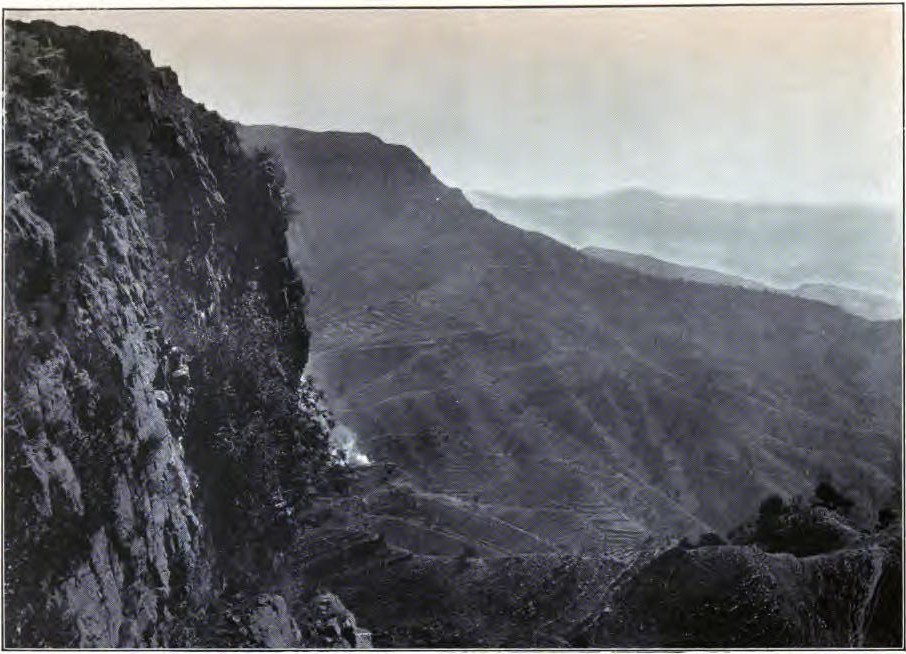
He describes the photo above, noting that "The narrow ridge at the right-hand bottom corner is the saddle over which the rush had to be made on the 18th and 20th..."

Connecting the crest of the spur...and the foot of the cliff there is a narrow neck or saddle one hundred yards long by thirty broad...devoid of all cover and completely exposed to the heights above, this ridge had to be crossed to reach the path ascending to the summit..."
On 18 OCT a force from the Second Division assaulted the heights; the movements of the British troops are in blue on the map above.

The 4th Brigade attacked from the village of Chagru Kotal while the 3rd Brigade swung around to the west. Afghan resistance was light, and the attackers easily took the crest of the ridge, the Afghan defenders falling back before them.

At this time GEN Lockhart made what has to be considered a mistake; he withdrew the force from the heights. In his tame reporter's letter to the London Times he says that the force was too isolated and unsupportable as well as difficult to supply.

All of that may have been true. We have no idea what would have happened if the British had tried to hold the heights.

But the problems that would come of the decision to withdraw were immediate and should have been evident before the last soldier came down off the hills.

The firing of the day's engagement had drawn a crowd; Shadwell (1898) says about 8,000 mixed Afridis and Orakzais were arriving from the nearby Khanki Valley as well as the original defenders of Dargai village returning to snipe at the invaders.

On the way downhill the British force suffered worse than in the attack from this converging force; finally dark and the artillery halted the Afghan pursuit but the Second Division lost 10 dead and 53 wounded in the operation for no tangible gain.

And, then, worse.

Late the following day (19 OCT) MG Yeatman-Biggs sent his commander a telegram from his position at Shinawari. He reported a "large gathering of tribesmen was visible on the Dargai position, and...proposed moving on Karappa, via Gulistan Fort, instead of down the Chagru defile." (Shadwell, 1898).

This move would have effectively turned the Dargai position, but GEN Lockhart "ordered the original route to be adhered to, remarking that, while it would probably be necessary to clear the enemy off the Dargai heights, they would very likely retire, to prevent their line of retreat from being threatened..." (Shadwell, 1898)

MG Yeatman-Biggs shook out his force to recapture the heights of Dargai.

The Engagement: Note - There are several sources for the attack on 20 OCT but the following account is primarily from Shadwell (1898) supplemented by Johnson (2009) for observations from the Afghan side.

The British attack force was organized in three waves. The first unit to assault was the 1/2 Gurkhas, the second "wave" the Dorsets, with the Derbyshire Regiment third. The Gordons were originally tasked with supporting fire.
The defense was spread all along the crest and military crest of the Dargai ridge. Shadwell (1898) notes that the defenders didn't make the same mistake as on 18 OCT; the defensive perimeter extended well to the west, where MG Kempster's flanking attack had climbed the cliffs. In the Shadwell account this is supposed to have been due to a cunning ploy by the Second Division intel officer - or "political officer" as they were called at the time - who fed the tribes a false plan, but there is no way to be sure that this was not merely a tactical adjustment to the British attack of the 18th.

Artillery prep began at 1000 hours. The Gurkha attack went forward soon after - Shadwell (1898) is not specific about the time, and the assault appears to have been effectively halted by fire along the saddle or at the base of the steep cliff within a short time of leaving the line of departure.

"Many a brave little Ghoorka bit the dust" is how Shadwell puts it.

Really. No shit. That's what he wrote.
Apparently some time soon after the two British units attempted to reinforce the Gurkha battalion. Both were shot to pieces as they tried to rush the saddle. Most of the British troops were killed in the open space. Neither unit, nor the Gurkha Rifles, could manage to advance up the steep path to the crest.

Johnson (2009) describes it thusly: "As they tried to cross in small groups ‘each clump of men that dashed forward melted away under the converging and accurate fire, and after a time affairs practically came to standstill’. The Gurkhas were pinned down for three hours and 2 other British regiments fared little better."

At some time in the early afternoon - probably about 1500 - BG Kempster was tasked to bring up the division reserves; the Gordons and the 3rd Sikhs. These units were "shot across" the open saddle by an artillery mad minute in which all 24 cannons fired a three-minute rapid fire.

The Gordons and Sikhs managed to make the base of the cliff in a body, probably picking up odd lots of Gurkhas and British soldiers along the way. From there it must have been a mad scramble up the steep path into a nasty rain of rifle fire.
One of the Gordons pipers, a man named Findlater, was shot through both legs at the ankles on the way up. He hauled himself onto a rock and continued playing as his fellow tribesmen attacked. His was the sort of bizarre gallantry that transfixed Victorian audiences; he got a sort of nursery rhyme from the kiddies of Glasgow out of it:

"Piper Findlater, Piper Findlater,
Piped "The Cock 'o the North".
He piped it so loud,
He gathered a crowd,
And won the Victoria Cross."


And so he did, although just to remind us that life isn't like the stories we like to tell about it, he later remarked;
"I am told that the ‘Cock of the North’ was the tune ordered to be played, but I didn’t hear the order, and using my own judgment I thought that the charge would be better led by a quick strathspey, so I struck up ‘The Haughs o’ Cromdale’. The ‘Cock o’ the North’ is more of a march tune and the effort we had to make was a rush and a charge."
Ha! Take that, popular fiction...

The final rush carried the crest, again the Afghan defenders retired in good order, and the 1/2 Gurkhas and Dorsetshire Regiment were posted to hold the crest while the rest of the attack force sloped off back down to the valley below to police up the dead and wounded and reorganize for the move forward.

A total of 37 attacking infantrymen were killed, with the point element suffering the worst; 1/2 Gurkhas lost 18 officers and men. Another 156 British troops were wounded. The Afghan losses were not counted, but the defenders managed to remove all their dead and wounded before the attack force seized its objective. "Many bloodstains were found on the ground..." is all Shadwell (1898) can come up with, remarking that the women and children commonly dragged off both wounded and killed.

Johnson (2009) sums up the Afghan tactical moves and their effects:
"First, and most importantly, the new Pashtun deployments had compelled Lockhart to change his plan to by-pass Dargai. Second, the tribesmen carefully selected (the ground) and channelled them into a specific killing area. Almost all the British casualties occurred in a one small area that could be swept by small arms’ fire. The British had suffered 200 casualties, and, whilst the tribesmen were forced to abandon the Dargai position at the end, they could claim satisfaction at their achievements if not outright victory. The British force had been held up, they had managed to escape with their own forces largely intact and they had carried away most of their own dead and wounded."
I consider it unlikely that the Afghan defenders lost significantly more than the attack force, even with the effects of the artillery fire.

The Tirah Expedition continued on to the northeast the following day.

The Outcome: British tactical victory

The Impact: Minimal. The fiasco at Dargai didn't put a real dent in the Afghan resistance, and the British had other problems to worry about soon. As other military forces in the high hills around the Durand Line have discovered, it is usually the support elements that find it hard to cope with the Afghan and his mountains.

Constant and deadly harassment of supply and transport columns continued. Some of the more notable of these deadly little assaults included:

9 NOV 1897 Elements of the Northampton Regiment separated from supporting units and ambushed while burning some villages around Saran Sar. 20 killed, 48 wounded.

22 NOV 1897 One company Dorsets, one company Sikhs (unit unknown) ambushed while searching for troopers lost in contact. 29 killed, 44 wounded.

19 JAN 1898
36th Sikhs and the King's Own Yorkshire Light Infantry (KOYLI) ambushed while patrolling out of Mamanai. 32 killed, 37 wounded; some of the badly wounded are left behind when the KOYLI retreats and are mutilated.

Now you notice the little item about what happened on 9 NOV?

"Burning villages"?

Yep.

The Brits didn't play that "hearts and minds" bullshit. The way they saw it, counterinsurgency was all about grabbing the insurgents by the balls and twisting those rascals until the rapscallions begged for mercy.

So the primary "job" of the soldiers in the Tirah Expedition, like pretty much every other "column" the British sent into the tribal areas, wasn't fighting tribesmen.

It was burning people's homes and crops. It was throwing stones into their wells to make them useless, it was lifting their cattle, sheep, and goats, it was doing just what the U.S. Army did to the Sioux, and the Cheyenne, the Seminoles, and the Creeks.

It was killing their men, and turning their women and children out in the wilderness to starve.
And it worked; it usually does. Eventually British logistical and numerical strength overwhelmed the tribesmen. In June 1898 negotiation resulted in a payment of 800 rifles and 50,000 rupees from the Afridi. The tribe also committed to dealing only with the Raj, and leaving road- and railway construction unmolested.

A new unit, the Khyber Rifles, was formed to replace the Afridi levies that had guarded the Khyber Pass. The troopers were Afridi but the officers were British, and there would be no more question of who were the Kings of the Khyber.

The British agreed to pay the tribal leaders stipends to keep the agreement, and the peace.

As you probably know, that peace has been most notable by its absence from that day to this.

But in the short term both sides seemed to get what they wanted.

Britain had a brisk little fight that ended in the restoration of British power over the hills around Dargai. The Northwest Frontier was secure for another several years from the threat of Afghan tribesmen working with the Russian Bear. British "honor" had been satisfied, and the truculent tribes "punished" for their fractious behavior. The troops has performed well, even if their leaders had made several critical blunders on the battlefield itself (such as at Dargai) and had, overall, failed to understand and adjust to the new tactical conditions they faced in the Orakzai hills.
The tribes also had reason to be pleased. Johnson (2009) notes that:
"They had inflicted considerable losses on the British and exchanged blow for blow in a manner that would accrue them honour and credit. Individuals who had survived the campaign would have been recognised as having demonstrated courage in defence of their lands, peoples and religion.

The sense that the Pashtuns had actually enjoyed the campaign because it had offered them a chance to enhance their honour was confirmed by a bizarre epilogue to the Tirah Campaign. When General Lockhart set off to leave India in April 1898, a crowd of 500 Afridis including Zaka-Khels mobbed him with cheers and insisted on pulling his carriage to the station. Some vowed to fight alongside the British in the future and promised eternal friendship. To the Pashtuns, this campaign had not been a British victory, but a draw, and, more importantly, honour had been preserved for both sides."
The strange world in which Afghan and Briton alternated between fighting alongside and against each other continued for exactly another fifty years, until Independence in 1947.
The tribes of the high hills then passed into the portfolio of the new government of Pakistan, where they have remained a tumult and a shouting to this very day.

In Dorchester in the county of Dorset the monument to the dead men of Dargai goes largely unvisited and unremarked in the Borough Gardens, the names of the troopers killed on that chilly October day slowly fading from the stone.
The Gordon Highlanders ceased to be in 1994, forced into amalgamation with the other two remaining Highland regiments to form "the Highland Regiment". Currently the 4th Battalion of the Royal Regiment of Scotland preserves what remains of the lineage and battle honors of the old 92nd Regiment of Foot; "Ninety-twa, no' deid yet".
On 8 NOV 2006 a suicide bomber - probably related to one of the Tarkani Pashtuns killed in an aerial attack on Bajaur nine days earlier - killed 42 Pakistani soldiers in the village of Dargai.

Wednesday, January 26, 2011

Burns Nicht

"There's nane that's blest of human kind,
But the cheerful and the gay, man,
Falala, la, la, (sotto voce: aye, etceteraa, ye bugger...!)

Here's a bottle and an honest friend!
What wad ye wish for mair, man?
Wha kens, before his life may end,
What his share may be o' care, man?

Then catch the moments as they fly,
And use them as ye ought, man:
Believe me, happiness is shy,
And comes not aye when sought, man."And before the night is over, may I be wishing you a very happy Robbie Burns Night? For all that I'm a just regular Yank, the blood of the great lairds (crofters, bandits, sheep-lifters, hedge-robbers, reivers, drunks, and generations of laborers, accountants, and itinerant soldiers) of Skye runs red in me veins. So from the Highlands of North Portland, may ye fare well this night, and may y'wake to a cuddle and a kiss?

Mmmph.

Saturday, May 29, 2010

Decisive Battles: Auldearn 1645

Auldearn Date: 9 MAY 1645Forces Engaged: Government of Scotland ("Covenanters") - about 1,700 regular infantry in five units: part of Buchanan's regiment and the regiments of the Lord Chancellor's, Campbell of Lawer's, Lothian's and Findlater's. Roughly 1,300 local levies in three units; Seaforth's and Sutherland's regiments and some sort of outfit only referred to as the "northern levies", probably Highland clan wild men. About 300 cavalry in three units, one of them (Campbell of Lawer's Horse) fielding 30 troopers or less. No artillery.So, approximately 3,000 horse and foot under MG Sir John Hurry.
Before We Go On - A Note About 17th Century Infantry: Although dimly remembered now if at all, the late 16th to mid 17th Centuries were the heyday of the "pike-and-shot" period.

The invention of hand-held gunpowder projectile weapons goes well back to the late medieval period. The arquebus, really just a sort of improved hand-cannon with a matchlock, was being used in maneuver warfare by the early 1400s. Like most other early gunpowder weapons, the matchlock arquebus was less accurate than a longbow and didn't hit as hard at a distance as a crossbow, but had a faster rate of fire than the most powerful crossbow, was easier to learn to shoot than a longbow, and was more powerful at close range than either.

This matchlock weapon had a whole laundry list of drawbacks. They were inaccurate, noisy, prone to misfires in the damp or wind (which might blow the match out!). They generated dense clouds of smoke and deafened the firer, both making command and control a nightmare for pike-and-shot unit officers. But the worst part was that they were hellaciously slow to reload. Slow, slow, slow. And the trick to fitting a blade on a musket was waiting for the 1670's when first the plug bayonet and, nearly immediately afterwards the socket bayonet of the 1690s, gave the musketeer a way to defend himself while reloading.

Musket fighting in 1645 was in that tricky stage where the technology was mature enough that nobody really wanted to go back to the bow. But there were still a lot of bugs in the business, and the musket-firing infantryman was not yet the lord of the battlefield he would become sixty years later. He still needed help to stay alive. He found it in a very old military technology; the pike.

Beginning with the Spanish tercios of the 16th Century the footsoldier in Europe reorganized around a central block of pike-armed infantry (who typically retained some of the armor of their medieval predecessors; a helmet, breastplate or breast-and-back and tassets over a "buffcoat" of thick leather. This central pike phalanx could act as a moving redoubt for the musketeers to hide in or behind when cavalry threatened, or could roll over lightly-armed infantry and engage similar pike formations in "push-of-pike" melees that the musketeers lacked the brute force to win. Typically the ratio of pikemen to musketeers in the 1640s was about 2-3, well up from the 1-1 of the early tercios but far from the all-musket-armed foot regiments of 1700.

So the infantry units that met at Auldearn were a strange mess, caught in amber between now and then; part medieval pikeman, part modern bullet-firing infantryman.
Royalists - 1,440 infantry in three main units (the Irish mercenary regiment, and two Gordon regiments; Moneymore's and the Strathbogie Regiment) and a small troop of mixed Irish mercenaries and Highland clansmen (MacColla's Lifeguard). Somewhere between 400 and 600 cavalry - the "Gordon Horse" had just defected from the Government and the estimates of their strength range from Reid's frankly improbable 600 to a more likely two-thirds of that. No artillery.Approximately 2,000 horse and foot under LTG James Graham, 1st Marquis of Montrose, and MG Alasdair "The Devastator" MacDonald, "MacColkitto" a.k.a. "MacColla"

The Sources:The Royalist version of events has always been supported by work published in 1647 by George Wishart, Montrose's chaplain, general dogsbody, and all-round enthusiastic lickspittle. The original Latin account, splendidly titled "I. G. De Rebus Auspiciis Serenissimi & Potentissimi Caroli Dei Gratiâ, Magnae Britanniae, Franciae & Hiberniae Regis, &c. Sub imperio illustrissimi Jacobi Montisrosarum Marchionis, Cometis de Kincardin, &c. Supremi Scotiae Gubernatoris, Anno CICICCXLIV, & duobus sequentibus, praeclare gestis, Commentarius.Interprete A. S. Anno Domini CICICCXLVII" was expanded and reprinted several times after Montrose's death. Finally the work was translated into English in 1819 as "Memoirs of the most renowned James Graham, marquis of Montrose".

Whatever the title, Wishart was no soldier and thus an unreliable observer of battles, and his admiration for the Marquis makes him an unreliable reporter of matters not reflecting well on his master. The work must be taken with care where issues of that sort arise which, as we will see, happens quite a bit on the 9th of May, 1645.

One Patrick Gordon of Ruthven is supposed to have written a valuable account of the Civil War in Scotland from the Royalist side of the hill entitled "A short abridgement of Britaine’s distemper, 1639-49". This document is cited in Reid (2003) as "the best (Royalist) account" of Auldearn and is noted in the British Battlefields Trust report as "...giv(ing) a detailed royalist report".

The provenance of this manuscript is more than a little perplexing. The first reference I can find for it occurs in a footnote in a volume entitled "Montrose and Covenanters: their characters and conduct" by one Mark Napier, Advocate, published in London in 1838. In his this work Napier introduces Gordon's account as "also unprinted, being a transcript of a manuscript...by Patrick Gordon (a son of Gordon of Cluny) who was admitted a burgess of Aberdeen March 23, 1608." In his endnotes, Napier says of this manuscript "I have not been able to discover that either the original or a transcript is known to exist", therefore citing essential the extracts he encountered in the journal of one James Man, identified as the "Straloch's Manuscript" then in the Advocate's Library in London.

Napier appears to have been misled or a poor researcher, however, for six years later the Spaulding Club of Aberdeen published "A short abridgement of Britane’s distemper : from the yeare of God M.DC.XXXIX. to M.DC.XLIX", John Dunn, ed., Spaulding Club (Series); 10. This MS appears to be the best Royalist eyewitness account of the battle.

Another single MS provides the account from the Government side: James Fraser's "Polichronicon seu policratica temporum, or, The true genealogy of the Frasers" This manuscript, held in Master Fraser's Parish of Wardlaw (now Kirkhill), Inverness, where this worthy was the minister of the kirk was edited by one William MacKay and printed at the Scottish History Society in 1905.

As always, Stuart Reid's 2003 Osprey campaign volume "Auldearn, 1645 : the Marquis of Montrose’s Scottish campaign" is a valuable resource. The Wiki entry is as bad as Wikipedia gets: disorganized, sparse, unreferenced, and factually wrong in several places.

Update 8/2011 - And I was sadly remiss earlier for not giving credit and drawing your attention to an excellent on-line source for the engagement that provided a number of hard-to-find images; "Project Aldearn 1645" is both a terrific reference for the battle itself as well as a nice forum for ECW gaming. Sorry, Rank, I didn't credit you initially and then forgot until you reminded me; I apologize and hope goes some little way in making amends.

The Origins and Setting for the Campaign: Whenever attempting to determine the cause of some obvious fucktardry at work in England or Scotland during the 17th and 18th Centuries the most likely suspects will be religion, a Stuart, or both.

The Auldearn campaign leads back to both.

The "First" English Civil War is too broad a topic to address here, but let's summarize it, at least, for the casual fan.

First, it wasn't all just Stuarts and religion; the war came about partly because of a series of big changes in the society of 17th Century England.

Until then, see, it was the nobles on top, the great lords, descendants of the thugs who had hacked their way to the top with swords. But by the middle 1650's most of the real wealth and economic power had migrated down to a group of commercial and newly-landowning newcomers - the gentry.

They were a genuine social irruption, these people; the squires, smallholders, and bourgeousie who had purchased a lot of the monastic lands as well as begun to profit from industry, unlike the nobility who generally despised "mechanics".Then there was religion. Part of it was the usual 17th Century Catholic-versus-Protestant. But England was unique, a place where the Tudors had tried to make themselves unCatholic without becoming really Protestant. But as rebels have found since Cain, it's nearly impossible to be a little bit pregnant or a little bit heretic.

The break with Rome generated its own momentum, and by the early 1600s a group of Anglicans were demanding not just disowning the Pope but shedding the old forms of worship and geegaws such as vestments and high churchmen. Many of the gentry were also sympathetic to these Puritans. The Scots, meanwhile, had gone in large measure for the Calvinism they called "presbyterian", and were in no mood to accept a return of the Roman Church or, and being Scots this might have well been more important, the return of Church lands and wealth (which they knew well would not be paid for...)

Of course, the ECW like most wars wasn't just the head-on collision of immense, societal forces. These forces affected, and were shaped by, individuals. And the forces interacted with the abilities - or lack of them - of these individuals.

In the case of the ECW, three critical individuals were Elizabeth Tudor and her successors, James Stuart and his son Charles.

Elizabeth, who died in 1603, had been, as the Scots would say, a canny Queen and a canny master. She chose her advisers well, ruled cautiously, and played the internal and external power games shrewdly. She especially refused to act decisively against those Catholics remaining in England. Her cunning helped tame the nobility, which no longer had any real military role to play, and whose ire was rising as they watched the House of Commons authority rivaling House of Lords in Parliament whilst they lost out to the gentry.

Elizabeth had refused to enact the anti-Catholic and anti-high-church reforms the Puritans demanded, but with her usual adroit sense of political realty had prevented an open breach with the reformers.

James Stuart, who succeeded after the childless Elizabeth's death in 1603, was not nearly as capable. In fact, James was worse than the usual feckless Stuart. His youth and upbringing couldn't have been worse, having been spent in a Scottish court nearly as grandiose and self-important as the Bourbon. He was greedy and spendthrift, and a vigorous believer in the divine right of kings. In 1609, James claimed to rule by divine right and by 1611 prorogued Parliament and ruled by fiat until 1621.

James' son Charles was actually a fairly competent man outside the usual Stuart prediliction for befriending and empowering gomers, dorks and losers. He is described as "...personable and dignified, temperate and level headed". He stood against the Spanish, which endeared him to the commons, and his government which was generally benevolent and efficient. But.

He had a French wife, and her, and his, favoritism towards their cronies was not helpful. He was violently Catholic and anti-Puritan. He was a fairly rotten administrator, and he was worse with money than his father.

Even a masterful statesman might not have been able to avoid the coming clash between Anglican Puritan and remnant Catholic; in that sense the ECW was a part of the terrible Wars of Religion that harrowed Europe during the 17th Century. But the clash was also between nobleman and gentleman, between Royalist and Parlimentarian. Like so many other wars, many of those Englishmen and Scots caught up in them must have felt that what was happening was just inescapable.The first shots of the war were fired, oddly enough, in Scotland. Charles wanted to suppress the Calvinism in the Church of Scotland. This "Bishop's War" was a bit of a farce, with neither army really wanting to get killed for a prayerbook, and the real effect was that 1) the Scots signed something called the "National Covenant" (a frankly nasty bit of anti-Catholic hate which demanded complete rejection of any non-Calvinist doctrine - it's worth recalling that the Covenanters are today sometimes known as the "Taliban of Scotland"), and 2) Charles needed to recall a Parliament (after eleven years, remember?) to raise money.

But this Parliament - called the "Long Parliament" - wasn't nearly as interested in funding royal sectarian wars as discussing Charles' regal pretensions. It revoked his assumed dictatorial powers, required that Parliament be called no more than three years apart, dismantled the "Star Chamber", the secret court the Stuart kings had used to deal with their political enemies, and condemned and executed two of Charles' closest cronies.Meanwhile things in Ireland were going to hell, as usual, with a revolt in the spring of 1641. With emotions running high the anti-royalists in Parliament started muttering darkly about Charles throwing in with the Irish Catholic terrorists until in January of 1642 the king tried to arrest his five sternest enemies in Parliament on the suspicion they were planning to impeach and arrest his Queen for complicity in Irish and Catholic plots. His move failed, and Charles fled London for Oxford where the war officially began in August.

The summer and autumn of 1642 and the spring and summer of 1643 went well for the Royalists. His nobles were rump-full of military tradition if not actual skill, and he was gifted as a relative with Rupert, Count Palatine of the Rhine and one of the 17th Century's better commanders.

(This lady has absolutely nothing to do with Auldearn or the Civil War or much of anything except being Rupert's mistress, Peg Hughes. But this is a long, gory tale, she's delightful, and it's really just time for something purely lovely, isn't it? I suspect that she was the Hubba-hubba Girl of 1653)

The Royalists won several tactical victories, at Adwalton Moor, Landsdown, and their smashing of Waller's forces at Roundway Down led to the fall of Bristol to the Royal standard. The high summer of 1643 was the highstand of the Royal cause.But the Parliament controlled the Navy, and had both men and material advantage over the Royalists. And with soldiers like Cromwell emerging from the foundry of war the effect of Rupert's skills was beginning to dull. But critically Parliament made alliance with the government of Scotland.

The Scots wanted help against possible royalist importation of Irish troops to assist the catholic clans; the English wanted the disciplined Covenanter troops to overbear the Royalist field army. So in August of 1643 the Parliament and the Scottish Convention of Estates signed an agreement to...well, we should quote it here in full, to get the idea of how the people involved thought about their war.

According to the "Solemn League and Covenant", the two governments agreed to combine for
"the preservation of the reformed religion in the Church of Scotland...the reformation of religion in the kingdoms of England and Ireland...the extirpation of Popery, prelacy (that is, Church government by Archbishops, Bishops, their Chancellors and Commissaries, Deans, Deans and Chapters, Archdeacons, and all other ecclesiastical officers depending on that hierarchy), superstition, heresy, schism, profaneness, and whatsoever shall be found to be contrary to sound doctrine and the power of godliness...to preserve the rights and privileges of the Parliaments, and the liberties of the kingdoms, and to preserve and defend the King's Majesty's person and authority"
Whew.Anyway, the pact of steel was made, and in January 1644 the Scots Covenanter Army marched across the border into England.

Charles needed someone to get the damn Scottish off his royal ass, and he called on a man who may have been one of the oddest, most militarily gifted, and most unlucky commander in the history of that land that has birthed so many gifted in the art of violent death, James Graham, 1st Marquess of Montrose.

Chief of the Grahams of Perthshire, soldier and poet, Montrose's military career in Scotland started on the other side; he fought for the Covenanter government in the "Bishop's Wars". He had signed the National Covenant and was involved in suppressing anti-Covenant Scots in Aberdeen and in western Scotland in the Clan Gordon lands. He fought and beat the Royalist army at the "Brig o' Dee".

Montrose's problem was that he thought about religion like a 20th Century man in the 17th Century. He wanted to get rid of the Episcopal bishops' authority in Scotland without making the Calvinist presbyters masters of the place - i.e. the clergy should friggin' well render unto God that which was God's and the king should worry about Caesar.His nemesis in the Convention of Estates was Archie Campbell, 1st Marquess of Argyll, who, like any smart politician rode the biggest wave - in his case the Presbyterian Talibs and their middle-class mujeheddin. Montrose, on the other hand, tried to offer his separation-of-church-and-state fluffy bunny hugs and failed because Charles, being a fucking pigheaded Stuart, wouldn't give him the bishops. If Henri IV could conclude that Paris was worth a Mass (or maybe not...) Charles was the sort of principled idiot who would have lost a kingdom rather than give one up.

Come to think of it...he did.

Anyway, in 1649 Montrose was still fighting for the Scottish government, forcing of the Tyne at Newburn. But on 27 May 1641 the Committee of Estates charged him with intrigues for King Charles and against Argyll, and he was imprisoned, then amnestied with other Royalists, then...he was offered command of the force sent south to the aid of Parliament in 1644!

Now a confirmed Royalist, however, Montrose headed south of Oxford, where he was roped into a scheme to pry the Scots Army out of England. The plan was that Montrose would lead a group of Scots and English troops into Scotland from the south in the early Spring of 1644 whilst the Gordons rose in the Scottish northeast and a Royalist force of Irish troops landed in the west. The theory was that this assault would set the Estates to screaming for their soldiers and the Covenant Army would be recalled to the north.

This plan fell apart almost comically, with the Gordons rising and getting hammered - their chief never forgave either Montrose or the King - because Montrose was quickly beaten back into the north of England and the Irish never arrived.So it was almost pure serendipity that Montrose, wandering almost alone in August, 1644 near the town of Blair, encountered Alasdair MacColla, who had finally landed in June with less than 2,000 Irish mercenaries and who was dragging this little force and 500 unhappy levied Scottish troops one step ahead of the Government's pursuit.

The two met and set about to accomplish their king's plan.

The Campaign: From Blair, the Royalist force moved south towards Perth, where Montrose's force defeated a Covenanter force at Tibbermore (or Tippermuir) in early September. Turning from another Covenanter force assembling near Stirling, the Royalists were unable to take Dundee by coup de main and turned north to Aberdeen, where they defeated another Government force (which outnumbered the Royalists by about half) and rather messily sacked Aberdeen, doing nothing to endear their cause to the locals. The Royalists spend most of October rummaging around Aberdeenshire; pursued by government troops Montrose was still able to raise some of the Gordons but was attacked and fought to a draw near Fyvie late in the month.The royalist force spent the winter of 1644-1645 in Argyllshire, bitchslapping the Campbells for being government stooges. This would probably have been MacColla's idea - his loyalty to the royal cause was pretty heavily compromised by his own ambitions, which were to destroy his clan rivals the Campbells and control the Gordon lands. By spring the Royal army (a pretty grandiose term for about 2,000 men)
was assailing Dundee, having casually butchered quite a few of the Campbells at Inverlochy in February, and in turn being driven off by the Covenanter relief force under MG Baillie.

Montrose's force now turned north, back towards the Gordon clan lands, leaving the Aberdeen area in early April, moving south almost as far as Stirling before turning north again in late April to deal with Covenanter forces under Hurry who were moving north and west through the Gordons from Aberdeen towards Inverness. Montrose, MacColla and The Gordon agreed that they needed to do something about this; the Royalist force caught up with Huntly in early May, 1645, and the Covenanter commander then conducted a slow withdrawal under pressure towards Inverness.

Hurry knew - and Montrose, with his typical slipshod intelligence, didn't - that the government garrison of Inverness and Seaforth's northern levies were moving east to link up with him. Luck, and poor Royalist fieldcraft, allowed him to break contact on the afternoon of 7 MAY, and contact his reinforcements. The Royalists had taken shelter around the village of Aulderan against a nasty, wet evening on 8 MAY and so were not expecting anything from their enemies. The royal forces were said to have been camped "commodiously" around Auldearn, suggesting that units had split into squads and teams to find barns, byres and cottages to sleep in.The village of Auldearn itself seems to have been quartered only by MacColla's Gordon lifeguards and another Gordon unit, the green Moneymore's. Montrose claims to have set a "strong watch or picquet together with sentries on all quarters", but does not seem to have bothered to put an officer or good sergeant in charge, as the sentries seem to have ducked out of the rainy night into Auldearn village where a mere half-dozen or so were roused just before daylight by MacColla, who kicked their asses down the road to Inverness, telling them to go find out what the hell was out there.

They found out in a thunder of Covenant muskets firing. Hurry, who had linked up with the separate elements earlier the preceding day and had marched hard to get back to the Royalist camp to destroy Montrose's scattered force, had been worried about the rain and the charges in his men's muskets. Rather than take the time to draw the rounds he faced the units left, marched down to Nairn Water and fired.

The Engagement:No doubt there were some soiled breeks on the road to Inverness in the pre-dawn thunder. The sentries scampered back to Auldern to inform MacColla that Scotland's Taliban were upon them.MacColla has been run down by Montrose's partisans beginning with Wishram as a sort of dumb side of Scottish mutton, but he earned his C-rations that morning and seems to have been a damn competent commander. He got his priorities in order; he informed his higher (Montrose) of the situation, his intent, and then formed his small force on the nearest key terrain; a small hill southwest of Auldearn village known as Garlic Hill.Hurry's troops, forming up in the fields to the south and west came on steadily and the Lifeguards and Moneymore's had to fight hard to keep from being overrun. They had a strong position and benefited from Hurry's decisions to attack with only one regiment up front and not to attempt to turn the flanks of the Royalist delaying force.

But the weight of shot couldn't help but be effective, and MacColla's force slowly fell back into Auldearn village itself.

The ground between Auldearn and Garlic Hill made this a successful maneuver, since the village sits on a fairly steep bench above a rather boggy and nasty little burn. Tucked into the kitchen gardens and backlots of Auldearn the Lifeguards could make good play on Campbell of Lawer's men in the burn below, while to the north on "Castle Hill" Moneymore's could put a vicious oblique fire down onto the struggling Campbells.At this point, with the enemy attack halted, sound tactics call for a counterattack and that is what MacColla did. His troops swept down out of the village, the Gordons swung around from the north side of Garlic Hill, and the chroniclers say that the Royalist soldiers got back up the near side of Garlic Hill, with Lawer's unit retreating to the top.

Here the battle halted again, with the probably increasingly exhausted survivors of the morning's firefight coming to dirk- and musket-butt-range. Another fight, this time probably less lengthy than the first, passed over the slope of Garlic Hill. MacColla's Highlanders and Irish mercs fell back into Auldearn, and the Gordons to Castle Hill as Campbell of Lawer's men came on again down into the mire and blood of the burn and up the steep little slope to crash into the houses of the village itself.A bitter fight for the small Scottish village then began in a flurry of claustrophobic panic and rage familiar to more recent veterans of Metz, Hue, Chechnaya, and Fallujah. Supposedly MacColla was speared by several Campbells only to catch the points on his targe shield and armored vest; the Covenanters fought their way in hard, killing and being killed by gunshots at the distance of lovers' confidences, short-gripped pikes gutting men who died screaming or sobbing, clubbed muskets smashing in skulls, and the butcher-shop sounds of sword and dirk cleaving human meat.

It must have been as fucking miserable as it always is.

By noon, or shortly after noon the Royalist center must have been mere moments from collapse. The Moneymore regiment clung to Castle Hill but must have been out or nearly out of ammunition. MacColla's Lifeguard was being driven out of the village. Hurry's regiments, stacked up on Garlic Hill, must have pressed forward at the feel of movement at the back of the Campbells in front of them, sensing the victory.

And then the first Gordon cavalryman cantered out of the darkness under the trees at the south end of Auldearn village.

Montrose's dispatch tries to elide it, and Wishart makes the entire battle into a cunning ambush, but it is fairly clear that what had happened is that Montrose assembled as many troops as he could in the defended space behind - traditionally the spot called "Montrose's Hollow" is just southeast of the old village of Auldearn - MacColla's line. When he saw Campbell of Lawer's pushing in, and realized that he could do no more there, Montrose seems to have sent in Gordon's cavalry unsupported. The troopers rounded the south side of the village and slammed into Hurry's right. The small troop of cavalry assigned right flank security took one look at the larger Royalist force and simply fled; in fact, Fraser's account says that they rode down some of Lawer's infantry in their haste to escape.

Gordon's troopers cut the hell out of several Covenant regiments, probably the Lord Chancellor's as well as Lawer's. The Covenant force was still being hacked apart when the second Gordon cavalry unit enveloped their left.

Hurry's force seems to have stood and fought. Fraser says that the royalists "run throw them, killing and goaring under foot...Lairs and Lothians regiment stood in their ranks and files, and were so killed where they stood." But when the royalist infantry, led by the Strathbogie Regiment falling on the Covenant right, waded into the butchery it was all up.

Hurry managed to get a good bit of his cavalry and some of his infantry away west, but the Royalist cavalry had spread out down the Inverness Road and did great execution among the infantry who survived the slaughter on Garlic Hill. The Lord Chancellor's Regiment had no more than 100 men fit for duty in August. Amazingly Campbell of Lawer's regiment was not destroyed, but lost it's colonel, lieutenant colonel, six captains, six lieutenants and 200 soldiers. Overall Covenant losses are likely to have been well over 500 and something between 800 and 1,200 is probable.Moneymore's and the Lifeguard must have suffered badly, too, however, and I suspect that Royalist losses, while reported as "light", probably came to several hundred. Montrose had had a bad scare, too, and rather than pursue Hurry retired eastwards to do some casual plundering and burning. Hurry's force was a broken reed but Baillie was still in the field. Montrose, MacColla and Gordon still hadn't solved their long-term problem; the Government forces were still in the field against them and the Estates hadn't recalled so much as a corporal's guard from England. The campaign was not yet over.

The Outcome: Decisive tactical Royalist victory,

The Impact: The real impact, to me, of Auldearn is the lesson that if strategy doesn't drive tactics tactical success will be barren.

Montrose's entire campaign was a strategic sideshow. Charles was trying to win in England...he didn't care about Scotland; all he needed was the Scottish troops back there and off his neck. If Montrose couldn't accomplish that his troops were wasted, and the Royalists didn't have enough troops to waste. Montrose has a gaudy reputation - he's often called "The Great Montrose" and several of his battle entries in Wiki maintain the tale of him as military genius - based on his victories at places like Auldearn, and Tibbermore, and Aberdeen.For a start, Montrose and Charles had no real idea of what they had to do to militarily to attain their political goal. To force the Scottish government to recall significant troop units from England they would have had to occupy a fairly decent-sized chunk of Scotland; they didn't and never would have the numbers to do that, and had they put any thought to the matter that should have been obvious to them.

Their entire "plan" consisted of chasing about Scotland fighting government troop units, at which Montrose was, admittedly, rather good. But Montrose's genius gained him and his king nothing. For one thing, the Parliamentarian victory at Marston Moor meant that any hope of a royalist north England was gone. The Great Montrose was never able to develop a plan that co-opted MacColla and his clansmen, who remained more concerned with winning their feud with the Campbells and gaining power in the clan lands than the royal cause. And in the final summation as long as the Scots government was willing to accept its losses and keep throwing local troops at Montrose, secure in the knowledge that he could not afford to sit in one place for long and cause them serious economic or political harm, short of some complete disaster the outcome was never in doubt.

Montrose's force went on to several more victories. Every time the Government force was replaced or relieved by another, until the Royalist string ran out at Philiphaugh in September. Having learned nothing from Auldearn, Montrose was loafing around several miles from his infantry when the Covenanter force under MG Leslie fell on him "without being described by a single scout". The Royalist "army", reduced by that time to a single battalion of Irish mercenaries and about 200 assorted cavalry and clansmen, was utterly destroyed. And with it the Royal cause in Scotland.
Touchline Tattles: There's no real lightness in this story; the ECW may well have been one of the most painfully unneeded wars in Western history. The combination of dynastic rule and religious hatred were and are absolutely toxic. Even the outcome wasn't an outcome. The Parliamentarians "won", Charles lost his noggin, the royalists came back, lost again, and soldiers that had won the war for Parliament ended up destroying and replacing it with a military dictatorship.

And after all that...a Stuart king came back and reigned for another twenty-five years - the last four after dissolving Parliament!

And Montrose? In March 1650 he landed in Orkney to raise the clans. His small force was defeated in battle, but he escaped to wander the country until he fell into the hands of one of my MacLeod ancestors. He tried before the Estates, condemned on the 20th of May and hanged on the 21st, with Wishart's hagiography round his neck.

To the last he protested that he was a real Covenanter and a loyal subject of the King of Scotland. The night before his execution he wrote:
"Let them bestow on ev'ry airth a limb;
Open all my veins, that I may swim
To Thee, my Saviour, in that crimson lake;
Then place my parboil'd head upon a stake,
Scatter my ashes, throw them in the air:
Lord (since Thou know'st where all these atoms are)
I'm hopeful once Thou'lt recollect my dust,
And confident thou'lt raise me with the just."


His opponent at Auldearn, Sir John Hurry, who had changed sides soon after the battle, was executed with Montrose.Shortly afterwards the Scottish Argyll Government switched sides and became Royalists, too.