Showing posts with label Asia. Show all posts

Friday, July 07, 2017

The NORK Nukes - 2017 International Tour!

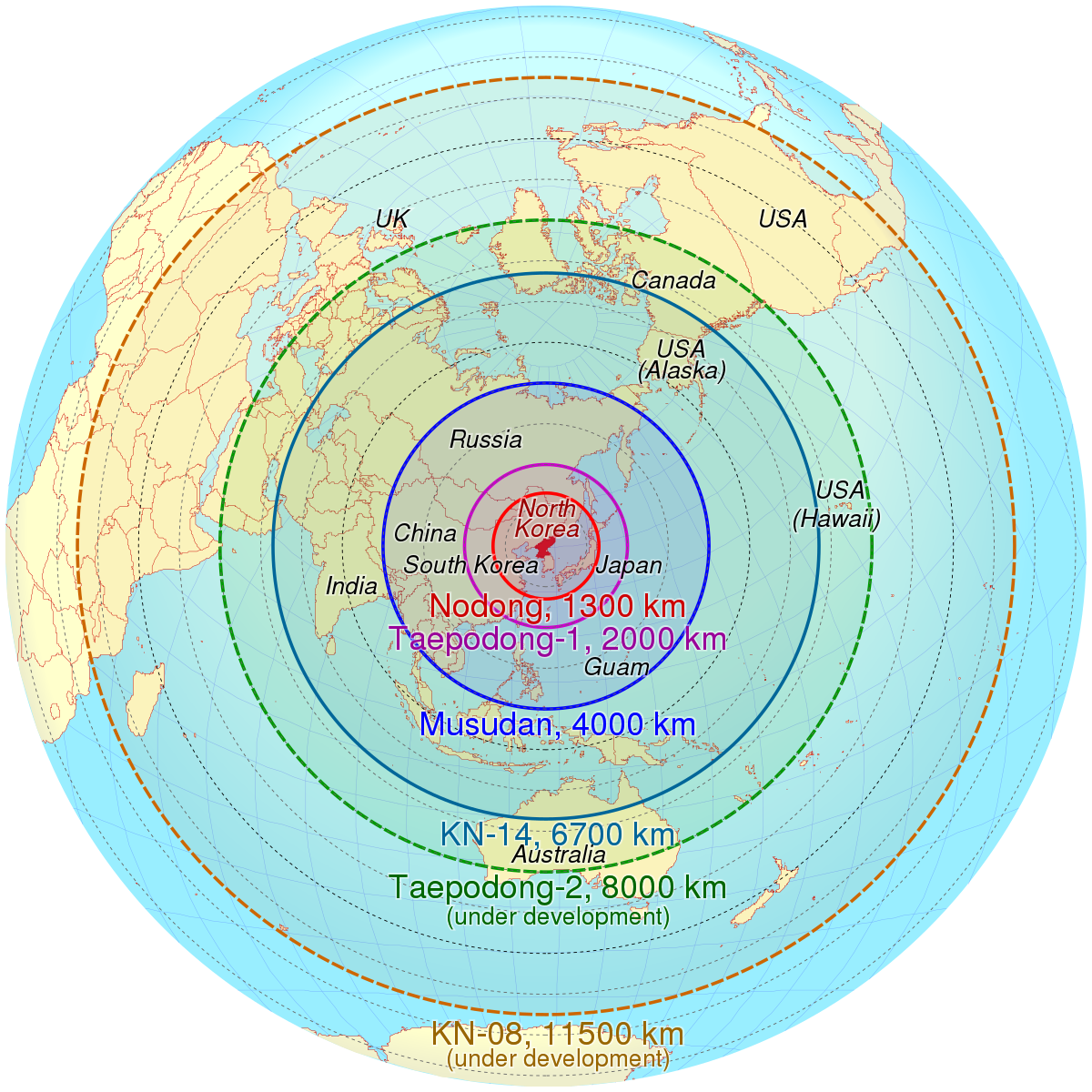
In what may well be the most NORK-y Fourth of July fireworks display ever, the Pyongyang regime appears to have successfully tested a nuclear-capable missile with the range to reach the western portions of North America; by definition an intercontinental ballistic missile.


The linked article does a good job discussing the strategic implications of this success, but the tl:dr version is "there are no good military options".

Simply put, the DPRK appears to have obtained what Stalin's Soviet Union did in the 1940s; a successful defense against U.S. military strongarming. Never a particularly good idea, given the NORK capabilities for inflicting nasty mayhem to American-aligned nations in northeast Asia, if the NORKs have the capability to directly threaten the U.S. mainland this option goes from "barely conceivable" to "off the table".

What's more, the strategic calculus of potentially-holding-U.S.-population-centers-hostage changes the relationship between the U.S. and Asian allies such as Japan and South Korea. If Trump wanted the Japanese government to start building its own nukes Pyongyang may well have given it the same push that the Soviets gave the British and French governments during the Cold War - the worry that the Land of the Big PX would be hesitant to risk its own civilians in the face of a possible nuclear exchange.

Where does the Tangerine Toddler fit into all this? Swinging the Big Stupid bat, of course. The King of the Deal is discovering what diplomats and potentates throughout history have discovered, albeit at his own, short-bus-slow-reader speed; that polities with interests that conflict with your own can't always - and often won't ever - be coaxed, swayed, or bullied into acting against their own interests. China fears a NORK collapse more than anything the U.S. can threaten. Figuring out a way to adjust U.S. geopolitical approaches to the new northeast Asian realities will require a hell of a lot more patience, creativity, and intelligence than either the current Chief Executive - who seems more interested in ginning up a "Blut und Ehre" white nationalist agenda - or his people have shown to date.

Nukes are funny things. Technically they are "weapons of war"...but they work well only as potential, not kinetic, energy. When the first nuke is thrown at a nuclear-armed adversary they have effectively lost much of their usefulness. If war is the "continuation of politics by other means" the problem with nuclear war is that, unlike politics, there is no real way to plan or predict or strategize what happens after the fallout settles. A single warhead getting through to a single city will mean that even the "winner" will suffer. There is little consolation for the "winning" public knowing that the northern portion of the Korean peninsula is a glassy wasteland.

Maintaining the nuclear balance was a difficult task for U.S. leaders like Truman and Eisenhower. What happens when the launch codes are clutched in the stubby fingers of a man whose primary education in conflict was as a WWF wrestling heel is something that I'm not sure I want to find out.

Wednesday, September 11, 2013

Battles Long Ago: Yalu River 1894

Battle of the Yalu River (黄海海战 or Huáng Hǎi Hǎizhàn, in Japanese 黃海海戰, Kokai-kaisen, "Naval Battle of the Yellow Sea") Date: 17 SEP 1894


Forces Engaged: Empire of China (Qing) - the Northern Ocean (Beiyang, 北洋舰队 or Běiyáng Jiànduì) Fleet of the Qing Imperial Navy.

2 "armored turret ships" (sometimes called "battleships" although these vessels were definitely not "battleships" by even pre-dreadnought standards) -
Dingyuan (定远 or Dìngyǔan, flagship) main battery - 4 × 12"/25 caliber) guns in two twin turrets, secondary battery included 2 × 6"/35 cal guns, 2 × 57 mm guns, 2 × 47 mm guns, 8 × 37 mm guns, 3 × 14 in (356 mm) torpedo tubes.


Zhenyuan (鎮遠, Chen Yuen) sister to Dingyuan; armament as the flagship except secondary battery consisted of 2 x 6"/35 cal guns, 6 × 37 mm (1 in) guns.
Note: We talked about these "turret" or "barbette" ships back in May of 2011 when we discussed Tsushima Strait. Basically these jokers were naval architects' first attempt to mate a conventional ship hull (that is, not a low-freeboard "Monitor"-type hull) with a centralized main battery in a rotating mount, either an actual turret or an open-topped armored bucket (a "barbette") instead of a broadside-style fixed side-shooting cannon. What's kind of interesting without being particularly conclusive is that McGiffin (1895) calls both of them "ironclads" instead of "battleships".
8 "cruisers" of various types:
1 "armored cruiser" or coastal defense ship - Pingyuan (平远 or Ping-yüan) Main battery 1 × 10" gun in a single turret, secondary battery 2 × 6" guns, 8 × machine guns, 4 × 18" torpedo tubes.
Note: This vessel was a thoroughgoing oddity.

First of all, while it's often described as an "armored cruiser" technically it was pretty much a straight copy of a French vessel described as an "armored gunboat of the first class", the Acheron. The originals were designed primarily for close-in coastal defense along the French Channel, Mediterranean, and North Sea coasts. The value of such a warship for the long coast and many large rivers of eastern China is fairly obvious but, still, this wasn't a vessel really designed to fight major fleet actions. McGiffin (1895) straight-out calls this vessel a "coast-defense ship".

The other thing about this vessel was that it was the first Chinese-built steel warship, laid down at the Foochow Arsenal at Mawei. While the design and many of the cannon and engine parts were European the vessel as a whole was Chinese from the keel up.
2 Chaoyong-class heavy protected cruisers -
Chaoyong (超勇, Chāoyǒng) 2 × 10" guns in single mounts (fore/aft), 4 × 4.7" guns, 4 × 9-pounder guns (2 twin mounts) ,4 × 11 mm Gatling guns, 4 × 37 mm Hotchkiss guns, 2 × 4-barreled Nordenfeldt guns
Yangwei (揚威, Yangwei) sister to Chaoyang with the same armament
These vessels are described as "cruisers" but the builders, Armstrong Whitworth of Great Britain, called them "gunboats" albeit pretty damn heavily gunned for such. The British Admiralty passed on them in the 1880s and they were sold to foreign clients. Not really terrible ships for the '80s but outclassed by vessels of similar size by 1894. McGiffin (1895) calls them "lame ducks". Similar to the "Elswick" cruisers in concentrating on speed and battery and skimping on armor.
2 "Elswick"-type (protected) cruisers -


Zhiyuan (致遠, Zhiyuan) 3 × 8.3" guns; twin gunshield-mount forward, single gunshield-mount aft, 2 × 5.9" guns, 8 × 57 mm (2.2") guns, 4 × 18" torpedo tubes
Jingyuan (靖遠, Jingyuan) - sister to Zhiyuan with the same armament.
Both of these vessels were built by Armstrong Whitworth and, again, called "gunboats" by the builders but classed as "cruisers" by the Qing Navy. The "Elswick"-design cruisers - constructed for export at the Armstrong Whitworth Elswick Yard - were typified by speed and relatively decent armament but often lightly armored compared to First World protected cruisers. These vessels are often called "armored cruisers" which misstates the type of protection they were designed with - specifically, an armored internal deck and gunshields or barbettes but without the side armor belts that characterized an "armored" cruiser".

Note that this Jingyuan is often referred to as the "1886 Jingyuan" to distinguish her from the German-built Jingyuan. Why the fuck they didn't just name one of the damn ships something else baffles the hell out of me. If the Qing system of supply and services hadn't already been as fucked up as a football bat this two-Jingyuan thing wouldn't have helped them a bit.
3 German-built protected cruisers -
Jingyuan (經遠, Jingyuan) 2 × 8.3" guns in a double barbette mount forward, 2 × 5.9" guns, 4 × 18" torpedo tubes, 8 × machine guns (this is the so-called 1887 Jingyuan)
Laiyuan (來遠, Laiyuan) sister to 1887 Jingyuan: 2 × 8.3" guns in double barbette mount forward, 2 × 5.9" guns, 4 18" torpedo tubes, 8 × machine guns
Jiyuan (济远) 2 × 8" guns in double barbette mount forward,1 × 6" gun, 4 × 3" guns, 6 × 47 mm (2") guns, 4 × 15" torpedo tubes
These three protected cruisers were all built for the Chinese Navy by Stettiner AG Vulkan of Stettin, Germany. Interestingly, McGiffin (1895) calls the first two of these three German-built ships "armored cruisers" although their specifications clearly show them to lack armored belts.
2 "corvettes" or similar light destroyer-type warships -
Kwan Chia (广甲) 1 × 6" gun in a single mount forward,4 × 5" guns in sponsons, 6 × 37mm guns
Guangbing (广丙) 3 × 4.7 guns, 8 × machineguns, 4 15/18" torpedo tubes


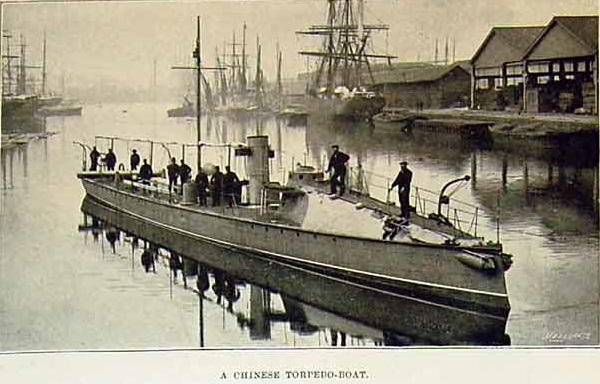
2 torpedo boats -
Fulong (福龙) 3 × 14" torpedo tubes (two forward, one aft) and either 2 × 37mm light cannon or 2 machineguns (probably the latter)
Tso Yih (??) presumably similar armament to Fulong

The Beiyang Fleet at the Yalu was organized into two wings;

Left Wing included the Jiyuan, Kwan Chia, Zhiwyuan and the flagship Dingyuan

The Right Wing included the Zhenyuan, Laiyuan, both Jingyuans, Chaoyong, and the Yangwei.

Pingyuan, Guangbing, and the two torpedo boats joined the Right Wing several hours after the opening of the engagement.

So two "ironclads" or pre-pre-dreadnought battleships, eight assorted cruiser types (or seven cruisers and a coast-defense ship), two corvettes, and two torpedo boats under the command of TITU (提督, the Qing rank equivalent to a modern USN four-star admiral) Ding Ruchang (丁汝昌, Dīng Rǔchāng)


Imperial Japanese Navy (大日本帝国海軍, Dai-Nippon Teikoku Kaigun) -


3 Matsushima-class protected cruisers -
HIJMS Matsushima (松島) 1 × 12.6" "Canet" gun barbette mount forward, 12 × QF 4.7" Mk I–IV guns, 16 × QF 6 pounder Hotchkiss guns, 6 × 1-pounder guns, 4 × 14" torpedo tubes
HIJMS Itsukushima (厳島) 1 × 12.6" Canet gun, 11 × QF 4.7" Mk I–IV guns, 5 × QF 6 pounder Hotchkiss guns, 5 × QF 3 pounder Hotchkiss guns, 4 × 14" torpedo tubes
HIJMS Hashidate (橋立) 1 × 12.6" Canet gun, 11 × QF 4.7" Mk I–IV guns, 6 × QF 6 pounder Hotchkiss guns, 2 ×QF 3 pounder Hotchkiss guns, 4 × 14" torpedo tubes

I can't really top what I wrote about these ships back in 2011, so I'll just paste it in here.
"The Matsushimas are a truly unusual vessel, and like many bizarrely entertaining and frivolously odd things, they are fundamentally French.

In the 1880s the young Imperial Japanese Navy was looking at a problem. Qing China, next on her list for a little European-style unequal-treaty fun, was arming up. The Germans had just delivered the two Dingyuan-class battleships; nothing Japan had could match the Dingyuan and Zhengyuan. Enter the French Navy. The Japanese were getting a little hinky about their dependence on the British, who at the time were rather cosy with the Qings. The then-Minister of Marine was a Francophile, and turned the IJN's interest to the French "Young School", which was then all excited about the idea of swarming enemy battleships with masses of light craft, cruisers, destroyers, and torpedo boats. The upshot of this was the arrival in the Japanese navel shipyard of one Emile Bertin. Starting in 1885, Bertin directed construction, either in France or at Yokosuka, of over 20 hulls, from torpedo boats to the Matsushimas. The latter were Japan's largest capital ships.

But they were utterly, absolutely weird.

These ships only displaced about 4,000 tons and mounted mostly light guns, 5-inch and below. But each one had a single, ginormous 12-inch cannon in a barbette. This so-called "Canet gun" loaded at the breech, but so frigging slowly that you could have timed the crew drill with a sundial and the effect of the monster gun firing was truly frightening; the entire ship would stagger, even seeming to lose way altogether. You couldn't train it abeam because the massive barrel would cause the cruiser to list so frighteningly it threatened to capsize. It was like one of those monster late-war Nazi tanks; huge, frightening, but practically useless."
2 Naniwa-class protected cruisers -
HIJMS Naniwa (浪速) 2 × 10"/35 guns in single mounts fore/aft, 6 x 6"/35 guns, 6 × QF 6 pounder Hotchkiss guns, 10 × 1" Nordenfelt guns, 4 × 11mm 10-barrel Nordenfelt guns, 4 × 14" torpedo tubes
HIJMS Takachiho (高千穂) armament as her sister Naniwa
Both of these warships were Armstrong-built "Elswick" cruisers purchased in the mid-1880s
1 "central battery ironclad" -
HIJMS Fusō (扶桑) 4 × 9.4" Krupp guns in recessed hull mounts, 4 × 6.7" Krupp guns, 8 × 3" guns (4 "long", 4 "short" barreled cannon), 2 × Nordenfelt quadruple machine gun
Fusō, along with Hiei, was really obsolete by 1894. These "central battery" or "casemate" warships were the first attempt by European naval architects to take advantage of the late-19th-Century technological advances in arms and armor. The idea was to - instead of dozens of smaller cannon firing straight out from the side of the ship - centralize several bigger guns near the center of the vessel inside an armored "box". The guns would be set in apertures recessed into the side of the hull with a sort of bevel fore and aft to allow them to pivot towards the bow and stern. Just what a craptacular idea this scheme is becomes quickly apparent; train the gun fore (or aft) so that the muzzle is right alongside the hull and the muzzle blast would likely set the sideplating (and anything else nearby) on fire and/or blast it to flinders. In practice battery-ship captains tended to fight broadside-on in the old style and navies quickly moved on to the deck-level barbette or rotating turret.
2 protected cruisers -
HIJMS Yoshino (吉野) 4 × QF 6"/40 guns (single mounts - gunshield-type fore and aft and in twin sponsons either side),8 × QF 4.7" Mk I–IV guns, 22 × QF 3-pounder Hotchkiss guns, 5 × 14" torpedo tubes
HIJMS Akitsushima (秋津洲) 4 × QF 6"/40 guns (single mounts, 2 forward, 2 aft),6 × QF 4.7" guns, 8 × QF 3-pounder Hotchkiss guns,5 x 1-inch Nordenfelt guns,4 × 14" torpedo tubes
Both new, fast, and powerful cruisers; Yoshino was an Elswick design built in Britain, Akitsushima a French Jeune Ecole design constructed in Japan after concerns developed about the intrinsic weirdness of the Matsushimas.


1 "belted" or light armored cruiser -
HIJMS Chiyoda (千代田) 10 × QF 4.7"/40 guns in single mounts (one each fore and aft, eight in two sets of four in side sponsons), 14 x QF 3-pounder Hotchkiss guns, 3 x 11mm 10-barrel Nordenfelt guns, 3 x 14" torpedo tubes
Chiyoda is often described as a "protected" cruiser but she was, in fact, an early "armored" cruiser based on the Royal Navy's Nelson-class iron armored frigates of the 1870s. Despite this she was a new ship, launched in 1890, and a relatively effective one for all that her main battery was poorly sited, the Big Fail of pre-turreted ships.
1 Kongō-class corvette -
HIJMS Hiei (比叡) 3 × 6.7" guns, 6 × 5.9" guns, 2 × 3"/1-pounder guns, 4 × 25 mm quadruple mount "pom-pom" guns, 2 × 11mm dual mount guns, 1 × 14" torpedo tube

Hiei was the other old feeb of the IJN present at the Yalu, a holdover from the earliest days of the Imperial Naval service in the 1870s. She was built at Pembroke Dock in Wales and was apparently quite the sensation. Here's a delightful oddiment that, while giving the overall history of the Dock, also provides us with the details of the construction of Hiei, including this treasure that's so perfect I can't just skip over it. Here you go:

"...the launch of Hiei on 9 June 1877 attracted many dignitaries of the time and created great interest and excitement among the population of Pembroke and Pembroke Dock. His Excellency Jushie Wooyeno Kagenori, Envoy Extraordinary and Minister Plenipotentiary of his Imperial Majesty the Mikado of Japan and Members of the Japanese Embassy attended, together with Prince Hachisuka ,Former Ministers ,Embassy Senior Staff,including the Consul General. Also attending were the British Admiral the Right Honourable Lord Clarence Paget, Chairman at the time of the Milford Haven Shipbuilding and Engineering Company and his Board of Directors, Pembroke Dock Mayor and numerous others. Mr. Reed's guests at a banquet in London were Dr and Mrs Schliemann (Discoverer of Troy) and Baron Reuter (Founder of the Newsagency). Celebrations began when the Japanese Ambassador and his party arrived by rail into the Royal Dockyard where they were wined and dined by the Captain Superintendent of the Dockyard. The Ambassador was presented to the Mayor of Pembroke Dock at Hobbs Point at 3.00pm and then proceeded on a serpentine tour of Pembroke Dock.

While proceeding along Bush Street, the procession arrived at the house of Mr. H A Jones– loyd , a solicitor ,where a pleasing and novel reception awaited the ambassador. A beautiful arch had been erected and upon a dais six or seven young girls in traditional Welsh costume presented an address of welcome to Lady Wooyeno."

(One can only imagine Lady Ueno's reaction of this little display, assuming that she could understand a word of it.)

"A pause at the Barrack Hill followed, to hear a song of welcome sung by local schoolchildren, then the party went up the hill to the site of the new Bethany Baptist Chapel in High Street where Miss Rose Reed (Sir Edward's Daughter) laid one of the foundation stones, after which another choir sang the Hallelujah Chorus. At the corner of Hill Street, Bufferland, another arch had been erected over the street. This was surmounted by a dragon made of wild iris leaves, a plant which abounded in the nearby marshy areas. It served equally well as it represented the dragon of Wales, though its colour was green and not red, while it served as a delicate compliment to the Ambassador and attendants by symbolizing the allegoric emblem of the East."

(I'm sure the Ambassador was...ummm...very touched by the...errr...delicate "compliment"...given that the dragon symbolized Qing China, the then-rival and eventual-enemy of Japan.)

Eventually the Procession eventually reached Lower Pennar at 5.30 p.m. in time for the 6.00pm launch. After the successful launch the Ambassador and his party attended a banquet after which there was a grand general illumination consisting of thousands of Japanese lanterns, balloons, peacocks and giraffes.

(Words fail me. Japanese lanterns, sure. But giraffes? Peacocks?)

"The banquet was held in the Victoria Hotel, situated at the top of Pembroke Street, Pembroke Dock, and quite the most opulent hotel in the town.. Eventually the Ambassador and his party were taken to Pembroke Dock railway station when the Japanese National Anthem was played prior to their departure for London."

(And I'll bet His Excellency and party had a lot to talk about on the trip back to the embassy. Wow.)
1 Maya-class gunboat -
HIJMS Akagi (赤城) 4 × 4.7" guns in single gunshield mounts, 4 × 2" guns, 2 x 30mm Nordenfelt guns

In addition to the warships the requisitioned civilian vessel Saikyo Maru with Chief of the Imperial Naval Staff ADM Kabayama Sukenori (樺山 資紀) embarked was engaged; the Akagi's defense of the unarmored merchie is quite a story in itself, and we'll get there in a bit.

For the engagement the IJN force was organized into two squadrons: the

Flying Squadron, composed of HIJMS Yoshino (flag, RADM Tsuboi Kōzō), Takachiho, Naniwa, and Akitsushima; and the

Main Body, composed of HIJMS Matsushima (flag, VADM Itoh Sukeyuki), Chiyoda, Itsukushima, Hashidate, Fusō, and Hiei.

The Saikyo Maru wasn't supposed to be involved at all but got stuck in because ADM Kabayama was a fucking lunatic, dragging poor little HIJMS Akagi in with her. This is him, by the way, looking every inch the madman you'd expect.

Overall, 12 vessels (11 warships): 9 cruisers (3 Matsushima-class protected cruisers, 4 protected cruisers, 1 "central battery"-type cruiser, 1 "belted" or light armored cruiser), 1 corvette, 1 gunboat, 1 auxiliary under Vice-admiral (海軍中将, Kaigun Chūjō, equivalent of modern USN 3-star admiral) Itō (or Itoh) Sukeyuki. (伊東 祐亨).

The Sources: As with Tsushima Strait, again we're dealing with two literate and bureaucratic adversaries that you'd expect to keep up-to-date official records in the form of things like orders, communications logs, after-action reports, briefings, damage and casualty returns, muster rolls and all the other bumf that industrial armies and navies generate.

Two problems.

First, neither of the combatants kept their records in English, so for an English-speaking observer the primary sources are difficult to access and impossible to read.

Second, the Beiyang Fleet - for all that it was better than anything Qing China had had for centuries - was a welter of corruption, mismangement, disorder, and barely-contained chaos. So for the one side the records are incomplete at best and completely missing at worst. Add to that the fifty-five years of foreign invasion, revolution, foreign invasion and revolution that followed this engagement it's pretty incredible that anything survived at all.


Fortunately for the English-speaker interested in the engagement a number of decent secondary sources exist to fill this void, including several contemporary or nearly so, including:

Eastlake, F.W. and Yamada, Y. 1897 Heroic Japan: A History of the War between China and Japan: S.Low, Marston&Co., London

Paine,S.C.M. 2003 The Sino-Japanese War of 1894-1895 Perceptions, Power, and Primacy: Cambridge University Press, NY, New York

Volpicelli, Z. 1896 The China-Japan War Complied from Japanese, Chinese, and Foreign Sources: Scribners, NY, New York

Xu, G. 2012 Sino-Japanese War (1894-1895), in China at War: An Encyclopedia, Xiaobing Li, ed. pp 11482-573. Santa Barbara, CA: ABC-CLIO,
A worthwhile primary source is:

McGiffin, Philo N. The Battle of Yalu, Personal Recollections by the Commander of the Chinese Ironclad 'Chen Yuen.' in The Century Magazine, Vol. 50, issue 4 (Aug 1895), pp 585-605 Available on-line here.
I can't pass this guy by without talking about him a little. Philo McGiffin was one of a group of people that you tended to run into a fair bit back in the day - Western officers out to make a name for themselves (or just collect a paycheck) amongst the Lesser Tribes Beyond the Law. These guys turn up first in numbers in India and the Middle East back in the 18th Century, mostly French and English (tho many of these "English" were actually Scots or Irish...) officers officially or privately working with native armies or navies either allied with or working in the interests of their home countries.

This breed of cat multiplied wildly in the Victorian Era, and by the middle 1800s you had white guys all over hell leading native troops, from Fred Ward and "Chinese" Gordon to "Kaid" Maclean and our man Philo. A lot of this was because the local rulers wanted Western technical expertise without taking the time and trouble to send their own guys out of the country to get it. So you get French "advisors" with the Sikh Army against the British at Chillianwallah and Russians with the Ethiopians against the Italians at Adowa or, as here, Germans, British, and Americans fighting with the Qing Imperial forces against the Japanese (who were, at least, nominally allied with Great Britain!).

Anyway, McGiffin sounds like he was a bit of a character in life and since has become a sort of mascot and legend at the US Naval Academy, where he is invoked as a sort of prankster spirit who was guilty of all sorts of spectacular misbehavior; we'll come back to him later, promise.

While not a primary source JSTOR provides a contemporary article by the then-U.S. Secretary of the Navy that discussed the combat factors involved and is well worth a glance:

Herbert, H.A. 1894 The Fight off the Yalu River, in The North American Review, Vol. 159, No. 456, November, 1894, pp. 513-528

Given the obscure (to Western mind) nature of this conflict I was not surprised to be unable to locate a detailed English-language works covering the engagement itself. The Wikipedia entry, while a decent example of the genre, admits this difficulty, noting that "(t)here is also no agreement among contemporary sources on the exact numbers and compositions of each fleet."


The Campaign: To know how we get to the Yellow Sea off the mouth of the Yalu River we have to first take a brief look at the "First Sino-Japanese War. In China this little fracas is known as the War of Jiawu (甲午战争, Jiǎwǔ Zhànzhēng) after the traditional year it was fought. The Japanese - since they couldn't agree with the Chinese about anything in those days - call it the Japan–Qing War (日清戦争, Nisshin sensō).

The Koreans, who were the ones who got fought over and got killed because other people were a bunch of greedy, venal, brutal, or simply incompetent pricks - as is the case in almost any and all wars - call it the Qing-Japan War (청일전쟁).

But whatever you call it, it was principally about greedy prickishness.

You can go to the Wiki entry and read about all the coups, "controversies", "incidents", "affairs", rebellions, hissy-fits, tantrums, chest-beating and dick-waving that brought Imperial Japan and Qing China to the battlefield, but the bottom line was that Japan, newly emerged from 400 years of isolation, was feeling tough and grabby and Korea was what they wanted to grab.

The Qing government has always considered Korea it's "near abroad". Even though the Qing "empire" was a bloody shambolic disaster by the end of the 19th Century this hadn't changed -enough - to accommodate the Japanese, who saw Korea as a sort of natural part of Japan only across the Yellow Sea and populated by Koreans.

Nobody asked the Koreans what the fuck they wanted, by the way.

So through the 1870s, 1880s, and 1890s Chinese and Japanese officials, officers and troopers did quite a bit of pushing and shoving in Korea and around the west Pacific. By the summer of 1894 things were getting ugly. Here's how the Wiki entry describes what happened next:
"A rebellion in Korea caused (the) Korean king to request Chinese troops on June 4 to aid in suppressing the Tonghak Rebellion. The Chinese government sent General Yuan Shikai as its plenipotentiary at the head of 2,800 troops. According to the Japanese, the Chinese government did not inform the Japanese government of its decision to send troops to the Korean peninsula, and in doing so failed to comply with the Convention of Tientsin.

In the face of China's violation of the convention, the Japanese countered and sent their own 8,000-man expeditionary force (the Oshima Composite Brigade) to Korea. Japan requested that China and Japan co-operate to reform the Korean government, which China refused. Korea requested that Japan withdraw its troops which Japan refused.


The Japanese force of 8,000 strong subsequently seized the king, occupied the Royal Palace in Seoul by early June 1894, and replaced the existing government with members from the pro-Japanese faction. A new government was formed July 25. The legitimacy of the new government was rejected by China, and the stage was thus set for conflict."
So. Trouble in Korea (what else is new?), China sends in the troops, Japan gets pissed and sends in their troops, grabs the palace in Seoul, China gets pissed.

Now everybody's pissed. With me so far?

Now here's where things get kind of weird.

In July 1894 the Qing outfit in Korea - part of the Beiyang Army (北洋軍, Běiyáng Jūn) had about 3,000 troops in the south end of Korea and another 10,000 or so in the middle of the country around Pyongyang. Don't ask me things like organization and equipment; I have no more idea than (probably) the Qing government in Beijing did then.

The appalling thing (to me, a modern U.S. soldier) about the Qing Chinese military is that there was no "Chinese Army" or "Chinese Navy".

Seriously.

After the human disaster we now call the Taiping Rebellion the already ridiculously awful Manchu "Eight Banner" forces (as well as the mob of "Green Standard" Han Chinese militia) pretty much dissolved into regional armies and navies. China didn't have "a navy"; it had a Beiyang Fleet, a Nanyang Fleet, a Fujian Fleet, and a Guangdong Fleet, all functionally separate and independent of each other. They didn't work together, they didn't train together, and they sure as hel didn't fight together.

One of the separate armies - the Huai Army (淮軍) eventually mutated into the Beiyang Army and branched out into the navy business as the Beiyang Fleet.

These two Beiyang organizations fought the Chinese part of the War of Jiawu; none of the other armies or navies even bothered to send a box of C-rations and a postcard.

The Beiyang troopers were at the far end of a looooong supply line. The reality of what a north Chinese peasant would have called "infrastructure" if he'd known there was a word for "infrastructure" for what passed for roads and bridges in Manchuria and Korea in 1894 was; none.

You couldn't supply a Chinese Army in Korea over land.

I know; that's hard for me to believe, too. But there it is; the Beiyang troops in Korea were as dependent as their Japanese enemies on their Navy to get their beans and bullets to them. So when the shooting started in Korea the Beiyang Fleet was critical to the Jiawu war effort. Convoys had to get through to Korea and that meant that the Beiyang swabbies had to get them there.

Meanwhile the war in Korea wasn't going so well. Right after the takeover in Seoul the Japanese Army sent a mixed force of about 4,000 south to hit the 3,500 Beiyang troops garrisoned at Seonghwan Station located east of the towns of Asan and Kongju. The two forces met on 28 JUL 1894 and the Chinese were whipped, running north towards Pyongyang. By the first week of August the Beiyang Army in Korea - about 13-15,000 all arms including reinforcements sent from North China - had fortified Pyongyang in an attempt to hold the southern part of Korea.

That didn't work, either; the IJA First Army assembled an two-division assault force of about 10,000 and stormed the place on 15 SEP 1894. The Beiyang defenders fought well but were outmaneuvered and broken in losing some 6,000 killed and wounded. The survivors broke out and fled west, towards Uiju near the mouth of the Yalu River. The Japanese lost 102 men killed, 433 wounded and 33 missing.


Meanwhile the Beiyang Fleet had been escorting convoys, bringing replacements and supplies to Korea. It was in the aftermath of escorting one of these convoys into the Yalu that the Chinese encountered the IJN's Combined Fleet. The Wiki entry explains it thusly:
"Even before the Battle of Pyongyang, Chinese Viceroy Li Hongzhang ordered reinforcements from the Beiyang Army to bolster the increasingly precarious Chinese position in Korea. As the roads were considered impassable, the only practical way to move a large number of men and equipment was by sea. However, he was constrained by orders from Beijing not to allow his ships to cross the line of the Yalu River, as the imperial authorities were reluctant to risk China's most modern western vessels in combat. However Emperor Guangxu was enraged that the Japanese fleet was near Chinese territory, so he insisted that the convoys be continued and that the Japanese fleet be pushed back. The Beiyang fleet had completed escorting a convoy to the mouth of the Yalu River, and was returning to its base at Lushunkou (Port Arthur) when it was engaged by the Japanese navy."
So far, so simple, it would seem. But - and you knew there'd be a but - there were some long-standing issues that come into play as the lookouts from the Beiyang squadron anchored off the mouth of the big river sight the first Japanese smoke.

The Beiyang Fleet was perhaps the best of the Qing navies. But this was a little like comparing it to the "best" of the French armies in 1940, or the "best" of the Republican candidates for President in 2008. The "best" just wasn't very good.

Part of this was the Qing government's fault. Allowing the idiotic "regional armies" and navies was a good example of Qing ineptitude, as was allowing the separate forces to become rivals and even enemies; the Nanyang Fleet, for example, hated the Beiyang Fleet for not helping them out against the French in 1884-85 and so returned the disfavor in 1894. The dysfunctional Qing court was unable to do anything about the administrative and logistical chaos that characterized Chinese government and military business in the second half of the 19th Century.

The Fleet didn't help itself, either. Corruption was endemic in the fleet as it was in most of Qing China; officers sold parts of their warships and looted training and equipment funds. Money was spent on the 1894-equivalent of Peruvian flake (opium...) and whores and the ammo ready racks were weighted with coal or rocks. Supposedly gunnery officers filled shells with sand or coal because there were no explosives. Many of the matelots were, like many Chinese of the time, addicted to opium - the "black smoke" - and were poorly trained when they were sober enough to work.

But they could fight when they had to; we'll see that.

So on the morning of 17 SEP the Beiyang Navy was in trouble long before the first round went downrange. At least the morning was pretty; McGiffin (1895) reported:
"The next morning, Monday, the memorable 17th of September, was a beautiful day, a light breeze gently ruffling the surface of the water. The forenoon was passed as usual. At 9:15 each ship went to general quarters, cleared for action, and for an hour exercised the crew at the guns, no one dreaming that the results of our training were so soon to be tested. As usual, the crews were full of spirit..."
But the fun was over not long after lunchtime. McGiffin (1895) again:
"...the Chen Yuen’s forenoon routine, drills and exercises, had been carried out, and the cooks were preparing the midday meal, when the smoke from the enemy’s ships was sighted by lookout men at the masthead. They were made out almost simultaneously from several vessels, and before even a signal could be made from the flagship the bugles throughout the fleet were sounding merrily the "officers’ call" and "action."

Columns of dense black smoke shooting upward from our funnels told that in the depth of each vessel the stokers were spreading fires, and, using forced draft with closed stoke-holes, were storing up energy in the boilers, that breath might not fail when most needed in the coming fight. These black pillars of smoke must have signaled our presence to the enemy; for their "smokes" now increased in volume and height, showing that they also had put on forced draft, and, like ourselves, were preparing for the contest.

For weeks we had anticipated an engagement, and had had daily exercise at general quarters, etc., and little remained to be done. There were woeful defects in our ammunition supplies, as will be seen; but had we kept the seas for a year longer before fighting, there would have been no improvement in that respect, since the responsibility for the neglect lay in Tientsin. So the fleet went into action as well prepared as it was humanly possible for it to be with the same officers and men, handicapped as they were by official corruption and treachery ashore."


The Engagement: To get a picture of what was happening LT McGiffin has given us a decent map of the opening movements. One thing to note is that for reasons of his own McGiffin or his cartographer has decided to make north down instead of the conventional up, so south is towards the TOP of the mapsheet:


"Our actual formation," he says, "which has justly been criticized, was an indented or zigzag line, the two ironclads in the center, as shown in the diagram."

Justly indeed; it's hard to imagine a worse way to come out to fight a fleet action.

Despite the advent of turreted or barbette-housed guns on a single deck most of the Qing warships still had many, or most, of their batteries on one side or the other. Firing directly forward reduced the Beiyang Fleet's firepower considerably. Add to that the difficulty of maneuvering a fleet in a broad column opposed to a line-ahead and you've got a real problem.

Meanwhile the IJN was coming on in good order and ready to fight. McGiffin (1895) describes how it looked from the Beiyang flagship:
"The Japanese formed into two squadrons: The Flying Squadron, consisting of the Yoshino (flag), Takachiho, Naniwa, and Akitsushima, led, followed by the Principal Squadron, composed of the Matsushima (flag of Admiral Ito, commander-in-chief), Itsukushima, Hasidate, Chiyoda, Fuso, and Hiyei. On the unengaged side were the Akagi and Saikio. These twelve Japanese ships, forming apparently a single line and preserving station and speed throughout most beautifully, could not but excite a feeling of admiration."
The Japanese commander ADM Itoh intended to cross the Chinese "T" and directed his advance "Flying Squadron" to turn the Chinese right and hit McGiffin's "lame ducks", the protected cruisers Chaoyong and Yangwei. Along with the problems inherent in the bizarre formation the Beiyang warships also suffered from having to fire at rapidly moving targets that were divided into two smaller units.

The sensible option at this point would have been for the Beiyang squadron to execute a turn together either to the left or right. They didn't, and in the hundred and nineteen years several theories have been proposed for why.


One is treachery. Supposedly TITU Ding did command a fleet maneuver that would have turned towards the IJN squadron but in the process exposed the flagship to the worse of the Japanese fire. As cited by Paine (2003), LT William Ferdinand Tyler, RN (who was aboard the flagship) claimed that the Dingyuan’s captain ordered the main battery to fire with the guns bearing directly forward. According to Tyler this was knwn to be a problem dating back to 1883, when the German builders determined that firing the main battery directly forward resulted in the destruction of the ship's own flying bridge. Tyler claims that Ding was wounded and out of action after this fragging along with most of his staff and senior officers. I find this unlikely, as McGiffin's account suggests that this supposed design flaw - a rather serious one for a large warship - was not shared by the Dingyuan's sister.

Allen (1898) claims that TITU Ding was advised by a German army officer, one Major Constantin von Hannecken, who treated the engagement like a land battle and thus lost it.

Whatever the reason, the Beiyang Fleet held it's course and speed and the Dingyuan opened fire at 12:20pm.
"The fleets closed on each other rapidly. My crew was silent. The sublieutenant in the military foretop was taking sextant angles and announcing the range, and exhibiting an appropriate small signal flag. As each range was called the men at the guns would lower the sight-bars, each gun captain, lanyard in hand, keeping his gun trained on the enemy. Through the ventilators could be heard the beats of the steam pumps; for all the lines of hose were joined up and spouting water, so that in case of fire no time need be lost. The range was about four miles, and decreasing fast. "Six thousand meters!" "Five thousand eight hundred" "six hundred" "five hundred!" "Five thousand four hundred!" The crisis was rapidly approaching. Every man’s nerves were in a state of tension, which was greatly relieved as a huge cloud of white smoke, belching from the Ting Yuen’s starboard barbette, "opened the ball." Just as the projectile threw up a column of white water a little short of the Yoshino, a roar from the Chen Yuen’s battery seconded the flagship’s motion. It was exactly 12:20 P.M. The range, as found on the Chen Yuen, was 5200 meters; on the Ting Yuen it was assumed to be 5300. On our side the firing now became general from the main batteries, but it was about five minutes before the Japanese replied." (McGiffin, 1895)
Almost as soon as the engagement began Beiyang Fleet suffered its first loss; the captain or the officers of the protected cruiser Jiyuan put the vessel's helm hard over to starboard and ran her down the back of the entire squadron running for Lüshunkou (Port Arthur).

The corvette Kwan Chia was right behind her. McGiffin (1895) notes contemptuously that her commander's "...courage was scarcely exceeded by his knowledge of navigation; for, about midnight, he ran upon a reef outside of Ta-Lien-Wan, which he said was a most unaccountable mishap, as he had laid his course (in a 100-mile run) "to clear it by one and a half miles"!"

The fight had barely begun, the Left Wing had already lost half its force and Beiyang Fleet was down to eight warships against twelve.


For the next 90 minutes or so both fleets pursued their separate plans. The Beiyang Fleet continued to steam slowly southwards in line abreast firing at whatever Japanese ships they could hit. The Japanese "Flying Squadron" crossed the Beiyang "T" and turned to close on the far end of the Chinese line where the two Chaoyong-class cruisers were posted while the Main Body engaged the Chinese left, which by this time was pretty much the two barbette ships the flagship Dingyuan and her sister Zhenyuan.

While the goofed-up Chinese formation was a problem, a much bigger problem turned out to be the difference in the type of heavy guns the two sides had mounted.

In the main the Beiyang warships were outfitted with the earlier models of breechloading artillery. These tended to be fairly short-barreled, relatively slow to reload and train, and fired with a relatively low muzzle velocity; the main battery on the Dingyuan is a good example of this sort of weapon:

Because they were so slow to fire these guns had terrific trouble hitting a target moving rapidly sideways; this is what in artillery is called "traversing fire" and it has always been a difficult skill.

Until the advent of a mount that could turn from side to side it was just impossible; the only way to hit such a target was to swing the entire ship, so it isn't surprising that the "tactic" for the muzzleloading, broadside-mounted cannon was to get reeeeeal close and shoot like a sonofabitch.

A target that is moving towards or away from you just adds to the difficulty. This is called "searching fire", and you combine the two and you have a "traverse and search" mission that is difficult even for a modern fire direction center with the ability to digitally compute the firing solution and produce gunlaying data.

So the Chinese gunners had a hell of a bad job. They had to try and track the faster Japanese ships moving across their bows and closing the range at the same time. That would have been a tricky job even for a central fire direction system, let alone the "system" the gunners of 1894 had.

Modern warships use a single control system for their guns (and all their other weapons, obviously...). Warships of the pre-dreadnought era - such as the warships at the Yalu - still relied on the individual gun captains, or the captains of individual turrets, to point the guns using simple optical sights attached to the cannon itself. This is a pretty crude system that was more difficult for the Chinese because of the arcing trajectory of their lower velocity shells.

McGiffin (1895) has a nice diagram of this:


His Japanese ships (on the right) are shooting high-velocity projectiles. The projectile travels in a relatively flat arc, and as a result is fairly simple to put on a target that is at the same elevation as the gun (land artillery has the issue of topography, which complicates matters immensely...). The Chinese gunners, firing from the left, have to use a sort of windage to drop the round on their target, making getting a hit like trying to toss a tennis ball into a moving bucket fifteen feet away. It's not easy and then remember that the bucket is throwing big fucking explosive bullets back at you while you're trying.

You can see how hard that could be.

So it's a credit to the Beiyang Fleet that its gunners did as well as they did. McGiffin (1895) paints a picture of the opening moments of the engagement:
"On our side the firing now became general from the main batteries, but it was about five minutes before the Japanese replied. As they opened fire, the Chinese quick-firing Hotchkiss and Maxim-Nordenfelt, 3- and 6-pounders, joined in, and thenceforward the conflict was almost incessant. Like ours, the enemy’s first shots fell short; but with an exultant chuckle we noted that a shot from one of our 12-inch guns had struck one of the Japanese leading ships. The bridge of the Chen Yuen, although some thirty feet above the water, was very soon soaked, as was, indeed, the entire exposed surface on the engaged side, by spray thrown up by line shots that struck the water a little short. Many of the men at the guns on deck were wet through, and indeed the water was flung on board with such violence as to sting the face and hands like hail. Every one in the conning tower had his ears stopped with cotton, yet the din made by projectiles rattling up against the outside of its 10-inch armor was a serious annoyance."
Notice that Philo talks about the irritating shell-splash and the sound of the shell fragments on the armor but doesn't mention how the Zhenyuan's flying bridge got blown off?

Yeah. Me neither.

That's why I don't buy the Tyler story cited above, the one about TITU Ding getting blown off his own bridge by the scaredy captain. Zhenyuan must have had a very similar if not identical firing solution to the Dingyuan, ranging from some acute angle off the bows to straight on, and yet there's no mention of this freakish design flaw where the muzzle-blast rips off the whole bridge superstructure.


But...some Beiyang ships did get blown to flinders. Here's McGiffin (1895) again:
"...the (Japanese) Flying Squadron...upon reaching our right flank, turned it and poured in a heavy cross-fire on the extreme wing, the Chao Yung and Yang Wei receiving the most of it. From the first these two old-fashioned cruisers were doomed. Two passageways in each superstructure connected the bow and stern 10-inch guns, on the outboard side of each being officers’ quarters, etc., the partitions and bulkheads being of wood highly varnished and oiled. The vessels were early set on fire, and the draft down these passageways at once turned them into alleys of roaring flame. The machine-guns overhead were thus rendered useless, the deck being untenable, and the bow and stern guns were isolated from each other and from their magazines. As a forlorn hope, the ill-fated vessels made for the nearest land."
Kind of a design flaw, all that pretty lacquered wood, eh? The naval architects of the time hadn't quite "got it", the deadly danger of high explosive shells against wooden warship or wooden parts of warships.


So at this point - probably some time between 1:30 and 2:00pm - the Beiyang Fleet has lost 4 of the 10 warships it opened the engagement with; two to enemy action, two to panic fear (or sensible cowardice, take your pick...) and the IJN is making fairly hard way amongst the survivors. Or, at least some of the IJN warships are. Both fleets' formations by this time are getting pretty ragged, and this leads both the Akagi and Hiei into trouble.

Well, it leads the Hiei into trouble.

What leads the Akagi into trouble is that idiot Kabayama aboard the Saikyō Maru.

McGiffin (1895) says that as the two Chinese Chaoyung-class cruisers drifted out of line afire the mad samurai ordered his converted passenger ship to chase down the Chinese vessels so...he could hit them with his sword, or some such damn thing.

"The Japanese armed transport Saikio, seeing their plight and intention, made for them;" says McGiffin, "whereupon the Chinese ironclads fired a few shots at her at long range, making fair practice; for, according to Japanese report, she received at least four 30.5-centimeter projectiles."

In fact the situation for Japan's Chief of Naval Staff and the poor helpless buggers he dragged with him on his personal death-ride were in worse shape than that. The cruiser Laiyuan closed on the liner and her escort Akagi first to 800 and finally to 300 meters; practically boarding range.

In the exchange of fire the Akagi was hit repeated by 8-inch projectiles. Her bridge was wrecked and her captain and most of his staff killed and then hit again, wounding the senior lieutenant that had taken command. For an hour the two ships pasted each other. Among the other damage to Akagi a Chinese shell got into her lower deck spaces and severed a a steam line. "Hot steam cut off access to her magazine, and shells have to be hand-fed through a broken vent to reach her guns." (Wiki, 2013)


Finally the combination of Japanese high-explosives and Chinese wooden upperworks produced an onboard fire so intense that Laiyuan could no longer maneuver and had to break off the action. Akagi took no further part in the engagement as well, however, as her crew was tied up in damage control. Amazingly enough for all the horrendous pounding she took Akagi lost only 11 killed and 17 wounded out of her complement of 111 and had effectively destroyed Laiyuan as a combat unit.

By 2:00pm the Beiyang Fleet had been pretty well shot to pieces. Chaoyyung, Yangwei, and Laiyuan were burning and unfightable and the two left-wing vessels fleeing and out of contact. At this point ADM Itoh seems to have determined to close with and destroy his enemy. McGiffin (1895) says: "The flagship Matsushima, leading the Principal Squadron, had now reached our right wing, and, flanking it, steamed down again on the opposite course."

The intent here seems to be to sail completely around the Chinese squadron. This prospect, however, wasn't particularly appealing to the captain of the last ship in line, Hiei, who decided to take advantage of the disintegrating Chinese formation rather than sail right across the front of it.
"The Hiyei, the last of the Principal Squadron, was now almost ahead of the Ting Yuen, having been engaged by the Chih Yuen on our flagship’s left. Her distance from her next in line ahead was increasing, and her captain, presumably seeing that his slow old ship could not keep up with the rest, and, being already on fire, fearing to continue on and receive the fire of both ironclads and of the King Yuen, Lai Yuen, and Ching Yuen, boldly decided to make a short cut between the two ironclads and rejoin his comrades on the other side. This was splendidly done. As his ship passed between our two big ships we fired into her point-blank. It was impossible to miss, and flying material showed that we did not. The smoke increased in volume and rolled up from the Hiyei’s quarter-deck and poop as high as the mizzentop, the ship yawing wildly at the same time. We considered her "done for" — as doubtless she would have been had we used shell — one shot, for instance, passing diagonally through the ship from one bow to the opposite quarter, doing various minor damages. Had it been a live shell the result may be imagined." (McGiffin, 1895)
Hell of an adventure for the crew of the Hiei, but despite her adventure she was lucky.

The Beiyang Fleet was not.


Itoh's maneuver had placed the remaining Chinese warships between his Main Body to the north and his Flying Squadron to the southeast. Remember that the original disadvantage the Chinese warships suffered was painfully slow rate of fire. Now they were forced to divide their fire between the two Japanese elements, further reducing the weight of metal the Chinese could put on any one target. Meanwhile the Japanese were continuing to pour fire into the already badly knocked-about Beiyang squadron.

The main targets were the two big turret ships.

"The Principal Squadron now seemed to ignore the four smaller Chinese vessels," says McGiffin, "...and its five ships steamed around our two ironclads, pouring in a storm of shell. Time and again fires broke out, but, with one notable exception, the flames were subdued without much trouble. Some of the enemy’s ships used melinite shells, the noxious fumes from which could at once be distinguished from those of powder. One ship, for a time, practiced "broadside firing by director"— i.e., each gun is laid by its crew on the object, and the entire battery, joined in one electric circuit, is fired by pressing a key. This system, though doubtless hard on the structure of the ship using it, was most effective — the result of so many shot striking at once, and producing perhaps several fires, being very annoying."

I'll bet.

Some time between 2:30 and 3:00 the Chinese squadron was reinforced by the arrival of the cruiser Pingyuan, corvette Guangbing and two torpedo boats; the Zhiwyuen swings east around the back of the two big turret ships to join the new arrivals and join them in giving Saikyō Maru hell. Here's McGiffin's situation map for about this time. Again, remember north is towards the bottom of the map:


So it's midafternoon, everyone's still pinging away, ships are afire and some (Yangwei, for example, and Hiei) are basically no longer worried about fighting but simply surviving, when the commander of the Chinese cruiser Zhiwyuen gets a wild hair. He firewalls the throttle and turns out of line towards the Flying Squadron, possibly with the intention of ramming, seeing as how the whole projectiles-filled-with-cement-and-sawdust thing isn't working out as well as the corrupt munitions suppliers and gunnery officers hoped it would.


This doesn't work well, either. McGiffin (1895):
"Just what happened no one seems to know, but apparently she was struck below the waterline by a heavy shell — either a ten-inch or a thirteen-inch. Be that as it may, she took a heavy list, and, thus fatally injured, her commander, Tang Shi Chang, a most courageous albeit somewhat obstinate officer, resolved at least to avenge himself and charged one of the largest vessels, intending to ram. A hurricane of projectiles from both heavy and machine guns swept down upon his ship, the list became more pronounced, and just before getting home to his intended victim his ship rolled over and then plunged, bows first, into the depths, righting herself as she sank, her screws whirling in the air and carrying down all hands, including the chief engineer, Mr. Purvis, a gentleman and a most efficient officer, who was shut up in the engine room. Seven of her crew clung to one of the circular life-buoys kept on the bridge, and were drifted by the tide toward the coast, where they were rescued by a junk."

You'd think that a notoriously corrupt, mismanaged, and nepotistic naval organization would have fallen apart by this time, sauve qui peut, every squid for himself, but you wouldn't have reckoned with the Beiyang Fleet. In fact, it was late in the engagement that the Zhenyuan dealt the Japanese flagship a hell of a knock.
"At about three o’clock the Matsushima closed upon the Chen Yuen to about 1700 meters, and we fired at her, from one of our 12.2-inch guns, a steel shell of 5 calibers (5x12.2-inches) length, having a bursting-charge of nearly ninety pounds of powder. The Japanese flagship was struck by this missile, and as a burst of flame arose from her, followed by a great cloud of white smoke, hiding her entirely from view, our gun’s crew yelled their satisfaction. This shell indeed wrought frightful havoc. From the Japanese report it totally disabled the big 13-inch Canet gun and swept the decks. Several charges of powder for this gun had been massed on deck, and these, exploding, gave the gunners a true "hoist with their own petard." By this one shell forty-nine officers and men were instantly killed, and over fifty wounded; the gunnery lieutenant was blown into the sea, his cap and telescope being all trace of him ever found on the ship." (McGiffin, 1895)
This nasty reminder that the Chinese guns were still dangerous at close range might have convinced ADM Itoh to stand off, for at or near this time the IJN Main Body turned away to the southeast. The two Dingyuan-class followed as best their speed could allow, although McGiffin (1895) says that the only weapons still firing were the 12-inch main battery; all other rounds had been expended.


This isn't such a good idea. The IJN is still faster, more maneuverable, and capable of putting more rounds downrange than the Chinese warships. The Main Body decides to deal forcefully with this Chinese snook-cocking. McGiffin (1895) again:
"When they had gone a distance of two or three miles the Principal Squadron turned, and, circling about us, poured in perhaps the most destructive fire we received during the day. We had now used up all of our 6-inch ammunition, having fired 148 projectiles of that caliber. There were left for the 12-inch guns (one of which was disabled) only some 25 steel shot, and no shell. The Ting Yuen was in a similar plight. In half an hour we would have none left, and be at the mercy of the enemy; for to ram agile, well-handled ships of 17½ knots speed with our slower ships was out of the question. We fired carefully, but having no shell, comparatively little damage was done. It was now nearly five o’clock. After about a half-hour’s cannonade the enemy again with- drew, we firing our last shot at them, save three left in the guns for the last moment."
This was the last real fighting of the day. The IJN withdrew out of range.

TITU Ding turned his flagship and her companion back to the remnants of his fleet. These had not fared well.

The 1886 Jingyuen had been pounded to pieces by the Flying Squadron; McGiffin says that "(a)fter covering the Saikio, Hiyei, and Akagi, the van (of the Flying Squadron) bore down on the King Yuen, which had been burning for some time, and the Yoshino with her next astern engaged the King Yuen at close range (less than 2000 meters). A heavy fire from the Yoshino’s three 6-inch quick-firing bow guns told upon her with terrible effect. One after another of the 100-pound shells tore up her sides, and after yawing about wildly, as if her steering gear was useless, she burst into flame and sank."

The Chinese admiral gathers his battered fleet and makes steam for Lüshunkou shadowed by the IJN. The Chinese squadron was barely serviceable, while the Japanese showed no enthusiasm for re-engaging.

The Battle of the Yalu River is over, and by morning the Beiyang fleet is safe in port.

The Outcome: Japanese tactical victory

The Impact: The main benefit Japan gets from her victory at the Yalu is propaganda. In a sense, the only way the Yalu "works" is counterfactually. If the Beiyang Fleet had been able to destroy Japanese seapower and control the Yellow Sea China might have been able to counterbalance the advantage Japan had on the ground. But Qing military incompetence was thorough and extended out to sea as well as on land. To have managed to get his ships to the Yalu in good order, well trained and equipped, and well-led enough to have had a chance to defeat the IJN TITU Ding would have had to be a magician, not a naval officer, and he was barely the latter.

Even so, many observers were impressed by the fighting quality of the Beiyang sailors. Herbert (1894) says flat-out that he considered the Yalu to be nearly a draw and that with better ammunition the Chinese might have gotten the better of the day.

But in fact the defeat meant that the IJN took control of the Yellow Sea and never lost it. The remains of the Beiyang Fleet remained bottled up in port, first at Lüshunkou and then Weihaiwei where a combined land-sea assault captured or destroyed the ships that escaped the Yalu. The outcome of the war was foreordained from the start. The antiquated, poorly managed, badly led Chinese forces were doomed.

However, in the larger sense the sweetness of the win at the Yalu, and the overall success over her old rival China, only served to bitter the cup that Japan was forced to drink after the war at the hands of the European Powers.

The so-called Triple Intervention that forced her to abandon her spoils was a shocking betrayal to the Japanese and especially to the elites of the Imperial Court who had seen the war as a path to an imperium in Asia. The resulting anger led first to the Russo-Japanese War and later to the campaigns of the Thirties and Forties to chew off more of the Chinese mainland. From there, to the Great Pacific War that changed Japan completely.

For the Chinese, the lesson of the Yalu and of the humiliations that followed was that the old ways were the wrong ways; that while you might not make good man into soldiers any more than good iron into horse-shoe nails there were times when you needed those nails and those men, like when foreigners with ill intent showed up to beat and rob you. What the Japanese did in China was perhaps worse than any atrocity of the Westerners. The big-noses were barbarians, after all. The Japanese were fellow Asians, products of generations of influence of Chinese culture. Their barbarism was infuriating.


That anger fueled the 1911 revolution and, when that revolution in turn decayed in corruption and nepotism, the rise of Mao and the Great Revolution of 1949.

An anger that we are still living with today.


Touchline Tattles: As you'd expect, pretty much all the human interest stories that emerge from the Yalu are grim. Here's Philo McGiffin with a tale of a man and his dog: "Captain Tang (of the cruiser Zhiwyuen) had a large dog of a most vicious temper, unruly at times even with his master. After the ship sank Captain Tang, who could not swim, managed to get to an oar or some small piece of wood — enough to have supported him had not his dog swum to him, and, climbing up on him, forced him to release his grasp and thus miserably drown, the brute sharing his fate — perhaps the only case on record of a man drowned by his dog."

Bad doggie.

The story of Philo himself is a pretty wretched one. Although he doesn't mention it in his tale he was badly torn up with shell fragments at Yalu. Here he is, looking like one large walking bandage:

He was released from Chinese service and returned to the States, still in hellish pain and - I suspect - serious PTSD. It was this that managed to get him committed to the Graduate Hospital in New York City.

Here's a piece of one of his letters discussing how the docs there recommanded that he have a little operation to help him "feel better": "I know that I will have to have a piece about three inches square cut out of my skull, and this nerve cut off near the middle of the brain, as well as my eye taken out (for a couple of hours only, provided it is not mislaid, and can be found). Doctor ---- and his crowd show a bad memory for failures. As a result of this operation others have told me--I forget the percentage of deaths, which does not matter, but--that a large percentage have become insane. And some lost their sight."

Finally the physical and mental pain became too hard to bear. McGiffin asked his nurse for his personal effects box, and then asked this individual to run another errand for him.

In the box along with his other belongings was his service pistol.

At the end of his 1895 Century article McGiffin wrote a valedictory to his commander at the Yalu.

Of Admiral Ding he said:
"Chief among those who have died for their country is Admiral Ting Ju Chang, a gallant soldier and true gentleman. Betrayed by his countrymen, fighting against odds, almost his last official act was to stipulate for the lives of his officers and men. His own he scorned to save, well knowing that his ungrateful country would prove less merciful than his honorable foe. Bitter, indeed, must have been the reflections of the old, wounded hero, in that midnight hour, as he drank the poisoned cup that was to give him rest."
Perhaps he was thinking of that cup on the February day as he raised the revolver from its box, and of what George Santayana would say more than 25 year later; that only the dead have seen an end to war.

Wednesday, June 12, 2013

Decisive Battles: Khalkhin-Gol (Nomonhan) 1939

Khalkhin-Gol (Nomonhan Incident) Dates: 11 MAY - 31 AUG 1939


Note: This was intended to be the "decisive battle" for May, the month of the initial engagement that opened this nearly half-year long campaign. My own sloth and inattention prevented this post from publication in that month, but the actual history of this engagement was such that you could almost pick a handful of dates as the "battle of Khalkhin-Gol". Was it the original Mongolian incursion in early May? The destruction of the Azuma force in late May? The Japanese offensive in early July? The second Japanese attack in late July? Or the final Soviet offensive in late August?

This is the third and final entry in the "The Imperial Japanese Army of WW2 - What Went Wrong?" series. The first was were Bataan, the second Kohima. The only link between the three - which were widely separated geographically, fought against three different enemies, and included a win and two disastrous losses - was the armed force of Imperial Japan.

I believe that all three speak eloquently about that force.

Much of what they say speaks well of the courage and resourcefulness of the Japanese soldier and his officers. But, I believe, they all have some bitterly scathing observations on the fundamental failings of the Japanese military and particularly the Japanese Army as both an organization and for its influence on the policies of the Japanese nation during the early years of the 昭和時代 Shōwa jidai, the reign of Emperor Hirohito.

Forces Engaged: Imperial Japanese Army (大日本帝國陸軍, Dai-Nippon Teikoku Rikugun) The IJA force that did the bulk of the fighting at Khalkhin-Gol was the 23rd Infantry Division (第23師団 Dai-nijūsan Shidan) of so-called Kwantung Army (関東軍, Kantō-gun).

The 23rd, also known as the "Sunrise Division (旭兵団, Kyokuhei-dan) was a relatively young outfit, having been raised in the southern city of Kumamoto only the year before. It was a "triangular" infantry division, formed of three infantry regiments of three battalions each. Divisional troops included the division artillery, a reconnaissance regiment, engineer, and transport regiment.

The notional strength of a typical triangular division was about 12,000 all arms and included 36 x 75mm cannon (in the divisional artillery) as well as 12 x 74mm Type 41 mountain howitzers and 18 x 70mm Type 92 infantry howitzers. The infantry regiments had an antitank-gun company for a total of 18 x 37 or 47mm AT guns.


In this organization you can already begin to see some problems for the Japanese grunt.

First, the artillery strength of an IJA infantry division was weak both in numbers and in weight of metal. The 70mm guns were little better than big mortars and, because they had no fire direction section, practically limited to direct fire. So in practice the direct support artillery for the IJA infantry consisted of something like 48 cannon, none larger than 75mm.

The experience of WW1 had shown that projectiles smaller than 100mm were almost useless against well dug-in infantry or armor.

Add to that the training and equipment deficiencies of the Japanese redlegs, which included antiquated or lacking commo gear, unrealistic training, and a Verdun-era reliance on preplanned fires. In a war where the artillery would prove to be the King of Battle the IJA had a very unimpressive royal house.


Another huge issue with the IJA was supply and transport and it showed in the 23rd's "transport regiment". "Transport" could as easily be horses, mules, or human porters as trucks. This owed much to the barely-mechanized condition of the IJA (and the larger Japanese society supporting it) but also to the primitive conditions on the frontier. "Roads" were often mere tracks and were uniformly unpaved; sandtraps in summer, bogs in winter. Transport in Manchuria depended on railways; typically an IJA staff plan for the Manchurian region considered any major operation beyond one day's drive (250km) from the railheads unsupportable (Drea, 1981).

The other units we know to have been present at Khalkhin-Gol include:

26th Infantry Regiment (7th Infantry Division), roughly 3,000 infantry and support troops

(Note: the authorized strength of IJA infantry units seems bizarrely huge to me, used to the smaller organizations of a modern army. For example, an IJA line infantry company was authorized around 200 troops and a battalion close to 1,000. Actual strengths at the time of Khalkhin-Gol apparently ran about 80%, so a typical battalion would have carried some 800 on strength for a total of 2,400 plus the regimental troops which included the signal, AT, and cannon companies.)

This unit was borrowed from the experienced 7th ID to stiffen the green 23rd ID for the early July attacks into Soviet Mongolia.

8th Border Guards Regiment Probably 3,000 to 3,500 infantrymen (Note: These "border guard" units were from the Quisling government of "Manchukuo", the Japanese puppet state of north China. I can find little about them other than they appear to have been organized similarly to an IJA infantry regiment, although likely without the regimental troops particularly the artillery.) In effect a light infantry outfit composed of Chinese troops with Japanese officers (or, at least, a Japanese commander is listed for the unit)

Participated largely in the static defense in July and August.

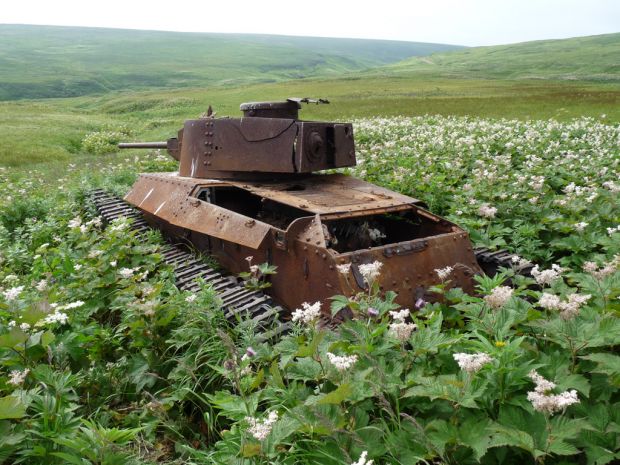
3rd (Medium) Tank Regiment (3TR, part of the Yasuoka Detachment) probably about 600-800 troops with 41 vehicles including 26 x Type 89 I-Go medium tanks, 4 x Type 97 Chi-Ha medium tanks. 7 x Type 94 tankettes, and 4 x Type 97 Te-Ke tankettes.


4th (Light) Tank Regiment (4TR, part of the Yasuoka Detachment), 600-800 tankers with 35 x Type 95 Ha-Go light tanks, 8 x Type 89 I-Go medium tanks, and 3 x Type 94 tankettes.

(Note: I'm finding some discrepancies in the strengths of these tank units. The above vehicle numbers are from the Wiki entry that cites Coox (1985) as the authority for these numbers. They conflict slightly with the numbers given for the units in Drea (1981) of 25 medium tanks (type unspecified) for 3TR, 35 light tanks and 7 medium tanks for 4TR. Drea (1981) also includes armored cars as either assigned or attached to both of these units. If I cannot find another authority I will simply have to accept that there are issues with unit strengths)

13th Artillery Regiment and 1st Independent Artillery Regiment (Kwantung Army troops?) Probably about 2,000 artillerymen with an estimated 24 cannon of various types. I cannot find MTO&E for these units.

However, I have encountered orders of battle for other "independent artillery regiments" in the IJA as well as the strengths listed in the 1944 U.S. Army TM-E 30-480 Handbook on Japanese Military Forces. So my best guess is that these units would have included about 1,500 to 2,500 artillerymen and 24 x Type 91 105mm or possibly Type 4 140 mm howitzers. However, some independent artillery units were largely armed with 75mm fieldpieces - typically 16 - and only 4 each 105mm and 150mm.

Air support was provided by the 2nd Army Air Division (2nd Hikoshidan). In early May a Rinji Hikotai (Provisional Air Group) was tasked to Hailar (about 160km NE of Nomonhan). This unit included 19 x Ki-27 ("Nate") fighters 6 x Ki-15 ("Babs") and 6 x Ki-30 light bombers.


By June IJAAF air strength included 4 reconnaissance A/C with the HQ element, 15 reconnaissance Ki-15 A/C directly attached to 23rd ID, and two combat wings with 125 aircraft: 12th Hikodan with 88 Ki-27 fighters and 9th Hikodan with 24 Ki-30 light bombers and 13 Ki-21 ("Sally") medium bombers.


Rising from less then 500 in May to about 20,000 all arms, ~90-100 cannon (and most of those 76mm or smaller), ~130 tanks, and ~250 aircraft by the end of August, the IJA ground forces were largely under the command of LTG Michitarō Komatsubara (小松原 道太郎, Komatsubara Michitarō), the 23rd ID commander.


Soviet Union - the Soviet forces in the Khalkhin-Gol area consisted of Soviet troops from the Trans-Baikal Military District and local Outer Mongolian troopers; the Outer Mongolians were to the Soviets what the Manchukuoans were to the Japanese.

From the original handful of Mongolian cavalry from the 6th Cavalry Division that ambled across the Halha River on or about 11 MAY 1939 the Soviet forces increased over the spring and summer.

The following are listed as engaged in the May actions:

6th Mongolian Cavalry Division Don't get these guys wrong; they weren't the wild riders of Genghis Khan. By 1939 smart cavalrymen realized that the big fat horse was transport, like a truck or a bicycle.

They probably carried a sword or three (they were still Mongols, after all...) but were primarily armed with rifles and dismounted to fight. Typical Soviet cavalry division organization in 1941 is listed as "...four cavalry regiments, a horse artillery battalion (8 x 76mm guns and 8 x 122mm howitzers), a tank regiment (64 x BT-series tanks), an anti-aircraft battalion (eight 76mm AA guns and two batteries of AA machine guns), a signals squadron, a field engineer squadron and other rear echelon support units and sections. The total authorized strength of a cavalry division included 8,968 personnel and 7,625 horses..." (Wiki, 2013)

Bykov Detachment 1 reinforced rifle battalion (with 8 x T-37 tanks and 21 BA-6 and FAI armored cars attached), 1 FA battery; probably 1,000 all arms
149th Motorized Rifle Regiment (MRR) (36th Motorized Rifle Division) less one battalion, and
175th Artillery Battalion

Total Soviet-Mongolian strength in May is listed as 2,300 all arms (including about 1,300 Mongolians), 12 x 76mm guns, 8 x 45mm anti-tank guns, 4 x 122mm howitzers, 4 x SU-1-12 self-propelled artillery vehicles (this thing...

...a sort of giddy harumphrodite with a 76mm cannon on a pedestal mount in back of a GAZ 4x6 truck.

As goofy as it looks it seems to have worked, proving my old drill sergeant's striction that if it's stupid and it works, it's not stupid.), 8 x T-37 tanks, 5 x HT-26/OT-26 flamethrower tanks, 39 assorted armored cars including BA-6 and FAI types.

By August, though, the Soviet First Front Army looked like this:

Left Wing:
6th Mongolian Cavalry Division
7th Armored Brigade
1 x medium armored car battalion
1 x reconnaissance battalion (medium and light armored cars)
1 x machine gun battalion
601st Infantry Regiment from 82nd Rifle Division
11th Tank Brigade (-) (2Bns - BT-5)

Center:
36th Motorized Rifle Division
5th Machine Gun Brigade
82nd Rifle Division minus the 601st Infantry Regiment.

Right Wing
57th Rifle Division
11th Tank Brigade (-) (2Bns - BT-5)
6th Tank Brigade (-) (3Bns - BT-7)
8th Mongolian Cavalry Division.

Reserve
9th Armored Brigade
(as 7th Armor)
6th Tank Brigade (-) (1Bn BT-5)
212th Airborne Brigade.


Soviet air support (the Soviet air arm was the Военно-воздушные силы, Voyenno-Vozdushnye Sily) initially consisted of two air groups; 70th IAP (Fighter Aviation Regiment) assigned 24 x Polikarpov I-16 and 14 x Polikarpov I-152 (also known as I-15) fighters and 150th SAP (Composite or "Mixed" Aviation Regiment) assigned 29 x SB medium bombers and 15 x Polikarpov R-5 light bomber/reconnaissance aircraft.


Reinforcing units included 22nd IAP (3 x I-152 and 28 x I-16 Type 10 fighters) and 38th SBAP (Composite Bomber Regiment, 59 x SB bombers).

Approximately 50,000 to 55,000 all arms, ~ 500 cannon (including 100+ over 100mm), ~500 tanks, ~800 aircraft under GEN Georgy Zhukov, GEN Grigoriy Shtern and GEN Yakov Smushkevich

The Sources: Here we the English-speaking and -reading publics have the same problems we had dealing with the Battle of Tsushima; all the primary sources are not in English.

Add to that the inevitable difficulties in dealing with two societies that - at least in 1939 - dealt with information as weapons. The opening of the former Soviet archives since 1989 has helped, obviously. And there has been some good work done on the subject in English, which I'll try and present here. But the initial difficulties persist and are reflected particularly in the sources available on-line.

One of the most worthwhile sources is the 1981 Leavenworth paper by E.J. Drea; Nomonhan: Japanese-Soviet Tactical Combat, 1939.

While this work is largely focused on the battalion-level (it reports and discusses the events recorded in the war diary of the IJA 2nd Battalion, 28th Infantry) it provides a clear, authoritative account of the larger engagement.

On the other hand, LTC Charles Otterstedt's 2000 War College paper The Kwantung Army and the Nomonhan Incident: Its Impact on National Security does a good job of describing the broader geopolitical context of the events with an emphasis on the politico-military finagling of the boys in the Kantō-gun.

The Wikipedia entry is well researched and cites Drea (1981) as well as the other most commonly-cited published source, Alvin Coox's 1985 work Nomonhan: Japan Against Russia, 1939.

One recent source it cites appears well worth pursuing; Stuart Goldman's Nomonhan, 1939; The Red Army's Victory That Shaped World War II, just published last year.

Someone named Ryan Schultz produced a fine work of scholarship for his thesis for Oberlin College in 2011. That paper, The Failure of Japanese Tactics at Changkufeng and Nomonhan and Lessons Left Unlearned is found here.

Among the more useful internet resources is a PDF version of an English translation of a 2002 paper in Russian by one M. Kolomiets entitled Boi u reki Khalkin-Gol from the Russian journal Frontovaya Illyustratsiya ("Frontline Illustrated").

Another is Bellamy and Lahnstein (1990) The New Soviet Defensive Policy: Khalkhin-Gol 1939 As Case Study from the September issue of Parameters. This article at "Warbird Forum" does a decent job of covering the air war from the Japanese side, while something called "Håkans aviation page" has a fairly good summary of both Soviet and IJAAF air operations.

Since the engagement at Nomonhan/Khalkhin-Gol took place over the course of months there is little use in subdividing the events into the "campaign" versus the "engagement" itself, so the course of the fighting will be summarized in a single section. However, since the situation in western Manchukuo/eastern Mongolia is so little known today I consider it worthwhile to briefly discuss the setting for the events of 1939.

The Situation: What really brought the two armies together in the plains of western Manchuria was the Russo-Japanese War of 1905. Before that time it was Russia and Qing China that had tussled over what the Chinese called Northeast China (東北失地) and the Russians called Приаму́рье (Priamurye) or "Outer Manchuria", the light pink corona around the dark red of the Manchurian heartland in the image below.


In particular the northwestern portion of Manchuria adjacent to the somewhat notional state of Mongolia was a very ill-defined piece of real estate. This area may well be among the most desolate and forsaken on earth, characterized by sandhills and grass and very little else. The people who have passed over the region for centuries are largely nomads, Mongol and Manchu, following the herds that must move on or worry the grass from the loose, sandy soil and turn the steppe back into a barren sea of blowing loess and sand dunes.

With no real interest in any particular piece of the steppe the idea of a "border" would have seemed risible to the nomads. Everything was just "the land"; a place to graze horses and sheep, to pitch a yurt on, for horse-lords to ride over and pass by.

But the rise of settled nations inevitably led to the establishment of borders. Where the eastern edge of "Mongolia" and the western edge of the Manchurian part of China met the "border" was still just as sketchy as ever.

Otterstedt (2000) sums up the place nicely:
"Perhaps the most vague border issue was that on the flatlands between western Manchuria and eastern Outer Mongolia. For over two centuries, the vicinity of Nomonhan has been the boundary line separating the pastoral plains of the Halha Mongols of Hulun Buir, and the Kalmuks of Outer Mongolia (but)...(n)o definitive borderline was every drawn or observed."
Where Japan marches onto the scene is after its defeat of Russia in 1905. Japan - which was already beginning to catch the imperial fever incubated in the European powers - latched onto Korea and portions of northeast China, specifically what it called Ryojun (or Port Arthur, now Lüshunkou, 旅顺口) and the adjacent bits of the Liaodong Peninsula and something called the "South Manchuria Railway". The latter becomes more important, but the former was the first critical bit of business because the IJA formed a garrison for the Port Arthur/Liaodong region (that the Japanese government designated 関東州, Kantō and in English we call Kwantung.

This outfit was called the 関東都督府陸軍部 or "Kwantung Governor General Prefecture Army Section" and consisted of an infantry division, an artillery battalion (typically described as "heavy siege artillery" but in my opinion more likely gunners for the Ryojun artillery defense batteries), and a half-dozen separate battalions of supposed "railway guards" that were in fact regular Japanese infantry; about 10,000 troops all arms.


After 1919 this organization was renamed the Kantō-gun, the "Kwantung Army". Coox (1985) describes the mindset that informed the Japanese government at the time of the formation of this army.
"Chinese mounted bandits, demobilized soldiers, vagrants, and other lawless elements poised a familiar threat in Manchuria, especially in the rural sectors. But the major concern of the Japanese High Command was the possibility that the Russians would seek revenge for their recent defeat. Consequently, the traditional defensive or reactive emphasis of the Japanese Army was transformed...and a clear-cut offensive strategy designed."
The Army retained this aggressive mindset throughout its existence; it was the intellectual center of the "Northern Expansion Doctrine" (北進論, Hokushin-ron) which insisted that the most profitable direction for Imperial aggression was to the north and west into the Siberian hinterlands combined with the conquest of China.

From 1906 to 1931 the Kwantung Army wasn't able to actually do anything much about this; they were separated from the Soviet border by the Chinese province of Manchuria.

Mind you, the Japanese wanted all that Manchurian goodness.

Manchuria, to the Hokushin-ron types in the Kantō-gun meant lots of lovely raw materials, new places to hawk Japanese goods, along with the sort of lebensraum that the fascist governments of the Thirties and Forties seem to have been obsessed with. You'd think with a restive Korea already inside the imperial borders that the Japanese Army would have been happy to leave the wilds of Manchuria alone, but you'd have counted without the Kwantung Army.

In 1931 a group of expansionist officers led by a couple of characters on the Army staff, COL Seishirō Itagaki and LTC Kanji Ishiwara, set off what is today called the "Mukden Incident", a sort of Reichstag-fire false flag plot that was designed to implicate the Chinese in an attack on the South Manchuria Railway and provide Japan with a casus belli.

It went slicker than water off a cat's ass and within six months Japan effectively owned all of Manchuria, which it set about organizing into a supposed-state called "Manchukuo" supposedly run by the deposed Qing Emperor, Puyi. In fact it was a military depot for Japan run by a Kwantung Army that set about trying to make its "Northern Strategy" into reality.

And that's where it ran into the Soviets.


Here's Otterstedt (2000) again:
"With the founding of Manchukuo, the border around Nomonhan became the scene of disputes between the Outer Mongolian "People's Republic" and the Hsinking (Manchukuoan) authorities. Since the strength of the Kwantung Army far exceeded that of the Soviet Far Eastern Army between 1931-1935, no border disputes broke out during that period. (H)owever, after the Soviets gradually built up their Far Eastern military strength and instituted far more stringent control over Outer Mongolia...(b)order disputes erupted with increasing frequency..."
The Wiki entry for "Japanese-Soviet border conflicts says that
"Imperial Japanese Army recorded 152 minor incidents on the border of Manchuria between 1932 and 1934. The number of incidents increased to over 150 per year in 1935 and 1936, and the scale of incidents became larger. In January 1935, the first armed battle, Halhamiao Incident (哈爾哈廟事件 Haruhabyō jiken?) occurred on the border between Mongolia and Manchukuo."
Clearly there was trouble brewing on the empty places around Manchuria, and both the Japanese government through the Kwantung Army and the Soviet Far Eastern Army were willing to mix it up.

By 1939 the forces on either side of the border were substantial. The Kantō-gun included 8 infantry divisions, two cavalry and tank brigades and something like thirteen "border guard" units supported by three air brigades; a total of some 250,000 troops. The Soviets, having to cover much longer exterior lines, had between 20 and 30 rifle divisions, 5 to 7 cavalry divisions and 6 to 8 mechanized rifle brigades; perhaps 500,000 troops, 2,500 tanks, and 2,500 aircraft (Otterstedt, 2000).

Between 1937 and 1939 the border spats escalated into serious fighting.

In June of 1937 three of some sort of Soviet river gunboats or small craft cruised by troops of the IJA 1st Division fortifying Kanchazu Island (乾岔子, a sort of instream bar of the Amur River the Russians called "Bolshoi Ussuryski Island"(болъшои Уссурыскии Остров) on the northeastern border of Manchuria. The Japanese opened up with 37mm AT artillery and sank one of the small craft and damaged another.

The Soviets, busy purging everyone in sight and other business in both Europe and Asia, chose not to retaliate. Another, more serious "incident" occurred in the summer of 1938. In the Changkufeng Incident (Хасанские бои and 張鼓峰事件, Chōkohō Jiken) the IJA 19th Infantry Division supported by Manchukuo units pushed elements of the Soviet 39th Rifle Corps off high ground near the Soviet-Korean border in July, but Soviet reinforcements returned the favor in August, shoving the IJA units back to or close to their start lines.


The 1938 encounter was not decisive but played a big role in clarifying the Kwantung Army's ideas of what it would do if challenged on the Soviet borderlands; in April 1939 the Kwantung Army drew up The Principles for the Settlement of Soviet-Manchurian Border Disputes which laid out the first two cardinal principles of the way it saw the Manchurian borderlands:

(1) The basic policy is never to invade and never to be invaded.

(2) If an enemy violates the frontiers, he must be wiped out at once.


It's worth noting that this little policy document was never approved - hell, it was barely even known - by the Army chiefs of staff or the Imperial Foreign Office in Tokyo. In effect the Kwantung Army had just re-written Japanese foreign policy for its Soviet borders, without consulting the Japanese government or even notifying their government that had done so.

Hmmm...

Where this directly impacts our engagement is in the question of "what IS the frontier?" In the vicinity of Nomonhan the two rivals had very different opinions on the subject. The Japanese through their Manchukuo proxy stated that the valley of the Halha/Khalkhin-Gol River was the border. The Soviets through their Outer Mongolian proxy had, instead, a rather arbitrary line on the steppe some considerable distance east - you'll note from the map below that it ran southeast from a bend in the Halha to Nomonhan then turned south and from there (off the map) southeast to rejoin the river valley again.


Mind you, unlike the northeast where the Soviets and the Kwantung Army were eyeball-to-eyeball, nobody much was farkling about on this portion of the border. A handful of Manchukuoan border guards were station in bustling downtown Nomonhan while the Mongolian cavalry patrolled the heights west of the Halha. Everybody might have been tense, given all the wars and rumors of wars but there were no serious signs of trouble along the Manchukuo-Mongolian border in the spring of 1939. That's where the we stand on the morning when a company from the Mongolian 6th Cavalry Division waded across the salty waters of the Halha River heading east to find some better grazing for their horses.


The Engagements: As noted above; entire books have been written on this business. I will, instead of giving you tactical details, attempt to summarize what happened in each major part of the Nohomhan engagements and discuss what I believe it reveals about the IJA.

May: First Encounters

Alerted to the Mongolians by their attack on the little Nomonhan garrison a battalion of Manchukuoan cavalry mounted up and chased the gringo Mongol bastards 'cross the Rio, or the Halha as it were.

But a couple of days later the pesky Mongols returned, this time in larger numbers, and refused to budge when the Manchurian troopers waved their Arisaka rifles at them. At this point the border-crossers seemed more than a mere nuisance; LTG Komatsubara, 23rd ID commander, tasked his division recon (actually about a battalion-size force of mixed horse cavalry and armored cars) backed up by the 1st BN, 64th Infantry Regiment (-) to run off the damn Mongols.

Drea (1981) notes that "Japanese staff officers (at 23rd ID) were having difficulty even locating Nomonhan on their operational maps, so there seemed no reason to believe that additional force might be required..." So the 1,000-man-odd IJA force rucked up and headed off for the border. The Japanese force swung south down the Halha River valley in 14 MAY and, sure enough, the invaders scampered away.

And returned the next week.

By this time Komatsubara was beginning to get seriously peeved. He ordered his task force commander, COL Yamagata (commander of the 2nd/64th), to deal with these pesky interlopers once and for all. So on 28 MAY the Yamagata Force played military hardball; the colonel divided his forces, swinging the recon unit under LTC Azuma out west along the Halha to encircle the Soviets, size the Halha bridge and be the anvil while his infantry swung the hammer and smashed the enemy. Azuma was so confident he left his AT guns behind - why bother? They would just slow everyone down and who needed antitank guns to shoot horses?

Instead of a bagatelle of NKVD border guards and Mongols, however, the IJA ran into a buzzsaw composed of motorized riflemen, three battalions of "machinegun" troops as well as the Mongolian 6th Cav and elements of 11th Tank Brigade. The 149th Motorized Rifle was supported by its regimental artillery, as well.


Yamagata's 2/64th was stopped dead, and worse, Azuma's recon company was attacked from both sides and cut off. Surrounded, hammered by tanks and artillery, swarmed by infantry the Azuma force was destroyed between 28/29 MAY; out of the original some 200 troops more than 100 were killed outright and another 30-some wounded. On the 29th the survivors of Azuma's outfit and the 64th Infantry withdrew to the northeast.

What happened and why; assessing the IJA's performance

Among the IJA's most persistent problems were a combination of underestimating enemy capabilities and overestimating the value of Japanese "spirit". The failure of the May expedition showcased both. The Yamagata plan was a Custer-level clusterfuck, dividing the attack force where extremely poor "intelligence preparation of the battlefield" (IPB) left the attacker with little or no knowledge of the locations or capabilities of the enemy forces. The failure to anticipate the presence of Soviet armor or artillery - or the "enemy's most dangerous course of action" - left the IJA force without the capability either to defeat the enemy they found or to break off contact effectively once engaged. Only through sheer fighting ability (and Soviet weakness in numbers) were the surviving Japanese units able to avoid disaster and consolidate on the east bank of the Halha.
June - July: Escalation

Drea (1981) says that 23rd ID and its higher were inclined to take their licking and move on "...because they believed that the Nomonhan desert was worth no more Japanese blood." But the Soviets were not so inclined. Reports from the border indicated troops showing up on the western side of the Halha and aggressive aerial activity. Continual small attacks on the Manchukuoan 8th Border Guard units continued. Finally in mid-June GEN Komatsubara requested, and received, Army permission to take the offensive and "restore the border".

After the disasters of May Kwantung Army decided to take no chances in June. 23rd ID was reinforced with two tank regiments, two artillery regiments, and four infantry battalions (26th IR plus 2/28th IR) from 7th ID. The date for the attack was set for late June or early July, and with the preponderance of force the Kwantung Army expected a sokusen sokketsu, a short and decisive battle that would end the fighting.
Instead, the assault, initiated on 2 JUL, was met with a sharp and bloody Soviet counterattack. Again the Japanese plan was for a double envelopment; the right wing consisting of three infantry regiments supported by engineers and artillery would cross the Halha and swing southeast while the left - four infantry battalions and the armor (with an artillery and engineer regiments in support) would sweep down the east side of the Halha. The two forces would meet near the Kawamata Bridge over the Halha, the objective of the Azuma force in May, cut off, and destroy the enemy forces.

Instead the right wing was stopped by combined arms counterattacks and forced back across the Halha by 5 JUL. The left wing managed to push aside weak Soviet and Mongolian defenses for the first two days of fighting but were counterattacked and stopped cold short of the Halha on 5 JUL.


The IJA would never again manage to advance past the river.

The IJA left wing continued to try and batter past the Soviet defenses for the next five days or so, including a night infantry assault on 10 JUL. It got nowhere.

Logistical nightmares made everything difficult, especially rounds for all the artillery and anti-tank guns. Indeed, Japanese anti-tank weapons and ammunition supply were so deficient that many, perhaps most, of the Soviet tanks disabled and destroyed were by teams of infantrymen attacking with explosives and firebomb "Molitov cocktails".


These insanely heroic groups were fortunate in that the Soviet BT-5 and BT-7 tanks were poorly protected against fire; their gasoline engines tended to "brew up" much more quickly than the T-34 which succeeded them.

For the next two weeks the Soviet and IJA forces engaged along the east bank of the Halha stretching about 2 to 3-miles north of the Holsten River conducted a series of small scale, back-and-forth actions without result.

The troops of the IJA 23rd ID suffered miserably throughout this period. Except for the units along the Holsten River they often had to count on the infrequent rain for water; no water reached the Nomonhan front from the Japanese railheads and the waters of the Halha and its nearby wetlands were too saline to drink. Rations and ammunition came in painfully small quantities. The Soviet logistical train, on the other hand, included over 2500 trucks to haul supplies to the fighting front.

Finally GEN Komatsubara tried again.


On 23 JUL 23rd ID kicked off another offensive, this time a division-sized deliberate attack. With nasty memories of the devastating Soviet steel rain of early July Kwantung Army had sent 23rd ID substantial artillery support, bringing the IJA fire support up to four regiments including the 23rd ID divisional artillery (82 cannon, including 16 x 105mm howitzers, 16 x 150mm howitzers, 6 x 150mm guns, and 12 old Type 38 120mm howitzers). Under this fire the 64th and 72nd Infantry Regiments attacked the Soviet troops defending the Kawatama Bridge; largely the 5th Machinegun Brigade and 149th Rifle Regiment.

IJA artillery fired 15,000 rounds on 23 JUL, a total of 25,000 rounds over the next two days to try and shoot in the infantry; a heavier weight of metal than any fired by IJA artillery since the assaults on Port Arthur in 1905, a barrage that shot up half the Class V (ammunition) stocks in the Manchurian theatre, to try and blast open the Soviet defenses.

They failed.

The assault made small gains but ground to a halt on 25 JUL. Not only had the "big barrage" failed to smash the Soviet infantry (who showed the facility for digging in deep that so frustrated the Germans two years later) but the Soviet counterbattery and defensive fires were heavier than all but the most intensive IJA concentrations.

Over 5,000 Japanese troops had been killed or wounded around the Halha since late May. When the artillery rounds began to run short GEN Komatsubara called off the attack.

What happened and why; assessing the IJA's performance

Again, the IJA operations staff made a succession of critical errors in both planning and execution. Again, IPB was pathetically faulty. The attackers had no real notion of the defenses they were attempting to breach. Little intelligence collection was done, even less planning was done to reflect that intelligence rather than the preconceptions of the Kwantung Army and 23rd ID highers.

Again the IJA assault of 2 JUL was planned as a double envelopment that depended on everything going perfectly. Instead the plan ran into the worst sort of trouble; a strong defense capable of defeating each wing in detail while the two attacking wings were unable to support each other.

Artillery support, while much improved, continued to suffer from a lack of tactical coordination. We haven't discussed this in much detail, but both combatants on the Halha noted that the biggest single difference between the two sides' artillery was that the Soviet gunners were much more nimble at adjusting onto new targets as well as working together with infantry and armor. Japanese fires, while often deadly accurate, tended to be sparse and limited by what their gunners could see around them. Japanese field guns also tended to have short ranges for their sizes; Soviet artillery was able to shoot counterbattery fires at ranges that IJA cannon of similar calibres could not reply.

One thing I should mention here that had a major impact on the fighting around the Halha and that was the terrain.

One of the first things I was taught as a soldier was; know the ground. And the second thing; know the ground. As simple a matter as a hill here and a valley there can make the difference between living and dying in combat, between winning and losing battles. And for all that there wasn't much in the Khalkhin-Gol region by way of terrain, what there was mattered, and that was that the west bank of the Halha was seriously higher than the right. See?


Possession of the high western bluffs allowed the Soviets to overwatch every Japanese movement on the low ground to the east, and the Japanese learned quickly that if you could be seen you would be shelled. The failure to appreciate the critical terrain and make a more determined attempt to seize it was another IJA planning error.

But of all the other fuck-ups perhaps the single poorest performance was put in by the Japanese tankers.

While the crewmen were individually brave and (in the case of the the Type 97 Chi-ha mediums) the tanks not thoroughly outclassed IJA tank doctrine had barely progressed beyond the waddle-alongside-the-infantry style of WW1. The IJA had just never bothered to develop tank-infantry-artillery combined arms warfare, but even the simpler coordination between infantry and armor was beyond the IJA tank regiments at Nomonhan. Add to that the light armor and low-velocity cannon of the Type 89, the most common IJA medium at Nomonhan, meant that if they could not fight in teams (and typically they could not; Japanese radios were poor even when mounted) they were vulnerable to the higher velocity cannon of the Soviet BT-5 and BT-7 cruiser tanks.

July - August: Stalemate

For about the next month the two sides fought a nasty WW1-style positional battle. Raids, minor assaults, artillery "hates", air-ground attacks. The Soviet artillery continued to pound the IJA positions with 2,000-odd rounds a day, a rate and volume of fire the Japanese could not hope to match or even aspire to. Japanese troops dug in and suffered the relentless fire, Soviet attacks, and probably most of all the misery of an undersupplied army in bad terrain.
"Apathy began to set in..."
reports Drea (1981)
"...as all that the (Japanese) soldiers could think of was eating white rice again and washing it down with fresh, clean water. In fact, the battalion (2/28th Infantry) collected rainwater in oil drums or helmets but since their move to Noro Heights (about a week before) there had been only one day of rain. The troops, desperate for water, drank from stagnant, discolored pools and got amoebic dysentery. The two battalion doctors were overwhelmed...thirty or more bloody bowel movements a day might not be considered serious enough to be sent to a rear area field hospital...typhus cases were reported. The continual Soviet shelling left the troops no choice but to defecate in their foxholes...and Japanese officers forbade cooking fires for fear of betraying their positions. At times the soldiers were reduced to eating grass."
Amazingly enough the Japanese infantrymen continued to fight hard and, when they could meet their Soviet enemies on equal terms, well. Drea (1981) describes a night engagement on 8 AUG where elements of No. 7 Company, 2/28th Infantry surprised a Soviet infantry platoon and artillery observers attempting to infiltrate 2/28 defensive lines. Machinegun and battalion gun fire hammered the surprised Soviets, whose approach had not been as stealthy as they had assumed. The fire lifted and shifted to allow a platoon of 7/2/28th to close assault the Soviet force with bayonets and swords.

Of the 51 Soviets in the unit only one was taken prisoner.

The grinding stalemate continued through August. Heat, blowing sand, thirst, vicious insects, and the constant drain of deaths and woundings - "normal wastage" in the callous language of WW1's Western Front - continued. Still the Japanese forces tried to fight the sorts of savage close combat fights they had trained for.

For this I recommend to you Drea (1981) pages 66-70; Night Attack II, a well-detailed report of the night raid conducted by No. 6 Company, 2/28th Infantry over 18/19 AUG. The action demonstrates the ability of the IJA infantry to conduct a precise and effective action over difficult terrain, at night, against a well-dug in enemy well-supported with artillery and automatic weapons.

The ironic thing about it was that the entire action was planned and executed because "...the enemy seemed to be preparing for some new action." (Drea, 1981). The raid was a "spoiling attack", designed to disrupt a planned enemy offensive. And for the eighty-some Soviet casualties in the 603rd Rifle Regiment it certainly did just that.

What the Japanese had not figured out is that the Soviet forces had been preparing a surprise for them beyond anything in their worst nightmares.

What happened and why; assessing the IJA's performance

The single biggest IJA shortcoming revealed by the static fighting of late July and early August was logistical. Japanese officers had never been taught to respect supply and transportation, inglorious province of those not "heroic" enough to actually fight. The realities of industrial war, however, took hold of the poor bastards in the Japanese positions on the Halha and literally choked the life out of them. While individual infantry units continued to fight well long after they should have fallen apart the lack of food, medical supplies, water, and ammunition meant that although valor and infantry skills could delay defeat they could not prevent it. Logistics had been the foundation of industrial warfare since the mid-19th Century and because of its sword-swaggering attitudes the IJAs foundation, as it proved at Nomonhan, was built on nothing firmer than the sands of the Halha valley.

August: Disaster

The 2/28th was right; the Soviets were "up to something". Kwantung Army intelligence had been intercepting Soviet radio traffic all through the end of July hinting at a general offensive in the works. A more aggressive aerial reconnaissance and patrolling effort would likely have revealed that the Soviets were reinforcing the Khalkhin-Gol front. The IJA intel weenies neither believed the intercepts nor harassed their recon elements.

So when some 200 Soviet aircraft hammered the 23rd ID positions in the early morning of 20 AUG the IJA defenders had no idea what was coming at them.


And what was coming was pretty brutal; the First Front Army had massed two rifle divisions and three cavalry divisions supported by two mech brigades and seven artillery regiments in the first echelon; the second had another rifle division and five more mech or armor brigades. These units now hammered down on both ends of the IJA defenses, manned by little more than a single reinforced infantry division.


A large part of the Soviet surprise was Japanese logistical ignorance. Remember how the Japanese didn't believe you could supply an army in Manchuria more than a day or two's drive away from the railheads? Well, the nearest Soviet logpac assembly areas - the centers for supplying the Nomonhan fighting - were Borzya on the Trans-Siberian rail line and Ondorhaan on the "main road" east from the Mongolian capital of Ulan Bator. Both were some 600 kilometers or more from the Halha:


And yet the Soviet commander, Zhukov, managed to assemble his corps-size assault force and all their food, fuel, ammunition, ash, and trash in a month. The Soviet secret?

Trucks.

First Front Army had over 3,000 trucks by the end of August, including some 1,000 fuel tankers. The IJA literally couldn't imagine such a wealth of vehicles; the idea just didn't fit into the way their brains worked.

The intel pukes weren't the only screwups; weather and bad luck played a part. Drea (1981) notes that
"From August 12 on, there had been only one day of clear weather. On August 19, Japanese pilots did spot a concentration of Soviet vehicles on the Halha's west bank, but their reports were still being evaluated at higher headquarters on August 20. Potentially significant intelligence data gathered by lower echelon units...was not expeditiously reported...most likely because there was no battalion intelligence officer to evaluate or disseminate such information."
The IJA infantry battalion had a very lean staff organization which did not include officers for either what a U.S. battalion would have identified as Operations (S-3) or Intelligence (S-2). The IJA infantry regiment had a staff officer identified as responsible for "Code and Intelligence", which sounds like a guy as much in charge of commo as intel. Only at division level did an IJA organization have a purely Intel staff position.

The Soviet attack, rather ironically, was designed as another double envelopment. As you can see from the map, the main force - 57th Rifle Division plus nearly three brigades of motorized infantry and armor with artillery support - would drive north through the 71st Infantry Regiment on the Japanese left.

Fixing attacks would keep the Japanese center pinned along the Halha, while a secondary attack would swing southeast to link up with the main effort around Nomonhan.

Well, it took the Soviets about ten days.

Here's Drea (1981):
"The Soviet armored attack, skilfully directed by General Georgi K. Zhukov of later World War II fame, rapidly turned the southern flank of the IJA's 23rd Division. To the north, progress was slower, but after vicious fighting on Fui Heights, where flame-throwing Soviet tanks finally dislodged and routed the Japanese defenders, the "Red juggernaut" rolled up the Japanese right flank. At the village of Nomonhan, the Soviet armored columns met and sealed off the 23rd Division."
The 23rd ID and its attachments were virtually destroyed. The U.S. Army in WW2 considered a unit "destroyed' - that is, completely combat-ineffective, so degraded by deaths, wounds, and terror that it would need to be disbanded or completely rebuilt - if it suffered more than 30% casualties.


The IJA units engaged at Nomonhan suffered 73% loss. Some even more; 2/28 Infantry lost 86% of its original compliment. The 71st Infantry Regiment lost over 90% of the men who had marched out towards Nomonhan in May.

Had Zhukov not halted his forces at the end of August there is no military reason why he could not have brushed aside the shattered remnants of 23rd ID and pushed further into Manchukuo; the Kwantung Army had no combat-effective units within a day's road-march at the closest, and it was purely due to Soviet contentment with its August gains that more of the Mongolian frontier was not lost.

Despite this, the Kwantung Army reinforced the Nomonhan sector. Fighting continued in the region, and the Army was planning another offensive when the Imperial Foreign Office negotiated a peace deal with the Soviets in mid-September. The war in western Europe had broken out and the Soviets had signed a pact with Japan's ally Germany. Suddenly getting valuable soldiers killed in border battles on the Manchurian steppes seemed pretty pointless.


The defeat at Nomonhan - in fact, the entire engagement at Nomonhan - was a nasty wake-up call for the Imperial Army and the Japanese government. The visible failure of the Hiranuma government to both anticipate the Nazi-Soviet Pact or control its Manchurian army forced the resignation of the Cabinet.

The effect of the defeat on the Kwantung Army command and staff was mixed. The IJA General Staff moved against the Kanto-gun; its commander, Ueda and many of his senior staff officers were either replaced or forced into retirement. But the failures of Nomonhan and particularly the poorly-thought-out aggression that caused them, were not really punished, and the issues raised by the insubordination and incompetence of the Kwantung Army at Nomohan were not made public.

Many of the architects of Nomonhan remained influential in the IJA and through the Army on Japanese foreign policy: "It is generally acknowledged by those who held contemporaneous High Command posts that the officers responsible for the Nomonhan debacle became strong advocates for launching the Pacific War" (Coox, 1985).

The Soviet Union held the ground they had taken in 1939 until the final days of August 1945, when the T-34's of the 6th Guards Tank Army ground the bones of dead men into the sandhills above the Halha River on their way to destroy the Kwantung Army and Imperial Japan.


The Outcome: Decisive Soviet grand tactical victory; the defeat at Nomonhan had some degree of impact on Japanese grand strategy in World War II.

The Impact: The most widely held opinion of the larger effects of Nomonhan was the defenestration of the "Northern" faction - the Army officers heavily represented in the Kwantung Army - from Imperial foreign policy and the ascendency of the 南進論, Nanshinron or "Strike South" faction that was largely centered around the Imperial Navy. In fact, Coox summed up this point precisely in a 1992 lecture:
"I feel that if at Nomonhan their affairs would have gone successfully, they would have initiated an offense against us." (Coox here is quoting from a postwar interview with Zhukov) "Their far-reaching plans included the capturing of the eastern part of Mongolia, cutting the Siberian main railway line." The Tokyo war trial jurists agreed and said, in memorable prose that as the door of opportunity closed in the north, the southern gates began to open for Japan." (Otterstedt, 2000)
I will be contrary here.

While I agree that the rough handling that the 23rd ID received from the Soviets at Nomonhan surely had the effect of cooling some of the hot heads that dreamed of an Imperial Japan stretching west to Lake Baikal, the economic and logistical realities of 1941 were that the Imperial armed forces needed reliable access to petroleum most of all. At the time no significant reserves were known in the Soviet Far East.

Militarily, politically, and economically the cost and difficulty of expanding the Imperial borders north and west far exceeded any potential gains to be had there. Siberia was then what it is now; a vast emptiness, difficult to traverse and costly to develop.

Add to that the fact that the "Southern" strategy was already part of the official policy of Imperial Japan and had been since 1936.

No question that the defeat at Khalkhin-Gol helped the Southerners. But I'm not really convinced that the "Go North, Young Nipponese!" notion was manifest destiny. There were just too many other factors against it.

I believe that the real military and political impact of Khalkhin-Gol was just what Zhukov said it was; to scare the IJA enough to prevent an opportunist move against the Soviet Union in the summer of 1941.

Simultaneous attacks from west and east would have been a hell of a nightmare for Stalin's STAVKA. At the very least, the counterfactual is that the units that arrived before Moscow in the autumn and early winter of 1941 would have been pinned down in Siberia. Whether that prevents the loss of Moscow...well, that's hard to say. But it sure narrows the margin for the Soviets.

Indeed, perhaps the most significant impact of Nomonhan was not on Japan and the IJA at all, but to train one of the craftsmen of the defeat of Nazi Germany in his craft. Then-GEN Zhukov took west with him the experience of assembling and employing a combined-arms force that he would continue to refine over the next six years. No question but that he was a blunt instrument. The Soviet Army was a hammer, not a rapier. But what worked on the Halha would work on the Don, and the Dnepr, and eventually on the Elbe.

What happened and why; final assessment of the Imperial Japanese Army of WW2

The August battles pretty much sum up my opinion of the Imperial Japanese Army of World War II; an anachronism of a force, a feudal warlord's fighting tail tricked out with a handful or tanks and aircraft but still fundamentally unable to fight a modern war.

Unwilling to change, unable to adapt, this costume-movie army muddled along until confronted with a decently-led, intelligently-organized armed force that knows how to fight industrial war.

At that point the IJA got handed its ass.

This happened over and over again between 1939 and 1945. It happened in the islands, it happened in New Guinea, it happened in India and Burma, and it even happened right here, again, in 1945 when the Soviets came storming back across the steppes.

In my opinion the IJA leaders were charlatans, tricksters who deluded their entire nation into thinking that somehow "spirit" and "warrior virtue" could defeat lead, fire, and steel. As culpable as any warlords in history whose hubris and folly led their peoples to their own destruction, the disaster they created and that destroyed them at least did Japan the favor of striking off its love of military posturing and the sort of chest-thumping "warriors" that have proved so disastrous throughout human history by being exposed for the frauds they were.

How fraudulent..?


Where to start?

The IJA doctrine of light infantry aggression was as fatally flawed in 1939 as the French attaque à outrance was in 1914. While it might have promised a tactical victory or three in the larger picture it meant futile deaths for tens of thousands.

Technically the IJA never learned the lessons of Nomonhan - or any of the other engagements we've discussed. It never developed a fully-integrated air arm. It's armored force never rose above comical. Its artillery - while, like its infantry, well-trained on the tactical level - never mastered the complex fire control and fire support tasks that were routine for all the other combatant armies by 1945.

Above all, it remained logistically shambolic until the end. Japanese soldiers, sailors, and airmen routinely suffered and died lacking supplies that Allied, and even German and Soviet troops took for granted.

The Kwantung Army in 1939 was Japan's overall WW2 problem writ small.

Instead of being an instrument of its nation the Kantō-gun acted as if it were the nation, and made decisions that affected that nation for reasons no better than solving minor military problems. The officers of the Japanese Army in Manchuria - with no better understanding, knowledge, or wisdom about the geopolitical implications of dragging their nation into war with the Soviet Union over a piece of worthless steppe - chose to put their nation on a course it had neither planned nor prepared for.

As individuals the officers and commanders of the IJA of the late Imperial period were no different than any other human. Some were brilliant, some were idiots. Some were sweethearts, some were assholes.

But as a group; as an Army, they were a damn deadly dangerous group of people. They ran their country into a war that they could not win, that they should have known - that the brighter of them did know - they could not win. And in the losing of it they killed uncountable millions, many of them their own people. Seldom in the history of human conflict has a group of ordinary men been so viciously culpable for so many terrible crimes. All with the ideal that they were living the most virtuous of lives; lives full of "honor", "duty", "sacrifice", and "loyalty".

And on the altar of those virtues they sacrificed a world of lives.


Touchline Tattles:


There's just nothing much "human interest" about Khalkhin-Gol; its pretty much all blood and misery. Except this - we don't know today exactly where Nomonhan was.

The modern border between Manchuria and Mongolia is a restricted zone; the borderline is drawn close to the 1939 Soviet claims, very near First Front Army stop line in August.

The area is as lightly lived-in today as it was in 1939 or in 939, I suspect. (Stuart Goldman, whose work on this battle I have recommended, has a nice little blog post about visiting the site of the fighting. He mentions the museum in the little town of Khalkgol which seems to be something something of a shithole).

At some point the Soviets (or their Mongolian pals) threw up some one of those usual ginormously hideous concrete-and-steel war memorials that the Soviets seemed to have enjoyed so much over on the west side of the Halha. Pictures really don't seem to do justice to the butt-ugliness of the thing, which appears from a distance like a monstrous wingnut on a stick:


Birds, though? That seems to be another matter; the rare Band-bellied Crake seems to find a happier summer in the valley of the Halha than the troopers of the 23rd Infantry Division. From what I can glean from the Internet the eastern end of Mongolia is nice for birdwatching and grazing and not much more.

In general the plains around the Halha River seem as little worth fighting over as they were seventy-four years ago. Life seems very precarious there, and the little towns always seem to be that close to simply disappearing when the residents just lose interest one day and wander off. The habits of nomadism die hard.

That is what seems to have happened to Nomonhan at some point between 1945 and now.

So far as I can tell there is nothing visible at the 1939 site of Nomonhan today. I can find no pictures or snapshots taken by visitors, even of ruins. No village is shown on the maps. Satellite pictures do show a sort of wrinkle or small irregularity in the otherwise-featureless plain, but of roads, buildings, of any of the works of man; of the small town that once stood by so much fighting and dying...nothing remains now but the grass, the river, the wind, and the sky.