Welcome back!

This is Part Five of our look at the opening campaign of what would become known as the "Western Front" of World War One; the so-called "Battle of the Frontiers" covering the opening campaign, from first shots fired on 1 AUG 1914 to the first day of the First Battle of the Marne, 5 SEP.
Remember that the hypothesis of our study is that among the, or possibly the - most critical elements of how the battles in August turned out was that either:
1)
The two sides' plans - from tactical to operational and possibly even
to the level of strategy - made some assumptions about their ability to
gather intelligence once the shooting started that were wrong, and which
meant that those plans miscarried because they were formed on incorrect
assumptions.
Or...
2) That the tactical conditions had changed, far beyond the ability of even the cleverest plans to account for them. Was the problem that the older means and methods of reconnaissance - horse cavalry and light infantry - and security were just no longer effective in the tactical environment of 1914, and the new techniques - air reconnaissance - un- or under-developed to the point where the commanders didn't receive (or were unable to process) the intelligence?
Part One - the geopolitical and diplomatic run-up to war - is here, Part Two (German war planning) is here, and Part Three (French war planning) is here. Part Four, where we started looking at the actual means of reconnaissance and security in August 1914 - the infantry and cavalry scouts - is here.
Now we've come to the last of the "prequels" (he says, ignoring the groans of relief and exasperated sighs of impatience from the readership), a look at what was then a new, almost experimental, arm of the recon elements; the air elements.
Just as the ground recon troops broke down further into those who walked and those who rode, the air "forces" (and the armies of the time thought nothing like that of them!) can be broken down grossly into two major elements, which we'll begin by looking at the
Lighter-than-air Reconnaissance: It is...balloon!
Putting aside Leonardoesque fantasies the first actual use of "air assets" in combat was the brief period of the "compagnie d'aérostiers", the "Aerostatic Company", formed for the French revolutionary Army that would become the "Sambre et Meuse" in 1794.
I know little of the original military aviators outside what's available on the Internet, but those accounts suggest that the military value of the balloonists was widely dismissed by the French officer cadre of the time.
Here's Marshal Soult on the original balloon flight over the Battle of Fleurus in 1794:
“I will not say anything about the balloon that we put up during the battle over the heads of the combatants, and this ridiculous innovation would not even deserve to be mentioned, if it hadn’t been made out to be something important. The truth is, this balloon was just plain embarrassing...At the beginning of the action, a general and an engineer entered the gondola to observe, it was said, the enemy movements…but at the height where we let them go up, the details escaped their view and everything was confused. We were no better informed, and no one paid any attention to it, neither the enemy nor ourselves.”
Tell us how you really feel, Jean-Dieu!
One serious limitation of the 18th Century military balloons were the lift methods.
The earliest balloons - the 1770s-1780s "Montgolfier Brothers" ones you've probably heard of - used heated air for lift. We've all seen the linear descendants, the "hot air balloons" beloved of romantic sunset floating excursions.

In the 18th Century the means to heat the lifting air ended once the gasbag left the ground. Up, until the air inside cooled, then down. One round trip per bonfire.
Militarily, that's fucking useless.
The early aeronauts figured out how to work around that fairly quickly; hydrogen.
Hydrogen
The properties of this gas had been investigated in the 1670s by Robert Boyle (the "Boyle's law" guy?) and in the 1760s by Henry Cavendish.
The bottom line on H2 is just what it says in the Wikipedia entry:
"It is the lightest element and, at standard conditions, is a gas of diatomic molecules with the formula H2...more commonly called hydrogen gas, molecular hydrogen or simply hydrogen. It is colorless, odorless, non-toxic, and highly combustible."
And there in bold you have both the aerial "good news" and "bad news" of hydrogen lighter-than-air flight.
Hydrogen is a lifting beast; it's great for making heavy things fly.
It's also flammable as all Hell, which tends to make those flying things first crispy, then (when the lifting envelope burns) dead at the end of the drop.
But in the 1790s it was the only real option.
FWIW, it was kind of a pain in the ass to start. The 18th Century form of hydrogen generator was a big chunk of metal and a big barrel or four of acid.
And I mean big...
 Here's a description of the first hydrogen balloon ascension in 1783:
"Jacques Charles and the Robert brothers began filling the world's first hydrogen balloon on 23 August 1783, in the Place des Victoires, Paris. The balloon was comparatively small, a 35-cubic-metre sphere of rubberised silk (about 13 feet in diameter), and only capable of lifting about 9 kg. It was filled with hydrogen that had been made by pouring nearly a quarter of a tonne of sulphuric acid onto half a tonne of scrap iron."
That's a fucking lot of acid and a lot of metal.
Now assume you're the S-4, the logistics guy, for an 18th Century army where everything - food, fuel, ammo, tents, pots, ash-and-trash-and-all - moves by muscle power, human and animal.
Over roads that range from "not quite a bottomless mire but close" to "better but not really a "road" as you and I would think of it".
And now some flyboys want you to make transport appear for something like 1,500 pounds of nasty corrosive liquid and scrap metal.
So you can imagine how unless these junior birdmen were doing something pretty militarily awesome you might not be reeeeal excited about that.
So this strikes me as:
1) something that a "revolutionary" movement/government might come up with that was
2) something that a more pragmatic (military, since that's what the Empire was) government would abandon...
...which they did.
The little Wiki "history of military ballooning" article goes on to discuss the other 19th Century efforts. Those were mostly French, but included some Austrian and British excursions and, of course, the Union Army's "Balloon Corps".
The hydrogen generation problem appears to have been largely solved by the 1860 and '70s, but the military problems inherent in a balloon - either tethered (and immobile) or free-floating (so whichever way the winds blew) - and its relatively high logistical "tail" meant that the tactical use of balloons was largely confined to single engagements at a relatively static battlefield.
The "balloon problem" was waiting to be solved by this thing:

Lighter-than-air Reconnaissance: Das Luftschiff!
The thing the balloon needed to be of military value was a way to get where it was tactically useful, stay there as long as needed, adjust position and height to see what its crew needed to see, and get to where that information could be passed to the maneuver (and fire support) element commander(s).
That meant, effectively, an internal combustion engine.
Oh, there was a sort of mid-19th-Century contraption (the "Giffard Airship") that had a steam engine that, in the words of the linked article "...was not sufficiently powerful to allow Giffard to fly against the wind to make a return journey."
Yeah, that's fucking useless, too.
So it was not until almost the end of the 19th Century that the same powerplant innovation that (as we'll discuss) pushed heavier-than-air flight from gliders to "airplanes" pushed the gasbags over into a militarily-useful form; the "airship".
In the last decade of the 19th and the first decade of the 20th Century several militaries experimented with these aircraft, including the United States, whose interest is outside the scope of this piece.
Of our combatants...
Belgium: had no domestic airship production facility. Three French airships were purchased in the early Teens of which at least one, Belgique III, appears to have been in commission in August 1914. The Belgian Air Force has a nice little page discussing the airships, including the mysterious Ville de Bruxelles.
 |
| Ville de Bruxelles |
The Belgian airship(s) appears to have been actively scouting in August 1914 out of a suburb of Antwerp; when Antwerp fell the Belgique III is reported to have been broken down, moved to France, and there used along the (presumably) Channel coast.
The linked page above says of Ville de Bruxelles that "(t)he exact use of this machine for military purposes remains shrouded in mystery but fact is that it surfaces in several military reports."
So...something? Who knows...

France: the first French airships were inspired by the work of a Brazilian aeronautical engineer, Albert Santos-Dumont, who arrived in France in the late 1890s. By the 1900s a private firm, Lebaudy Frères, was building "semi-rigid" airships.
The French Army commissioned several, but by 1914 had lost much interest in them, as we'll discuss in a bit, but is at least partially explained in this list of the fates of the "Lebaudy Airships".
Even when operational the French designs were typically "semi- or "non-rigid" - meaing that the lifting envelope was a single unreinforced gasbag - and generally smaller and less capable than their German opposite numbers. We'd call them "blimps".
However at least six or seven were in commission on 1 AUG 1914. "Rod Filan" at The Aerodrome Forum website translated the following information "...from the original French of "Le Mensonge du 2 Août 1914." L'agression allemande. pp. 356, 357".
I found additional information at this website run by "Global Security" as well as a very informative (if a bit mysterious) site going by "Another Field":
Rod Filan at The Aerodrome begins by reporting; "...here is the exact state of (French) aeronautical resources on the date of August 1: France had only 7 airships."
1. L' Adjudant Reau (based in Verdun, said to have sortied at least once, first on 4 AUG; the Global Security site reports this airship was out of action by 8 AUG. The "Another Field" site amplifies the Reau's problems:
"The flight of Adjudant Réau was a dismal failure. The airship’s aft engine stopped after an hour and forty-five minutes and could not be repaired in flight, forcing the mission to be aborted. This is the third successive failure for Adjudant Réau: missions on 6 August and 8 August also had to be abandoned when the airship simply could not gain altitude."
That would explain things after 8 AUG, yep).
2. L'Adjudant Vincenot (based in Toul. Sortied 8 AUG. "Another Field" reports she and her crew...
"...departed her base at Toul late in the evening of 8 August on a successful 180-km reconnaissance flight over Dieuze, Château-Salin, and Bénestroff. She returned yesterday morning (10 AUG). The mission was generally successful, and the airship took only light damage from German fire: around ten hits."
So did "something" recon-adjacent, tho not sure how useful.)
3. Fleurus (based in Verdun. "operational" 9 AUG, and sortied (probably) 10 AUG, to:
"...attack the German railway station at Konz. The airship successfully reached her target last night and dropped four 155-mm (6-inch) artillery shells. However, damage to the railway was negligible, and so although Fleurus reached the target and returned safely home, the mission cannot be considered a success."...per Another Field)

4. Éclaireur Conté (based in Belfort (or possibly Epinal as reported in "Another Field". Sortied first 9 or 10 AUG. "Another Field" says this mission...
"...came to an abrupt halt when brought down by fire from French troops. Mistaking the airship for a German machine, they scored 1,300 hits on her within ten minutes of her appearing over French lines. The crew returned Éclaireur Conté to base only with enormous difficulty and she is no longer airworthy."
...sucks to be them, eh? Global Security says this hard-luck gasbag was shot down again, and repaired again.)
5. Montgolfier (based in Maubeuge. Reported as prepared to sortie over Namur 10 AUG but no further detail. Global Security says "no info?")
6. Dupuy de Lôme (based in Maubeuge, not in commission until 18 AUG; "Global Security" reports it was shot down by French troops 24 AUG, so in action six days - tho fairly critical days.)
7. Tissandier (based in Toul. Filan's reporting suggests a first sortie 12 OCT, but Global Security says "not used in WW1", so while it's hard to say what this craft did it did nothing on the Frontier in August or September.).
We'll go into this in depth in a bit, but it appears that the French Army had an active airship reconnaissance program in August; what we don't know is how effective it was in the air. We do know how much effect it had on the ground, though.
We'll get there.
Britain: The British were well behind both France and Germany; the first British military airship, Nulli Secundus, wasn't flight-tested until 1907. So far as I can tell the British Army experimented with airships from the Oughts until close to the outbreak of the war, but by 1914 the only British airships were operated by the Royal Navy for various sea duties.

No British airships were over Belgium and France in August.
Lighter-than-air: The Entente
So here's what the three "allies" could float off the ground in 1 AUG 1914:
Belgium: 1 (probably 2) airship(s),
France: 4 airships, probably rising to five by 18 AUG but back to four on 24 AUG,
Britain: none
So somewhere between five to seven airships, all of which were relatively small, slow, and used largely for reconnaissance, though the effectiveness of those operations seem questionable.
Now, however, we come to the boss airship operator,

Germany.
Let's face it; when you think "airship" or "dirigible" you probably immediately think "zeppelin".
The rigid airship designed by Count Ferdinand von Zeppelin has become the default image of "airship"; as I mentioned, the semi- or non-rigid types like the French, British, and Belgian airships we've looked at until now we think of today as "blimps".
.jpg)
Even the German airships themselves get caught up in this; another German company built rigid airships but nobody outside pure pedants called them "Schütte-Lanz".
They were called "zeppelins".
The aircraft were defined by a fabric-shrouded metal frame containing multiple "gasbags". Engines and command and control mechanisms were located in separate gondolas or nacelles.
On 1 AUG the German Army had ten operational Army airships (the Navy had one which was not deployed to the ground campaign), but of those only six appear to have served in the West. Let's look at them first and then discuss German airship doctrine and operations.
A Note on Organization and Nomenclature:
All Army airships were treated as a "strategic" asset and were directly under the flagpole, assigned somewhere in Imperial Headquarters. However, I can't find exactly where and who was/were supposed to be directing the gasbags.
I'm guessing that it would have been unlikely to have been all the way at the top (the "Große Hauptquartier", which was the 1914 equivalent of the Joint Chiefs plus the Emperor) but rather somewhere in the "Oberste Heeresleitung", OHL, the "Supreme Army Command".
The most likely subsection within the OHL seems to be either the Operations section or Intelligence (Nachrichtenabteilung) but as noted, I'm not sure which.
The designations of the airships themselves included the manufacturer's designation (for Luftschiffbau Zeppelin-built aircraft this was "LZ" (for Luftschiff Zeppelin) followed by a number, and the Army designation, which changed over time; in August the Army renumbered their airships as "Z" followed by a Roman numeral. So, for instance, the Zeppelin LZ 12 was Army zeppelin Z III when it was decommissioned 1 AUG 1914. Later in the war this stopped, and the Army retained the "LZ" numbers.
The best information I have for the German airships over the Frontiers comes from this list attached to this Wikipedia page. The Zeppelin History site has a database too, but it's pretty bare-bones.
The Western Front Zeppelins:
1. LZ 13 (LZ 13) G-class zeppelin in civilian service from 1912. Commandeered by the Navy in 1913 and then transferred to Army service in 1914. One of the two exceptions to the re-naming convention due to the earlier civilian service. Described in the Wiki list as "...used for reconnaissance missions over the Baltic Sea and bombing missions over France."
2. LZ 17 (LZ 17) H-Class zeppelin commandeered from civilian service by the Army in 1914. I can't find any record of what this airship did for nearly a month, but after more than three weeks of war the Wiki article says it "...took part in several raids against Antwerp" on 25/26 AUG. It quickly became clear that the airship "...was not suitable for warfare on the western front...". There's a more complete account in this webpage, but it's in German.
3. LZ 21 (Z VI) K-Class zeppelin purpose-built for Army service in 1913. This airship opened the zeppelin-bombing campaigns of WW2 by attacking the Belgian fortress city of Liege on 6 AUG. Supposedly the payload of artillery rounds killed nine or ten civilians, suggesting the bombing wasn't particularly effective in a military sense, and ground fire holed enough lift cells that Z VI crash-landed on Schneeberg Hill between Cologne and Bonn that day, a complete writeoff.
4. LZ 22 (Z VII) L-Class zeppelin purpose-built for Army service in 1914. Appears to have flown at least one reconnaissance mission in the southeastern portion of the front, where on 21 AUG it "...was sent to find the retreating French Army around the Vosges mountains in Alsace, and drop bombs on the camps. After passing through clouds Z VII found itself right above the main army, whose small-arms fire penetrated many gas cells. Leaking heavily, the crew force-landed the airship near St. Quirin, Lorraine." (Wikipedia). Also a writeoff.
5. LZ 23 (Z VIII) L-Class zeppelin purpose-built for Army service in 1914. Was engaged on the same mission as Z VII on 21 AUG and suffered the same fate: "...engaged the French army while at an altitude of a few hundred feet...made a forced landing in no man's
land near Bandonvilliers." (Wiki). The wreck was taken and some of the crew captured by the French Army.

The "Another Field" website provides a bit more detail on the day Z VIII had:
"As she set out on her mission, she was first fired upon by German troops, who scored many hits with small arms and at least one artillery shell. Despite the damage and gas leaks, commander Hauptmann Konrad Andrée decided to proceed with the mission. Ironically, when the airship did finally locate the French, the French army below did not fire on the Zeppelin, believing it to be a French craft until it started dropping shells.
By now, Z VIII was below 400 metres (1,300 ft ) and no longer able to gain height. Consequently, she was heavily damaged by return fire from the 75-mm guns of the 65ème régiment d’infanterie territorial. Pursued by French cavalry and out of control, she began to drift and eventually crashed near Bandonvilliers. The crew attempted to burn the airship to avoid it falling into French hands, but were unsuccessful. They then engaged the French in a brief firefight on the ground before escaping into the nearby forest. Fourteen of the crew were able to rejoin German forces, and four were captured by the French. Sections of the wreckage were taken to Paris and displayed as trophies of war."
What a shitty day!
6. LZ 25 (Z IX) M-Class zeppelin purpose-built for Army service in 1914. Reported to have been "...(u)sed for reconnaissance and bombing missions in northern France; on 25 August 1914 nine bombs dropped on Antwerp..." (Wiki). Z IX was destroyed in an October bombing raid.
Just to give you a sense of the range of zeppelin design, here's the specs for the 1912 H-Class zeppelins like Z IV and LZ-17:

General -
Crew: 20
Length overall: 158 m (518 ft 4 in)
Useful lift: 26,100 kg (57,500 lb)
Powerplant: 3 × Maybach B-Y 6-cyl water-cooled in-line piston engines, 123 kW (165 hp) each
Performance -
Maximum speed: 76.32 km/h (47.42 mph, 41.21 kn)
Range: 2,300 km (1,400 mi, 1,200 nmi) maximum
Armament -
Guns: 3 x Parabellum MG 14 machineguns (front and rear of control cabin, rear dorsal position)

Payload: Up to 3,600 kg (7,900 lb); in 1914 aerial bombs were in the future; airships, when they carried air-to-ground munitions used large (150mm) artillery rounds.
Here's the 1914 L-Class:

General -
Crew: 18
Length overall: 156 m (511 ft 10 in)
Useful lift: 25,700 kg (56,700 lb) typical gross lift
Powerplant: 3 × Maybach CX 6-cylinder water-cooled in-line piston engines, 130 kW (180 hp) each
Performance -
Maximum speed: 72 km/h (45 mph, 39 kn)
Range: 1,900 km (1,200 mi, 1,000 nmi)
Armament -
Guns: 4 to 5 x Parabellum MG 15 machineguns (control cab (1 or 2), dorsal forward (2 to 3), dorsal aft (1)

Payload: By later in the war, typically 5 x 50 kg (110 lb) high explosive bombs and 20 x 3 kg (7 lb) incendiary bombs.
So there's the German side of the airship shed.
So...what did all these airship operations look like in August 1914? Lighter-than-air Conclusions:
Well...after a longish look the airship war doesn't look like much.
The Belgian airships appear to have been pretty useless. Given how overwhelmed the Belgian Army was in general whatever recon work that the Bruxelles and Belgique did - if anything - was unlikely to have had much of any effects.
It's kinda hard to pin down exactly what the French and German airship operations were supposed to be doing were in the early phase of the war.
I don't have a log of sorties or anything similar; there's probably something covering the Germsn operations in the Richard Duiven Collection, but that's 1,600 miles away in the University of Texas library in Dallas, which is kind of impractical for me to access.
But what seems to have gone on was a mishmash of tactical operations and a lack of recorded strategic ones.
At least some of the airship sorties by both sides were intended to find enemy troop movements; L'Adjudant Vincenot for sure, LZ 13 and Z IX by report, Z VII, Z VIII for certain (and unfortunate for them).
But these look purely local and are interspersed with what seems like kind of pointless tactical bombing; Z VI over Liege, LZ 17 and Z IX over Antwerp, Fleurus over Kohn.
There doesn't seem to have been - on either side - any sort of organization for tasking these airships or employing them in systematic ways; assigning sectors to patrol, using the airship strengths - extended range and the ability to carry radio equipment that was impossible for heavier-than-air craft and impractical for ground forces - to perform deep, strategic reconnaissance missions that no other systems or troop types could.
Which isn't shocking; this was the first "air war", after all, and everyone was trying to figure things out on the fly, so to speak.
But what does seem pretty sketchy is that both the French and German airships seem to have been used in ways that maximized their tactical weaknesses; their slow speed and the low operational ceiling needed for low-level observation and ground attack made them appallingly likely to be shot down.
Look back up at the lists; two of the six operational French airships were destroyed by friendly fire, three of the six German were blown out of the sky, plus LZ 17 that had to be sent to the less-lethal Eastern Front.
That's pretty brutal; 50% casualties? Damn.
So between the doctrinal chaos, poor operational use, and the overall technical issues the lighter-than-air element of aerial reconnaissance appears to have been a small, and ineffective, element in the Battle of the Frontiers.

Heavier-than-air Reconnaissance: Up in the air, junior birdmen!
With the airships kind of doing not much of anything, that left the skies to the guys in the flying machines; the Aéronautique Militaire of France, the Royal Flying Corps of Great Britain, the Aviation Militaire Belge/Belgische militaire luchtvaart of Belgium, and the Fliegertruppen des deutschen Kaiserreiches of Imperial Germany.
Let's take them in order of overall strength, starting with
Belgium

The "Belgian Wings" site has a nice rundown of the equipment the Belgian air arm fought with in August.
So far as I can make out, the Aviation Militaire Belge/Belgische militaire luchtvaart (let's call it the AMB for simplicity...) had:
10 x JERO-Farman type Militaire 1914 or F.23 bis two-seater biplanes (that's the photo above); one is reported to have been destroyed in a crash in July, so maybe only 9 by 4 AUG.
6 x JERO-Farman type Militaire 1913 (also called F.XVI (F.16 or HF 16), similar to the F.23. Eight were delivered in 1913; at least two of which were out of action by 4 AUG.
These aircraft were organized into two (initially) rising to four squadrons ("escadrilles") of something like 6 aircraft each (the personnel strength is reported as five pilots, six observers, and an officer commanding (who'd likely have been the sixth pilot).
The small AMB added a fifth Escadrilles de monoplanes composed of three Bleriot XI machines...
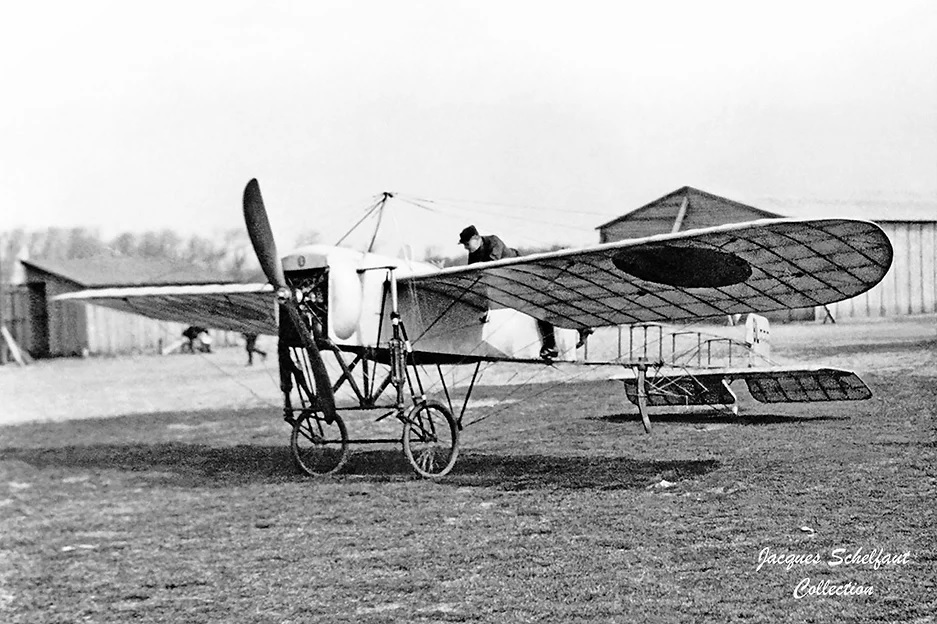
...flown by civilian volunteers.
So a total of about 20-odd aircraft in five escadrilles. They had some unknown number of ground support crew - let's figure maybe 20 or so, three guys per airplane, and each squadron had a truck, plus one for the AMB so five trucks.
Pretty skimpy for an airforce.
Which reminds us; it's good to keep in mind how close these guys - all these 1914 fliers; Belgian, French, British, and German - were to the Wright Flyer...

...of 1903 compared to the airplanes, pilots, observers, and air forces of only four years later like the Fokker D.VIII below.

Like all the August aircraft the Belgian machines were unarmed (although it didn't take long for the fliers to start lugging pistols or rifles along; someone in a Belgian aircrew - presumably the observer - shot a German pilot with a rifle in late September that the dying German then force-landed or crashed...the world's first air combat loss) and intended purely for scouting.
They were fragile and slow; here's the JERO-Farman F.23 bis specifications:
General -
Crew: 2 (pilot and observer)
Length overall: 8.06 m (26 ft 5 in)
Wingspan: 13.65 m (44 ft 9 in)
Powerplant: 1 × Gnome Lambda 7-cylinder air-cooled rotary piston engine, 60 kW (80 hp)
Performance -
Maximum speed: 165 km/h (103 mph, 89 kn)
Range: 315 km (196 mi, 170 nmi)
Endurance: 3 hours
Service ceiling: 1,050 m (3,440 ft)
Armament -
1914: none
by 1915: Guns: 1 × machine gun on flexible mount for observer
Bombs: small load of 75 mm (3.0 in) bombs.
Heavier-than-air (Belgium): Organization and Operations
We're going to do this here, but the "air operations" part applies to all the combatants of 1914, so take that as a heads-up.
The Belgian air-ground coordination and organization above escadrille levels is kind of opaque. The Wiki entry for the Belgian Army order of battle says this about aviation:
"In 1913, the Belgian government created the Company of Aviators (Compagnie des Aviateurs), the antecedent of the Belgian Air Force, just two years after the inauguration of the country's first airfield at Brasschaat in 1911. Attached to the fortresses, the company was equipped with a total of 16 Maurice Farman biplanes. The Belgian army also had had four observation balloons which, like the aircraft, were also attached to the fortresses, and two small airships."
Presumably by 1914 the fliers were no longer "attached to fortresses", although the first AMB air operation is reported to have been over Liege, so perhaps some connection still existed.
What the Belgian Army order of battle does suggest is that the aviators were "Army assets"; there doesn't appear to be anything like the connection between air and maneuver forces that we'll see when we look at France and Germany.
So my assumption is that the Belgian fliers' were technically assigned to the GQG - the top headshed - but directed to coordinate with whichever ground element was in or around their operational area. The alternative would be to report their observations directly to the Army HQ, which would then push the intel down to the troop unit command(s) in the air ops area.
That's...not ideal.
As we'll see, the big problems with 1914 air recon were 1) transmission, 2) timeliness, and 3) detail.
Without radio commo - and the air-to-ground radio "problem" was never really solved in WW1; the sets were too bulky and too finicky for reliable aircraft use - the only ways that air observers could communicate with the ground in real time were 1) dropping little notes or 2) actually landing.
The former were naturally limited in transmission and detail. Writing up a detailed reconnaissance report in an open cockpit is damn near impossible. So, at best, assuming the crew could find (or knew) where the local maneuver unit command element was located, the "report" would consist of a container with a sheet of paper inside dropped over the command staff reading "enemy (infantry/cavalry/artillery) dug in (advancing/retreating) at (distance) to the (direction)".
 |
| A British "message streamer" of later in the war |
Not entirely worthless, but pretty sketchy for the division CG to write his op orders.
Landing was even sketchier. Remember how fragile these aircraft were, and the lack of infastructure of 1914 Europe. No nice broad paved roads or parking lots to land on and takeoff from.
Even the farm fields - as level as any piece of 1914 ground around - were not the vast expanses of modern mechanized farming. And obstacles like wire fences, hedges, or ditches, might very well be invisible from the air but lethal touching down.
But the alternative was losing timeliness; having to return to the aircraft's home airstrip and then send - probably by courier, since the airstrip "base" surely lacked a radio, too - a report either to the maneuver headquarters directly or, worse, to Army HQ. Assuming the recon report actually reached the right field headquarters it would be hours (at best) old.
Bottom line; there wasn't a great answer to the "air recon" problem; that there were any, and that the fliers did have impacts on the ground maneuvers - and they did -is pretty outstanding.
Belgian air operations: Summary
I'm sure the AMB did what it could, but it was up against a German invasion so over powering that it forced the entire Belgian Army, including its aviators, out of all but a tiny corner of Belgian skies.
So I'm not sure what, if anything, the AMB air reconnaissance missions accomplished; like the Belgian airships, there were just too many Germans and the Germans were better armed and organized.
Knowing where the moving van is doesn't make standing in front of it any more profitable.
Next up:
Britain:

The Royal Flying Corps - RFC - was operational in France on or about13 AUG. The force that deployed consisted of four squadrons:
#2 Squadron; about 12 x B.E.2a two-seat biplanes (that's the photo above), 19 officers, 2 warrant officers, 21 sergeants and 111 rank and file, 7 light aircraft tenders, 6 heavy aircraft tenders, 4 repair lorries, 3 shed lorries, 4 reserve equipment lorries, 6 trailers and 6 motor cycles, 30cwt lorries for transporting equipment and supplies, which included 131 pistols, 23 whistles, 65 bars of yellow soap and 192 signal rockets (hat tip to the invaluable "RFC" website for the list...)
#3 Squadron: a mix of about 12 x B.E.2a and Farman F.20 two-seater biplanes and Bleriot XI monoplanes. Personnel and equipment as #2 Squadron.
#4 Squadron: as #2 Squadron.
#5 Squadron: a mix of about 9 x B.E2a and Farman F.20 and 3 x Avro 504 (that's the color photo below) two-seater biplanes. Personnel and equipment as #2 Squadron.
.jpg)
Aircraft Park "...a complement of spare aircraft and mechanics to undertake major repairs. The Park was to have 5 non-flying officers and 6 flying officers, 2 light tenders, 8 heavy tenders, 2 repair lorries 4 motor cycles and 2 reserve equipment lorries." (RFC website).
Assorted bits and pieces included an R.E.1 experimental two-seater biplane, two F.E.8 two-seater biplanes, and a Bleriot "Parasol" monoplane.
So a total of about 80 to 88 aircraft - 40-48 x B.E.2a, 22 x Farman F.20, 11 x Bleriot XI, 3 x Avro 504 and four or five odds and sods - about 80 officers, 4 warrant officers, 85 NCOs, 450 other ranks with the assorted vehicles and equipment needed to sustain flight operations.
Britain: Organization and Operations.
With the RFC, we know where the fliers fit in the BEF organizational chart. Here:

The British fliers were directly under the flagpole, assigned to the Expeditionary Force General Headquarters. They were, as the chart says, "Army troops"
What I don't know is exactly how they operated there. The RFC in France was commanded by a one-star (brigadier general), so technically separated by three levels of command from the general officer commanding, Field Marshal Sir John French.
So in theory it's possible that the individual aircraft reports went through their squadron (operations? intelligence?) officers up to the one of the general staff boffins, "GSO 1 (Operations) or "(Intelligence)" and from there bsck out to the troop units.
But.
Several major Army-troops unit commanders reported directly to the CG, including the Army engineer and artillery bosses. So I can see how the BEF might have stovepiped air recon intel directly to the CG's map table.
We'll come back to this, as well as talk about the RFC operations, after we look at the other two, the "big" aerial forces of August 1914.
France

So the Wikipedia post says that the Aéronautique Militaire contained 132 aircraft in 21 escadrilles. That works out to about 6.28 aircraft per squadron, which seems kinda hard on the guys who have to try and fly the 0.28 of an airplane.
I think those airplane and squadron numbers are wrong.
Another Wiki piece, on the 1914 French order of battle, breaks down the flying units and comes up with 23 squadrons.
And I think if we look back at the Belgians - who probably took not just their airplanes but their squadron MTO&E from their French neighbors - you get that a 1914 French escadrille was probably set up as 12 pilots and observers (for the two-seat aircraft) and six aircraft (or six pilots for the single-seaters).
So 23 x 6 = 132, which I think is where the aircraft number comes from.
But the breakdown numbers are different, and, I think, more probable.
Figure ground support staff about half the strength of the 12-airplane RFC squadron gives you about 50-60 troops and the usual trucks, whistles, bar soap (and wine, no doubt...) per escadrille.
Now...the problem we have is that France and Germany have big aircraft industries (by 1914 standards, anyway). And the "early industrial period" nature of airplane manufacturing at the time meant that it wasn't either "Boeing or Airbus". A gajillion little mom-and-pop-and-Maurice-Farman outfits were building airplanes that could and would be used for war, so here we go:
French aircraft:
The Farman F.20 was a big seller in 1914. The following units are listed as flying that aircraft type: Escadrilles HF 1, HF 7, HF 13, and HF 19. So let's call it 24 x Farman F.20s in four squadrons.

An earlier Farman two-seater biplane type, the MF.11 "Shorthorn", was operated by Escadrilles MF 2, MF 5, MF 8, MF 16, and MF 20; 30 x Farman MF.11's in five squadrons. That's the MF.11 above.
The Caudron G.3 single-seat biplane is listed as operated by Escadrille C 11, so 6 x G.3 biplanes in a single squadron.
The Dorand DO.1 was the Sturmovik of it's day; the Wiki entry says that the crew was "... protected from small arms fire by 90 kg (200 lb) armour plates."

As you can imagine, given the tiny engine the DO.1 mounted, like all these early airplanes, adding 200 pounds of metal made a slow machine. The escadrilles reportedly equipped with them (DO 4, DO 6, and DO 22) are reported to have turned them in as soon as possible, but for August 1914, 18 x Dorand DO.1s.
(Worth noting that the Wiki entry for this aircraft lists three different squadrons for the Dorand; DO 14, DO 22, and says that the Voison squadron V 14 also operated several DO.1s. I'm not sure how to resolve this; the Wiki piece appears well researched and I have no way to field-check the squadron lists at the "order of battle" site. We'll just have to leave this out there...)The two-seater REP Type N monoplane was operated by Escadrilles REP 15 and REP 27; so 12 x REP N's in two squadrons.

Voison type-L two-seater biplanes (that's the contraption tipping backwards in the photo at the head of this section) was operated by three squadrons; Escadrilles V 14, V 21, and V 24; so 18 x Voisons
Four squadrons operated Bleriot XI single-seat monoplanes; Escadrilles BL 3, BL9, BL 10, and BL 14; 24 x Bleriot types total.
Morane-Saulnier made two types of single-seater monoplane models in 1914, and either the Morane-Saulnier G and H types are reported to have been operated by Escadrille MS 17.

So we're looking at 30 x MF.11, 24 x Farman F.20 and Bleriot XI, 18 x Voison L-type, Dorand DO-1s, 12 x REP N-types, and 6 x Nieuport VI and Caudron G.3 (for a total of 138, so either not all the squadrons were full strength or the overall number aircraft reported is wrong), about 200-250 officers and something like 1,200-2,000 troops with the assorted trucks, whistles, bar soap, etc.
France: Organization and Operations
We're going to see a big difference between the "minnows" - Belgium and Britain (and Britain is maybe more like herring or something, but still...) - and the "whales", France and Germany.
Because when we talked about the whole "air-to-ground-coordination/communication" thing?
The big land powers had clearly been thinking about that.
The "timeliness" problem - getting intelligence from the air to the ground and once there over the ground to where it was useful - had a simple and practical solution that the two smaller air powers either overlooked or considered unworkable; divvy up the air assets to the maneuver units rather than centralize them under the Army HQ flagpole.
We'll see how the Germans did this in a bit, but the French Army handed air reconnaissance out to the field armies.
Here's what that looked like in print, from northwest to southeast:
France – Air Tasking 1 AUG 1914
5th Armee:
Six squadrons - DO 4, DO 6, C.11, N 12, REP 15, and V 24
4th Armee:
Two squadrons - V 14 and V 21
3rd Armee:
Five squadrons - MF 2, HF 7, HF 13, MF 16, and DO 22
2nd Armee:
Five squadrons - HF 1, MF 8, HF 19, MF 20, and MS 17
1st Armee:
Five squadrons - BL 3, BL 9, BL 10, BL 18, and MF 5
And on the map:

Makes pretty good sense. 5th Army with the open flank gets six squadrons; 4th, in reserve, gets only two, everyone else gets five.
In Foch's place I might have robbed a couple more - say one squadron each - from 1st and 2nd Armies to strengthen 4th and 5th's recon program.
But the idea is there.
We'll get into the weeds on French air operations to the extent we can when we start to look at the ground campaign, but first let's look at the other side of the "forward edge of the battle area", at...
Germany

The German air service (what would come to be called the Deutsche Luftstreitkräfte in 1916 but on 1 AUG 1914 was still Die Fliegertruppen des deutschen Kaiserreiches - "the flying-troops of the German Empire" but let's call it "DFK" because the original German is a mouthful) was set up the same year at France's Aéronautique Militaire; 1910.
The German version of "military aviation" was spun up quickly - to match or counter the obvious French development of air power - and with a very German orderliness (the DFK was the only organization of the three major powers to have an intermediate levels of organization between the overall air command authority and the individual squadrons - called Abteilung in German - in the form of administrative "battalions" with internal "companies" of three to four squadrons each)
It also grew in size more rapidly than it's opponent; most of the standard references I can find state than on 1 AUG the two main opponents lined up across the Franco-German border like this:
France: about 130-140 aircraft in 23 squadrons of about 6 aircraft each,
Germany: a total of about 230 aircraft (of which about 50 were obsolete, so about 180 operational ) in 31 squadrons of 6 aircraft.
Don't forget that Germany also had to provide air reconnaissance for the eastern Army elements, so another five squadrons and 25 or 30 aircraft were posted there in August.
So here's a problem with all this.
Unlike the French, the Germana DFK didn't add a helpful tag to their squadron numbers, and I can't find a source (for a reasonable-to-a-hobby-historian-price, anyway) that breaks down who was flying which aircraft.
And Germany, like France, had a busy cottage-aircraft-industry. So there's a fair number of possibilities, and I'll just try and give you and idea of the general range of German aircraft that would have been employed for reconnaissance over the Frontiers.
German aircraft:
Perhaps the most iconic early-war machine was the Taube.

A 1909 design (originally by the Austro-Hungarian Etrich company, but by 1914 produced by numerous German firms including Albatros, DFW, Aviatik, Gotha, and Rumpler) this two-seater monoplane was verging on obsolescence at the start of the war but was insanely numerous; this website claims that roughly half of all German military aircraft - so something like 120-125 - were Taubes.
The Taube was, as the graceful wings suggest, very gentle and stable in the air. If you look closely at them, though, the wings (which aren't, despite the appearance, supposed to be "bird" wings but were modeled after some sort of winged seed-pod like a maplecopter) suggest one big problem:
No control devices, no ailerons. Taubes turned, climbed, and dove using the original Wright Brothers-style "wing warping".
That made them stable but slow to turn and easy prey for faster, more nimble enemies, and they were relegated to training in less than a year.
The remaining half-or-so of the DFK aircraft included several "B.I/B.II"-type two-seater biplanes; they all look similar, and my suspicion is that there was a standard DFK spec for this type that, like the Taube, was built by numerous manufacturers. For example, here's a AEG B.II,

an LVG B.I

an Aviatik B.I

and an Albatros B.I:

Look a lot alike, eh?
Makes sense when you think "military equipment"; keep it simple.
If a "two-seater biplane" is always the same two-seater biplane then your mechanic's toolkit works on the replacment machine you just received even though it was built in Johannisthal by Luftverkehrsgesellschaft m.b.H. while the airplane it replaced was built by Albatros Flugzeugwerke GmbH next door.
So something like 180-185 operational aircraft in 31 Feldflieger Abteilung (FFA) of 6 aircraft each. Presuming a nominal officer establishment of 12 to 14 suggests another 50-60 NCOs and enlisted ground staff with the usual couple of trucks, tents, cookpots, etc., so something like 2,000-2,500 all ranks.
This is just the Western Front field force; it leaves out the whole rest of the DFK, which included the training schools (Fliegerersatzabteilungen), "fortress flying detachments" (Festungfliegerabteilungen), the reserve air-park units (Armee-flug-park). The FFA are just the tip of the DFK propellor.
Germany: Organization and Operations
We've seen the Entente air coordination get further into the weeds as the air organizations got more bigger and more sophisticated; nothing below Army GHQ for Belgium and Britain, down to field Army HQ for France.
The DFK broke their coordination down one level further; to the corps - "Armeekorps" in German - level. Here's the breakout. "AK" is an active armeekorps, "RK" is a reserve corps, so "2AK" is II Armeekorps, "4 RK" is IV Reserve-Korps. Bavarian units are identified by a "B" or "(Bavarian)":
Germany – Air Tasking:
Total of 31 Feldflieger Abteilungen (including 3 Bavarian)
1st Feldarmee (total of 5 attached FFA)
Army: FFA 12
2AK: FFA 30
3AK: FFA 7
4AK: FFA 9
9AK: FFA 11
3RK: None
4RK: None
2nd Feldarmee (total of 4 FFA)
Army: FFA 23
Guard AK: FFA 1
Guard RK: None
7AK: FFA 18
10AK: FFA 21
7RK: None
10RK: None
3rd Feldarmee (total of 4 FFA)
Army: FFA 7
11AK: FFA 28
12AK: FFA 29
19AK: FFA 24
12RK: None
4th Feldarmee (total of 4FFA)
Army: FFA 6
6AK: FFA 13
8AK: FFA 10
18AK: FFA 27
7RK: None
18RK: None
5th Feldarmee (total of 4 FFA)
Army: FFA 25
5AK: FFA 19
13AK: FFA 4
16AK: FFA 2
5RK: None
6RK: None
6th Feldarmee (total of 4 FFA)
Army: FFA 6
21AK: None
1BAK: FFA 1 (Bavarian)
2BAK: FFA 2 (Bavarian)
3 BAK: FFA 3 (Bavarian)
1BRK: None
7th Feldarmee (total of 3 FFA)
Army: FFA 26
14AK: FFA 20
15AK: FFA 3
14RK: None
FYI, here's the Eastern Front units for comparison:
8th Feldarmee (total of 4/5 FFA)
Army: FFA 16
1AK: FFA 14
17AK: FFA 17
20AK: FFA 15
1RAK: None
East (unassigned?) – FFA 4
Everything I've read suggests that the DFK was well organized and cooperated effectively with the Imperial maneuver commanders in ways that the zeppelins either didn't or couldn't.
Certainly the breakdown of air detachments to individual army corps - which often had tactical intelligence needs not shared by their field army as a whole, or the other corps in that army - suggests a higher level of German understanding of air reconnaissance intelligence collection, processing, and dissemination that any of their French or British opponents.
But there appears to be some real holes there, as we'll see.

At this point I think we've discussed all the precursors; the setting, the plans, the reconnaissance troops that had to execute those plans. All that remains is to set the plans in motion and, looking at the reconnaissance elements, try and see what happened along the frontier in the month of August.
That's for the next installment:
Next: Shots Fired!


