Showing posts with label China. Show all posts

Saturday, February 04, 2023

Gasbags

This is the Republican senator from Ohio, J.D. Vance:


Apparently this fucking cluck is out guarding his woodpile from the eeeevil Chinese spy balloon.

Also apparently either this nimrod doesn't - or he assumes his other wingnut constituents don't - know or care that the maximum effective range of his billybadass AR-15 knockoff is not 40,000+ feet but about, umm...1,500 yards. 

I don't really care so much that this nitwit is cosplaying some sort of Air Raid Warden. You be you, peckerhead.

What's irking is that there are a whole basketful of deplorables out there who eat this nonsense up.

It's the exact sort of thing that we had last week in the U.S. House where We the People got our tax dollars used to condemn "socialism".

Y'know what people like this chucklefuck also called "socialism"?

The 40-hour week.

Workplace safety regulations.

Pollution controls.

Old age pensions.

The G.I. Bill.

The New Deal.

Yeah. It's just that stupid.

As stupid as a faux hillbilly out guarding his woodpile from a balloon he couldn't do a goddamn thing to if he fired every round of 5.56 in Ohio.

Friday, November 06, 2020

Late-Autumn Storm

 Back in midsummer I talked about doing one final post in the "The Imperial Japanese Army - What Went Wrong" series about "August Storm", the Soviet invasion of Manchuria in the late summer of 1945. 

I spent a fair amount of time finding and reading LTC Glantz' monumental Leavenworth Papers on the thing (and have to say that they are, indeed, amazingly thorough and worthwhile pieces of historical research, and well worth reading...) to try and develop a post out of it and, unfortunately, struggling badly.

I just couldn't find a hook there to hang a post on.

Largely because the whole magilla is so vast. The Soviets mobilized a million and a half, the Kwantung Army defended with about 700,000, and the area of operations included the entire perimeter of Japanese-held Manchuria. Engagements included deliberate attacks in open, wooded, mountainous, and riverine terrain, hasty attacks, movement-to-contact and meeting engagements, and included assaults on fortified positions, amphibious operations, as well as a truly complex and monumental logistical support operation by the Soviet Far East Command.

But also simply because Glantz does such a good job. Anything I could do would simply be a recapitulation of his work. That's ridiculous along with being immense; I don't want to do that.

But I do want to say something about it. It seems to me to sum up the appalling failure of the Imperial Army that caused and led to so much suffering and destruction, including that of the very people and polity that the IJA was supposed to protect. I'm still going through the second of Glantz' publications, the case study paper, to see if there's a piece of this engagement that I can break off and chew on.

And at least it led me to this:

The whole "Taiwanese WW2 re-enactors do Soviets versus Japanese in Manchuria" thing is entirely made of 110% Taiwanese awesome, and I recommend you watch the whole thing while I scramble to come up with something just as worthwhile to entertain you with.

Monday, May 13, 2019

Somebody's smoking Hemp for Victory

THIS stuff is what drives me nuts about the current American pash for tongue-bathing soldiers.
When speaking of the Americans who are going to take it in the shorts because of the trade wars with the PRC that are fun and easy to win Senator Tom Cotton (R - Arkansas) consoled them that:
"There will be some sacrifices on the part of Americans, I grant you that, but I also would say that sacrifice is pretty minimal compared to the sacrifices that our soldiers make overseas that are fallen heroes that are laid to rest in Arlington make."
Except those farmers and manufacturers and Sears customers getting hit with these costs didn't ask to be dragged into a pissing contest with the PRC over Fitbit parts any more than those GIs asked to be walking the streets of Kabul trying to remake Afghanistan into Belgium.

To equate these trade wars with the "blood of heroes"?

It's despicable on it's face, but, worse, it makes taking issue with the trade wars to a level of Dolchstoß comparable to betraying the Noble Soldiers. It's a version of Godwin's Law, a rhetorical trick designed to put a stop to debate.

Worse, it's deeply dishonest, if for no other reason than those "fallen heroes" didn't "fall" as "sacrifices" in a war declared by the People in Congress, or to any sort of existential threat to the United States, or, for that matter, for any sort overarching national interest, but in a bog-standard squalid little imperial expedition in the global hustings that has been ginned up largely by lies, misdirection, fear, and pants-pissing panic.

I love my Army brothers, but the guys holding down a slot in Asia or Africa today aren't holding back global fascism, or facing the might of a hostile superpower. They're doing the dirty business of empire. If my country wants them to do that business that's one thing. But if Tom Cotton - or my country - wants to drag me and every other American into a trade war in Asia and justify it by comparing it to that service?

He and it need to come to me first and make a case for that trade war and that service, not simply assume that they're worth blood and/or treasure and demand I respect that because some poor bastards are getting hosed wasting a year-and-a-half in fucking Helmand Province playing whack-a-muj.

Because if you gave me the choice between:

1) "Sacrificing" in a boneheaded trade war with China because I "support the troops", or
2) Skipping the trade war AND ending the expeditionary wars in Asia and Africa and bringing those troopers home?

I'd go with Door #2.

It'd be bad enough if We the People really were Army-mad, but in a nation where barely anyone bothers to give up a couple of years to the tree suit it REALLY drives me nuts when I run across this faux-militarism stuff.

Tuesday, November 17, 2015

More military wisdom regarding the Islamic State

From Sun Tzu's The Art of War:

From Chapter XII (The Attack by Fire):

17. Move not unless you see an advantage; use not your troops unless there is something to be gained; fight not unless the position is critical.

18. No ruler should put troops into the field merely to gratify his own spleen; no general should fight a battle simply out of pique.

19. If it is to your advantage, make a forward move; if not, stay where you are.

20. Anger may in time change to gladness; vexation may be succeeded by content.

21. But a kingdom that has once been destroyed can never come again into being; nor can the dead ever be brought back to life.

22. Hence the enlightened ruler is heedful, and the good general full of caution. This is the way to keep a country at peace and an army intact.


Wednesday, November 26, 2014

Battles That Changed History: Bun'ei (文永の役 Bun'ei no eki or First Hakata Bay) 1274

文永の役 (Bun'ei/First Hakata Bay)

Date: 19 NOV 1274AD (Bun'ei 11, 20th day of the 10th month)
Note on dates: Traditional Japanese dates are based on a 年号, nengō, literally a "year-name" that was typically chosen by the Imperial court to celebrate important occasions such as the accession of a new emperor or some auspicious event in his reign. 文永, Bun'ei, was the name chosen for something - frankly, I have no idea what - that occurred in the reign of 亀山天皇, Kameyama-tenno, Emperor Kameyama, 90th in the traditional succession. You'll note that in the Imperial calendar the date would have been rendered as 20 OCT - the 20th day of the 10th month...but by the Western Gregorian calendar the date is 19 NOV, one month later. Before you think "that's weird" remember that the Julian calendar was nearly a month different from the Gregorian when the changeover took place in most of the Western world in the 18th Century.
Forces Engaged: Japanese - The Japanese defenders that met the Mongol invaders at the shores along Hakata Bay were drawn from the gokenin, the household troops of the various clans of the island of Kyūshū. From the paucity of sources - we'll get to that in just a bit - it's difficult to tell how many of these troops and what type were on the north shore of the island that day.

We can discount the Mongol statements of 100,000 or more found in the Yuan Shi. This is pure propaganda designed to excuse the failure of the first invasion. The combined strength of the two sides at the Battle of Sekigahara fought nearly 300 years later, at a time when Japanese feudal militarization was at its height, was something like 160,000 all arms; I doubt if the bakufu could have raised 100,000 troops from all of Japan in 1274.

We have no direct strength reports from the Japanese sources. In the absence more modern estimates run from somewhere in the mid-thousands, 4,000 to 6,000, to as high as 10,000-12,000 all arms, a maximum I find easily believable, because:

1. The 鎌倉幕府, Kamakura bakufu or Kamakura shogunate, was a damn good military organization for it's time. Japan typically fought "above its weight" in the premodern period simply because the Japanese feudal organization was better logistically and organizationally than many of its contemporaries. The 13th Century shogunate was hardly the sleek military bureaucracy of the Tokugawa Era, as we'll see, but it was still well able to field, supply, and feed a significant force for some time, and

2. The battle took place in October after the harvest was in and the bulk of the peasant footsoldiers (that would eventually become the 足軽 ashigaru of the high feudal wars of the 16th and 17th Centuries) would have been freed of their agricultural responsibilities, and

3. The invaders had been knocking on the door for some time; this wasn't a surprise attack. Mongol embassies had arrived in Japan in March and September of 1269, again in September of 1271; and finally in May of 1272, each time with a message from the court of the Khan that pretty much boiled down to "Nice little island you got...shame if anything happened to it."


The Wiki entry for the Mongol Invasions notes that
"The Kamakura shogunate (Bakufu) under Tokimune ordered all those who held fiefs in Kyūshū (the area closest to Korea, and thus most likely to be attacked) to return to their lands, and forces in Kyūshū moved west, further securing the most likely landing points. After acknowledging its impotence, the Imperial Court led great prayer services, and much government business was put off to deal with this crisis."
So let's guess that the Japanese defense consisted of somewhere around 6,000-10,000.

This might be on the high side - Turnbull (2010) gives 4,000 to 6,000 as his guess - but clearly the Japanese force numbered more than a couple of thousand (that would have been blown away within hours) but less than "tens of thousands" (that would probably have managed to hold at the beaches without much trouble).

The problem, though, is even guessing the total that we still have no real notion of how this force broke down.

We know that the hard core of the Japanese defense was the 武士, bushi; the armored warrior we know as samurai; let's use the latter term as the more familiar to a Western reader.

Whatever you called them, at the time of the invasion these troops would have been primarily armored mounted archers, the bow (弓, yumi) the principal weapon. The better-known 刀, katana or "samurai sword", was not in widespread use during the 13th Century, the mounted man preferring the 太刀, tachi or longsword but preferring the bow to both.


The method of engagement was long-range arrow fire, the idea being to pick off your enemy with a superbly placed shot while riding around him. At some point the two sides got stuck in at handstrokes, but the ride-and-shoot part was the best part as far as these armored knights were concerned.

And I should note that in his general attitude the high-status 13th Century Japanese warrior was more-or-less a close relative of his contemporary the feudal European knight. He was NOT the fanatically-loyal-and-obedient automaton of the 17th Century. He was feudal in the military sense to the ends of the tassels on his agemaki; all about his own glory and his rep. His whole thing was battle, specifically, single-combat with an equal enemy whose death would bring him fame and riches. He was aggressive as hell but even then, as we'll see, the problem wasn't getting him to fight, it was trying to get him to fight where and when and how you wanted him to.

He was a pain in the fucking ass, frankly, and a hell of a lot of Japanese history can be explained by trying to figure out what the right answer would be to the simple question "How do we control these kami-damned samurai?"

The samurai families were about 10% of the population of Japan in the 18th and 19th Centuries but the group would have been at significantly over-represented at Hakata bay in Bun-ei 11. Japanese troops had little experience at that point fighting outside Japan or enemies other than Japanese, and the primary objective of the bushi was, as I've said, individual glory and single-combat; the notion of a "tailored force package" was gibberish to the 13th Century Japanese commanders. So it's very probable that the Hakata force was samurai-heavy, full of guys looking for glory and Mongol heads.

Let's assume that half to more than half the defenders - somewhere between 3,000 and 5,000 - were mounted samurai. So here we've got a whole bunch of homicidal armored bowmen standing around that November day looking to mount up and kill something.

The quality of these soldiers would have been generally high but somewhat variable, ranging from well-trained, well-armed wealthy men with a fairly substantial fighting tail numbering in the dozens to single individuals who could barely scrape together enough money to afford the arms, armor, and mount, but all would have been fairly to very effective at the sort of individual mounted combat they specialized in.

But what about the rest of the gang?

Well, some of them would have been armored footsoldiers, probably another 2,000 to 3,000 or so. These would have been the poorer armed retainers of the local clans, not the large units of organized ashigaru infantry of the later Muromachi and Sengoku Periods. Their armor would have been the much less elaborate, probably the 胴丸, dō-maru style rather than the 大鎧, ō-yoroi, type worn by the knightly class and their primary weapons would probably have been some sort of polearm, 槍, yari, the straight-bladed spear or 薙刀, naginata, the glaive or curve-bladed spear with a sword in reserve. Some would have been archers, some, the humbler, might have had no more than a sword or two. Effective fighters in an individual sense, but not "infantry", much less an infantry unit or units in the way we think of them.

That would leave almost all of the remaining 2,000 or so as the rice-farmer sort of peasant levy. These poor sods would have been the humblies from the local samurai estates and usually dragged off their farms with all the enthusiasm of their European equivalents.

It's worth noting that raising the peasants was probably much less difficult for this fight than for the usual inter-clan feud; the Mongols had been very naughty on the way over to the Japanese home islands and the results of a Mongol landing would have been ugly even by Japanese-peasant-standards.
However even with their blood up the fighting value of these levies was probably debateable and their impact on the events of Bun'ei 11 questionable. Some probably had real spears or naginata but probably a bunch with nothing but a sharpened bamboo spear, a rice-flail, or a pitchfork. Their ability to do more than more than stand in place is unlikely; even moving short distances without their becoming a mob is hard to imagine. But, as we'll see, much of the fighting for the Japanese side consisted of standing in one place.

So; perhaps 2,000-5,000 armored missile cavalry and another 2,000-3,000 armored melee infantry with a light infantry contingent of perhaps another 2,000 or so under the overall command of several of the 守護, shugo or military officials, of Kyūshū including Shimazu Hisatsune (shugo of Satsuma, Hyuga, and Osumi provinces) and Otomo Yoriyasu, shugo of Bungo, Buzen, and Higo provinces. The notional commander of this force would have been Shoni Tsunesuke, shugo of Hizen, Chikuzen, and Chikugo provinces as well as the islands of Ikishima and Tsushima, but my understanding is that this officer had no direct role in the combat at Hakata Bay.
A Brief Note on Provinces and Their Adminstration: The ancient internal divisions of Japan have a tangential relationship with the modern prefectures; there's a hint of similarity in the areas but the extents and the names are very different.

県, ken, or prefectures are the modern internal divisions of Japan, established in the 19th Century; Kyūshū has eight, including Okinawa. The modern prefectures are shown on the map at the beginning of the post. Go ahead and take a look. I'll wait.

OK, got it?

The older divisions were called 国, kuni, which is typically rendered into English as "provinces" or "counties". Of these, Kyūshū also had eight back in the day but the boundaries were very different. Here they are:

There's Hakata again, the orange circle in Chikuzen no kuni, Chikuzen Province.

In 1274 these administrative divisions were typically run by two representatives of the military government at Kamakura. The shugo you've heard already; this was the guy with the police and military powers, a sort of combined state adjutant general and state police commissioner and, especially in a remote province, the local magistrate.

His counterpart was the 地頭, jito, whose function was more administrative; he collected the imperial taxes and was more concerned with estate management, but he would also have been of the bushi class and was at bottom a fighting man. Both typically were appointed from the 御家, gokenin, military "nobility" that are described in the Wiki entry as "...descendants of former (independant land)owners, former peasants, or former samurai, who...were rewarded (with land and/or position). They also collected local taxes and ruled over territories they were entrusted with, but nominally didn't own (those lands). Because the shogun had usurped the emperor's power to nominate them, they owed loyalty only to him. As long as they remained faithful, they had considerable autonomy from the central government."

The defenders of 1274 would have been these gokenin, the feudal troops of the military ruler; nominally loyal to the Emperor and "Japan" but, in practice, owing their livelihoods to the bakufu and it's leaders and considering themselves men of their clan, first, then their region, and only lastly "Japanese". The men who defended the beach that day were not just removed from us in time; they were very much men of the Japan of 1274, a Japan which bears some likeness but as much or more difference to the Japan of 2014.

Forces of 大元, Dao Yuan, the Great Yuan Dynasty - 忽必烈;, The Great Khan, Kublai, had proclaimed the beginning of the Yuan Dynasty three years earlier in 1271 as part of the long conquest of the Chinese heartland by the Mongolyn Ezent Güren, the Mongol Empire founded by Genghis Khan in the early 13th Century. At the time of the Battle of Bun'ei Kublai's forces were still fighting to conquer the southern Song state in what is now the parts of China south of the Yangtze River. The Yuan had, however, already invaded and largely subdued the Korean peninsula and put a Yuan Quisling on the throne there. This will have an impact on the battle for Hakata Bay, as we'll see.

The hard core of the invasion force was probably roughly between a Tümen and one-and-a-half Tümen of the sort of Mongol troops that had swept out of the steppe of central Asia and conquered half the Eurasian world by the last quarter of the 13th Century. A Tümen was the basic grand tactical Mongol unit; 10,000 troops divided into decimal sub-units down to a 10-man aravt or squad.

The image we have of the Mongols of the 13th Century is "This Guy":


The squat, hard-faced horseman with his shaggy steppe pony, his floppy fut hat and his bow, peering patiently down from the ridge onto the peaceful village below, grim harbinger of Death.

The Mongol of our imagination is part of a Horde of light horsemen, swarming out of the dust and the forest, bows sleeting a deadly hail of arrows. That image impressed itself on the peoples of eastern Europe for more than a century and it's actually, for a popular conception, remarkable accurate.

The central strength of the Mongol Empire was that horseman; hardy and rapid moving, tactically flexible, well-disciplined, and ferociously violent. But he was not the only weapon in the Mongol arsenal in 1274.

By 1274 the waves of light horse-archers were backed up by a mailed fist of heavy armored mounted lancers; the equivalent of the Byzantine cataphract cavalry or the Ottoman or Mamluk heavy horse; armored men on armored horses armed with lances as their primary weapon that charged into close combat. The ratio of light to heavy cavalry in the Mongol armies of the 13th Century seems to have been roughly 3:2.
Our only source for the number and composition of the Yuan expeditionary force is the Yuan Shi, that gives the Mongol and Chinese numbers as 15,000. We don't have a better breakdown that that, but given that the conquest of China was fairly recent and the Northern Song troops fairly newly incorporated into the new dynasty I suspect that most of the "Mongol and Chinese" troops were, in fact, Mongol.

Another 1,600 of the expedition are listed as Korean. Korea was even more recent a conquest than China, and the reliability of Korean grunts would likely have been pretty low. I suspect that some of the Koreans listed were crew for the some 900 ships that conveyed the invasion force from the embarkation ports to the Japanese shore as well as infantrymen.

Here's the thing about this force, though. All the sources we have for this battle suggest - or show - that many of the Mongol forces 1) fought on foot and 2) in compact formations.

This doesn't sound like the sort of swirling mobile tactics the Mongol horse archers were known for; it sounds a lot more like the kind of infantry tactics used in Song Dynasty China as well as in Goryeo Korea. This tends to change our ideas of this force. Perhaps the conquered peoples - Chinese and Korean - provided more fighting soldiers than they otherwise would have.

Or...maybe the Mongols left their ponies at home.

That's my thought. Without modern steel vessels and specialized horse-transport ships its difficult for us, in our mechanized society, to conceive of the difficulty for a preindustrial society of transporting horses by sea.

Horses don't like to stand on an uneven surface. Unless they've been rigorously trained to do it they typically don't go up and down things like ramps willingly, and they don't like to jump up or down onto a wooden deck from a dock or quay, or over railings into the water.


They tend to be exceptionally poor sailors, nervous in the confinement of a small stall and a wooden deck overhead, and spooking at the sudden movement of the ship or the strange noises of wind and wave. When frightened they will typically attempt to run and, if restrained, will fight to escape, kicking, rearing, and plunging, and a terrified thousand-pound animal can do a tremendous amount of damage to a wooden ship.

Frankly, I have serious doubts about how many horses the invasion force brought along. I suspect that a lot of the Mongol troops were dismounted for this expedition. That wasn't an automatic deal-breaker as it might have been with some other nomadic armies; the Mongols were known for their siegecraft, very much a footsoldier sort of task, and they had considerable experience with infantry, if only to attack them. So while I have no doubt that some of the Mongol soldiers brought their mounts along with them I strongly doubt that this number was large or significant as a tactical factor in the engagement.

So, roughly 16,500 to perhaps about 20,000 all arms. Probably somewhere between several hundred to several thousand mixed light missile and heavy melee cavalry with the remainder a varied mix of light missile infantry and heavy melee infantry. The commanders are virtual cyphers; we know some of their names from the Yuan Shi: Chinese general Liu Fuxiang, Korean officer Kim Pang-gyong, and Mongol officers Hu-tun and Hong Ta-gu...but beyond the mere names we have no real idea who these men were and what their abilities were. Turnbull (2010) dismisses them with the observation that "(t)he Khan's leading generals were fully engaged in the main struggle against the Song..." so we are left to conclude that both the troops and the leaders of the 1274 expedition were likely less than the best that the Yuan Dynasty could field.


The Sources: Three. Or very nearly.

I'm not kidding. As far as I can find out there are only three major sources of information on the Battle of Bun'ei; one from China and two Japanese. All three suffer from the usual failings of medieval chronicles; excessive reliance on hearsay and anecdote, relative innumeracy, and the disconnect between the men who fought the fight and the men who wrote about it. No reports from the commanders to their rulers, no casualty returns, logistical tallies, orders of battle, or morning reports; none of the sort of technical and tactical records we expect from modern military forces.

Add on the difficulty for a Western reader to access sources written in Japanese as well as a Chinese work (the Yuan Shi) that was compiled by Chinese scholars reading Mongolian records.

From the Japanese side there are also a small collection of minor sources such as the accounts of the then-controversial Buddhist monk 日蓮Nichiren, samurai family histories, and surviving official records of the Kamakura bafuku.

You can imagine the difficulties.

From the Mongol side the only real source is a chronicle of the Yuan Dynasty called the 元史, Yuan Shi, or History of Yuan, a work with a plethora of problems.

First of all, despite its title it was not written by a Mongol, or during the Yuan Dynasty. So far as we can tell it was begun about two years after the fall of the Yuan and the accession of the first emperor of the succeeding Ming Dynasty. Talk about history being "written by the victor"...the supposed eyewitness account of the Mongol rule of China was written by the Chinese who kicked the Mongols out.

Adding to the obvious bias on the part of the authors was the haste with which the Yuan Shi was compiled. The entire 200-odd chapter compilation took less than a year to finish. The Wiki entry says:
"The History of Yuan has been criticized by imperial Chinese scholars for its lack of quality and numerous errors, attributed to the haste with which it was compiled. The Qing-era historian and linguist Qian Daxin commented that of the official histories, none was more quickly completed - or worse in quality - than that of the Yuan dynasty. Wang Huizu, another Qing-era scholar, compiled a work on the history pointing out more than 3,700 factual and textual errors in the text, including duplicated biographies for important figures such as Subutai, as well as inconsistent transliterations of the same name - Phagspa, for example, was transliterated in three different ways."
If that wasn't trouble enough the actual manuscript is extremely rare: only two copies are known to exist today, both in the Mongolian National Library and extremely difficult to access. Try as I might I could find no image of the original text on the Internet. So it's difficult to assess how accurate the original history of the expedition was, and what, if any, inaccuracies crept in in the seven centuries since its creation.

The primary Japanese source is a piece of official propaganda from the Hachiman shrine at Iwashimizu called the Hachiman Gudokun and is principally concerned with convincing the bafuku that the prayers offered to Hachiman were the main reason the invaders were licked. I am not entirely sure if there exists an English translation of the full text, which though composed in the early 14th Century is known only from a manuscript copy from the Late 15th.

Additional contemporary Japanese sources are said to exist in family records as well as in the Imperial archives as well as in the libraries of temples and monasteries.

Perhaps the must controversial, confusing, and delightful record of the events of Bun'ei 11 is a collection of images with explanatory text - a sort of military historical strip-cartoon called the 蒙古襲来絵詞, Moko Shurai Ekotoba, the "Illustrated Account of the Mongol Invasion" or, more commonly, the "Mongol Invasion Scrolls".


This work seems to have been commissioned in the late 13th Century - the year 1293 is cited on the second section - by a guy named 竹崎 季長, Takezaki Suenaga, a gokenin samurai from Higo Province.

This joker Takezaki seems to have either been one of history's biggest shameless douchebags or a man with absolutely no filter between his mind and his mouth. His conduct on the battlefield is certainly fierce - to the point of lunacy, at time - but is characterized by a ridiculous amount boneheaded tactical stupidity, chicanery, and disobeying the orders of his feudal masters. Keep in mind that the story recounted is his version of the events; as Turnbull (2010) puts it: "...it would not have been surprising to have read the the Mongol Invasion Scrolls were compiled by his commanding officer so that Suenaga could be have been adequately disciplined."

In common with other medieval manuscripts the Scrolls have had a tough life over the ensuing seven centuries. Campi (2002) recounts this:
"The scrolls were kept at the Kaito shrine until seized in the 1360s by the Nawa and placed in the Aso shrine. The work ha(d) suffered extensive water damage and the glue that held the pages together dissolved. The Suenaga scrolls were rediscovered late in the eighteenth century, but there (wa)s no clear order for the images and passages.

In 1793 the scrolls were dispatched to Edo [Tokyo] and copied into the documents that exist today. However, the work was only divided into two scrolls in 1797, so there is some confusion as to which invasion story some illustrations belong. The scrolls were returned to Higo province in 1825 until presented to the Japanese Meiji emperor in 1890. Only
in 1989 were the scrolls bestowed to the nation and placed in the Museum of the Imperial Collections (Sannomaru Shozokan)"
Thomas Conlan has produced a worthwhile little study of the Invasion Scrolls, In Little Need of Divine Intervention (Conlan, 2001). I enjoyed the work, the reproductions of the Scrolls are invaluable, but it is not without its critics, and his conclusion - that the Japanese defeated the Yuan invasions based on military superiority alone and that the famous kamikaze was more myth than fact - seems to me poorly supported.

A number of worthwhile secondary works have been produced on the Invasions; all undoubtedly suffer from the same paucity of primary sources as does this one. In preparation of this post I used the Conlan book as well as the 2010 Stephen Turnbull The Mongol Invasions of Japan 1274 and 1281 published by Osprey and found both as useful as could be.

I encountered a scattering of worthwhile resources on the Internet that cover the Mongol invasions in general. Bowdoin College has a lovely little site that presents Takezaki's Invasion Scrolls, providing nice images of parts of the manuscript as well as some useful insight into the difficulty in reassembling the original from the various versions and revisions extant.

The Wiki entry appears to be acceptable for its setting though with some peculiar assertions. For example, it cites the 日本王代一覧, Nihon ōdai ichiran, or Table of Rulers of Japan as the source for the Japanese belief that the invasion was defeated because the invasion force ran out of arrows - a frankly unbelievable assertion and one hard to credit the gokenin who were on Hakata beach as seriously proposing - without mentioning that the Table of Rulers was written in the late 17th Century. While useful as a general introduction it contains little of real military value.

Although not really pertinent to the events of 1274 the Archaeology website has a good little article on the modern investigation into the wrecks of the great storm of 1281. Another good naval archaeological site is maintained by one Ramdall Sasaki; the pictures alone are well worth investigating.

That's pretty much it. As with the sources, little has been published on the Internet about this engagement. I figure I might as well be the first.


The Campaign: One good first question to ask would be; what the fuck did Kublai Khan want with Japan, anyway?

No kidding, really; Kublai, what the fuck, man? Your Mongol Empire was as continental a polity as ever was, run and ruled by a bunch of steppe-nomads and hacked out of Eurasia by a bunch of guys on horses with bows. You needed a navy and an island outpost like a duck needs nuclear weapons, and trying to get them got a lot of your good troops killed. What was the attraction?

Certainly one reason may well have been what we'd call today "national security". Once the Song Dynasty was overthrown the Yuan controlled all of the mainland from Korea to Vietnam; the only real military threat to the east was Japan. While the Japanese showed little interest in military conquest on the mainland they were really the only state that might, and as we here in the United States know only too well it takes little more than an ambitious ruler to insist that a smoking gun may become a mushroom cloud at any moment and decide to invade to prevent that fantasy of danger.

Another might simply have been momentum; the Mongol armies had conquered all before them to the edge of the Pacific Ocean. Why stop there? Certainly there must have been a sort of "manifest destiny" faction at the Yuan Court that believed that it was just natural for Mongol rule to extend as far as there were people to rule, Japanese included.

Turnbull (2010) suggests that Japan's wealth was a reason. He cites Marco Polo as claiming that the Imperial Palace was paved with gold and that these riches were part of Kublai Khan's motivation. This, given the incredible wealth for the taking in Song China, seems frankly unbelievable.

One more plausible reason is that Japan had both the capability to intervene on the side of the Southern Song (in 1274, at least) as well as military power that would be helpful in defeating the Song if properly re-directed. So by taking control of Japan the Khan would further his greater goal of the complete subjugation of China.


Whatever the reasons, Mongol pressure on Japan to join the Coalition of the Willing began as early as 1266 and, as we've discussed, accelerated in the years between 1269 and 1272. The messages were couched in the usual diplomatic flannel but the steel beneath the niceties was tangible. The message from 1269 concludes with the admonition: "...if we should not establish friendly relations between us...(w)ho would care to appeal to arms?"

These messages, along with warnings of Mongol preparations from the Korean government-in-exile (to the island of Ganghwa in the Han River delta) until the final conquest of Korea, were dealt with not by the Emperor - who was a figurehead and had been since the Genpei War of the 12th Century - but by one of the samurai military elite that had taken power. In 1274 this was not even the ostensible military ruler, the shogun - a mook by the name of 惟康親王, Prince Koreyasu - but his 執権, shikken (regent), a guy named 北条 時宗, Hōjō Tokimune. Tokimune, the regent for the regent, mobilized the gokenin of Kyūshū some time after the threatening messages in the late 1260s or early 1270s, but the gokenin of southern Honshu only late in 1274.
Meanwhile the Mongol invasion fleet and its troops sailed from harbors along the south coast of Korea on 2 NOV 1274 (the 3rd day of the 10th lunar month) to begin the operation. Two days later the fleet was sighted off the island of Tsushima.

The fight for Tsushima was brief, and brutal. A couple of hundred defenders - 80 mounted samurai and their footsoldiers - met about 1,000 Mongol, Chinese, and Korean troops on the beach near the town of Sasuura. The fighting was hard, and the attackers are said to have been badly mishandled, but the entire Japanese force was butchered.


The invasion force spent about a week enjoying some casual plunder, murder, rape, and the other traditional prerogatives of the victor before sailing on 13 NOV to arrive at the small island of Iki the same afternoon.

Same shit, different day; Mongols and their Chinese and Korean troops pile ashore, Japanese kill as many as possible before being overrun. The usual atrocities ensue. By nightfall the next day the invasion force lands on the Matsuura peninsula and do their usual killing and burning before re-embarking and sailing for the larger settlements around Hakata Bay, which they reached some time on 19 NOV.
The Engagement: As with the other aspects of Bun'ei 11, what we don't know about the actual fighting is extensive. What we do know is the outline of the Mongol and Japanese movements and some tactical details of the fighting.

We know that the Mongol commander landed a detachment within Hakata Bay but west of the main landing site in what is now Imazu Bay, near the modern towns of Imajuku and Shimoyamato. We don't know how large this force was or how it was organized, except that at least some of this force may have been mounted. The Hachiman Gudokun says: "The Mongols disembarked from their ships, mounted their horses, raised their banners and began the attack." However, it seems that another portion of the Mongol force consisted of massed infantry. The Hachiman continues: "Halberds and long-shafted weapons were carried with no empty space between them..."

We can assume that the Japanese commander - or whoever was in command of the western elements of the Japanese force - sent out a portion of his command to intercept this Mongol attack as it marched eastwards. Whatever this force was and whatever it did the mission was either unsuccessful or the commander's intent was a purely delaying action, because the western Mongol force attacked successfully eastwards to meet the main landing at the southeastern arc of Hakata Bay near the modern Port of Hakata.

At this point both of the combatants began to notice the real difference in the way the two sides fought.

The Mongols (and their Chinese and Korean subject troops) fought as units under the command and control of their officers. The Yuan Shi says: "...(the Mongol) generals gave command by beating drums and the troops advanced or retreated according to the beat of the drums". The Hachiman notices the same thing: "The commander-in-chief of their army took up a position on high ground, and when they had to pull back he beat the drum of retreat. When they were going to advance he struck the attack gong."

The Japanese gokenin, on the other hand, were still thinking largely of personal glory. One of the samurai opened the main engagement in traditional Japanese warrior fashion by firing a signalling arrow - an arrow tipped with some sort of whistle - over the Mongol formation. This was to alert the kami that men were going to do great deeds. The invasion force - probably worried that this joker was going to skewer someone - laughed their asses off when the whistler looped overhead.

The chronicles note that the gulf between the two sides was technical as well as tactical. The Mongol force had adopted Chinese artillery; what the Chinese supposedly called "chien tienli" and the Japanese "tetsuhau".


These were some sort of rocket with a warhead made of ceramic or cast iron filled with black powder, a sort of 13th Century Congreve Rocket. The effects of these early RAP-rounds seems to have been as much psychological as physical; the Hachiman says that between the explosions, the drums, and the gongs the Japanese horses were utterly bugnuts and almost uncontrollable. All the accounts agree that the samurai tried their usual ride-around-and-shoot style and managed to kill their share but were usually unable to kill enough people - to "attrit", in the term soldiers prefer to "butcher", the Mongol force - enough to disorder their units and alter their movements.

We don't know exactly what happened, but my guess is that the Mongol bowmen would drive off the samurai cavalry to enable the melee infantry to move forward and then the blocks of spearmen would provide protection for the foot-archers as they forced the Japanese back from handstrokes. Without artillery, without an equivalent mass of infantry, and without either horse archers acting in groups or heavy cavalry capable of riding down footsoldiers (the samurai cavalry doesn't seem to have acted in mass, and individuals or small mounted groups trying to ride into infantry are dead once their movement stops; unable to use their greater mass and surrounded by more numerous enemies they will eventually be pulled down and killed) the Japanese really had no tactical "solution" to the advancing Mongol infantry units.

So between the mismatch of close-order infantry and armored missile cavalry, and the better tactical organization of the invaders, the defenders were pushed off the beach and down the Mikasa River to the southeast.

This was bad. The regional capital was just southeast of Hakata Bay at 太宰府市, Dazaifu-shi. Loss of the admin center at Dazaifu would have caused real problems for the defense of the island, and would have given the invaders a fortified place to spend the night.

As it was, the defenders seem to have managed to fall back on and hold what was called the ミズキ, Mizuki, or "water castle".

This thing wasn't really a castle but rather a rock curtain wall constructed across the valley of the Mikasa River.


This fortification is described as "...a fortress on a mound, 1.2km long and 14m high, surrounded by a bulwark. It had a moat (on the northwest side) with a width of 60 meters and a depth of 4 meters and was filled with water..."

The Japanese defenders were still holding this fortification as night began to fall. According to the Hachiman at this point Shoni Kagesuke also seriously wounded one of the Mongol leaders, Liu Fuxiang.

At that point the invasion force withdrew to their ships.
Why?

I mean, so far the fighting had been hard and the invaders taken some - perhaps significant - casualties. But they were beating the Japanese, had pushed them off the beach and several miles up the Mikasa to the Water Castle. It would seem to me as a simple cannon-cocker that there was no real reason to assume that the next day would change things assuming the two sides remained roughly equal.

So what was it? Were the invasion force commanders unwilling to spend the night on a largely unknown hostile shore? Had the resistance of the Japanese been fierce enough - and both sides agree that it was fierce, even if more disorganized than it should have been - to convince the Mongol leaders to sod this for a game of soldiers? Were these leaders also worried that the Japanese might be gathering troops (a not unreasonable suspicion) and that the next day they might be facing not 2.5:1 or 2:1 odds but more like 1:1, or even worse?

Or was the intent all along to just see what would happen on a single day of fighting? Was this nothing more than a big raid, a vast reconnaissance-in-force, designed to gather whatever information about the defenders and defenses of the northern Kyūshū coast could be had in a day?

The Yuan Shi presents a Ming scholar's reconstruction of the council of war that took place in the Mongol CP as night fell on 19 NOV.:
"Kim Pang-gyong remonstrated with Hu-tun and Hong ta-gu, saying, "Our forces are small in number, it is true, but that are already on the emeny's land. They are battle-minded now. Let us therefore fight it out." Hu-tun replied, saying, "They say if one puts up a strong fight with a small force, one ends up being captured by the large force. To drive on fatigued troops into the enemy ground is not safe tactics. It is better to draw back our forces."
Whatever the reason, the invasion force pulled back, not just to the beach but to their ships.

Presumably the Japanese defenders set into the sort of restless night typical for soldiers in close quarters with an armed enemy; the guys who can sleep snoring and twitching and thrashing in the nightmares that follow a day of fighting, many of the other trying to just lie down and rest bodies exhausted from the hard physical work of hand-to-hand combat and the mental strain of spending a full day in the immediate presence of death and grievous wounds.
And, of course, all the other sorts of military bullshit that keeps the joes from sleeping; the asshole from HQ who trips over you while shouting for some guy you know is not in your unit, the nosy NCO looking for some idle bodies for a detail, and the random noise and confusion of any outfit on the first night in the field.

Then there would have been the pre-dawn stand-to, as the dirty, tired, sleepy, probably hungry, probably nervous (and some, the braver, excited) Japanese troops were shaken awake to fall into their positions. Undoubtedly there was a mutter of conversation ranging from pure nervous chatter and bad jokes to some variation of "Wonder what that fuckin' genius (insert shifty offier's name here) has planned for us today?" to some variation of "For what we are about to receive may the kami make us truly thankful." Hands would have tightened around hilts and shafts, or adjusted and re-adjusted bowstrings and armor.

But when the first sunlight of 20 NOV showed Hakata Bay the invasion fleet was gone.
Again, we don't really know why.

Again, possibly this was a planned withdrawal. Possibly this was a tactical decision; the ground troops may have been so badly mishandled the day before that the invasion commanders had decided that a full withdrawal was their only real choice.

Possibly the plan was to have re-landed on 20 NOV but the weather had turned during the night; the Yuan Shi says: "...that night there was a great storm and our fighting craft were dashed against the rocks and destroyed in great numbers." although the problem with this is that some of the Japanese sources - especially the Hachiman that never fails to mention any sort of divine intervention - make no mention of any storm along the Japanese coast and says that the local people we surprised to find the invaders gone except for a single ship that had run aground. Certainly November is not typical typhoon season, and even normal winter storms tend to come from the west or northwest, suggesting that a big winter storm would have driven the invasion fleet ashore rather than drive it off to the north or west. However, an imperial court diary uses the term "a contrary wind" and notes that this contrary wind "left some on land".

This storm may have struck after the invasion commanders chose to withdraw for tactical reasons. The force is reported to have lost heavily (Turnbull (2010) cites a "contemporary record" as claiming that this number was 13,500 and one-third of the invasion force, which seems extreme given what we think was the initial strength of the invasion) though whether these losses were during the engagement or the voyage to and from the islands is impossible to determine.

Regardless of the why, the danger to the Japanese home islands was over. For now.


The Outcome: Japanese tactical victory
The Impact: Well, we know that the "impact" in strategic terms was minimal. The Mongols returned in August of 1281 with an even larger force. This force was not just defeated but destroyed, supposedly largely by the kamikaze, the typhoon that has since been famous as the "divine wind" that showed the gods were on the side of the Japanese.

I'd like to suggest, though, that the events of Bun'ei 11 had several long-term effects - beginning in 1281 but continuing down through the centuries.

First, the bakufu reorganized the defenses of Kyūshū, including building a series of defensive walls along the north shore of the island so as to provide tactical strongpoints similar to the Mizuki, and raising additional gokenin from both Kyūshū and across the Home Islands.

And, second, the samurai had learned some of what worked and what didn't against a massed infantry force. All that feudal caprioling and promiscuous arrow dueling went by the board . The second invasion was met at the water's edge by massed bowfire backing armored infantry in fortified positions; unlike 1274, in 1281 the invasion force couldn't even manage to force a beachhead and had to return to their ships again that evening where the kamikaze could destroy them.

Perhaps the single most significant impact was, eventually, on the Japanese national character. The stories of the invasions of the 13th Century passed into lore and eventually legend. The legend as Japan as the 神国, shinkoku or land of the gods, the favored people and polity of Heaven.

I'll go ahead and say straight out; any people, or any nation, that is convinced that "God is on our side" is setting themselves up to make appalling political mistakes, whether you say it as "shinkoku" or "Gott mit uns" or "God Bless America". The Japanese conviction of divine sanction - born of the events of the 13th Century - that mere Japanese-ness was enough to ensure rightness and goodness led eventually to the horrors of Nanjing, Unit 731, and Death Railway.

Touchline Tattles: As you can imagine, the only piece of entertainment to emerge from the events of the Mongol invasions comes from our pal Takezaki Suenaga, the Bad Samurai of Higo.

He managed to get recognition for doing not-much in 1274. In 1281 he was back at it, still trying to win fame and fortune by lopping Mongol heads. But things didn't work out all that well for him, again.

After the repulse of the initial landings the fighting was transferred to the bay itself, where samurai swarmed the invasion fleet in small boats. But our boy Takezaki hadn't bothered to get himself a boat, and he quickly found that getting a ticket to the fighting wasn't easy. Turnbull (2010) describes Takezaki's adventures:
"Time and again Suenaga tried to negotiate for a place while successive boats...set off without him...when he spotted a boat bearing the flag of Adachi Yasumori. Suenaga commandeered a messenger boat to row him out...and proclaimed that he had been sent by the shugo and had been ordered to get on the next available boat. No one on board believed this falsehood...so (when) Suenaga jumped on to Adachi's boat...several men tried to throw him back."
Adachi finally orders Takezaki the hell of his boat and our hero reluctantly retreats to his rowboat.

But that's not the end for our enterprising samurai. He sees another boat and has his oarsman row like Hell to catch it, whereupon he "...first claimed that he was on a secret mission from the shugo, hence his solitary role, and then that he was, in fact, the deputy shugo. The boat in question was already full but the commander, who was eager to get into battle, allowed him to clamber on board."

So full, in fact, that Takezaki had to leave not just his footsoldiers behind but his helmet, as well. Oh, well; our boy wasn't going to let the lack of a brain bucket keep him out of the slaughter - he strapped a couple of shinguards around his head!

On the way to the hackfest Takezuki proceeds to regale his probably-irritated companions about his experience fighting Mongols, which I'm sure they all enjoyed - nothing is as entertaining for a GI as listening to a someone else's war story.

But the man could at least back up his talk; here he is shortening a Mongol by a head - notice his field-expedient shinguard-helmet coming loose...


We don't know how effective Takezaki's cartoon tale of heroism was at securing him the recognition he clearly felt he clearly deserved; so far as I know there is no record of whether or how well he was rewarded for his somewhat ridiculous adventures at Hakata Bay.

But give the boy credit for this - it he didn't get his props wasn't his fault. Suenaga was livin' the Code of Bushi StreeT: Get Riches and Glory Or Die Tryin'.

Sunday, November 02, 2014

Mortem et censito

Bob Farley at Lawyers, Guns & Money has a link to a Stanford paper titled State revenue and expenditure in the Han and Roman empires (Scheidel 2012).

The entire paper is pretty wonkish but worth reading for a glimpse into half of the supposedly inescapable pairing of this stuff with death back in the day. I'll cook it down here for you into the Clif's Notes version:
The bureaucratic tax-and-spend set-up of Han Dynasty China (a period that extended about 400 years, roughly spanning the 2nd Centuries BCE to CE) included a lot of individual ("poll" or flat taxes per person regardless of income) taxes collected and disbursed by a small army of relatively low-payed local officials. A lot of the money stayed in the place it was collected, a relatively smaller portion went to pay the senior officials both civilian and military, and significantly less went to direct military costs.
The early Roman imperium (from roughly the end of the civil wars period in the 1st Century CE to before the crises of the 3rd), on the other hand, tended to try and capture more easily-extracted revenues; things like tariffs and fees on goods and transfers, the profits from imperial enterprises such as mines, and "luxury taxes" on great legacies and the enterprises of the wealthy such as slaves on the huge latifunda.

However, a very much larger proportion of these revenues was spent on "big projects" - public buildings and the like - as well as directed to Rome (the infamous grain dole, "bread and circuses"), and military expenses, as well as a proportionally much higher amount on the pay of the highest levels of officialdom.

Roman senatorial appointments such as the Praetorian prefect and consul-level provincial governors made something like 8 to 18 times what their Han equivalents made. This discrepancy gets smaller but persists at lower levels. A 1st Century BCE Han company commander (who ran an outfit similar to a modern infantry company, about 100-120 troops) was paid between half and two-fifths as much as his 2nd Century CE Roman counterpart (a centurio who ran a smaller outfit, typically about 80 guys at full strength).

The really pointed observation comes in the final section. Here's what Scheidel (2012) has to say about the relative strengths and weaknesses of the two systems:
"By funneling resources towards high-level agents, a privileged capital city, and a military that were all far removed from local society, the Roman state weakened the nexus between taxation and spending. In the Han system...geography impeded massive transfer of staples, senior officials were paid less, the military less lavishly endowed and at least in times of stability more constrained by civilian leadership, and the local affairs above the village level were dealt with by formal state agents rather than self-governing urban elites.

This superficially paradoxical combination of greater cellularity and deeper state penetration may have strengthened the institution of the state at the local level. In the long term it may ultimately...explain the permanent dissolution of the Roman empire and the comparatively greater resilience or perhaps rather regenerative capacity of early Chinese state institutions."
You know I've remarked on what I see as some of the similarities of the late-republican United States and late Republican Rome. Well, here's what looks to me like some similarities between early imperial Rome and the early-oligarchic United States; a greatly increased social stratification and disconnection between the proles from whom the taxes are collected from (or who are simply too impoverished to pay more than local and state taxes - let's not forget that the really bullshit part of R-money's "47 Percent" bullshit was that federal income taxes are typically a small portion of what poor and lower-middle-class Americans pay; things like sales taxes, payroll taxes (the Social Security collection that is capped for the truly wealthy), gas taxes, state and local taxes, and property taxes (including the cost included in their rent).

In the place of the narrow Roman political elite we have an increasingly narrow American economic elite that has effectively captured the political process. Outside the truly brain-dead Teatards most Americans not in the two-yacht economy are well aware that the economic and political Game is rigged against them. It doesn't mean that they can or will stop playing. But it does mean that the tie between the citizen and the state is strained and frayed.
Add in the truly toxic Republican rhetoric about "government is the problem", the demonization of any taxation (and a deliberate drive to deflect inquiry into the actual structure and impact of taxation), and exaltation of the march towards open oligarchy as "Freedom!" and you have a system almost crafted to fail under pressure, either into a fractious anarchy or to a Man on Horseback.

I've said this before; my disgust lies not so much in the lies of the Right - after all, they're nothing but whores and whores lie to get paid - but that the rest of us, We the People, are happy to let those lies pass and let them become the language we use to "debate" our lives. At least the Romans had the excuse that they'd never seen this shit happen before.

Thursday, September 26, 2013

This Day in Family History

It seems a lifetime ago.


But only six years have passed since we stood in the endless line in the convention-center-dining-room entry hall to Portland International Airport customs with our carry-on baggage and a little girl who had been born somewhere outside Dongguan about seventeen months earlier.

I don't think I can ever forget the awful two weeks we spent in China. And it was less horrible for me than it was for my bride. Mojo - for all that her father's longstanding motto is "Everybody's out to screw ya, so watch yer back..!" - is an optimist at heart, or, perhaps, a justist; she really believes that if you do the right and decent thing and work hard to do it you should get what you work for. The notion that a cold and uncaring world will let you break your heart and then gleefully spit on the pieces is unacceptable to her.

So when our first adoption fell to pieces, and especially the way it fell to pieces, she was shattered in the fall. In some ways I think she will never be mended; I still remember the bitterness in her voice when she looked upon our children and said "We're two-for-four in kids".


Still. We've managed to get this far with our health and two reasonably happy, reasonably healthy kiddos. Our little Miss seems to be growing up with no more than the usual number of kid problems and issues, while some of the other APs we know are fighting with horrors like attachment and emotional maelstroms. So as far as I am concerned we are not "lucky" - call no family lucky until they are all dead of peaceable old age - but we have been lucky so far.

Last night I came home to find the Girl outside under the golden rain tree in the city strip. She was collecting seedpods and shaking the seeds into a jar.

After she had collected a full jar she hopped over and asked me a hundred questions - little Miss Question Time is the Queen of Questions, in case you hadn't noticed from the blog here - about the tree; what it was and why it was where it was and how it had grown and what we planned to do with it.

After I answered her questions - or as many as I could - she pondered the immensity of trees and their future and decided that she would send some of her seeds to the Friends of Trees, so that they would be able to raise more trees and help more families have wonderful trees like ours.


Today I find myself recalling that nightmarish adoption anabasis with a certain detached and bitter amusement. It could hardly have been worse unless we had left China without a little person.

But as it turned out we seem to have managed, through no virtue of our own, to have blundered into a very sweet, very funny, very loving little person who loves ponies and pasta and trees and her mom and me.

Her brother? Well, that might take some time.

I'm not going to get all goopy about fucking red threads and ladybuggery, don't worry. I don't have to, because Gina Biggs, who is awesomesauce, has already said everything that needs to be said about that stuff;


Sometimes.

Sometimes the thread you're desperate to hang on to breaks.

Sometimes you lose that thread, and sometimes you cast it away.

Sometimes, though, you get tangled in a thread that you didn't look for or want, didn't hope or work for, and that turns out to be the one that twines around your heart.


So thanks, little one, for tangling us up. Our happy coincidence doesn't lighten a single step of the hard journey to where we met you. It doesn't take away old sorrows, and it will not forestall the sorrows to come.

But it has lightened many since we met.

Ours is an odd sort of love; we were not born into it, and we didn't happen upon it, and we didn't fall into it. We built it, day by day, word by word and touch by touch, without knowing the shape of what we were building or whether we could build a love that wouldn't fall to dust and ashes with a harsh word or a cruel touch. But we did, and do; every day we live we are a gift of love.

We didn't know we loved each other until we did.

Thursday, September 19, 2013

The Moon Sees Me

Today is Moon Festival for much of Asia including China as well as for many folks of Chinese heritage all over the world.

I see from my Facebook that my fellow Families with Children From China are all doing some sort of Moony things; eating mooncakes, going out for moon-viewing, all the good stuff. Even Pobaby gets into the moon in mid-autumn.


Well, we might go look at the moon, providing the clouds hold off. But we ain't eating no goddamn mooncakes until someone comes up with one that tastes like something other than raw bean curd dough. Bleh.

My favorite Moon Festival story took place when we were in Guangzhou in process of adopting Missy. I told it six years ago but it's worth repeating.

On one of our many, many trips downtown Guangzhou to see our pals at the police station we got to talking with our agency guide, the sharp young woman who was Rob the Yob's stand-in.

"So, what's the deal with Moon Festival?" we asked her. "Oh, it's a big family holiday, all families get together and have a big meal and party." she explained. Mojo and I looked at each other.


"Lemme ask you something...are you married?" She admitted that she wasn't.

"When you go home for Moon Festival, do your mom and grandma give you a hard time about not having a man, getting too old, and not giving them grandkids?" Yep, she said, all the time.

"Does your Dad and your uncles drink too much, argue and watch sports on TV?" She said that they usually did.

"Do the kids make noise, raise hell and throw food, and does one of the auntie's kids throw a huge tantrum and/or get sick?" She agreed that was what usually happened.

"And do all the grown-up kids hang out in the back yard, smoking, and complain about having to travel to do this every year?" She just smiled and nodded. Mojo and I smiled back, looked at each other and laughingly explained that we had the exact same holiday in America only in late autumn and instead of the moon we used a made-up story about our native tribes and a bunch of white religious nuts who turned up in a boat, took the land, and eventually killed off all the natives - "Thanksgiving", we called it.

She totally didn't get it.

But she saw the similarity between the two holidays.


Regardless of what you do today, I hope the Moon Rabbit is bringing you and yours a lovely Mid-Autumn Moon Festival!

Wednesday, September 11, 2013

Battles Long Ago: Yalu River 1894

Battle of the Yalu River (黄海海战 or Huáng Hǎi Hǎizhàn, in Japanese 黃海海戰, Kokai-kaisen, "Naval Battle of the Yellow Sea") Date: 17 SEP 1894


Forces Engaged: Empire of China (Qing) - the Northern Ocean (Beiyang, 北洋舰队 or Běiyáng Jiànduì) Fleet of the Qing Imperial Navy.

2 "armored turret ships" (sometimes called "battleships" although these vessels were definitely not "battleships" by even pre-dreadnought standards) -
Dingyuan (定远 or Dìngyǔan, flagship) main battery - 4 × 12"/25 caliber) guns in two twin turrets, secondary battery included 2 × 6"/35 cal guns, 2 × 57 mm guns, 2 × 47 mm guns, 8 × 37 mm guns, 3 × 14 in (356 mm) torpedo tubes.


Zhenyuan (鎮遠, Chen Yuen) sister to Dingyuan; armament as the flagship except secondary battery consisted of 2 x 6"/35 cal guns, 6 × 37 mm (1 in) guns.
Note: We talked about these "turret" or "barbette" ships back in May of 2011 when we discussed Tsushima Strait. Basically these jokers were naval architects' first attempt to mate a conventional ship hull (that is, not a low-freeboard "Monitor"-type hull) with a centralized main battery in a rotating mount, either an actual turret or an open-topped armored bucket (a "barbette") instead of a broadside-style fixed side-shooting cannon. What's kind of interesting without being particularly conclusive is that McGiffin (1895) calls both of them "ironclads" instead of "battleships".
8 "cruisers" of various types:
1 "armored cruiser" or coastal defense ship - Pingyuan (平远 or Ping-yüan) Main battery 1 × 10" gun in a single turret, secondary battery 2 × 6" guns, 8 × machine guns, 4 × 18" torpedo tubes.
Note: This vessel was a thoroughgoing oddity.

First of all, while it's often described as an "armored cruiser" technically it was pretty much a straight copy of a French vessel described as an "armored gunboat of the first class", the Acheron. The originals were designed primarily for close-in coastal defense along the French Channel, Mediterranean, and North Sea coasts. The value of such a warship for the long coast and many large rivers of eastern China is fairly obvious but, still, this wasn't a vessel really designed to fight major fleet actions. McGiffin (1895) straight-out calls this vessel a "coast-defense ship".

The other thing about this vessel was that it was the first Chinese-built steel warship, laid down at the Foochow Arsenal at Mawei. While the design and many of the cannon and engine parts were European the vessel as a whole was Chinese from the keel up.
2 Chaoyong-class heavy protected cruisers -
Chaoyong (超勇, Chāoyǒng) 2 × 10" guns in single mounts (fore/aft), 4 × 4.7" guns, 4 × 9-pounder guns (2 twin mounts) ,4 × 11 mm Gatling guns, 4 × 37 mm Hotchkiss guns, 2 × 4-barreled Nordenfeldt guns
Yangwei (揚威, Yangwei) sister to Chaoyang with the same armament
These vessels are described as "cruisers" but the builders, Armstrong Whitworth of Great Britain, called them "gunboats" albeit pretty damn heavily gunned for such. The British Admiralty passed on them in the 1880s and they were sold to foreign clients. Not really terrible ships for the '80s but outclassed by vessels of similar size by 1894. McGiffin (1895) calls them "lame ducks". Similar to the "Elswick" cruisers in concentrating on speed and battery and skimping on armor.
2 "Elswick"-type (protected) cruisers -


Zhiyuan (致遠, Zhiyuan) 3 × 8.3" guns; twin gunshield-mount forward, single gunshield-mount aft, 2 × 5.9" guns, 8 × 57 mm (2.2") guns, 4 × 18" torpedo tubes
Jingyuan (靖遠, Jingyuan) - sister to Zhiyuan with the same armament.
Both of these vessels were built by Armstrong Whitworth and, again, called "gunboats" by the builders but classed as "cruisers" by the Qing Navy. The "Elswick"-design cruisers - constructed for export at the Armstrong Whitworth Elswick Yard - were typified by speed and relatively decent armament but often lightly armored compared to First World protected cruisers. These vessels are often called "armored cruisers" which misstates the type of protection they were designed with - specifically, an armored internal deck and gunshields or barbettes but without the side armor belts that characterized an "armored" cruiser".

Note that this Jingyuan is often referred to as the "1886 Jingyuan" to distinguish her from the German-built Jingyuan. Why the fuck they didn't just name one of the damn ships something else baffles the hell out of me. If the Qing system of supply and services hadn't already been as fucked up as a football bat this two-Jingyuan thing wouldn't have helped them a bit.
3 German-built protected cruisers -
Jingyuan (經遠, Jingyuan) 2 × 8.3" guns in a double barbette mount forward, 2 × 5.9" guns, 4 × 18" torpedo tubes, 8 × machine guns (this is the so-called 1887 Jingyuan)
Laiyuan (來遠, Laiyuan) sister to 1887 Jingyuan: 2 × 8.3" guns in double barbette mount forward, 2 × 5.9" guns, 4 18" torpedo tubes, 8 × machine guns
Jiyuan (济远) 2 × 8" guns in double barbette mount forward,1 × 6" gun, 4 × 3" guns, 6 × 47 mm (2") guns, 4 × 15" torpedo tubes
These three protected cruisers were all built for the Chinese Navy by Stettiner AG Vulkan of Stettin, Germany. Interestingly, McGiffin (1895) calls the first two of these three German-built ships "armored cruisers" although their specifications clearly show them to lack armored belts.
2 "corvettes" or similar light destroyer-type warships -
Kwan Chia (广甲) 1 × 6" gun in a single mount forward,4 × 5" guns in sponsons, 6 × 37mm guns
Guangbing (广丙) 3 × 4.7 guns, 8 × machineguns, 4 15/18" torpedo tubes


2 torpedo boats -
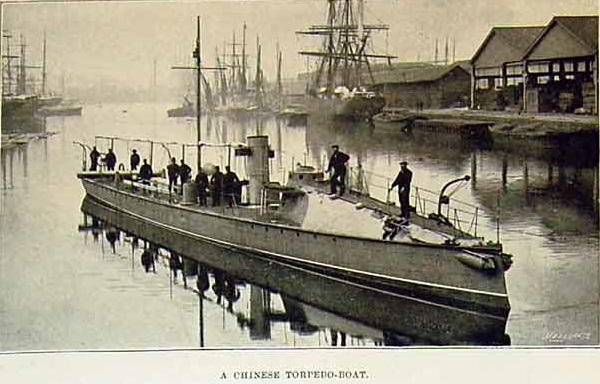
Fulong (福龙) 3 × 14" torpedo tubes (two forward, one aft) and either 2 × 37mm light cannon or 2 machineguns (probably the latter)
Tso Yih (??) presumably similar armament to Fulong

The Beiyang Fleet at the Yalu was organized into two wings;

Left Wing included the Jiyuan, Kwan Chia, Zhiwyuan and the flagship Dingyuan

The Right Wing included the Zhenyuan, Laiyuan, both Jingyuans, Chaoyong, and the Yangwei.

Pingyuan, Guangbing, and the two torpedo boats joined the Right Wing several hours after the opening of the engagement.

So two "ironclads" or pre-pre-dreadnought battleships, eight assorted cruiser types (or seven cruisers and a coast-defense ship), two corvettes, and two torpedo boats under the command of TITU (提督, the Qing rank equivalent to a modern USN four-star admiral) Ding Ruchang (丁汝昌, Dīng Rǔchāng)


Imperial Japanese Navy (大日本帝国海軍, Dai-Nippon Teikoku Kaigun) -


3 Matsushima-class protected cruisers -
HIJMS Matsushima (松島) 1 × 12.6" "Canet" gun barbette mount forward, 12 × QF 4.7" Mk I–IV guns, 16 × QF 6 pounder Hotchkiss guns, 6 × 1-pounder guns, 4 × 14" torpedo tubes
HIJMS Itsukushima (厳島) 1 × 12.6" Canet gun, 11 × QF 4.7" Mk I–IV guns, 5 × QF 6 pounder Hotchkiss guns, 5 × QF 3 pounder Hotchkiss guns, 4 × 14" torpedo tubes
HIJMS Hashidate (橋立) 1 × 12.6" Canet gun, 11 × QF 4.7" Mk I–IV guns, 6 × QF 6 pounder Hotchkiss guns, 2 ×QF 3 pounder Hotchkiss guns, 4 × 14" torpedo tubes

I can't really top what I wrote about these ships back in 2011, so I'll just paste it in here.
"The Matsushimas are a truly unusual vessel, and like many bizarrely entertaining and frivolously odd things, they are fundamentally French.

In the 1880s the young Imperial Japanese Navy was looking at a problem. Qing China, next on her list for a little European-style unequal-treaty fun, was arming up. The Germans had just delivered the two Dingyuan-class battleships; nothing Japan had could match the Dingyuan and Zhengyuan. Enter the French Navy. The Japanese were getting a little hinky about their dependence on the British, who at the time were rather cosy with the Qings. The then-Minister of Marine was a Francophile, and turned the IJN's interest to the French "Young School", which was then all excited about the idea of swarming enemy battleships with masses of light craft, cruisers, destroyers, and torpedo boats. The upshot of this was the arrival in the Japanese navel shipyard of one Emile Bertin. Starting in 1885, Bertin directed construction, either in France or at Yokosuka, of over 20 hulls, from torpedo boats to the Matsushimas. The latter were Japan's largest capital ships.

But they were utterly, absolutely weird.

These ships only displaced about 4,000 tons and mounted mostly light guns, 5-inch and below. But each one had a single, ginormous 12-inch cannon in a barbette. This so-called "Canet gun" loaded at the breech, but so frigging slowly that you could have timed the crew drill with a sundial and the effect of the monster gun firing was truly frightening; the entire ship would stagger, even seeming to lose way altogether. You couldn't train it abeam because the massive barrel would cause the cruiser to list so frighteningly it threatened to capsize. It was like one of those monster late-war Nazi tanks; huge, frightening, but practically useless."
2 Naniwa-class protected cruisers -
HIJMS Naniwa (浪速) 2 × 10"/35 guns in single mounts fore/aft, 6 x 6"/35 guns, 6 × QF 6 pounder Hotchkiss guns, 10 × 1" Nordenfelt guns, 4 × 11mm 10-barrel Nordenfelt guns, 4 × 14" torpedo tubes
HIJMS Takachiho (高千穂) armament as her sister Naniwa
Both of these warships were Armstrong-built "Elswick" cruisers purchased in the mid-1880s
1 "central battery ironclad" -
HIJMS Fusō (扶桑) 4 × 9.4" Krupp guns in recessed hull mounts, 4 × 6.7" Krupp guns, 8 × 3" guns (4 "long", 4 "short" barreled cannon), 2 × Nordenfelt quadruple machine gun
Fusō, along with Hiei, was really obsolete by 1894. These "central battery" or "casemate" warships were the first attempt by European naval architects to take advantage of the late-19th-Century technological advances in arms and armor. The idea was to - instead of dozens of smaller cannon firing straight out from the side of the ship - centralize several bigger guns near the center of the vessel inside an armored "box". The guns would be set in apertures recessed into the side of the hull with a sort of bevel fore and aft to allow them to pivot towards the bow and stern. Just what a craptacular idea this scheme is becomes quickly apparent; train the gun fore (or aft) so that the muzzle is right alongside the hull and the muzzle blast would likely set the sideplating (and anything else nearby) on fire and/or blast it to flinders. In practice battery-ship captains tended to fight broadside-on in the old style and navies quickly moved on to the deck-level barbette or rotating turret.
2 protected cruisers -
HIJMS Yoshino (吉野) 4 × QF 6"/40 guns (single mounts - gunshield-type fore and aft and in twin sponsons either side),8 × QF 4.7" Mk I–IV guns, 22 × QF 3-pounder Hotchkiss guns, 5 × 14" torpedo tubes
HIJMS Akitsushima (秋津洲) 4 × QF 6"/40 guns (single mounts, 2 forward, 2 aft),6 × QF 4.7" guns, 8 × QF 3-pounder Hotchkiss guns,5 x 1-inch Nordenfelt guns,4 × 14" torpedo tubes
Both new, fast, and powerful cruisers; Yoshino was an Elswick design built in Britain, Akitsushima a French Jeune Ecole design constructed in Japan after concerns developed about the intrinsic weirdness of the Matsushimas.


1 "belted" or light armored cruiser -
HIJMS Chiyoda (千代田) 10 × QF 4.7"/40 guns in single mounts (one each fore and aft, eight in two sets of four in side sponsons), 14 x QF 3-pounder Hotchkiss guns, 3 x 11mm 10-barrel Nordenfelt guns, 3 x 14" torpedo tubes
Chiyoda is often described as a "protected" cruiser but she was, in fact, an early "armored" cruiser based on the Royal Navy's Nelson-class iron armored frigates of the 1870s. Despite this she was a new ship, launched in 1890, and a relatively effective one for all that her main battery was poorly sited, the Big Fail of pre-turreted ships.
1 Kongō-class corvette -
HIJMS Hiei (比叡) 3 × 6.7" guns, 6 × 5.9" guns, 2 × 3"/1-pounder guns, 4 × 25 mm quadruple mount "pom-pom" guns, 2 × 11mm dual mount guns, 1 × 14" torpedo tube

Hiei was the other old feeb of the IJN present at the Yalu, a holdover from the earliest days of the Imperial Naval service in the 1870s. She was built at Pembroke Dock in Wales and was apparently quite the sensation. Here's a delightful oddiment that, while giving the overall history of the Dock, also provides us with the details of the construction of Hiei, including this treasure that's so perfect I can't just skip over it. Here you go:

"...the launch of Hiei on 9 June 1877 attracted many dignitaries of the time and created great interest and excitement among the population of Pembroke and Pembroke Dock. His Excellency Jushie Wooyeno Kagenori, Envoy Extraordinary and Minister Plenipotentiary of his Imperial Majesty the Mikado of Japan and Members of the Japanese Embassy attended, together with Prince Hachisuka ,Former Ministers ,Embassy Senior Staff,including the Consul General. Also attending were the British Admiral the Right Honourable Lord Clarence Paget, Chairman at the time of the Milford Haven Shipbuilding and Engineering Company and his Board of Directors, Pembroke Dock Mayor and numerous others. Mr. Reed's guests at a banquet in London were Dr and Mrs Schliemann (Discoverer of Troy) and Baron Reuter (Founder of the Newsagency). Celebrations began when the Japanese Ambassador and his party arrived by rail into the Royal Dockyard where they were wined and dined by the Captain Superintendent of the Dockyard. The Ambassador was presented to the Mayor of Pembroke Dock at Hobbs Point at 3.00pm and then proceeded on a serpentine tour of Pembroke Dock.

While proceeding along Bush Street, the procession arrived at the house of Mr. H A Jones– loyd , a solicitor ,where a pleasing and novel reception awaited the ambassador. A beautiful arch had been erected and upon a dais six or seven young girls in traditional Welsh costume presented an address of welcome to Lady Wooyeno."

(One can only imagine Lady Ueno's reaction of this little display, assuming that she could understand a word of it.)

"A pause at the Barrack Hill followed, to hear a song of welcome sung by local schoolchildren, then the party went up the hill to the site of the new Bethany Baptist Chapel in High Street where Miss Rose Reed (Sir Edward's Daughter) laid one of the foundation stones, after which another choir sang the Hallelujah Chorus. At the corner of Hill Street, Bufferland, another arch had been erected over the street. This was surmounted by a dragon made of wild iris leaves, a plant which abounded in the nearby marshy areas. It served equally well as it represented the dragon of Wales, though its colour was green and not red, while it served as a delicate compliment to the Ambassador and attendants by symbolizing the allegoric emblem of the East."

(I'm sure the Ambassador was...ummm...very touched by the...errr...delicate "compliment"...given that the dragon symbolized Qing China, the then-rival and eventual-enemy of Japan.)

Eventually the Procession eventually reached Lower Pennar at 5.30 p.m. in time for the 6.00pm launch. After the successful launch the Ambassador and his party attended a banquet after which there was a grand general illumination consisting of thousands of Japanese lanterns, balloons, peacocks and giraffes.

(Words fail me. Japanese lanterns, sure. But giraffes? Peacocks?)

"The banquet was held in the Victoria Hotel, situated at the top of Pembroke Street, Pembroke Dock, and quite the most opulent hotel in the town.. Eventually the Ambassador and his party were taken to Pembroke Dock railway station when the Japanese National Anthem was played prior to their departure for London."

(And I'll bet His Excellency and party had a lot to talk about on the trip back to the embassy. Wow.)
1 Maya-class gunboat -
HIJMS Akagi (赤城) 4 × 4.7" guns in single gunshield mounts, 4 × 2" guns, 2 x 30mm Nordenfelt guns

In addition to the warships the requisitioned civilian vessel Saikyo Maru with Chief of the Imperial Naval Staff ADM Kabayama Sukenori (樺山 資紀) embarked was engaged; the Akagi's defense of the unarmored merchie is quite a story in itself, and we'll get there in a bit.

For the engagement the IJN force was organized into two squadrons: the

Flying Squadron, composed of HIJMS Yoshino (flag, RADM Tsuboi Kōzō), Takachiho, Naniwa, and Akitsushima; and the

Main Body, composed of HIJMS Matsushima (flag, VADM Itoh Sukeyuki), Chiyoda, Itsukushima, Hashidate, Fusō, and Hiei.

The Saikyo Maru wasn't supposed to be involved at all but got stuck in because ADM Kabayama was a fucking lunatic, dragging poor little HIJMS Akagi in with her. This is him, by the way, looking every inch the madman you'd expect.

Overall, 12 vessels (11 warships): 9 cruisers (3 Matsushima-class protected cruisers, 4 protected cruisers, 1 "central battery"-type cruiser, 1 "belted" or light armored cruiser), 1 corvette, 1 gunboat, 1 auxiliary under Vice-admiral (海軍中将, Kaigun Chūjō, equivalent of modern USN 3-star admiral) Itō (or Itoh) Sukeyuki. (伊東 祐亨).

The Sources: As with Tsushima Strait, again we're dealing with two literate and bureaucratic adversaries that you'd expect to keep up-to-date official records in the form of things like orders, communications logs, after-action reports, briefings, damage and casualty returns, muster rolls and all the other bumf that industrial armies and navies generate.

Two problems.

First, neither of the combatants kept their records in English, so for an English-speaking observer the primary sources are difficult to access and impossible to read.

Second, the Beiyang Fleet - for all that it was better than anything Qing China had had for centuries - was a welter of corruption, mismangement, disorder, and barely-contained chaos. So for the one side the records are incomplete at best and completely missing at worst. Add to that the fifty-five years of foreign invasion, revolution, foreign invasion and revolution that followed this engagement it's pretty incredible that anything survived at all.


Fortunately for the English-speaker interested in the engagement a number of decent secondary sources exist to fill this void, including several contemporary or nearly so, including:

Eastlake, F.W. and Yamada, Y. 1897 Heroic Japan: A History of the War between China and Japan: S.Low, Marston&Co., London

Paine,S.C.M. 2003 The Sino-Japanese War of 1894-1895 Perceptions, Power, and Primacy: Cambridge University Press, NY, New York

Volpicelli, Z. 1896 The China-Japan War Complied from Japanese, Chinese, and Foreign Sources: Scribners, NY, New York

Xu, G. 2012 Sino-Japanese War (1894-1895), in China at War: An Encyclopedia, Xiaobing Li, ed. pp 11482-573. Santa Barbara, CA: ABC-CLIO,
A worthwhile primary source is:

McGiffin, Philo N. The Battle of Yalu, Personal Recollections by the Commander of the Chinese Ironclad 'Chen Yuen.' in The Century Magazine, Vol. 50, issue 4 (Aug 1895), pp 585-605 Available on-line here.
I can't pass this guy by without talking about him a little. Philo McGiffin was one of a group of people that you tended to run into a fair bit back in the day - Western officers out to make a name for themselves (or just collect a paycheck) amongst the Lesser Tribes Beyond the Law. These guys turn up first in numbers in India and the Middle East back in the 18th Century, mostly French and English (tho many of these "English" were actually Scots or Irish...) officers officially or privately working with native armies or navies either allied with or working in the interests of their home countries.

This breed of cat multiplied wildly in the Victorian Era, and by the middle 1800s you had white guys all over hell leading native troops, from Fred Ward and "Chinese" Gordon to "Kaid" Maclean and our man Philo. A lot of this was because the local rulers wanted Western technical expertise without taking the time and trouble to send their own guys out of the country to get it. So you get French "advisors" with the Sikh Army against the British at Chillianwallah and Russians with the Ethiopians against the Italians at Adowa or, as here, Germans, British, and Americans fighting with the Qing Imperial forces against the Japanese (who were, at least, nominally allied with Great Britain!).

Anyway, McGiffin sounds like he was a bit of a character in life and since has become a sort of mascot and legend at the US Naval Academy, where he is invoked as a sort of prankster spirit who was guilty of all sorts of spectacular misbehavior; we'll come back to him later, promise.

While not a primary source JSTOR provides a contemporary article by the then-U.S. Secretary of the Navy that discussed the combat factors involved and is well worth a glance:

Herbert, H.A. 1894 The Fight off the Yalu River, in The North American Review, Vol. 159, No. 456, November, 1894, pp. 513-528

Given the obscure (to Western mind) nature of this conflict I was not surprised to be unable to locate a detailed English-language works covering the engagement itself. The Wikipedia entry, while a decent example of the genre, admits this difficulty, noting that "(t)here is also no agreement among contemporary sources on the exact numbers and compositions of each fleet."


The Campaign: To know how we get to the Yellow Sea off the mouth of the Yalu River we have to first take a brief look at the "First Sino-Japanese War. In China this little fracas is known as the War of Jiawu (甲午战争, Jiǎwǔ Zhànzhēng) after the traditional year it was fought. The Japanese - since they couldn't agree with the Chinese about anything in those days - call it the Japan–Qing War (日清戦争, Nisshin sensō).

The Koreans, who were the ones who got fought over and got killed because other people were a bunch of greedy, venal, brutal, or simply incompetent pricks - as is the case in almost any and all wars - call it the Qing-Japan War (청일전쟁).

But whatever you call it, it was principally about greedy prickishness.

You can go to the Wiki entry and read about all the coups, "controversies", "incidents", "affairs", rebellions, hissy-fits, tantrums, chest-beating and dick-waving that brought Imperial Japan and Qing China to the battlefield, but the bottom line was that Japan, newly emerged from 400 years of isolation, was feeling tough and grabby and Korea was what they wanted to grab.

The Qing government has always considered Korea it's "near abroad". Even though the Qing "empire" was a bloody shambolic disaster by the end of the 19th Century this hadn't changed -enough - to accommodate the Japanese, who saw Korea as a sort of natural part of Japan only across the Yellow Sea and populated by Koreans.

Nobody asked the Koreans what the fuck they wanted, by the way.

So through the 1870s, 1880s, and 1890s Chinese and Japanese officials, officers and troopers did quite a bit of pushing and shoving in Korea and around the west Pacific. By the summer of 1894 things were getting ugly. Here's how the Wiki entry describes what happened next:
"A rebellion in Korea caused (the) Korean king to request Chinese troops on June 4 to aid in suppressing the Tonghak Rebellion. The Chinese government sent General Yuan Shikai as its plenipotentiary at the head of 2,800 troops. According to the Japanese, the Chinese government did not inform the Japanese government of its decision to send troops to the Korean peninsula, and in doing so failed to comply with the Convention of Tientsin.

In the face of China's violation of the convention, the Japanese countered and sent their own 8,000-man expeditionary force (the Oshima Composite Brigade) to Korea. Japan requested that China and Japan co-operate to reform the Korean government, which China refused. Korea requested that Japan withdraw its troops which Japan refused.


The Japanese force of 8,000 strong subsequently seized the king, occupied the Royal Palace in Seoul by early June 1894, and replaced the existing government with members from the pro-Japanese faction. A new government was formed July 25. The legitimacy of the new government was rejected by China, and the stage was thus set for conflict."
So. Trouble in Korea (what else is new?), China sends in the troops, Japan gets pissed and sends in their troops, grabs the palace in Seoul, China gets pissed.

Now everybody's pissed. With me so far?

Now here's where things get kind of weird.

In July 1894 the Qing outfit in Korea - part of the Beiyang Army (北洋軍, Běiyáng Jūn) had about 3,000 troops in the south end of Korea and another 10,000 or so in the middle of the country around Pyongyang. Don't ask me things like organization and equipment; I have no more idea than (probably) the Qing government in Beijing did then.

The appalling thing (to me, a modern U.S. soldier) about the Qing Chinese military is that there was no "Chinese Army" or "Chinese Navy".

Seriously.

After the human disaster we now call the Taiping Rebellion the already ridiculously awful Manchu "Eight Banner" forces (as well as the mob of "Green Standard" Han Chinese militia) pretty much dissolved into regional armies and navies. China didn't have "a navy"; it had a Beiyang Fleet, a Nanyang Fleet, a Fujian Fleet, and a Guangdong Fleet, all functionally separate and independent of each other. They didn't work together, they didn't train together, and they sure as hel didn't fight together.

One of the separate armies - the Huai Army (淮軍) eventually mutated into the Beiyang Army and branched out into the navy business as the Beiyang Fleet.

These two Beiyang organizations fought the Chinese part of the War of Jiawu; none of the other armies or navies even bothered to send a box of C-rations and a postcard.

The Beiyang troopers were at the far end of a looooong supply line. The reality of what a north Chinese peasant would have called "infrastructure" if he'd known there was a word for "infrastructure" for what passed for roads and bridges in Manchuria and Korea in 1894 was; none.

You couldn't supply a Chinese Army in Korea over land.

I know; that's hard for me to believe, too. But there it is; the Beiyang troops in Korea were as dependent as their Japanese enemies on their Navy to get their beans and bullets to them. So when the shooting started in Korea the Beiyang Fleet was critical to the Jiawu war effort. Convoys had to get through to Korea and that meant that the Beiyang swabbies had to get them there.

Meanwhile the war in Korea wasn't going so well. Right after the takeover in Seoul the Japanese Army sent a mixed force of about 4,000 south to hit the 3,500 Beiyang troops garrisoned at Seonghwan Station located east of the towns of Asan and Kongju. The two forces met on 28 JUL 1894 and the Chinese were whipped, running north towards Pyongyang. By the first week of August the Beiyang Army in Korea - about 13-15,000 all arms including reinforcements sent from North China - had fortified Pyongyang in an attempt to hold the southern part of Korea.

That didn't work, either; the IJA First Army assembled an two-division assault force of about 10,000 and stormed the place on 15 SEP 1894. The Beiyang defenders fought well but were outmaneuvered and broken in losing some 6,000 killed and wounded. The survivors broke out and fled west, towards Uiju near the mouth of the Yalu River. The Japanese lost 102 men killed, 433 wounded and 33 missing.


Meanwhile the Beiyang Fleet had been escorting convoys, bringing replacements and supplies to Korea. It was in the aftermath of escorting one of these convoys into the Yalu that the Chinese encountered the IJN's Combined Fleet. The Wiki entry explains it thusly:
"Even before the Battle of Pyongyang, Chinese Viceroy Li Hongzhang ordered reinforcements from the Beiyang Army to bolster the increasingly precarious Chinese position in Korea. As the roads were considered impassable, the only practical way to move a large number of men and equipment was by sea. However, he was constrained by orders from Beijing not to allow his ships to cross the line of the Yalu River, as the imperial authorities were reluctant to risk China's most modern western vessels in combat. However Emperor Guangxu was enraged that the Japanese fleet was near Chinese territory, so he insisted that the convoys be continued and that the Japanese fleet be pushed back. The Beiyang fleet had completed escorting a convoy to the mouth of the Yalu River, and was returning to its base at Lushunkou (Port Arthur) when it was engaged by the Japanese navy."
So far, so simple, it would seem. But - and you knew there'd be a but - there were some long-standing issues that come into play as the lookouts from the Beiyang squadron anchored off the mouth of the big river sight the first Japanese smoke.

The Beiyang Fleet was perhaps the best of the Qing navies. But this was a little like comparing it to the "best" of the French armies in 1940, or the "best" of the Republican candidates for President in 2008. The "best" just wasn't very good.

Part of this was the Qing government's fault. Allowing the idiotic "regional armies" and navies was a good example of Qing ineptitude, as was allowing the separate forces to become rivals and even enemies; the Nanyang Fleet, for example, hated the Beiyang Fleet for not helping them out against the French in 1884-85 and so returned the disfavor in 1894. The dysfunctional Qing court was unable to do anything about the administrative and logistical chaos that characterized Chinese government and military business in the second half of the 19th Century.

The Fleet didn't help itself, either. Corruption was endemic in the fleet as it was in most of Qing China; officers sold parts of their warships and looted training and equipment funds. Money was spent on the 1894-equivalent of Peruvian flake (opium...) and whores and the ammo ready racks were weighted with coal or rocks. Supposedly gunnery officers filled shells with sand or coal because there were no explosives. Many of the matelots were, like many Chinese of the time, addicted to opium - the "black smoke" - and were poorly trained when they were sober enough to work.

But they could fight when they had to; we'll see that.

So on the morning of 17 SEP the Beiyang Navy was in trouble long before the first round went downrange. At least the morning was pretty; McGiffin (1895) reported:
"The next morning, Monday, the memorable 17th of September, was a beautiful day, a light breeze gently ruffling the surface of the water. The forenoon was passed as usual. At 9:15 each ship went to general quarters, cleared for action, and for an hour exercised the crew at the guns, no one dreaming that the results of our training were so soon to be tested. As usual, the crews were full of spirit..."
But the fun was over not long after lunchtime. McGiffin (1895) again:
"...the Chen Yuen’s forenoon routine, drills and exercises, had been carried out, and the cooks were preparing the midday meal, when the smoke from the enemy’s ships was sighted by lookout men at the masthead. They were made out almost simultaneously from several vessels, and before even a signal could be made from the flagship the bugles throughout the fleet were sounding merrily the "officers’ call" and "action."

Columns of dense black smoke shooting upward from our funnels told that in the depth of each vessel the stokers were spreading fires, and, using forced draft with closed stoke-holes, were storing up energy in the boilers, that breath might not fail when most needed in the coming fight. These black pillars of smoke must have signaled our presence to the enemy; for their "smokes" now increased in volume and height, showing that they also had put on forced draft, and, like ourselves, were preparing for the contest.

For weeks we had anticipated an engagement, and had had daily exercise at general quarters, etc., and little remained to be done. There were woeful defects in our ammunition supplies, as will be seen; but had we kept the seas for a year longer before fighting, there would have been no improvement in that respect, since the responsibility for the neglect lay in Tientsin. So the fleet went into action as well prepared as it was humanly possible for it to be with the same officers and men, handicapped as they were by official corruption and treachery ashore."


The Engagement: To get a picture of what was happening LT McGiffin has given us a decent map of the opening movements. One thing to note is that for reasons of his own McGiffin or his cartographer has decided to make north down instead of the conventional up, so south is towards the TOP of the mapsheet:


"Our actual formation," he says, "which has justly been criticized, was an indented or zigzag line, the two ironclads in the center, as shown in the diagram."

Justly indeed; it's hard to imagine a worse way to come out to fight a fleet action.

Despite the advent of turreted or barbette-housed guns on a single deck most of the Qing warships still had many, or most, of their batteries on one side or the other. Firing directly forward reduced the Beiyang Fleet's firepower considerably. Add to that the difficulty of maneuvering a fleet in a broad column opposed to a line-ahead and you've got a real problem.

Meanwhile the IJN was coming on in good order and ready to fight. McGiffin (1895) describes how it looked from the Beiyang flagship:
"The Japanese formed into two squadrons: The Flying Squadron, consisting of the Yoshino (flag), Takachiho, Naniwa, and Akitsushima, led, followed by the Principal Squadron, composed of the Matsushima (flag of Admiral Ito, commander-in-chief), Itsukushima, Hasidate, Chiyoda, Fuso, and Hiyei. On the unengaged side were the Akagi and Saikio. These twelve Japanese ships, forming apparently a single line and preserving station and speed throughout most beautifully, could not but excite a feeling of admiration."
The Japanese commander ADM Itoh intended to cross the Chinese "T" and directed his advance "Flying Squadron" to turn the Chinese right and hit McGiffin's "lame ducks", the protected cruisers Chaoyong and Yangwei. Along with the problems inherent in the bizarre formation the Beiyang warships also suffered from having to fire at rapidly moving targets that were divided into two smaller units.

The sensible option at this point would have been for the Beiyang squadron to execute a turn together either to the left or right. They didn't, and in the hundred and nineteen years several theories have been proposed for why.


One is treachery. Supposedly TITU Ding did command a fleet maneuver that would have turned towards the IJN squadron but in the process exposed the flagship to the worse of the Japanese fire. As cited by Paine (2003), LT William Ferdinand Tyler, RN (who was aboard the flagship) claimed that the Dingyuan’s captain ordered the main battery to fire with the guns bearing directly forward. According to Tyler this was knwn to be a problem dating back to 1883, when the German builders determined that firing the main battery directly forward resulted in the destruction of the ship's own flying bridge. Tyler claims that Ding was wounded and out of action after this fragging along with most of his staff and senior officers. I find this unlikely, as McGiffin's account suggests that this supposed design flaw - a rather serious one for a large warship - was not shared by the Dingyuan's sister.

Allen (1898) claims that TITU Ding was advised by a German army officer, one Major Constantin von Hannecken, who treated the engagement like a land battle and thus lost it.

Whatever the reason, the Beiyang Fleet held it's course and speed and the Dingyuan opened fire at 12:20pm.
"The fleets closed on each other rapidly. My crew was silent. The sublieutenant in the military foretop was taking sextant angles and announcing the range, and exhibiting an appropriate small signal flag. As each range was called the men at the guns would lower the sight-bars, each gun captain, lanyard in hand, keeping his gun trained on the enemy. Through the ventilators could be heard the beats of the steam pumps; for all the lines of hose were joined up and spouting water, so that in case of fire no time need be lost. The range was about four miles, and decreasing fast. "Six thousand meters!" "Five thousand eight hundred" "six hundred" "five hundred!" "Five thousand four hundred!" The crisis was rapidly approaching. Every man’s nerves were in a state of tension, which was greatly relieved as a huge cloud of white smoke, belching from the Ting Yuen’s starboard barbette, "opened the ball." Just as the projectile threw up a column of white water a little short of the Yoshino, a roar from the Chen Yuen’s battery seconded the flagship’s motion. It was exactly 12:20 P.M. The range, as found on the Chen Yuen, was 5200 meters; on the Ting Yuen it was assumed to be 5300. On our side the firing now became general from the main batteries, but it was about five minutes before the Japanese replied." (McGiffin, 1895)
Almost as soon as the engagement began Beiyang Fleet suffered its first loss; the captain or the officers of the protected cruiser Jiyuan put the vessel's helm hard over to starboard and ran her down the back of the entire squadron running for Lüshunkou (Port Arthur).

The corvette Kwan Chia was right behind her. McGiffin (1895) notes contemptuously that her commander's "...courage was scarcely exceeded by his knowledge of navigation; for, about midnight, he ran upon a reef outside of Ta-Lien-Wan, which he said was a most unaccountable mishap, as he had laid his course (in a 100-mile run) "to clear it by one and a half miles"!"

The fight had barely begun, the Left Wing had already lost half its force and Beiyang Fleet was down to eight warships against twelve.


For the next 90 minutes or so both fleets pursued their separate plans. The Beiyang Fleet continued to steam slowly southwards in line abreast firing at whatever Japanese ships they could hit. The Japanese "Flying Squadron" crossed the Beiyang "T" and turned to close on the far end of the Chinese line where the two Chaoyong-class cruisers were posted while the Main Body engaged the Chinese left, which by this time was pretty much the two barbette ships the flagship Dingyuan and her sister Zhenyuan.

While the goofed-up Chinese formation was a problem, a much bigger problem turned out to be the difference in the type of heavy guns the two sides had mounted.

In the main the Beiyang warships were outfitted with the earlier models of breechloading artillery. These tended to be fairly short-barreled, relatively slow to reload and train, and fired with a relatively low muzzle velocity; the main battery on the Dingyuan is a good example of this sort of weapon:

Because they were so slow to fire these guns had terrific trouble hitting a target moving rapidly sideways; this is what in artillery is called "traversing fire" and it has always been a difficult skill.

Until the advent of a mount that could turn from side to side it was just impossible; the only way to hit such a target was to swing the entire ship, so it isn't surprising that the "tactic" for the muzzleloading, broadside-mounted cannon was to get reeeeeal close and shoot like a sonofabitch.

A target that is moving towards or away from you just adds to the difficulty. This is called "searching fire", and you combine the two and you have a "traverse and search" mission that is difficult even for a modern fire direction center with the ability to digitally compute the firing solution and produce gunlaying data.

So the Chinese gunners had a hell of a bad job. They had to try and track the faster Japanese ships moving across their bows and closing the range at the same time. That would have been a tricky job even for a central fire direction system, let alone the "system" the gunners of 1894 had.

Modern warships use a single control system for their guns (and all their other weapons, obviously...). Warships of the pre-dreadnought era - such as the warships at the Yalu - still relied on the individual gun captains, or the captains of individual turrets, to point the guns using simple optical sights attached to the cannon itself. This is a pretty crude system that was more difficult for the Chinese because of the arcing trajectory of their lower velocity shells.

McGiffin (1895) has a nice diagram of this:


His Japanese ships (on the right) are shooting high-velocity projectiles. The projectile travels in a relatively flat arc, and as a result is fairly simple to put on a target that is at the same elevation as the gun (land artillery has the issue of topography, which complicates matters immensely...). The Chinese gunners, firing from the left, have to use a sort of windage to drop the round on their target, making getting a hit like trying to toss a tennis ball into a moving bucket fifteen feet away. It's not easy and then remember that the bucket is throwing big fucking explosive bullets back at you while you're trying.

You can see how hard that could be.

So it's a credit to the Beiyang Fleet that its gunners did as well as they did. McGiffin (1895) paints a picture of the opening moments of the engagement:
"On our side the firing now became general from the main batteries, but it was about five minutes before the Japanese replied. As they opened fire, the Chinese quick-firing Hotchkiss and Maxim-Nordenfelt, 3- and 6-pounders, joined in, and thenceforward the conflict was almost incessant. Like ours, the enemy’s first shots fell short; but with an exultant chuckle we noted that a shot from one of our 12-inch guns had struck one of the Japanese leading ships. The bridge of the Chen Yuen, although some thirty feet above the water, was very soon soaked, as was, indeed, the entire exposed surface on the engaged side, by spray thrown up by line shots that struck the water a little short. Many of the men at the guns on deck were wet through, and indeed the water was flung on board with such violence as to sting the face and hands like hail. Every one in the conning tower had his ears stopped with cotton, yet the din made by projectiles rattling up against the outside of its 10-inch armor was a serious annoyance."
Notice that Philo talks about the irritating shell-splash and the sound of the shell fragments on the armor but doesn't mention how the Zhenyuan's flying bridge got blown off?

Yeah. Me neither.

That's why I don't buy the Tyler story cited above, the one about TITU Ding getting blown off his own bridge by the scaredy captain. Zhenyuan must have had a very similar if not identical firing solution to the Dingyuan, ranging from some acute angle off the bows to straight on, and yet there's no mention of this freakish design flaw where the muzzle-blast rips off the whole bridge superstructure.


But...some Beiyang ships did get blown to flinders. Here's McGiffin (1895) again:
"...the (Japanese) Flying Squadron...upon reaching our right flank, turned it and poured in a heavy cross-fire on the extreme wing, the Chao Yung and Yang Wei receiving the most of it. From the first these two old-fashioned cruisers were doomed. Two passageways in each superstructure connected the bow and stern 10-inch guns, on the outboard side of each being officers’ quarters, etc., the partitions and bulkheads being of wood highly varnished and oiled. The vessels were early set on fire, and the draft down these passageways at once turned them into alleys of roaring flame. The machine-guns overhead were thus rendered useless, the deck being untenable, and the bow and stern guns were isolated from each other and from their magazines. As a forlorn hope, the ill-fated vessels made for the nearest land."
Kind of a design flaw, all that pretty lacquered wood, eh? The naval architects of the time hadn't quite "got it", the deadly danger of high explosive shells against wooden warship or wooden parts of warships.


So at this point - probably some time between 1:30 and 2:00pm - the Beiyang Fleet has lost 4 of the 10 warships it opened the engagement with; two to enemy action, two to panic fear (or sensible cowardice, take your pick...) and the IJN is making fairly hard way amongst the survivors. Or, at least some of the IJN warships are. Both fleets' formations by this time are getting pretty ragged, and this leads both the Akagi and Hiei into trouble.

Well, it leads the Hiei into trouble.

What leads the Akagi into trouble is that idiot Kabayama aboard the Saikyō Maru.

McGiffin (1895) says that as the two Chinese Chaoyung-class cruisers drifted out of line afire the mad samurai ordered his converted passenger ship to chase down the Chinese vessels so...he could hit them with his sword, or some such damn thing.

"The Japanese armed transport Saikio, seeing their plight and intention, made for them;" says McGiffin, "whereupon the Chinese ironclads fired a few shots at her at long range, making fair practice; for, according to Japanese report, she received at least four 30.5-centimeter projectiles."

In fact the situation for Japan's Chief of Naval Staff and the poor helpless buggers he dragged with him on his personal death-ride were in worse shape than that. The cruiser Laiyuan closed on the liner and her escort Akagi first to 800 and finally to 300 meters; practically boarding range.

In the exchange of fire the Akagi was hit repeated by 8-inch projectiles. Her bridge was wrecked and her captain and most of his staff killed and then hit again, wounding the senior lieutenant that had taken command. For an hour the two ships pasted each other. Among the other damage to Akagi a Chinese shell got into her lower deck spaces and severed a a steam line. "Hot steam cut off access to her magazine, and shells have to be hand-fed through a broken vent to reach her guns." (Wiki, 2013)


Finally the combination of Japanese high-explosives and Chinese wooden upperworks produced an onboard fire so intense that Laiyuan could no longer maneuver and had to break off the action. Akagi took no further part in the engagement as well, however, as her crew was tied up in damage control. Amazingly enough for all the horrendous pounding she took Akagi lost only 11 killed and 17 wounded out of her complement of 111 and had effectively destroyed Laiyuan as a combat unit.

By 2:00pm the Beiyang Fleet had been pretty well shot to pieces. Chaoyyung, Yangwei, and Laiyuan were burning and unfightable and the two left-wing vessels fleeing and out of contact. At this point ADM Itoh seems to have determined to close with and destroy his enemy. McGiffin (1895) says: "The flagship Matsushima, leading the Principal Squadron, had now reached our right wing, and, flanking it, steamed down again on the opposite course."

The intent here seems to be to sail completely around the Chinese squadron. This prospect, however, wasn't particularly appealing to the captain of the last ship in line, Hiei, who decided to take advantage of the disintegrating Chinese formation rather than sail right across the front of it.
"The Hiyei, the last of the Principal Squadron, was now almost ahead of the Ting Yuen, having been engaged by the Chih Yuen on our flagship’s left. Her distance from her next in line ahead was increasing, and her captain, presumably seeing that his slow old ship could not keep up with the rest, and, being already on fire, fearing to continue on and receive the fire of both ironclads and of the King Yuen, Lai Yuen, and Ching Yuen, boldly decided to make a short cut between the two ironclads and rejoin his comrades on the other side. This was splendidly done. As his ship passed between our two big ships we fired into her point-blank. It was impossible to miss, and flying material showed that we did not. The smoke increased in volume and rolled up from the Hiyei’s quarter-deck and poop as high as the mizzentop, the ship yawing wildly at the same time. We considered her "done for" — as doubtless she would have been had we used shell — one shot, for instance, passing diagonally through the ship from one bow to the opposite quarter, doing various minor damages. Had it been a live shell the result may be imagined." (McGiffin, 1895)
Hell of an adventure for the crew of the Hiei, but despite her adventure she was lucky.

The Beiyang Fleet was not.


Itoh's maneuver had placed the remaining Chinese warships between his Main Body to the north and his Flying Squadron to the southeast. Remember that the original disadvantage the Chinese warships suffered was painfully slow rate of fire. Now they were forced to divide their fire between the two Japanese elements, further reducing the weight of metal the Chinese could put on any one target. Meanwhile the Japanese were continuing to pour fire into the already badly knocked-about Beiyang squadron.

The main targets were the two big turret ships.

"The Principal Squadron now seemed to ignore the four smaller Chinese vessels," says McGiffin, "...and its five ships steamed around our two ironclads, pouring in a storm of shell. Time and again fires broke out, but, with one notable exception, the flames were subdued without much trouble. Some of the enemy’s ships used melinite shells, the noxious fumes from which could at once be distinguished from those of powder. One ship, for a time, practiced "broadside firing by director"— i.e., each gun is laid by its crew on the object, and the entire battery, joined in one electric circuit, is fired by pressing a key. This system, though doubtless hard on the structure of the ship using it, was most effective — the result of so many shot striking at once, and producing perhaps several fires, being very annoying."

I'll bet.

Some time between 2:30 and 3:00 the Chinese squadron was reinforced by the arrival of the cruiser Pingyuan, corvette Guangbing and two torpedo boats; the Zhiwyuen swings east around the back of the two big turret ships to join the new arrivals and join them in giving Saikyō Maru hell. Here's McGiffin's situation map for about this time. Again, remember north is towards the bottom of the map:


So it's midafternoon, everyone's still pinging away, ships are afire and some (Yangwei, for example, and Hiei) are basically no longer worried about fighting but simply surviving, when the commander of the Chinese cruiser Zhiwyuen gets a wild hair. He firewalls the throttle and turns out of line towards the Flying Squadron, possibly with the intention of ramming, seeing as how the whole projectiles-filled-with-cement-and-sawdust thing isn't working out as well as the corrupt munitions suppliers and gunnery officers hoped it would.


This doesn't work well, either. McGiffin (1895):
"Just what happened no one seems to know, but apparently she was struck below the waterline by a heavy shell — either a ten-inch or a thirteen-inch. Be that as it may, she took a heavy list, and, thus fatally injured, her commander, Tang Shi Chang, a most courageous albeit somewhat obstinate officer, resolved at least to avenge himself and charged one of the largest vessels, intending to ram. A hurricane of projectiles from both heavy and machine guns swept down upon his ship, the list became more pronounced, and just before getting home to his intended victim his ship rolled over and then plunged, bows first, into the depths, righting herself as she sank, her screws whirling in the air and carrying down all hands, including the chief engineer, Mr. Purvis, a gentleman and a most efficient officer, who was shut up in the engine room. Seven of her crew clung to one of the circular life-buoys kept on the bridge, and were drifted by the tide toward the coast, where they were rescued by a junk."

You'd think that a notoriously corrupt, mismanaged, and nepotistic naval organization would have fallen apart by this time, sauve qui peut, every squid for himself, but you wouldn't have reckoned with the Beiyang Fleet. In fact, it was late in the engagement that the Zhenyuan dealt the Japanese flagship a hell of a knock.
"At about three o’clock the Matsushima closed upon the Chen Yuen to about 1700 meters, and we fired at her, from one of our 12.2-inch guns, a steel shell of 5 calibers (5x12.2-inches) length, having a bursting-charge of nearly ninety pounds of powder. The Japanese flagship was struck by this missile, and as a burst of flame arose from her, followed by a great cloud of white smoke, hiding her entirely from view, our gun’s crew yelled their satisfaction. This shell indeed wrought frightful havoc. From the Japanese report it totally disabled the big 13-inch Canet gun and swept the decks. Several charges of powder for this gun had been massed on deck, and these, exploding, gave the gunners a true "hoist with their own petard." By this one shell forty-nine officers and men were instantly killed, and over fifty wounded; the gunnery lieutenant was blown into the sea, his cap and telescope being all trace of him ever found on the ship." (McGiffin, 1895)
This nasty reminder that the Chinese guns were still dangerous at close range might have convinced ADM Itoh to stand off, for at or near this time the IJN Main Body turned away to the southeast. The two Dingyuan-class followed as best their speed could allow, although McGiffin (1895) says that the only weapons still firing were the 12-inch main battery; all other rounds had been expended.


This isn't such a good idea. The IJN is still faster, more maneuverable, and capable of putting more rounds downrange than the Chinese warships. The Main Body decides to deal forcefully with this Chinese snook-cocking. McGiffin (1895) again:
"When they had gone a distance of two or three miles the Principal Squadron turned, and, circling about us, poured in perhaps the most destructive fire we received during the day. We had now used up all of our 6-inch ammunition, having fired 148 projectiles of that caliber. There were left for the 12-inch guns (one of which was disabled) only some 25 steel shot, and no shell. The Ting Yuen was in a similar plight. In half an hour we would have none left, and be at the mercy of the enemy; for to ram agile, well-handled ships of 17½ knots speed with our slower ships was out of the question. We fired carefully, but having no shell, comparatively little damage was done. It was now nearly five o’clock. After about a half-hour’s cannonade the enemy again with- drew, we firing our last shot at them, save three left in the guns for the last moment."
This was the last real fighting of the day. The IJN withdrew out of range.

TITU Ding turned his flagship and her companion back to the remnants of his fleet. These had not fared well.

The 1886 Jingyuen had been pounded to pieces by the Flying Squadron; McGiffin says that "(a)fter covering the Saikio, Hiyei, and Akagi, the van (of the Flying Squadron) bore down on the King Yuen, which had been burning for some time, and the Yoshino with her next astern engaged the King Yuen at close range (less than 2000 meters). A heavy fire from the Yoshino’s three 6-inch quick-firing bow guns told upon her with terrible effect. One after another of the 100-pound shells tore up her sides, and after yawing about wildly, as if her steering gear was useless, she burst into flame and sank."

The Chinese admiral gathers his battered fleet and makes steam for Lüshunkou shadowed by the IJN. The Chinese squadron was barely serviceable, while the Japanese showed no enthusiasm for re-engaging.

The Battle of the Yalu River is over, and by morning the Beiyang fleet is safe in port.

The Outcome: Japanese tactical victory

The Impact: The main benefit Japan gets from her victory at the Yalu is propaganda. In a sense, the only way the Yalu "works" is counterfactually. If the Beiyang Fleet had been able to destroy Japanese seapower and control the Yellow Sea China might have been able to counterbalance the advantage Japan had on the ground. But Qing military incompetence was thorough and extended out to sea as well as on land. To have managed to get his ships to the Yalu in good order, well trained and equipped, and well-led enough to have had a chance to defeat the IJN TITU Ding would have had to be a magician, not a naval officer, and he was barely the latter.

Even so, many observers were impressed by the fighting quality of the Beiyang sailors. Herbert (1894) says flat-out that he considered the Yalu to be nearly a draw and that with better ammunition the Chinese might have gotten the better of the day.

But in fact the defeat meant that the IJN took control of the Yellow Sea and never lost it. The remains of the Beiyang Fleet remained bottled up in port, first at Lüshunkou and then Weihaiwei where a combined land-sea assault captured or destroyed the ships that escaped the Yalu. The outcome of the war was foreordained from the start. The antiquated, poorly managed, badly led Chinese forces were doomed.

However, in the larger sense the sweetness of the win at the Yalu, and the overall success over her old rival China, only served to bitter the cup that Japan was forced to drink after the war at the hands of the European Powers.

The so-called Triple Intervention that forced her to abandon her spoils was a shocking betrayal to the Japanese and especially to the elites of the Imperial Court who had seen the war as a path to an imperium in Asia. The resulting anger led first to the Russo-Japanese War and later to the campaigns of the Thirties and Forties to chew off more of the Chinese mainland. From there, to the Great Pacific War that changed Japan completely.

For the Chinese, the lesson of the Yalu and of the humiliations that followed was that the old ways were the wrong ways; that while you might not make good man into soldiers any more than good iron into horse-shoe nails there were times when you needed those nails and those men, like when foreigners with ill intent showed up to beat and rob you. What the Japanese did in China was perhaps worse than any atrocity of the Westerners. The big-noses were barbarians, after all. The Japanese were fellow Asians, products of generations of influence of Chinese culture. Their barbarism was infuriating.


That anger fueled the 1911 revolution and, when that revolution in turn decayed in corruption and nepotism, the rise of Mao and the Great Revolution of 1949.

An anger that we are still living with today.


Touchline Tattles: As you'd expect, pretty much all the human interest stories that emerge from the Yalu are grim. Here's Philo McGiffin with a tale of a man and his dog: "Captain Tang (of the cruiser Zhiwyuen) had a large dog of a most vicious temper, unruly at times even with his master. After the ship sank Captain Tang, who could not swim, managed to get to an oar or some small piece of wood — enough to have supported him had not his dog swum to him, and, climbing up on him, forced him to release his grasp and thus miserably drown, the brute sharing his fate — perhaps the only case on record of a man drowned by his dog."

Bad doggie.

The story of Philo himself is a pretty wretched one. Although he doesn't mention it in his tale he was badly torn up with shell fragments at Yalu. Here he is, looking like one large walking bandage:

He was released from Chinese service and returned to the States, still in hellish pain and - I suspect - serious PTSD. It was this that managed to get him committed to the Graduate Hospital in New York City.

Here's a piece of one of his letters discussing how the docs there recommanded that he have a little operation to help him "feel better": "I know that I will have to have a piece about three inches square cut out of my skull, and this nerve cut off near the middle of the brain, as well as my eye taken out (for a couple of hours only, provided it is not mislaid, and can be found). Doctor ---- and his crowd show a bad memory for failures. As a result of this operation others have told me--I forget the percentage of deaths, which does not matter, but--that a large percentage have become insane. And some lost their sight."

Finally the physical and mental pain became too hard to bear. McGiffin asked his nurse for his personal effects box, and then asked this individual to run another errand for him.

In the box along with his other belongings was his service pistol.

At the end of his 1895 Century article McGiffin wrote a valedictory to his commander at the Yalu.

Of Admiral Ding he said:
"Chief among those who have died for their country is Admiral Ting Ju Chang, a gallant soldier and true gentleman. Betrayed by his countrymen, fighting against odds, almost his last official act was to stipulate for the lives of his officers and men. His own he scorned to save, well knowing that his ungrateful country would prove less merciful than his honorable foe. Bitter, indeed, must have been the reflections of the old, wounded hero, in that midnight hour, as he drank the poisoned cup that was to give him rest."
Perhaps he was thinking of that cup on the February day as he raised the revolver from its box, and of what George Santayana would say more than 25 year later; that only the dead have seen an end to war.