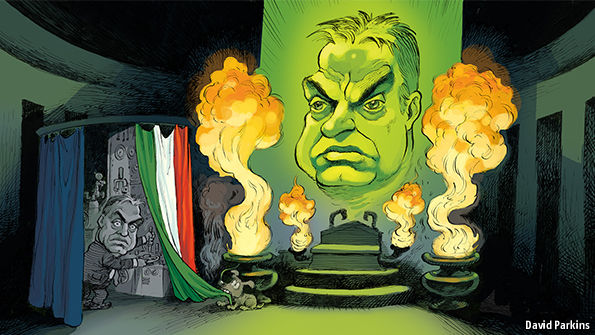
President Trump's EU pash, Viktor Orban, is now officially the Dictator of Hungary.
Somewhere in the bowels of the White House Stephen Miller does a little dance.
I'm as terrified of this plague as anyone, but I'm almost equally terrified of our little American Orbans and their orange Leader. War and pestilence are the great enablers of dictators. It is when We the People are the most fearful and beaten that we are willing to trade liberty for "safety". We will get neither - especially given that these new dictators worship the old Gods of the Gilded Age that mean more profits for themselves - but those of us who prize "security" over that liberty will surely be tempted.
And, given our recent history, I cannot be sure we can resist that temptation. Four of ten Americans have already shown they will gleefully support any amount of destruction to small-r republican mores if it means shuttering drag queen story hour and keeping the dusky heathens in their place.
It will be intriguing to watch the reaction to this from the EU. If the leader of a European nation can become an out-and-proud dictator without consequence, what will stop those others (looking at you, Poland...) who are teetering along the border?
Did I mention lately how I reeeeeeally hate this timeline?
Showing posts with label Europe. Show all posts
Tuesday, March 31, 2020
Tuesday, March 22, 2016
Strategic Bombing
For the record; Brussels is the EU capital, and the EU is and has been deeply involved in fighting in North Africa and the Middle East. The Belgian "air component" (the air arm of the Belgian armed forces) has been bombing the Islamic State in Iraq and Syria. Obviously, none of that "justifies" blowing up women and kids in train stations and airports.
But at the same time let's be adults; if you're part of fighting a "war on terror" you shouldn't be surprised when terror fights you back.
I thought we learned that sixty-odd years ago. The people who died under the bombers in London and Berlin and Tokyo were "innocent civilians", too, and they died in their job lots for their leaders' policies. For American politicians to act outraged about this is an insult to We the People's intelligence. This is war, the war our politicians have argued for and supported for years now. This is as expected and expectable thing in a war as the sun rising.
Innocents die in war. If you don't like that, your only real option is not to fight one.
Labels:
"war on terror",
Belgium,
bombings,
Europe,
Islamic State,
war
Thursday, December 18, 2014
Russia's "interesting position" gets a little more interesting
Back in August (when the Guns of August were thundering in the eastern parts of was still nominally "Ukraine") over at MilPub my buddy Al wrote about the Curious Case of Russia. He noted that:
Well.
I'm kind of intrigued by this for several reasons.
One is that it tends to reinforce my suspicions that the rump-Soviet state is, in fact, what I called it back in August: "...a lot of the Soviet weaknesses...overlaid...with 1) a thicker layer of corruption and 2) an excessive, almost-Nigerian-level of extraction resource dependency." The Post article makes an interesting point, that:
The other is that it gives me a nasty little cat-smile remembering all the Usual Idiots who were fulminating about how manly Vladi Putin was and how the United States needed a sharp dose of his shirtless manly manliness to counteract the emo-girly-man Kenyan Usurper.
To quote O'Brien from the Post: "At this rate Putin will be riding around shirtless because he can't afford one anymore."
Perhaps the single most worrying part about this is the reminder that Russia - still a major Eurasian power and a nuclear one at that - is neither stable nor as powerful as it thinks it is.
This isn't to talk up my own country, whose political response to the Great Recession has been to double- and triple-down on the great shift to oligarchic meanness and stupidity that characterized the fucking Hoover Administration, but to note that for all that my country seems to be overrun with morons who think that "government is the problem" that if you deliberately set things up to govern badly it will be badly governed. And that after a bad government the next-worse idea is to turn the levers of power over to a bunch of rich pricks whose only concern is their own profit. That's the sort of thing about the incoming Republican Congress (as expressed recently in the loathsome Wall Street Welfare rider to the cromnibus spending bill...) that makes me sleep poorly at times.
But I don't think I'd be sleeping nearly as well if I lived in Gdansk, or Tallinn.
"The Cold War was primarily a standoff between two military powers. The Soviet impact on, and involvement in, the world's economy was negligible. Probably one of the major reasons the USSR collapsed. It was Soviet military, and the resultant political power, that we wanted to keep in check. We are now dealing with a new Russia, and that new Russia has become an economic player far greater than the old Soviet Union. Now, when Russia rattles it's political saber, there are economic ramifications of concern. Yet we still seem to be stuck in the Cold War mentality that Russia is always to be opposed."and quoted an editorial from one of the Athenian newspapers that in their opinion "...a "stable and powerful Russia" is a key ingredient to global economic security."
Well.
I'm kind of intrigued by this for several reasons.
One is that it tends to reinforce my suspicions that the rump-Soviet state is, in fact, what I called it back in August: "...a lot of the Soviet weaknesses...overlaid...with 1) a thicker layer of corruption and 2) an excessive, almost-Nigerian-level of extraction resource dependency." The Post article makes an interesting point, that:
"There's one way, and only one way, that this ends: with capital controls. Or, in plain English, by making it illegal for people or companies to turn their rubles into foreign currency. That would get rid of the selling pressure, and let the ruble settle at a new, lower equilibrium. Putin, though, is loath to use capital controls, because his political base—the oligarchs—wants to move their money abroad, whether that's to their London or New York hideouts."So the "tyrant" is an economic hostage to his political condotierri, another little reminder of the old saying about doing anything with bayonets (or in this case, the long knives of your criminal crony-capitalist "pals"...) except sitting on them.
The other is that it gives me a nasty little cat-smile remembering all the Usual Idiots who were fulminating about how manly Vladi Putin was and how the United States needed a sharp dose of his shirtless manly manliness to counteract the emo-girly-man Kenyan Usurper.
To quote O'Brien from the Post: "At this rate Putin will be riding around shirtless because he can't afford one anymore."
Perhaps the single most worrying part about this is the reminder that Russia - still a major Eurasian power and a nuclear one at that - is neither stable nor as powerful as it thinks it is.
This isn't to talk up my own country, whose political response to the Great Recession has been to double- and triple-down on the great shift to oligarchic meanness and stupidity that characterized the fucking Hoover Administration, but to note that for all that my country seems to be overrun with morons who think that "government is the problem" that if you deliberately set things up to govern badly it will be badly governed. And that after a bad government the next-worse idea is to turn the levers of power over to a bunch of rich pricks whose only concern is their own profit. That's the sort of thing about the incoming Republican Congress (as expressed recently in the loathsome Wall Street Welfare rider to the cromnibus spending bill...) that makes me sleep poorly at times.
But I don't think I'd be sleeping nearly as well if I lived in Gdansk, or Tallinn.
Labels:
economics,
Europe,
petroleum industry,
Russia,
U.S. foreign policy
Monday, November 10, 2014
Named in vain
Fascinating.
For centuries the Jews of Europe were in but not of the places they lived, kept apart by a combination of tradition (much of it horrible) and law (much of it unjust and punitive). The tradition of patro- and matronymics rather than surnames was just one small part of that strange world where an entire people were held at lethal distance from their neighbors through generation after generation.
In our own country we can still see the deep scars left by the imprisonment of one race by another, even now, more than a century after the formal dissolution of that bond. What scars did the imprisonment - both physical, in places like urban ghettoes as well as within entire regions such as the Pale of Settlement, and social - of the Ashkenazim leave on both the "prisoners" and their "jailers"?
It is difficult for me to imagine how this must have seemed at the time. Did a man of my age and nature resent being told to take some name that meant nothing to him in contravention of hundreds of years of tradition? Or would he have seen it as just another day in the life that offered little justice and less mercy from the goyische world the surrounded him? Would hearing his new "name" have produced tooth-grinding rage, or a resigned sigh?
We know so much of our relatively-recent past and, yet, things like this remind us that we often know much less than we think we know.
"Ashkenazic Jews were among the last Europeans to take family names. Some German-speaking Jews took last names as early as the 17th century, but the overwhelming majority of Jews lived in Eastern Europe and did not take last names until compelled to do so. The process began in the Austro-Hungarian Empire in 1787 and ended in Czarist Russia in 1844.Its easy for Americans to forget the vast weight of Jew-gentile history in Europe given the degree to which the Nazi death regime so destroyed the Ashkenazic world. But it is just this history that helps make the present relations between Europeans and Israel so fraught, and still throws out little complications to the relationships between Jews and Gentiles in general.
In attempting to build modern nation-states, the authorities insisted that Jews take last names so that they could be taxed, drafted, and educated (in that order of importance)."
For centuries the Jews of Europe were in but not of the places they lived, kept apart by a combination of tradition (much of it horrible) and law (much of it unjust and punitive). The tradition of patro- and matronymics rather than surnames was just one small part of that strange world where an entire people were held at lethal distance from their neighbors through generation after generation.
In our own country we can still see the deep scars left by the imprisonment of one race by another, even now, more than a century after the formal dissolution of that bond. What scars did the imprisonment - both physical, in places like urban ghettoes as well as within entire regions such as the Pale of Settlement, and social - of the Ashkenazim leave on both the "prisoners" and their "jailers"?
It is difficult for me to imagine how this must have seemed at the time. Did a man of my age and nature resent being told to take some name that meant nothing to him in contravention of hundreds of years of tradition? Or would he have seen it as just another day in the life that offered little justice and less mercy from the goyische world the surrounded him? Would hearing his new "name" have produced tooth-grinding rage, or a resigned sigh?
We know so much of our relatively-recent past and, yet, things like this remind us that we often know much less than we think we know.
Labels:
Eastern Europe,
Europe,
Judaism,
odd historical stuff...
Thursday, September 19, 2013
TFT
The reason this blog is called "Graphic Firing Table" is because when I started it I was an artilleryman in the Oregon National Guard.
I explained back then what a GFT was and what it did, and it seemed like a good sort of title for something like a blog that delivers opinions and ideas like projectiles into the aether. I didn't talk about the other form of manual fire direction computation (as opposed to an actual computer, which was then and now the primary method of fire direction in use in the U.S. Army); this is a "Tabular Firing Table" or TFT, simply a book that contains table after table of information; this stuff includes things like corrections for wind, atmospheric pressue, temperature, elevation differences between the gun and the target, and barrel wear.
Eventually you get to "Table F", which, depending on projectile type, fuze type, and charge provides an elevation for the gun barrel and a setting for the fuze.
Anyway, the point of this post is that right now I'm reading the last of Rick Atkinson's "Liberation Trilogy", Guns at Last Light, and came across this bit of history buried in his discussion of the autumn battles along the German frontier:
One of the first things you get hammered into you when you learn fire direction is that you have to know the characteristics of your projectile and propellant. Changes in ammunition type, changes in fuze type, changes in propellant type can all have enormous effects on the point of impact of the round. Shoot a high explosive round using gun data calculated for an illumination round and you might sail hundreds of meters beyond your plotted target; shoot an HE round on data calculated for a white phosphorus round and it impacts tens or hundreds of meters short. Same with propellant. One lot might send the round 10% further than another, a third 10% less.
This is the great advantage of the modern ballistic computer. It can store data from hundreds of ammunition lots, freeing the fire direction crew from having to sort through all that shit.
But in 1944 the battery FDC's didn't have a computer. They had a bunch of guys, a chart board, and a bunch of TFTs.
The idea of trying to sort out twelve hundred individual ammo lots?
Gah. Gives me the shivers just thinking about it.
Anyway, the Atkinson book is damn good, worth a read for anyone interested in the period and the command and control issues of the Allied advance on Germany through Western Europe. Not a tactical primer but terrific on limning the times and peoples and giving you a sense of what happened and why.
I explained back then what a GFT was and what it did, and it seemed like a good sort of title for something like a blog that delivers opinions and ideas like projectiles into the aether. I didn't talk about the other form of manual fire direction computation (as opposed to an actual computer, which was then and now the primary method of fire direction in use in the U.S. Army); this is a "Tabular Firing Table" or TFT, simply a book that contains table after table of information; this stuff includes things like corrections for wind, atmospheric pressue, temperature, elevation differences between the gun and the target, and barrel wear.
Eventually you get to "Table F", which, depending on projectile type, fuze type, and charge provides an elevation for the gun barrel and a setting for the fuze.
Anyway, the point of this post is that right now I'm reading the last of Rick Atkinson's "Liberation Trilogy", Guns at Last Light, and came across this bit of history buried in his discussion of the autumn battles along the German frontier:
"The shortfall partly reflected the inability of U.S. plants to meet demand: a 155mm shell required forty separate manufacturing procedures. The more common 105mm howitzer ammunition was produced and shipped under twelve hundred different lot numbers, each with minor variations in propellant that affected accuracy. (First Army was to spend 25,000 man-hours in the early fall sorting jumbled ammunition to avoid catastrophic short barrages."I was horrified when I read this.
One of the first things you get hammered into you when you learn fire direction is that you have to know the characteristics of your projectile and propellant. Changes in ammunition type, changes in fuze type, changes in propellant type can all have enormous effects on the point of impact of the round. Shoot a high explosive round using gun data calculated for an illumination round and you might sail hundreds of meters beyond your plotted target; shoot an HE round on data calculated for a white phosphorus round and it impacts tens or hundreds of meters short. Same with propellant. One lot might send the round 10% further than another, a third 10% less.
This is the great advantage of the modern ballistic computer. It can store data from hundreds of ammunition lots, freeing the fire direction crew from having to sort through all that shit.
But in 1944 the battery FDC's didn't have a computer. They had a bunch of guys, a chart board, and a bunch of TFTs.
The idea of trying to sort out twelve hundred individual ammo lots?
Gah. Gives me the shivers just thinking about it.
Anyway, the Atkinson book is damn good, worth a read for anyone interested in the period and the command and control issues of the Allied advance on Germany through Western Europe. Not a tactical primer but terrific on limning the times and peoples and giving you a sense of what happened and why.
Sunday, June 02, 2013
Sick man?
Something appears to be going on in Istanbul.

While the original protests do not appear to have had much, if any, political motivation at this moment there appears to be a relatively small but highly vocal series of protests going on against the government of Prime Minister Erdogan and his AK Party.
Why could this be significant?
Because - as our frequent commenter Sven Ortmann pointed out back in 2008

Here, for example, is a post from something called the "Social Action Network" that, I think, may overlook the possibility that the Army may step in if the Erdogan government appears to be in danger.
The author concludes with "This is not yet a revolution, but it is not only tear gas that marks the air in Istanbul. It is also a scent of revolutionary aspirations." without anywhere in the body of the article speculating or even acknowledging what might happen if the Turkish Army decided that the "revolution" threatened the Turkish state with either a leftist rebellion or an government-led Islamic reaction. The Army has a long history - beginning with the Ottoman years and continuing as recently as 1997 - of intervening in Turkish politics when things look sketchy.
The AKP was elected largely due to popular dissatisfaction with the military and the Army has so far respected that. At the same time I cannot believe that the Turkish Army is at all pleased with the openly sectarian policies, the pan-Turkish rhetoric, and the Syrian adventurism of PM Erdogan.

But...in the comments section over at MilPub one of our regulars there (thanks, BB!) links to a pretty good summary over at TPM that concludes that at this time the AKP has pretty much destroyed the Army's ability and willingness to intervene in politics.
That adds even more uncertainty to what's going on.
One of the big reasons I am peculiarly fascinated by this is the implications it has for the wider Middle East. Turkey and the political career of the AKP was until recently perhaps the only test-case for an "Islamic state lite"; the possibility that a polity with a largely Muslim population could, in the absence of an Islamic Enlightenment and a thoroughgoing rejection of sectarian politics, have an "islamic" party in power without that party using that power to attempt to implement islamic social policies. Much of the recent governing that the protesters are calling despotic centers around attempts by the ruling party to enact conservative islamic shibboleths into public law; restricting things like alcohol sales and advertising and public displays of affection.
If the Turkish islamic party cannot rule without imposing or trying to impose sectarian law on its secular fellow-citizens I think it bodes poorly for everywhere else in the Muslim world where the traditions and practices of nonsectarian government are less entrenched than Turkey. I consider this a big part of this story and I think that this aspect is being poorly covered. I suspect that to a degree this is "urban hipsters who want to go West" versus "rural hicks who like them some religious limits" but I can't get a feel for to WHAT degree.
I also suspect that the U.S. press, assuming that it bothers to cover this much at all, is likely to frame it in the context of the "us versus them" way that it has taken to reporting events from the Middle East, with the islamist AKP taking the "them" part. But that the larger import of potential instability, or military coup, or the potential failure of the "nonsectarian islamist project" in the pivotal nation of Turkey and its role in a fractious part of the world is likely to go unexamined...
Hard to tell at this point if all this will blow over or blow up, but I'd suggest that events in Turkey are well worth keeping an eye on.

While the original protests do not appear to have had much, if any, political motivation at this moment there appears to be a relatively small but highly vocal series of protests going on against the government of Prime Minister Erdogan and his AK Party.
Why could this be significant?
Because - as our frequent commenter Sven Ortmann pointed out back in 2008
"Turkey is in a peculiarly important position geopolitically; It controls the Bosporus (exit/entry for Black Sea) and is NATO's access point to the Persian Gulf region (other than from the sea). Sea lanes through Suez Canal/Eastern Mediterranean can be threatened or blocked from Turkey's soil. It's the only almost-Western but Muslim country and could bridge the gap culturally between Europeans and Arabs, being in between both. I should add that the Pan-Turkic ideology (a nationalist party got about 1/8 of the votes in the 2011 elections) could put Turkey into a rival position to Russia in regard to influence in Central Asia (Turkic languages there). The West's encroachment has been stopped in Belarus (as long as the dictatorship doesn't crumble) and Ukraine (where any national election can change the trajectory entirely). Russia would not exactly be happy to face a Turkish challenge on its southern flank."And, I would add that the intriguing aspect of these protests is the possibility of their bringing the Turkish Army out of its barracks, and I think that a lot will depend on the protesters themselves, the government, and how the Army perceives them both.

Here, for example, is a post from something called the "Social Action Network" that, I think, may overlook the possibility that the Army may step in if the Erdogan government appears to be in danger.
The author concludes with "This is not yet a revolution, but it is not only tear gas that marks the air in Istanbul. It is also a scent of revolutionary aspirations." without anywhere in the body of the article speculating or even acknowledging what might happen if the Turkish Army decided that the "revolution" threatened the Turkish state with either a leftist rebellion or an government-led Islamic reaction. The Army has a long history - beginning with the Ottoman years and continuing as recently as 1997 - of intervening in Turkish politics when things look sketchy.
The AKP was elected largely due to popular dissatisfaction with the military and the Army has so far respected that. At the same time I cannot believe that the Turkish Army is at all pleased with the openly sectarian policies, the pan-Turkish rhetoric, and the Syrian adventurism of PM Erdogan.

But...in the comments section over at MilPub one of our regulars there (thanks, BB!) links to a pretty good summary over at TPM that concludes that at this time the AKP has pretty much destroyed the Army's ability and willingness to intervene in politics.
That adds even more uncertainty to what's going on.
One of the big reasons I am peculiarly fascinated by this is the implications it has for the wider Middle East. Turkey and the political career of the AKP was until recently perhaps the only test-case for an "Islamic state lite"; the possibility that a polity with a largely Muslim population could, in the absence of an Islamic Enlightenment and a thoroughgoing rejection of sectarian politics, have an "islamic" party in power without that party using that power to attempt to implement islamic social policies. Much of the recent governing that the protesters are calling despotic centers around attempts by the ruling party to enact conservative islamic shibboleths into public law; restricting things like alcohol sales and advertising and public displays of affection.
If the Turkish islamic party cannot rule without imposing or trying to impose sectarian law on its secular fellow-citizens I think it bodes poorly for everywhere else in the Muslim world where the traditions and practices of nonsectarian government are less entrenched than Turkey. I consider this a big part of this story and I think that this aspect is being poorly covered. I suspect that to a degree this is "urban hipsters who want to go West" versus "rural hicks who like them some religious limits" but I can't get a feel for to WHAT degree.
I also suspect that the U.S. press, assuming that it bothers to cover this much at all, is likely to frame it in the context of the "us versus them" way that it has taken to reporting events from the Middle East, with the islamist AKP taking the "them" part. But that the larger import of potential instability, or military coup, or the potential failure of the "nonsectarian islamist project" in the pivotal nation of Turkey and its role in a fractious part of the world is likely to go unexamined...
Hard to tell at this point if all this will blow over or blow up, but I'd suggest that events in Turkey are well worth keeping an eye on.
Labels:
Europe,
geopolitics,
Middle East,
protests,
the media,
Turkey
Sunday, September 02, 2012
Decisive Battles: Constantinople 717-718
Second Siege of Constantinople Dates: July 717-August 718
I wanted to discuss this, possibly the most important military event between the Fall of the Western Roman Empire in 476 and the Ottoman conquest of the city (and the final curtain on the "Roman" imperial polity) in 1453.
But...
There's a real problem with doing this in my usual way, and that's that we have almost no record of the military actions of the Second Siege. I'll get to this issue in the "Sources" section, but the accounts of the events of the tumultuous year that ended the Omayyad expansion into southeastern Europe are largely political or anecdotal in nature. The best we can do at this remove is make some guesses about what happened and why, so the "military lessons" from this engagement are perforce at a higher level than what is by rights the province of a sergeant.
I will, however, attempt to reconstruct the siege year and draw some conclusions from my results. But, unlike a typical "Decisive Battles" post, this one will address the geopolitical issues and outcomes of the 8th Century collision between the first wave of Islam and the last remnants of Rome.
Forces Engaged: Roman (Byzantine) Imperial - here's where we come up against our first encounter with the empty space where the military record of the Second Siege should be - we have no idea how large, or what units composed, the garrison of the city of Constantinople in 717. Those records must have existed - the Roman Empire still kept a professional standing army, with all the bureaucracy that implies - but in the succeeding 1300 years they were destroyed, lost, or mislaid. We have none of the imperial records of units assigned to the capital garrison as we have for much earlier times in Rome itself. So the best we can do is guess.
By the 8th Century the Byzantine version of the Roman Army had undergone significant changes from the classical short-sword-and-square-shield infantry legion of Augustus' times. Probably the most important change was the rise of the cavalryman. After the Gothic tribes showed how effective a heavy armed and armored man on a heavy horse could be the Byzantine/Romans did what any good soldier does - they adapted and overcame.
In addition to becoming a cavalry-heavy organization the Byzantine empire lacked the logistical efficiency of the earlier imperium. The Empire was unable to support a large force of full-time professionals, and therefore developed the "Theme" system.
Under this arrangement the Byzantine field armies ceased to become Imperial garrisons or expeditionary forces, controlled by the central administration in Rome (or Constantinople, as was now the case). The units were settled in provinces, or themata, and the army commander also became the local civil ruler.
This allowed the themata to become what we would think of as reservists; farmers or landholders most of the time but with their arms and armor on hand to form up when the barbarians came over the wire.
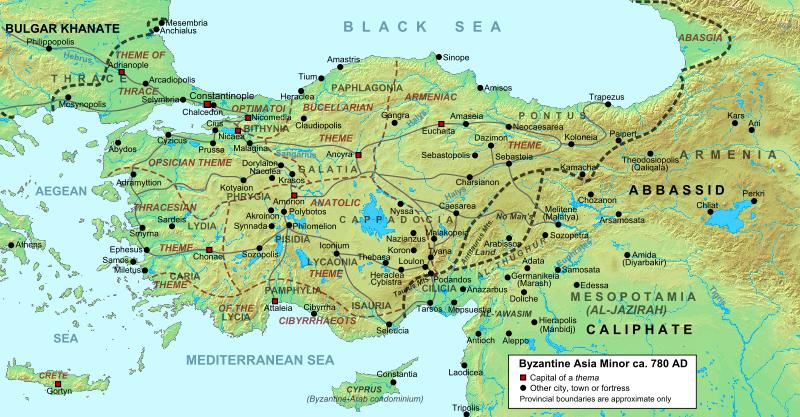
At the time of our Siege there were eight themata, but only two were close enough to the capital to have provided troops to the garrison; Thrace and Optimatoi.
In the 10th Century we have a TO&E for the Thracian theme that puts the total troop number at 9,600; I could not find a breakdown of cavalry and infantry but a typical Byzantine force would certainly have been at least half heavy cavalry, called cataphracts, armed with lance, bow and sword.
Don't confuse these guys with the ironheaded medieval chivalry that followed them; they were competent professional troopers equally comfortable skirmishing with the bow or charging home with long lance in hand. They could and would also fight on foot if needs must; no feudal pigheadedness about the "nobility" of the steed in these guys.
The remaining half would have been some combination, largely heavy melee infantry with a mixture of projectile-firers, slingers or more likely archers.
Light troops would probably have been hired "barbarian" horsemen; Turks, Arabs, Scythians or other Central Asians.
The problem with drawing too many troops from the themata, though, is that the remainder of the Empire had to be defended as well; the besiegers hadn't actually conquered the Anatolian mainland - as we'll see, they had moved through Byzantine territory as a mobile force, and other Arab incursions from the east, as well as potential Balkan raiders, were still a threat. So it's unlikely that the themata provided more than 8,000-10,000 troops or so to the garrison before the siege lines closed.
The primary garrison of the city, however, was drawn from what was called the tagmata "the regiments"; the full-timers, the Active Duty guys. There were four main tagmata units that would have been around the Emperor and the capital when the Arab banners showed up around the Golden Horn;
- The Scholai (Σχολαί, "the Schools"), was the senior unit, the direct successor of the imperial guards that replaced the Praetorians after Milvian Bridge. The Scholai of 717 were not genuine fighting soldiers, however; they had become a sort of parking place for young noblemen too incompetent to be given a troop command and too sparky to be happy lolling about Constantinople as a town clown.
The real imperial guards units included:
- The Exkoubitoi or Exkoubitores (Ἐξκούβιτοι, "the Sentinels"), and
- The Arithmos (Ἀριθμός, "Number") or Vigla (Βίγλα, from the Latin Vigiles, or Watch)
The actual Constantinople garrison included the Noumeroi (Gr. Νούμεροι, "Numbers"), and a similar regiment called "of the Walls" (τῶν Τειχέων in Greek).
Now...we have no fucking idea of the strength of these units. We know that the Exkoubitoi and the Arithmos were cavalry units and the Noumeroi were infantry, but other than that we can only guess. The numbers mentioned range from 1,000 to 4,000. Let's be generous and assume that a big city like Constantinople would need a sizeable garrison, so let's take the top number for the two city infantry units, together about 8,000 to 10,000. Let's assume probably about 5,000-6,000 for the two other guards units, plus another 5,000 for the sort of ash-and-trash that gets swept up whenever there's a real panic on, and you have a land garrison of roughly 25,000.
But the combat power of the Constantinople garrison wasn't primarily land-based. The city was surrounded on three sides by water, so the Home Fleet was a powerful component of the garrison.
Again, we have no real idea of the number of warships and sailors on hand to meet the Islamofascists of 717. The Byzantine fleet had been hammered pretty badly by Muslim warships at the "Battle of the Masts" in 655, and though the Imperial navy had been largely rebuilt, it also had a hell of a lot of the Mediterranean to patrol. So to assume that the fleet base at the capital moored no more then 300 to 400 galleys and no more then 10,000 sailors and marines probably isn't too harsh on the Imperials.
So, altogether, roughly 35,000 troops and 400 warships, all under the overall command of the Emperor Leo III (Λέων Γ), the so-called Isaurian who should have been called the Cunning, or the Sneaky. We'll hear more of His Sneakiness later.
Omayyad Caliphate - Here again, we're talking about accounts usually written decades or even generations after the events of 717-718, and often by men who had little or no military experience. Medieval chroniclers tended to exaggerate troop numbers wildly, either to celebrate their own forces' victory over the Heathen Hordes, or because they assumed that armies were just huge and invented numbers that sounded huge-y to them,
Here's what we've got:
An Arabic account written in Syria in the late 8th Century (i.e. geographically distant and outside the lifetime of the participants) just calls the Omayyad army "innumerable".
Writing about 300 years later "Michael the Syrian" pegs the Omayyad forces as 200,000 men and 5,000 ships; this is just ridiculous and can ignored.
Abu al-Hasan Ali ibn al-Husayn ibn Ali al-Mas'udi (أبو الحسن علي بن الحسين بن علي المسعودي ), writing in Egypt in the 10th Century comes up with 120,000 troops, and the 9th-century account by the monastic chronicler Theophanes puts the Omayyad fleet at 1,800 ships. Other guesstimates for the Arab forces put the land contingent at between 80,000 and 100,000 and the fleet at something between 800 and 1,000 vessels. It's really anyone's guess, but something like 80,000 troops sounds like the minimum needed for a siege of this sort, and 1,000 warships doesn't sound unreasonable.
As with the Byzantines, the composition of the Omayyad army is almost unknown. The Arab chroniclers claim that the most numerous and dependable element of the force was the ahl al-Sham, the "Army of Syria" that had formed the hard core of the Omayyad campaigns against the Romans. These troops would have included a mixture of melee infantry and foot archers, light cavalry and heavy cavalry similar to the Byzantine cataphracts.
For a siege the force probably included a fairly large number of "labor troops", a nice way of describing a bunch of poor bastards levied from the villages to do the dog-work of digging and carrying essential to taking a fortified place in the 8th Century.
This force was led by Maslamah ibn Abd al-Malik ( مسلمة بن عبد الملك ) and included the Omayyad commanders Umar ibn Hubaira, Sulayman ibn Mu'ad, and Bakhtari ibn al-Hasan (the Kitab al-'Uyun says Abdallah al-Battal instead of Bakhtari).
The Sources: We're dealing with the usual problems of ancient history again; the primary sources have been lost; army pay records, unit lists, first-hand accounts, letters, diaries - not many of those, anyway, in a largely illiterate age.
The secondary sources are usually written by monks or academics, whose military knowledge is scanty and credulity about military matters bottomless.
And even those sources are often lost; let's look at one, the Byzantine "history" of Theophanes "the Confessor".
First of all, this mook wasn't even born until some time in the middle 8th Century. By the time he was old enough to spit up his mother's milk the guys who had fought over the walls of Constantinople would have been in their fifties at best, those who were still alive.
His entire training for the job of military historian was the standard education for a Byzantine noble; reading and writing in Latin and Greek, typically the older Roman classics.
He is said to have written his historical chronicle (referred to as Annus Mundi ("Years of the World") probably because the text survived in Latin although the original would have been in Greek) some time in the early 9th Century; this, in turn, is supposed to have been not much more than an annotation and continuation of the Ἐκλογὴ Χρονογραφίας (Selection of Chronography) by an earlier monastic scholar, George Syncellus. Of this earlier work "(d)espite its obvious influence on and importance to later chronographic tradition, nothing survives of the original text" (Thornton, 2004).
I was not able to track down the provenance of the existing texts of Theophanes' work in the short time alloted to this post; I am guessing that it followed the typical monastic copyist routes until the Gutenberg Revolution. It seems to have been transcribed accurately enough, but begs the question of exactly how and from who Theophanes got his information.
We don't know, is how, and the who seems to have been largely other, older chroniclers up until the events of his recent past. We have no idea who told him the story of the Second Siege - he doesn't attribute anyone. It may well have been an eyewitness...or not. We just don't know.
Let's look at the Arab side of the hill. One of the main secondary sources is the Khitab Al 'Uyun, or Book of Springs, written some time in the 11th Century. This work is well discussed in Brooks (1899) in the Journal of Hellenic Studies article found here. In it Brooks (1899) states that the author of the work sourced mostly from two earlier Arab writers, al-Waqidi ( الواقدي) and primarily Abu Ja'far Muhammad ibn Jarir al-Tabari (أبو جعفر محمد بن جرير بن يزيد الطبري) whose monster work History of the Prophets and Kings ( تاريخ الرسل والملوك, Tarikh al-Rusul wa al-Muluk) forms the primary source for much of our understanding of the Omayyad period.
But the author of the Book of Springs includes a highly detailed - if, at times, highly creative - account of the political side of the campaign, and it is from this that we derive much of our understanding of the Arab strategy and movements.
But here, too, I cannot find any indication that a contemporary copy of either Al-Tabari's manuscript, or the later Book of Springs survived into the print era; both were preserved as later copies; al-Tabari as a Persian digest made nearly forty years after the author's death, and the later work as a European print edition.
On-line studies of this engagement are likewise sparse. The Wiki entry appears to be well-written and researched but suffers from the lack of military detail evident from all other sources. I could not find a single site that discussed the military aspects of the siege, probably because the details from the sources for the tactical and even the grand tactical operations are so sparse.
The usual sources are available for the forces engaged although, as I've noted above, many of the usual sorts of details we expect for military organizations such as size of units, number, and type are absent.
As you can tell; ancient history is damn frustrating.
The Campaign: To understand how a bunch of Arabs wound up slowly starving outside the walls of what is today the capital of the Republic of Turkey, a largely-Islamic state, you have to start with Rome.
Because by their lights the Byzantines WERE Romans. They called themselves that, and thought of themselves as the unbroken successors to the Caesars even though they spoke Greek instead of Latin, worshiped the God that the Caesars would have scoffed at (and in a rite that the then-Christians of Rome were horrified by and anathematized with all the bile they could scrape up), and were about as much like the classical Romans of the early Imperial period as a stone is like cheese.
But in fact the empire that ran out of Constantinople was about as Roman as anything left in the 8th Century. The fragmented mess that existed west of the Strait of Mamara was like nothing a Roman citizen of the glory years of imperium would have recognized, while the orderly edifice of Imperial power that emanated from Constantinople, well...that was Roman.
For centuries, the Eastern Rome - let's just agree to call it "Byzantium", though, just to satisfy convention - had looked East and South; down the Levantine coast to Egypt and northern Africa, and to the old "fertile crescent" of Iraq, Syria, and dreamed of India beyond.
Oh, sure, the Byzantines has frolicked about in the old Roman territories (remember the campaigns of Belisarius? Yeah, them) back in the 6th and 7th Centuries. But the center of Byzantium was in Anatolia - modern Turkey.
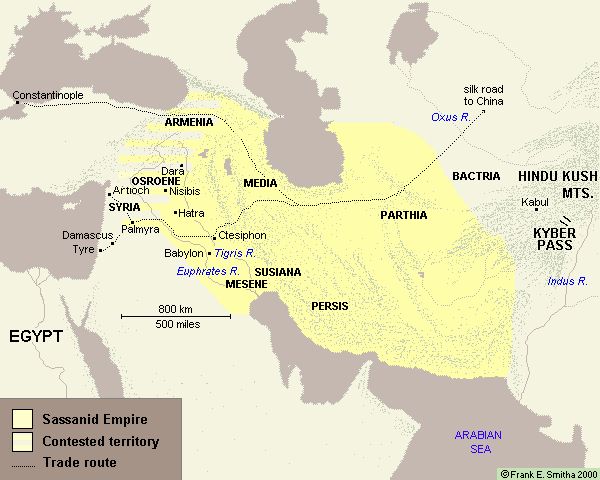
And for that entire time the Byzantines clashed with the Persian empire of the Sassanids. The story of the Byzantine-Sassanid Wars - and there were a pantsload of them, follow the link - lasted over the whole of the 6th Century and is a tale all of its own. But the short version is that the two fairly evenly-matched enemies battered each other until they were both worn out.
The Wiki entry above sums this ginormous clusterfuck up concisely and viciously:
Part of this was the old devil of Roman rule; a province couldn't be kept too weak or the barbarians would be tempted to take a slap at it. But make it too strong and the governor would be tempted to try his hand as king. So the fringes of Empire alternated between barbarian wars (from raids all the way up to full-scale invasions) and rebellions.
All very familiar and very trying, yes, but...
But overtopping everything else was the completely unexpected ex oriens semper aliquid novi of the 7th Century; the Muslims.
We talked about the rise of Islam back in March of 2009 in discussing the Battle of Badr. That little scrum had been fought at nearly the exact moment that the Sassanid Persians finally went down for the third time. If the Byzantine and Sassanid commanders had been directed to take note of some tiny desert skirmish fought who-the-fuck-knew-where between a couple of gangs of scruffy Arab heatherns versus god-pesterers they'd have laughed themselves sick.
But fifty years later the laugh was on the other side of the Byzantine's faces.
The Arabs had boiled out of the worthless sands of the Arabian peninsula like something out of a scary Bible story and had started beating the living homoousios out of the Byzantine garrisons. The Rashidun caliphs snatched Syria and Egypt; their successors the Omayyads completed the conquest of North Africa (and on into Spain) and began pushing into the Byzantine heartland of Anatolia. The attacks culminated in an opportunistic years-long "siege" of Constantinople between 674 and 678.
The Omayyad forces weren't really prepared for an assault; it seems that they had been just doing their usual attack-the-Byzantine thing and had ended up camped out around the imperial capital. They had no battering train and "siege" lines were so loose that the city was never in real danger of starvation, the other sure winner for besiegers back in the days before high explosives. Eventually Caliph Muawiyah's guys decided to quit dicking around outside the walls and sloped off back to Syria.
Then the two enemies spent much of the next forty-odd years focused on internal problems rather than each other.
First the Omayyads had a civil war. That kept them occupied for a decade or so.
The Byzantines' bad luck was that just as the Omayyads sorted out their rebels the Byzantine Empire spent twenty years going through a period that comes across as one hell of a good story but as one seriously screwed up form of government.
It all started with a gomer called Emperor Justinian II (who rejoiced in the improbable nickname of Rhinotmetus (ὁ Ῥινότμητος) which means "slit-nosed"; wonderful, yes, but what the fuck? Wait, it gets better), who turned out to be a major asshole. He managed to piss off pretty much everyone in the Empire to the point that in 695 they up and kicked him out. To be sure he was a goner someone cut off his nose (slit-nose, get it? Politics in Byzantium was a full-contact sport, baby...) and exiled the noseless son-of-a-bitch.
Which didn't stop him for a moment. He proceeded to strangle two wanna-be assassins with his bare hands, returned to Constantinople a decade later behind a horde of Bulgarian (old enemies of Byzantium from the European side of the ditch) wild men, snuck into the city through a drain, took it back and, with his brand-new shiny golden nose (See? See? Is this a great story, or what?) taped firmly in place proceeded to butcher all his old enemies and eff the place up for another six years or so, until a whole new bunch of people who hated his ass finally killed him.
And replaced him with a guy who lasted two years.
Who got kicked out and replaced with another guy who lasted...two years.
Who was in turn kicked out and replaced with a guy who lasted...you guessed it...two years.
Who was finally replaced by our man Leo III.
Meanwhile the Bulgars were romping in the west and the Arabs in the east. The Byzantine Army was one hell of a damn fine outfit; it managed to keep things pretty well together while all these aristocratic ding-dongs were kacking each other and everyone else they could get hold of. But things changed in 715.
That year a fella named Sulayman bin Abd al-Malik ( سليمان بن عبد الملك) climbed the gaddi in Damascus. Somebody had told him that a Caliph with the name of a prophet - Solomon - would take the Imperial city. Apparently Sulayman was no slouch, and he set out to assemble the forces to do just that.
Meanwhile, the current Byzantine Emperor was a former tax farmer ruling as Theodosius III. This poor idiot had been hoicked on the throne by the Fleet as an afterthought to a mutiny and is said to have been a boob as well as a functionary. He did what he could, which wasn't much, but he didn't have much time (two years, remember?).
In September 715 the Omayyad advance forces pushed into Anatolia, marching westwards along what is now the south coast of Turkey. In the spring of 716 the Omayyad fleet joined in cruising the south coast. Back in Syria Maslamah ibn Abd al-Malik - y'know, let's just call him "Maslamah" from now on - waited with the main force.
Our boy Maslamah had already started playing footsie with Leo-the-then-Isaurian who was the commander of the powerful Anatolian Theme. Hard to say what these two were playing at; it's likely that both we trying to bullshit the other. Leo may have promised to take over as an Omayyad vassal, while Maslamah probably just wanted Leo to stir stuff up and make it easier for his own takeover bid.
The first time this played out was at the "strategically important fortress of Amorium" (which is no longer a place, by the way; the ruins are in west central Turkey near the little town of Hisarköy).
Anyway, Maslamah's commanders showed up outside this place with all their bag and baggage, fierce nasty Arabs and all, and offered the good citizens of Amorium a deal; hail Leo as Byzantine emperor, or get what the residents of conquered cities usually got (that is, to get raped, then killed, then probably raped some more).
The folks of Amorium said yabetcha! but still did not open the gates; no fools they.
Not long after Leo himself comes farkling up smartly with a corporal's guard, and starts running his jaw. And here the plot really thickens.
Because Leo seems to have had the measure of Maslamah's guy (it's probably Sulayman ibn Mu'ad, the commander of the lead element) and Maslamah himeslf. The Book of Springs says this about him:
Leo managed to finesse his way out of Amorium, leaving the Omayyad forces outside, a small Byzantine garrison inside, and himself off to Constantinople to kick poor dumb Theo the Third off the throne and take his place. Sulayman had to withdraw east, out of food and unable to take Amorium and therefore leaving a potential enemy in his rear.
And just in time, too; Maslamah was coming on strong with the main Arab army straight for Amorium. Because he thought his puppet-emperor Leo was still his pal he did not trash the Armeniac and Anatolic themes - he still thought the governors there were his allies.
Maslamah responded to the news that Leo had punked him out by changing direction and starting a act like an invader: he attacked Akroinon, sacked Sardis and Pergamon, and marched to the west coast of Turkey for the winter, with his fleet spending the winter of 716-717 along the south coast.
In early summer of 717 Maslamah ordered up his fleet and crossed the Hellespont into Thrace, southwest of the imperial capital. The approach march to Constantinople is a reaving; the Arabs take what they can and burn the rest, human and material both. Some time in mid-July the Omayyad army reaches the landward side of the city and built classic lines of circum- and contravallation to begin the siege in earnest.
The Book of Springs claims that at this point Leo offered to pay a gold coin for every resident. Maslamah refused; he was there for the fight.
The Arab fleet is said to have arrived in 1 SEP 717; on 3 SEP various squadrons began anchoring on the both shores around of Constantinople while the main fleet sailed northeast past the city and cut off the supply lines from the Black Sea.
Constantinople was invested for the second time in fifty years.
The Engagement: Here's where we start to lose our sight picture; we just don't know what happened, the tactical to-and-fro of a year-long siege. We do know a couple of incidents, however. The first happened within the first several days, according the our guy Theophanes.
As the last twenty-odd vessels in the Arab fleet were sailing past the capital they lost the wind and - presumably pushed south and west by the current - were pushed down onto the seawalls where a Byzantine squadron sortied and attacked them with Greek fire.
Let's stop right here for a moment and talk about this stuff, because it's usually described as the secret weapon that saved Byzantium and Constantinople in 717. Basically, what it was was napalm.
Sure, there's some big mysteries to it - we don't know exactly what is was made of, or how it was "projected"; apparently it needed some special flamethrower-type devices like the one pictured below - but, basically, it was the same sort of thing you've seen in every film about the Pacific War; a tank full of nasty flammable stuff that shot out and fried you to a crisp.
This stuff was probably the first "state secret"; security was so good that the actual gimmick has been lost - nobody wrote down the whole macguffin and eventually someone died without passing it on. But it was a new thing, a shocking terror weapon in 717, and it apparently had a stunning effect on the Arabs.
The Wiki entry says that
But of siege actions?
Nothing.
We talked about sieges just earlier this year, when we were discussing the Battle of Canton in 1841. Well, what was true in 1841 was true in 717; there were three ways of getting into a defended city; over, under, and through.
Well, the Walls of Theodosius were some damn fine walls. Here's a typical section; nasty, isn't it? Any sensible infantryman would take one look at that thing and whistle for the nearest artilleryman.
Even in ruins they're pretty impressive, and to batter them down would probably have taken more of a siege train than Maslamah had brought with him.
Except from all accounts it seems pretty evident that he a) hadn't brought a siege train and b) hadn't brought anything to construct one.
The big wall-smashing counterweight trebuchets hadn't been invented yet - they came along sometime in the late 11th Century. The versions extent in the 8th Century were something called "traction trebuchets" that were basically a big staff sling; a long arm that you pulled on that tossed a rock.
As you can see, these rocks were pretty small. It would have taken a lifetime to batter down those big walls this those little pissant traction trebuchets. But there are no reports of siege engines of any sort. No towers, no rams. Nothing.
So "through" doesn't seem to have been in the plans. "Under" - mining - wasn't much faster, although I imagine that the Arabs may have tried. But mining was a pretty specialized profession even then, and I doubt whether the attempts got anywhere.
So if through was out - and the other way "through", treachery, was surely tried but went nowhere - and so was under, then the only other real option was over; escalade.
And that's where the Greek Fire comes in. I'll bet that the Arabs tried a couple of throw-the-ladders-against-the-wall-and-climb-like-buggery schemes. But when every time you start up the ladder you get quick-fried to a crackly crunch, or baked to a delicate crunch?
Sod THAT for a game of soldiers.
So you could pretty much see how the Arab army got nowhere for a year. But the question it raises to me is; why the hell did they STAY there for a year?
The fleet was cringing in harbor and the Byzantines were clearly not going to get peckish and come crawling out begging for some fois gras and fizzy water drinks anytime soon.
All the methods of ground attack were pretty much obviously - as in "within a week or two" obviously - somewhere between "Gee, that doesn't seem like a good idea..." and "OhmyfuckingAllah!"
So the only hope was for some sort of epidemic to break out, or a wall to suddenly collapse, or a revolution to break out...in other words, an improbable to impossible miracle to happen.
And the thing is that time was not on the Omayyads' side.
The chronicles say that initially the Arab supply situation was fairly decent; they had even brought grain to plant (although how well that went, planting in high summer, I can't imagine...). The Thracian side had been pretty damn well ruined, though, and so there was not much else there to eat if the logpacs ran short.
The Book of Springs claims that Leo the Sneaky Isaurian kept up his shenanigans all winter. Supposedly he either tricked Maslamah into handing over most of his grain supplies (WTF?) or into burning them to show the defenders that he was coming over the wall that night (ummm...not sure how that one worked). Mind you, the Byzantine sources say nothing of this, so it's hard to credit the more outrageous tales.
But the bottom line was that the Omayyad Army sat outside the walls of Constantinople all winter, freezing and starving.
Because the winter of 717-718 was a bad one; snow is reported to have stuck for over three months, in the relatively mild northeastern Levant.
And the neighbors were nasty, too, either from natural cussedness or Sneaky Leo's machinations. Supposedly the besieging force fought and lost a fight against the Bulgars. Theophanes says this was a big battle and that Maslamah's force lost 22,000 men. This seems unlikely, since such a major engagement would have likely been reported elsewhere, but is is clear that the Bulgars and Omayyads clashed, whether because the Bulgars attacked the Arab siege lines per a treaty with the Byzantines or because the Omayyads sent foraging parties into Bulgarian territory (which is what the Syriac Chronicle of 846 says happened).
Don't be fooled by the coy little smile on the Bulgar lass in the picture above; the real Bulgars were a bunch of nasty former horse-nomads with an attitude more like the guy with the scowly face over there on the right.
All in all it was a pretty sucky winter to be an Arab trooper.
As the rations ran out first the jawans ate the livestock, and then anything green, and then even the bark and roots of the trees.
Paul the Deacon, writing later in the century, claimed a ridiculous 300,000 deaths from starvation and disease. But, still; the toll was ruinous. Even the Caliph, Sulayman, died in his quarters in Palestine (that was just a coincidence, by the way...).
In the early spring the new Caliph, Umar II, sent 400 ships from Egypt and 360 ships from Africa with supplies and dispatched fresh troops through Anatolia to reinforce the besiegers.
But the majority of the crews of the relieving squadrons were galvanized Muslims - recent more or less forced converts (or out-and-out Coptic Christians) from Egypt and North Africa. When they arrived within swimming (or rowing) distance of their Jesus-freak pals the Byzantines they headed over the hill most quick smart.
They also warned the defenders about the incoming reinforcements, so the Byzantine fleet sortied again, used their flame weapons again, and again destroyed the Arab task forces.
Meanwhile a Byzantine thematic force bushwhacked the Omayyad relief column in the hills around Sophon, south of the city of Nicomedia, and decimated it.
With the reinforcements and resupply destroyed, the "siege lines" porous, and the methods of forcing entry impractical, the siege had clearly failed.
So later in the the summer Caliph Umar ordered Maslamah to retreat, and on 15 AUG 718, the feast of the Dormition of the Theotokos (what Roman Catholics call the "Assumption of Mary"), the defenders woke to find the walls of circumvallation deserted and the Arab fleets sailing east.
The siege of thirteen months was over.
Mind you, 718 still had a further reaming in store for the hapless Omayyad troops; more ships were lost in a storm in the Sea of Marmara and still more to fire...when they sailed into a volcanic ash cloud from an eruption of Santorini!
I can only imagine what the hapless survivors of this goatscrew were thinking. If I had been an Omayyad troop I'd have had some choice words for the re-up guy when he came around after that, I can tell you. Allah wept. What a mess.
Even the Arab sources estimate some 150,000 casualties; again, a massive exaggeration but some sense of the disaster that was so great that even the paid Omayyad scribes couldn't ignore or downplay it...
The Outcome: Strategic Byzantine Victory
The Impact: Given the obvious inability of the Omayyads to make a dent in the walls of Constantinople the counterfactual - the city falls and with it, the Byzantine Empire nearly 700 years before the actual collapse in the 15th Century - seems wildly improbably and surely is. In fact, the Caliphate had reached it's high-water-mark in the first half of the 8th Century. This defeat and the inability of the Muslim forces in Iberia to breach the Pyrenees (or, indeed, to reduce the Christian kingdoms in northern Spain), meant that Europe would remain Christian and Western until the conquerors issued out again with the weaponry, tactics, and organization of the Enlightenment to subjugate the rest of the World.
The losses were difficult for the overstretched Omayyad Caliphate to replace, while the Byzantines under Leo the Wily got a second wind and even managed to regain some of the eastern territories lost in the 7th Century. By the time the Abbasids replaced the Omayyads in the middle of the 8th Century the initial wave of Muslim expansion had been stopped. The next outward push would have to wait for the arrival of the Ottomans hundreds of years later.
In regards the actual fight you have to wonder what the hell Maslamah was thinking. He must have known the strength of the land defenses of the city - the earlier siege was within living memory. And yet his forces were pathetically unprepared for either an assault or a bombardment, and the fleet proved shockingly incapable of the task of blockading. All he could have accomplished was what he did - sitting around on his ass watching the Byzantines flip C-rat crackers at him.
Maybe if his admirals had had a little more sack.
Mind you, the Second Siege may be one of the few times in military history when a single weapon - not a combination of weapons like the fast tank-aircraft-radio of the blitzkrieg campaigns of 1939 and 1940 - had a decisive impact on a major engagement. Greek Fire seems to have been a genuine game-changer, and it's pretty incredible that the secret, since military secrecy is usually highly perishable (almost every weapon can be captured and reverse-engineered from the captured equipment) has remained as such to this day.
Touchline Tattles: At such a vast remove there is little I can find to add a human dimension to this story - the wild tale of Justinian, The Man With The Golden Nose aside. Instead, let me give you al-Tabari, whose History of the Prophets and Kings has another of those bizarre Maslamah-you-is-mah-woman-now stories (what is it about the Arab chroniclers and abusing guys by calling them out as chicks?) about him and Leo the Extra Cunning;
I wanted to discuss this, possibly the most important military event between the Fall of the Western Roman Empire in 476 and the Ottoman conquest of the city (and the final curtain on the "Roman" imperial polity) in 1453.
But...
There's a real problem with doing this in my usual way, and that's that we have almost no record of the military actions of the Second Siege. I'll get to this issue in the "Sources" section, but the accounts of the events of the tumultuous year that ended the Omayyad expansion into southeastern Europe are largely political or anecdotal in nature. The best we can do at this remove is make some guesses about what happened and why, so the "military lessons" from this engagement are perforce at a higher level than what is by rights the province of a sergeant.
I will, however, attempt to reconstruct the siege year and draw some conclusions from my results. But, unlike a typical "Decisive Battles" post, this one will address the geopolitical issues and outcomes of the 8th Century collision between the first wave of Islam and the last remnants of Rome.
Forces Engaged: Roman (Byzantine) Imperial - here's where we come up against our first encounter with the empty space where the military record of the Second Siege should be - we have no idea how large, or what units composed, the garrison of the city of Constantinople in 717. Those records must have existed - the Roman Empire still kept a professional standing army, with all the bureaucracy that implies - but in the succeeding 1300 years they were destroyed, lost, or mislaid. We have none of the imperial records of units assigned to the capital garrison as we have for much earlier times in Rome itself. So the best we can do is guess.
By the 8th Century the Byzantine version of the Roman Army had undergone significant changes from the classical short-sword-and-square-shield infantry legion of Augustus' times. Probably the most important change was the rise of the cavalryman. After the Gothic tribes showed how effective a heavy armed and armored man on a heavy horse could be the Byzantine/Romans did what any good soldier does - they adapted and overcame.
In addition to becoming a cavalry-heavy organization the Byzantine empire lacked the logistical efficiency of the earlier imperium. The Empire was unable to support a large force of full-time professionals, and therefore developed the "Theme" system.
Under this arrangement the Byzantine field armies ceased to become Imperial garrisons or expeditionary forces, controlled by the central administration in Rome (or Constantinople, as was now the case). The units were settled in provinces, or themata, and the army commander also became the local civil ruler.
This allowed the themata to become what we would think of as reservists; farmers or landholders most of the time but with their arms and armor on hand to form up when the barbarians came over the wire.
At the time of our Siege there were eight themata, but only two were close enough to the capital to have provided troops to the garrison; Thrace and Optimatoi.
In the 10th Century we have a TO&E for the Thracian theme that puts the total troop number at 9,600; I could not find a breakdown of cavalry and infantry but a typical Byzantine force would certainly have been at least half heavy cavalry, called cataphracts, armed with lance, bow and sword.
Don't confuse these guys with the ironheaded medieval chivalry that followed them; they were competent professional troopers equally comfortable skirmishing with the bow or charging home with long lance in hand. They could and would also fight on foot if needs must; no feudal pigheadedness about the "nobility" of the steed in these guys.
The remaining half would have been some combination, largely heavy melee infantry with a mixture of projectile-firers, slingers or more likely archers.
Light troops would probably have been hired "barbarian" horsemen; Turks, Arabs, Scythians or other Central Asians.
The problem with drawing too many troops from the themata, though, is that the remainder of the Empire had to be defended as well; the besiegers hadn't actually conquered the Anatolian mainland - as we'll see, they had moved through Byzantine territory as a mobile force, and other Arab incursions from the east, as well as potential Balkan raiders, were still a threat. So it's unlikely that the themata provided more than 8,000-10,000 troops or so to the garrison before the siege lines closed.
The primary garrison of the city, however, was drawn from what was called the tagmata "the regiments"; the full-timers, the Active Duty guys. There were four main tagmata units that would have been around the Emperor and the capital when the Arab banners showed up around the Golden Horn;
- The Scholai (Σχολαί, "the Schools"), was the senior unit, the direct successor of the imperial guards that replaced the Praetorians after Milvian Bridge. The Scholai of 717 were not genuine fighting soldiers, however; they had become a sort of parking place for young noblemen too incompetent to be given a troop command and too sparky to be happy lolling about Constantinople as a town clown.
The real imperial guards units included:
- The Exkoubitoi or Exkoubitores (Ἐξκούβιτοι, "the Sentinels"), and
- The Arithmos (Ἀριθμός, "Number") or Vigla (Βίγλα, from the Latin Vigiles, or Watch)
The actual Constantinople garrison included the Noumeroi (Gr. Νούμεροι, "Numbers"), and a similar regiment called "of the Walls" (τῶν Τειχέων in Greek).
Now...we have no fucking idea of the strength of these units. We know that the Exkoubitoi and the Arithmos were cavalry units and the Noumeroi were infantry, but other than that we can only guess. The numbers mentioned range from 1,000 to 4,000. Let's be generous and assume that a big city like Constantinople would need a sizeable garrison, so let's take the top number for the two city infantry units, together about 8,000 to 10,000. Let's assume probably about 5,000-6,000 for the two other guards units, plus another 5,000 for the sort of ash-and-trash that gets swept up whenever there's a real panic on, and you have a land garrison of roughly 25,000.
But the combat power of the Constantinople garrison wasn't primarily land-based. The city was surrounded on three sides by water, so the Home Fleet was a powerful component of the garrison.
Again, we have no real idea of the number of warships and sailors on hand to meet the Islamofascists of 717. The Byzantine fleet had been hammered pretty badly by Muslim warships at the "Battle of the Masts" in 655, and though the Imperial navy had been largely rebuilt, it also had a hell of a lot of the Mediterranean to patrol. So to assume that the fleet base at the capital moored no more then 300 to 400 galleys and no more then 10,000 sailors and marines probably isn't too harsh on the Imperials.
So, altogether, roughly 35,000 troops and 400 warships, all under the overall command of the Emperor Leo III (Λέων Γ), the so-called Isaurian who should have been called the Cunning, or the Sneaky. We'll hear more of His Sneakiness later.
Omayyad Caliphate - Here again, we're talking about accounts usually written decades or even generations after the events of 717-718, and often by men who had little or no military experience. Medieval chroniclers tended to exaggerate troop numbers wildly, either to celebrate their own forces' victory over the Heathen Hordes, or because they assumed that armies were just huge and invented numbers that sounded huge-y to them,
Here's what we've got:
An Arabic account written in Syria in the late 8th Century (i.e. geographically distant and outside the lifetime of the participants) just calls the Omayyad army "innumerable".
Writing about 300 years later "Michael the Syrian" pegs the Omayyad forces as 200,000 men and 5,000 ships; this is just ridiculous and can ignored.
Abu al-Hasan Ali ibn al-Husayn ibn Ali al-Mas'udi (أبو الحسن علي بن الحسين بن علي المسعودي ), writing in Egypt in the 10th Century comes up with 120,000 troops, and the 9th-century account by the monastic chronicler Theophanes puts the Omayyad fleet at 1,800 ships. Other guesstimates for the Arab forces put the land contingent at between 80,000 and 100,000 and the fleet at something between 800 and 1,000 vessels. It's really anyone's guess, but something like 80,000 troops sounds like the minimum needed for a siege of this sort, and 1,000 warships doesn't sound unreasonable.
As with the Byzantines, the composition of the Omayyad army is almost unknown. The Arab chroniclers claim that the most numerous and dependable element of the force was the ahl al-Sham, the "Army of Syria" that had formed the hard core of the Omayyad campaigns against the Romans. These troops would have included a mixture of melee infantry and foot archers, light cavalry and heavy cavalry similar to the Byzantine cataphracts.
For a siege the force probably included a fairly large number of "labor troops", a nice way of describing a bunch of poor bastards levied from the villages to do the dog-work of digging and carrying essential to taking a fortified place in the 8th Century.
This force was led by Maslamah ibn Abd al-Malik ( مسلمة بن عبد الملك ) and included the Omayyad commanders Umar ibn Hubaira, Sulayman ibn Mu'ad, and Bakhtari ibn al-Hasan (the Kitab al-'Uyun says Abdallah al-Battal instead of Bakhtari).
The Sources: We're dealing with the usual problems of ancient history again; the primary sources have been lost; army pay records, unit lists, first-hand accounts, letters, diaries - not many of those, anyway, in a largely illiterate age.
The secondary sources are usually written by monks or academics, whose military knowledge is scanty and credulity about military matters bottomless.
And even those sources are often lost; let's look at one, the Byzantine "history" of Theophanes "the Confessor".
First of all, this mook wasn't even born until some time in the middle 8th Century. By the time he was old enough to spit up his mother's milk the guys who had fought over the walls of Constantinople would have been in their fifties at best, those who were still alive.
His entire training for the job of military historian was the standard education for a Byzantine noble; reading and writing in Latin and Greek, typically the older Roman classics.
He is said to have written his historical chronicle (referred to as Annus Mundi ("Years of the World") probably because the text survived in Latin although the original would have been in Greek) some time in the early 9th Century; this, in turn, is supposed to have been not much more than an annotation and continuation of the Ἐκλογὴ Χρονογραφίας (Selection of Chronography) by an earlier monastic scholar, George Syncellus. Of this earlier work "(d)espite its obvious influence on and importance to later chronographic tradition, nothing survives of the original text" (Thornton, 2004).
I was not able to track down the provenance of the existing texts of Theophanes' work in the short time alloted to this post; I am guessing that it followed the typical monastic copyist routes until the Gutenberg Revolution. It seems to have been transcribed accurately enough, but begs the question of exactly how and from who Theophanes got his information.
We don't know, is how, and the who seems to have been largely other, older chroniclers up until the events of his recent past. We have no idea who told him the story of the Second Siege - he doesn't attribute anyone. It may well have been an eyewitness...or not. We just don't know.
Let's look at the Arab side of the hill. One of the main secondary sources is the Khitab Al 'Uyun, or Book of Springs, written some time in the 11th Century. This work is well discussed in Brooks (1899) in the Journal of Hellenic Studies article found here. In it Brooks (1899) states that the author of the work sourced mostly from two earlier Arab writers, al-Waqidi ( الواقدي) and primarily Abu Ja'far Muhammad ibn Jarir al-Tabari (أبو جعفر محمد بن جرير بن يزيد الطبري) whose monster work History of the Prophets and Kings ( تاريخ الرسل والملوك, Tarikh al-Rusul wa al-Muluk) forms the primary source for much of our understanding of the Omayyad period.
But the author of the Book of Springs includes a highly detailed - if, at times, highly creative - account of the political side of the campaign, and it is from this that we derive much of our understanding of the Arab strategy and movements.
But here, too, I cannot find any indication that a contemporary copy of either Al-Tabari's manuscript, or the later Book of Springs survived into the print era; both were preserved as later copies; al-Tabari as a Persian digest made nearly forty years after the author's death, and the later work as a European print edition.
On-line studies of this engagement are likewise sparse. The Wiki entry appears to be well-written and researched but suffers from the lack of military detail evident from all other sources. I could not find a single site that discussed the military aspects of the siege, probably because the details from the sources for the tactical and even the grand tactical operations are so sparse.
The usual sources are available for the forces engaged although, as I've noted above, many of the usual sorts of details we expect for military organizations such as size of units, number, and type are absent.
As you can tell; ancient history is damn frustrating.
The Campaign: To understand how a bunch of Arabs wound up slowly starving outside the walls of what is today the capital of the Republic of Turkey, a largely-Islamic state, you have to start with Rome.
Because by their lights the Byzantines WERE Romans. They called themselves that, and thought of themselves as the unbroken successors to the Caesars even though they spoke Greek instead of Latin, worshiped the God that the Caesars would have scoffed at (and in a rite that the then-Christians of Rome were horrified by and anathematized with all the bile they could scrape up), and were about as much like the classical Romans of the early Imperial period as a stone is like cheese.
But in fact the empire that ran out of Constantinople was about as Roman as anything left in the 8th Century. The fragmented mess that existed west of the Strait of Mamara was like nothing a Roman citizen of the glory years of imperium would have recognized, while the orderly edifice of Imperial power that emanated from Constantinople, well...that was Roman.
For centuries, the Eastern Rome - let's just agree to call it "Byzantium", though, just to satisfy convention - had looked East and South; down the Levantine coast to Egypt and northern Africa, and to the old "fertile crescent" of Iraq, Syria, and dreamed of India beyond.
Oh, sure, the Byzantines has frolicked about in the old Roman territories (remember the campaigns of Belisarius? Yeah, them) back in the 6th and 7th Centuries. But the center of Byzantium was in Anatolia - modern Turkey.
And for that entire time the Byzantines clashed with the Persian empire of the Sassanids. The story of the Byzantine-Sassanid Wars - and there were a pantsload of them, follow the link - lasted over the whole of the 6th Century and is a tale all of its own. But the short version is that the two fairly evenly-matched enemies battered each other until they were both worn out.
The Wiki entry above sums this ginormous clusterfuck up concisely and viciously:
"The devastating impact of this last war, added to the cumulative effects of a century of almost continuous conflict, left both empires crippled. When Kavadh II died only months after coming to the throne, Persia was plunged into several years of dynastic turmoil and civil war. The Sassanids were further weakened by economic decline, heavy taxation from Khosrau II's campaigns, religious unrest, rigid social stratification, and the increasing power of the provincial landholders. The Roman Empire was even more severely affected, with its financial reserves exhausted by the war, the Balkans now largely in the hands of the Slavs, Anatolia devastated by repeated Persian invasions and the empire's hold on Syria, Mesopotamia, Palestine and Egypt loosened by many years of Persian occupation."And there was worse - the Empire was constantly torn up by civil wars.
Part of this was the old devil of Roman rule; a province couldn't be kept too weak or the barbarians would be tempted to take a slap at it. But make it too strong and the governor would be tempted to try his hand as king. So the fringes of Empire alternated between barbarian wars (from raids all the way up to full-scale invasions) and rebellions.
All very familiar and very trying, yes, but...
But overtopping everything else was the completely unexpected ex oriens semper aliquid novi of the 7th Century; the Muslims.
We talked about the rise of Islam back in March of 2009 in discussing the Battle of Badr. That little scrum had been fought at nearly the exact moment that the Sassanid Persians finally went down for the third time. If the Byzantine and Sassanid commanders had been directed to take note of some tiny desert skirmish fought who-the-fuck-knew-where between a couple of gangs of scruffy Arab heatherns versus god-pesterers they'd have laughed themselves sick.
But fifty years later the laugh was on the other side of the Byzantine's faces.
The Arabs had boiled out of the worthless sands of the Arabian peninsula like something out of a scary Bible story and had started beating the living homoousios out of the Byzantine garrisons. The Rashidun caliphs snatched Syria and Egypt; their successors the Omayyads completed the conquest of North Africa (and on into Spain) and began pushing into the Byzantine heartland of Anatolia. The attacks culminated in an opportunistic years-long "siege" of Constantinople between 674 and 678.
The Omayyad forces weren't really prepared for an assault; it seems that they had been just doing their usual attack-the-Byzantine thing and had ended up camped out around the imperial capital. They had no battering train and "siege" lines were so loose that the city was never in real danger of starvation, the other sure winner for besiegers back in the days before high explosives. Eventually Caliph Muawiyah's guys decided to quit dicking around outside the walls and sloped off back to Syria.
Then the two enemies spent much of the next forty-odd years focused on internal problems rather than each other.
First the Omayyads had a civil war. That kept them occupied for a decade or so.
The Byzantines' bad luck was that just as the Omayyads sorted out their rebels the Byzantine Empire spent twenty years going through a period that comes across as one hell of a good story but as one seriously screwed up form of government.
It all started with a gomer called Emperor Justinian II (who rejoiced in the improbable nickname of Rhinotmetus (ὁ Ῥινότμητος) which means "slit-nosed"; wonderful, yes, but what the fuck? Wait, it gets better), who turned out to be a major asshole. He managed to piss off pretty much everyone in the Empire to the point that in 695 they up and kicked him out. To be sure he was a goner someone cut off his nose (slit-nose, get it? Politics in Byzantium was a full-contact sport, baby...) and exiled the noseless son-of-a-bitch.
Which didn't stop him for a moment. He proceeded to strangle two wanna-be assassins with his bare hands, returned to Constantinople a decade later behind a horde of Bulgarian (old enemies of Byzantium from the European side of the ditch) wild men, snuck into the city through a drain, took it back and, with his brand-new shiny golden nose (See? See? Is this a great story, or what?) taped firmly in place proceeded to butcher all his old enemies and eff the place up for another six years or so, until a whole new bunch of people who hated his ass finally killed him.
And replaced him with a guy who lasted two years.
Who got kicked out and replaced with another guy who lasted...two years.
Who was in turn kicked out and replaced with a guy who lasted...you guessed it...two years.
Who was finally replaced by our man Leo III.
Meanwhile the Bulgars were romping in the west and the Arabs in the east. The Byzantine Army was one hell of a damn fine outfit; it managed to keep things pretty well together while all these aristocratic ding-dongs were kacking each other and everyone else they could get hold of. But things changed in 715.
That year a fella named Sulayman bin Abd al-Malik ( سليمان بن عبد الملك) climbed the gaddi in Damascus. Somebody had told him that a Caliph with the name of a prophet - Solomon - would take the Imperial city. Apparently Sulayman was no slouch, and he set out to assemble the forces to do just that.
Meanwhile, the current Byzantine Emperor was a former tax farmer ruling as Theodosius III. This poor idiot had been hoicked on the throne by the Fleet as an afterthought to a mutiny and is said to have been a boob as well as a functionary. He did what he could, which wasn't much, but he didn't have much time (two years, remember?).
In September 715 the Omayyad advance forces pushed into Anatolia, marching westwards along what is now the south coast of Turkey. In the spring of 716 the Omayyad fleet joined in cruising the south coast. Back in Syria Maslamah ibn Abd al-Malik - y'know, let's just call him "Maslamah" from now on - waited with the main force.
Our boy Maslamah had already started playing footsie with Leo-the-then-Isaurian who was the commander of the powerful Anatolian Theme. Hard to say what these two were playing at; it's likely that both we trying to bullshit the other. Leo may have promised to take over as an Omayyad vassal, while Maslamah probably just wanted Leo to stir stuff up and make it easier for his own takeover bid.
The first time this played out was at the "strategically important fortress of Amorium" (which is no longer a place, by the way; the ruins are in west central Turkey near the little town of Hisarköy).
Anyway, Maslamah's commanders showed up outside this place with all their bag and baggage, fierce nasty Arabs and all, and offered the good citizens of Amorium a deal; hail Leo as Byzantine emperor, or get what the residents of conquered cities usually got (that is, to get raped, then killed, then probably raped some more).
The folks of Amorium said yabetcha! but still did not open the gates; no fools they.
Not long after Leo himself comes farkling up smartly with a corporal's guard, and starts running his jaw. And here the plot really thickens.
Because Leo seems to have had the measure of Maslamah's guy (it's probably Sulayman ibn Mu'ad, the commander of the lead element) and Maslamah himeslf. The Book of Springs says this about him:
"And Leo used to go to Maslamah in his position at Ammuriya (Amorium) and converse and negotiate with him with fraud and deceit, until he said, "If Maslamah had been a woman, and I had then chosen to seduce her, I would have done it, and he would never have refused me anything that I desired of him."First, let's linger on the image of steamy hot 8th Century man-love for a momen...nah, let's not. But as a passing observation, you'll note the fixation the author of the Book of Springs has for Maslamah as - for lack of a more polite term - Leo's bitch. We'll hear more on that subject before we're done.
Leo managed to finesse his way out of Amorium, leaving the Omayyad forces outside, a small Byzantine garrison inside, and himself off to Constantinople to kick poor dumb Theo the Third off the throne and take his place. Sulayman had to withdraw east, out of food and unable to take Amorium and therefore leaving a potential enemy in his rear.
And just in time, too; Maslamah was coming on strong with the main Arab army straight for Amorium. Because he thought his puppet-emperor Leo was still his pal he did not trash the Armeniac and Anatolic themes - he still thought the governors there were his allies.
Maslamah responded to the news that Leo had punked him out by changing direction and starting a act like an invader: he attacked Akroinon, sacked Sardis and Pergamon, and marched to the west coast of Turkey for the winter, with his fleet spending the winter of 716-717 along the south coast.
In early summer of 717 Maslamah ordered up his fleet and crossed the Hellespont into Thrace, southwest of the imperial capital. The approach march to Constantinople is a reaving; the Arabs take what they can and burn the rest, human and material both. Some time in mid-July the Omayyad army reaches the landward side of the city and built classic lines of circum- and contravallation to begin the siege in earnest.
The Book of Springs claims that at this point Leo offered to pay a gold coin for every resident. Maslamah refused; he was there for the fight.
The Arab fleet is said to have arrived in 1 SEP 717; on 3 SEP various squadrons began anchoring on the both shores around of Constantinople while the main fleet sailed northeast past the city and cut off the supply lines from the Black Sea.
Constantinople was invested for the second time in fifty years.
The Engagement: Here's where we start to lose our sight picture; we just don't know what happened, the tactical to-and-fro of a year-long siege. We do know a couple of incidents, however. The first happened within the first several days, according the our guy Theophanes.
As the last twenty-odd vessels in the Arab fleet were sailing past the capital they lost the wind and - presumably pushed south and west by the current - were pushed down onto the seawalls where a Byzantine squadron sortied and attacked them with Greek fire.
Let's stop right here for a moment and talk about this stuff, because it's usually described as the secret weapon that saved Byzantium and Constantinople in 717. Basically, what it was was napalm.
Sure, there's some big mysteries to it - we don't know exactly what is was made of, or how it was "projected"; apparently it needed some special flamethrower-type devices like the one pictured below - but, basically, it was the same sort of thing you've seen in every film about the Pacific War; a tank full of nasty flammable stuff that shot out and fried you to a crisp.
This stuff was probably the first "state secret"; security was so good that the actual gimmick has been lost - nobody wrote down the whole macguffin and eventually someone died without passing it on. But it was a new thing, a shocking terror weapon in 717, and it apparently had a stunning effect on the Arabs.
The Wiki entry says that
"Theophanes reports that some went down with all hands, while others, burning, sailed down to the Princes' Islands of Oxeia and Plateia. The victory encouraged the Byzantines and dejected the Arabs, who, according to Theophanes, had originally intended to sail to the sea walls the same night and try to scale them using the ships' steering paddles."Which, by the way, sounds idiotic and the sort of thing that a damn monk would think was a cunning sort of fighting stunt. Jesus, padre, why don't you stick to writing about what you know..? Sorry; back to Theo -
"The same night, Leo drew up the chain between the city and Galata, closing the entrance to the Golden Horn. The Arab fleet became reluctant to engage the Byzantines, and withdrew to the safe harbour of Sosthenion further north on the European shore of the Bosporus."We also have a report of another fleet action the following spring, more about which later.
But of siege actions?
Nothing.
We talked about sieges just earlier this year, when we were discussing the Battle of Canton in 1841. Well, what was true in 1841 was true in 717; there were three ways of getting into a defended city; over, under, and through.
Well, the Walls of Theodosius were some damn fine walls. Here's a typical section; nasty, isn't it? Any sensible infantryman would take one look at that thing and whistle for the nearest artilleryman.
Even in ruins they're pretty impressive, and to batter them down would probably have taken more of a siege train than Maslamah had brought with him.
Except from all accounts it seems pretty evident that he a) hadn't brought a siege train and b) hadn't brought anything to construct one.
The big wall-smashing counterweight trebuchets hadn't been invented yet - they came along sometime in the late 11th Century. The versions extent in the 8th Century were something called "traction trebuchets" that were basically a big staff sling; a long arm that you pulled on that tossed a rock.
As you can see, these rocks were pretty small. It would have taken a lifetime to batter down those big walls this those little pissant traction trebuchets. But there are no reports of siege engines of any sort. No towers, no rams. Nothing.
So "through" doesn't seem to have been in the plans. "Under" - mining - wasn't much faster, although I imagine that the Arabs may have tried. But mining was a pretty specialized profession even then, and I doubt whether the attempts got anywhere.
So if through was out - and the other way "through", treachery, was surely tried but went nowhere - and so was under, then the only other real option was over; escalade.
And that's where the Greek Fire comes in. I'll bet that the Arabs tried a couple of throw-the-ladders-against-the-wall-and-climb-like-buggery schemes. But when every time you start up the ladder you get quick-fried to a crackly crunch, or baked to a delicate crunch?
Sod THAT for a game of soldiers.
So you could pretty much see how the Arab army got nowhere for a year. But the question it raises to me is; why the hell did they STAY there for a year?
The fleet was cringing in harbor and the Byzantines were clearly not going to get peckish and come crawling out begging for some fois gras and fizzy water drinks anytime soon.
All the methods of ground attack were pretty much obviously - as in "within a week or two" obviously - somewhere between "Gee, that doesn't seem like a good idea..." and "OhmyfuckingAllah!"
So the only hope was for some sort of epidemic to break out, or a wall to suddenly collapse, or a revolution to break out...in other words, an improbable to impossible miracle to happen.
And the thing is that time was not on the Omayyads' side.
The chronicles say that initially the Arab supply situation was fairly decent; they had even brought grain to plant (although how well that went, planting in high summer, I can't imagine...). The Thracian side had been pretty damn well ruined, though, and so there was not much else there to eat if the logpacs ran short.
The Book of Springs claims that Leo the Sneaky Isaurian kept up his shenanigans all winter. Supposedly he either tricked Maslamah into handing over most of his grain supplies (WTF?) or into burning them to show the defenders that he was coming over the wall that night (ummm...not sure how that one worked). Mind you, the Byzantine sources say nothing of this, so it's hard to credit the more outrageous tales.
But the bottom line was that the Omayyad Army sat outside the walls of Constantinople all winter, freezing and starving.
Because the winter of 717-718 was a bad one; snow is reported to have stuck for over three months, in the relatively mild northeastern Levant.
And the neighbors were nasty, too, either from natural cussedness or Sneaky Leo's machinations. Supposedly the besieging force fought and lost a fight against the Bulgars. Theophanes says this was a big battle and that Maslamah's force lost 22,000 men. This seems unlikely, since such a major engagement would have likely been reported elsewhere, but is is clear that the Bulgars and Omayyads clashed, whether because the Bulgars attacked the Arab siege lines per a treaty with the Byzantines or because the Omayyads sent foraging parties into Bulgarian territory (which is what the Syriac Chronicle of 846 says happened).
Don't be fooled by the coy little smile on the Bulgar lass in the picture above; the real Bulgars were a bunch of nasty former horse-nomads with an attitude more like the guy with the scowly face over there on the right.
All in all it was a pretty sucky winter to be an Arab trooper.
As the rations ran out first the jawans ate the livestock, and then anything green, and then even the bark and roots of the trees.
Paul the Deacon, writing later in the century, claimed a ridiculous 300,000 deaths from starvation and disease. But, still; the toll was ruinous. Even the Caliph, Sulayman, died in his quarters in Palestine (that was just a coincidence, by the way...).
In the early spring the new Caliph, Umar II, sent 400 ships from Egypt and 360 ships from Africa with supplies and dispatched fresh troops through Anatolia to reinforce the besiegers.
But the majority of the crews of the relieving squadrons were galvanized Muslims - recent more or less forced converts (or out-and-out Coptic Christians) from Egypt and North Africa. When they arrived within swimming (or rowing) distance of their Jesus-freak pals the Byzantines they headed over the hill most quick smart.
They also warned the defenders about the incoming reinforcements, so the Byzantine fleet sortied again, used their flame weapons again, and again destroyed the Arab task forces.
Meanwhile a Byzantine thematic force bushwhacked the Omayyad relief column in the hills around Sophon, south of the city of Nicomedia, and decimated it.
With the reinforcements and resupply destroyed, the "siege lines" porous, and the methods of forcing entry impractical, the siege had clearly failed.
So later in the the summer Caliph Umar ordered Maslamah to retreat, and on 15 AUG 718, the feast of the Dormition of the Theotokos (what Roman Catholics call the "Assumption of Mary"), the defenders woke to find the walls of circumvallation deserted and the Arab fleets sailing east.
The siege of thirteen months was over.
Mind you, 718 still had a further reaming in store for the hapless Omayyad troops; more ships were lost in a storm in the Sea of Marmara and still more to fire...when they sailed into a volcanic ash cloud from an eruption of Santorini!
I can only imagine what the hapless survivors of this goatscrew were thinking. If I had been an Omayyad troop I'd have had some choice words for the re-up guy when he came around after that, I can tell you. Allah wept. What a mess.
Even the Arab sources estimate some 150,000 casualties; again, a massive exaggeration but some sense of the disaster that was so great that even the paid Omayyad scribes couldn't ignore or downplay it...
The Outcome: Strategic Byzantine Victory
The Impact: Given the obvious inability of the Omayyads to make a dent in the walls of Constantinople the counterfactual - the city falls and with it, the Byzantine Empire nearly 700 years before the actual collapse in the 15th Century - seems wildly improbably and surely is. In fact, the Caliphate had reached it's high-water-mark in the first half of the 8th Century. This defeat and the inability of the Muslim forces in Iberia to breach the Pyrenees (or, indeed, to reduce the Christian kingdoms in northern Spain), meant that Europe would remain Christian and Western until the conquerors issued out again with the weaponry, tactics, and organization of the Enlightenment to subjugate the rest of the World.
The losses were difficult for the overstretched Omayyad Caliphate to replace, while the Byzantines under Leo the Wily got a second wind and even managed to regain some of the eastern territories lost in the 7th Century. By the time the Abbasids replaced the Omayyads in the middle of the 8th Century the initial wave of Muslim expansion had been stopped. The next outward push would have to wait for the arrival of the Ottomans hundreds of years later.
In regards the actual fight you have to wonder what the hell Maslamah was thinking. He must have known the strength of the land defenses of the city - the earlier siege was within living memory. And yet his forces were pathetically unprepared for either an assault or a bombardment, and the fleet proved shockingly incapable of the task of blockading. All he could have accomplished was what he did - sitting around on his ass watching the Byzantines flip C-rat crackers at him.
Maybe if his admirals had had a little more sack.
Mind you, the Second Siege may be one of the few times in military history when a single weapon - not a combination of weapons like the fast tank-aircraft-radio of the blitzkrieg campaigns of 1939 and 1940 - had a decisive impact on a major engagement. Greek Fire seems to have been a genuine game-changer, and it's pretty incredible that the secret, since military secrecy is usually highly perishable (almost every weapon can be captured and reverse-engineered from the captured equipment) has remained as such to this day.
Touchline Tattles: At such a vast remove there is little I can find to add a human dimension to this story - the wild tale of Justinian, The Man With The Golden Nose aside. Instead, let me give you al-Tabari, whose History of the Prophets and Kings has another of those bizarre Maslamah-you-is-mah-woman-now stories (what is it about the Arab chroniclers and abusing guys by calling them out as chicks?) about him and Leo the Extra Cunning;
"And Leo...wrote to Maslama, telling him what had happened and asking him to allow enough corn to be brought in...to make them believe that he and Maslama were at one, and that they were secure from captivity and removal from their country, and to grant them a night to carry off the corn.Oooooh, snap!
It was carried away during the night.and in the morning Leo fought; and he had tricked him by a trick with which a woman would not have been deceived."
Labels:
Asia,
decisive battles,
Europe,
siege warfare,
war
Saturday, June 18, 2011
Decisive Battles: Why NOT Waterloo, 1815?
196 years ago some 190,000 men; British, French, Prussian, Dutch, Belgian, Saxon, Bavarian, Polish, along with probably a smattering of every other nationality in central Europe outside the Austrian Empire had a very long and tiring afternoon in a patch of farmland along the edge of the Forêt de Soignes, near the village of Mt. St. Jean on the dusty road from Charleroi to Brussels.
At the end of the day as any as 15,000 of them were dead and the twenty-six years of warfare between the forces of the government of France and much of the remainder of Europe were over; a peace that lasted, at least in western Europe, for another 75 years.
This day, the anniversary of the Battle of Waterloo, may also, perhaps, be the birthdate of the entire concept of the "decisive battle". In 1851, one Edward Shepherd Creasy published "The Fifteen Decisive Battles of the World" which picked up with Marathon and ended with Waterloo. Creasy, a true Victorian, believed that Waterloo spelled the end of the intermittent bloodbath that had been western European history until 1815; the "end of history" as a later historian might have said. His approach has persisted among Western historians, and Waterloo is always cited when the decisive battles of the world are listed.
But I have not, and will not, write about it. This month's "decisive battle" is not one at all, but a famous engagement and one with an impact on the history of the time, the fight along the Little Bighorn River in Montana. I have several reasons for this, and the least significant is the most reasonable; that the Battle of Waterloo has already been written to death.
If I had anything to add to the mountain of paper and pixels already dedicated to Waterloo I would. But it's not really that. In my honest opinion, as much as it was the end of the fighting of what we call the "Napoleonic Wars", the decision had been made more than two years earlier. Waterloo was simply the encore, the epilogue, to the long, sorry tale of monarchical Europe's effort to beat the French Revolution to death. The great battle was just the period at the end of the last sentence.
To consider it a stand-alone even is to not just misinterpret it but to distort the entire notion of a "decisive battle". The winter of 1812 was part of the decisive end of Napoleonic France, as was Leipzig, and the 1814 Campaign in France. Waterloo was just the shot in the head that put the dead man out of his misery.
Why?
First, and the lesser reason of the two, was that Spain and Russia had already destroyed the old French Army, and what turned up at Waterloo was not the same organization. If the former artillery captain from the Brienne school had had his old army from Austerlitz, Wagram, Jena, or even Friedland things might have gone differently. But as much as the old master had lost - and his campaigns of 1814 were masterful, as good as anything in Italy or Austria - the former Grande Armee had lost more. What hadn't been frittered away in Spain had perished on the long, frigid roads back from Moscow.
The sword that Napoleon I drew to hack across the Dutch-Belgian frontier in June, 1815 was a brittle instrument, one that lacked many of the strengths of the French armies prior to the Hundred Days but that perpetuated many of the weaknesses. The highest commanders, the Marshalate in particular, were if anything, worse than ever, showing the worst effects of the Napoleonic Cult of Personality. While Napoleon did not do what he might have to win the day, his bobos Ney and Grouchy certainly worked hard to lose it. Special mention to General Reille, who allowed his corps to become entirely sucking into the subsidiary "Battle of Hougoumont", pulling more than 10,000 French soldiers away from the rest of the engagement in order to destroy a fortified outpost held by a couple of battlion's-worth of troopers.
But the main reason is that in over twelve years Napoleon I had never found a military solution to the Allied Coalitions, he had no better plan in 1815, and a victory at Waterloo would not have worked, either. The French Army was possibly the most sophisticated technical and tactical instrument in Europe between 1803 and 1811. But without naval power the French military could no conquer Great Britain, whilst Britain remained active no permanent conclusion could be had to the continental wars, and between his personality, British gold, the political loathing of the Austrian, Prussian, and Russian autocrats for the French regicides, and the economic problems caused by the rapacious French indemnities (and the Continental System) Napoleon could not negotiate or buy himself lasting peace with Austria or Russia. He never figured out that fighting victories without a workable strategic plan were meaningless, and he couldn't figure out a plan to make the monarchies make peace with him.
The grand tactical plan for the Belgian Campaign of 1815 was fairly sound; drive a wedge straight between the Allies, throw the Prussian back on the Rhine and the Briton into the Channel. But that was really the extent of Napoleon's thinking, so far as we can tell. There was no larger plan, no means of dealing with the inevitable eastern European forces that would be arriving soon, no attainable political solution to the Alliance. With the alliance unshaken, and with the massive Allied Army arriving, a repeat of the Battle of the Nations was almost a foregone conclusion.
So even if he had won at Waterloo, the Russians and Prussians were already marching, the Prussians would simply have sent more armies, and the British would have refused to capitulate. The Russians and Austrians would not have allowed a separate peace, and although Waterloo made the end emphatic, the end would have come later rather than sooner in any case.
So; is Waterloo a "great battle"? Yes. Was it decisive in ending a phase or a campaign? Yes. But was it "decisive" in being the single blow that ended the Napoleonic Wars?
No; that end had already come, in the bitter snows of December, 1812 and in the waters of the Elster in October, 1813. The Army that sustained it destroyed twice over, in 1815 the First Empire was dead.
It just took until the morning of the 19th of June for the corpse to finally lay still.
Interestingly, for a battle as celebrated as it is, Waterloo has produced very little in the way of reflection in art. The Victorians produced any number of vivid battle paintings, almost all of the full of the most vivid and melodramatic nonsense.
There are no songs I know of, and but two works of literature of any note; one the segment of Byron's poem "Childe Harold's Pilgrimage" which, like all things Byronic, has not fared well in this bare-steel-and-glass age. The other is an immense portion of Victor Hugo's novel of revenge and justice, Les Miserables. The workmanlike prose of Hugo is much more to my taste, and so it is with a portion of this I leave you; from Chapter 2 of the first book of Volume II, "Hougomont"
At the end of the day as any as 15,000 of them were dead and the twenty-six years of warfare between the forces of the government of France and much of the remainder of Europe were over; a peace that lasted, at least in western Europe, for another 75 years.This day, the anniversary of the Battle of Waterloo, may also, perhaps, be the birthdate of the entire concept of the "decisive battle". In 1851, one Edward Shepherd Creasy published "The Fifteen Decisive Battles of the World" which picked up with Marathon and ended with Waterloo. Creasy, a true Victorian, believed that Waterloo spelled the end of the intermittent bloodbath that had been western European history until 1815; the "end of history" as a later historian might have said. His approach has persisted among Western historians, and Waterloo is always cited when the decisive battles of the world are listed.
But I have not, and will not, write about it. This month's "decisive battle" is not one at all, but a famous engagement and one with an impact on the history of the time, the fight along the Little Bighorn River in Montana. I have several reasons for this, and the least significant is the most reasonable; that the Battle of Waterloo has already been written to death.
If I had anything to add to the mountain of paper and pixels already dedicated to Waterloo I would. But it's not really that. In my honest opinion, as much as it was the end of the fighting of what we call the "Napoleonic Wars", the decision had been made more than two years earlier. Waterloo was simply the encore, the epilogue, to the long, sorry tale of monarchical Europe's effort to beat the French Revolution to death. The great battle was just the period at the end of the last sentence. To consider it a stand-alone even is to not just misinterpret it but to distort the entire notion of a "decisive battle". The winter of 1812 was part of the decisive end of Napoleonic France, as was Leipzig, and the 1814 Campaign in France. Waterloo was just the shot in the head that put the dead man out of his misery.
Why?First, and the lesser reason of the two, was that Spain and Russia had already destroyed the old French Army, and what turned up at Waterloo was not the same organization. If the former artillery captain from the Brienne school had had his old army from Austerlitz, Wagram, Jena, or even Friedland things might have gone differently. But as much as the old master had lost - and his campaigns of 1814 were masterful, as good as anything in Italy or Austria - the former Grande Armee had lost more. What hadn't been frittered away in Spain had perished on the long, frigid roads back from Moscow.
The sword that Napoleon I drew to hack across the Dutch-Belgian frontier in June, 1815 was a brittle instrument, one that lacked many of the strengths of the French armies prior to the Hundred Days but that perpetuated many of the weaknesses. The highest commanders, the Marshalate in particular, were if anything, worse than ever, showing the worst effects of the Napoleonic Cult of Personality. While Napoleon did not do what he might have to win the day, his bobos Ney and Grouchy certainly worked hard to lose it. Special mention to General Reille, who allowed his corps to become entirely sucking into the subsidiary "Battle of Hougoumont", pulling more than 10,000 French soldiers away from the rest of the engagement in order to destroy a fortified outpost held by a couple of battlion's-worth of troopers.
But the main reason is that in over twelve years Napoleon I had never found a military solution to the Allied Coalitions, he had no better plan in 1815, and a victory at Waterloo would not have worked, either. The French Army was possibly the most sophisticated technical and tactical instrument in Europe between 1803 and 1811. But without naval power the French military could no conquer Great Britain, whilst Britain remained active no permanent conclusion could be had to the continental wars, and between his personality, British gold, the political loathing of the Austrian, Prussian, and Russian autocrats for the French regicides, and the economic problems caused by the rapacious French indemnities (and the Continental System) Napoleon could not negotiate or buy himself lasting peace with Austria or Russia. He never figured out that fighting victories without a workable strategic plan were meaningless, and he couldn't figure out a plan to make the monarchies make peace with him.
The grand tactical plan for the Belgian Campaign of 1815 was fairly sound; drive a wedge straight between the Allies, throw the Prussian back on the Rhine and the Briton into the Channel. But that was really the extent of Napoleon's thinking, so far as we can tell. There was no larger plan, no means of dealing with the inevitable eastern European forces that would be arriving soon, no attainable political solution to the Alliance. With the alliance unshaken, and with the massive Allied Army arriving, a repeat of the Battle of the Nations was almost a foregone conclusion.
So even if he had won at Waterloo, the Russians and Prussians were already marching, the Prussians would simply have sent more armies, and the British would have refused to capitulate. The Russians and Austrians would not have allowed a separate peace, and although Waterloo made the end emphatic, the end would have come later rather than sooner in any case.So; is Waterloo a "great battle"? Yes. Was it decisive in ending a phase or a campaign? Yes. But was it "decisive" in being the single blow that ended the Napoleonic Wars?
No; that end had already come, in the bitter snows of December, 1812 and in the waters of the Elster in October, 1813. The Army that sustained it destroyed twice over, in 1815 the First Empire was dead.
It just took until the morning of the 19th of June for the corpse to finally lay still.
Interestingly, for a battle as celebrated as it is, Waterloo has produced very little in the way of reflection in art. The Victorians produced any number of vivid battle paintings, almost all of the full of the most vivid and melodramatic nonsense. There are no songs I know of, and but two works of literature of any note; one the segment of Byron's poem "Childe Harold's Pilgrimage" which, like all things Byronic, has not fared well in this bare-steel-and-glass age. The other is an immense portion of Victor Hugo's novel of revenge and justice, Les Miserables. The workmanlike prose of Hugo is much more to my taste, and so it is with a portion of this I leave you; from Chapter 2 of the first book of Volume II, "Hougomont"
"This orchard is sentient, like others, in the month of May. It has its buttercups and its daisies; the grass is tall there; the cart-horses browse there; cords of hair, on which linen is drying, traverse the spaces between the trees and force the passer-by to bend his head; one walks over this uncultivated land, and one's foot dives into mole-holes. In the middle of the grass one observes an uprooted tree-bole which lies there all verdant. Major Blackmann leaned against it to die. Beneath a great tree in the neighborhood fell the German general, Duplat, descended from a French family which fled on the revocation of the Edict of Nantes. An aged and falling apple-tree leans far over to one side, its wound dressed with a bandage of straw and of clayey loam. Nearly all the apple-trees are falling with age. There is not one which has not had its bullet or its biscayan. The skeletons of dead trees abound in this orchard. Crows fly through their branches, and at the end of it is a wood full of violets.
Bauduin, killed, Foy wounded, conflagration, massacre, carnage, a rivulet formed of English blood, French blood, German blood mingled in fury, a well crammed with corpses, the regiment of Nassau and the regiment of Brunswick destroyed, Duplat killed, Blackmann killed, the English Guards mutilated, twenty French battalions, besides the forty from Reille's corps, decimated, three thousand men in that hovel of Hougomont alone cut down, slashed to pieces, shot, burned, with their throats cut,--and all this so that a peasant can say to-day to the traveler: Monsieur, give me three francs, and if you like, I will explain to you the affair of Waterloo!"
Labels:
decisive battles,
Europe,
France,
Great Britain,
military history,
war
Thursday, June 02, 2011
Hauptverwaltungsoffizier!
Interesting study here regarding the persistence and quality of the long-gone Habsburg bureaucracy in the governance of eastern and modern southeastern Europe.
The present-day U.S. has developed a curious loathing for the notion that a well-run state is important to civil society. The people of mittelEuropa, fought over and beaten up by foreign invaders and local bullies alike, have no such delusion. And it seems that the crucial element inspiring local good government involves the probity and competence of the local chief administrative officer;
Whilst I suspect that no one has enjoyed bureaucracy since the first Australopithecene home builder was fined a basket of warra nuts and two monkey tails for failing to meet code standards for her wickiup, the honest and efficient regulation of the conduct of human business is both art and science. I think perhaps we've had it so good for so long in so much of the U.S. that we've forgotten that much of those places that didn't - like the ex-Ottoman and ex-Imperial Russian parts of eastern Europe - are a nasty welter of bribery, bullying, and personal politics.
While that makes for a delightfully colorful story, it makes for a tetchy and difficult way to live, and we Americans would do well to remember that.
The present-day U.S. has developed a curious loathing for the notion that a well-run state is important to civil society. The people of mittelEuropa, fought over and beaten up by foreign invaders and local bullies alike, have no such delusion. And it seems that the crucial element inspiring local good government involves the probity and competence of the local chief administrative officer; "Comparing individuals left and right of the long-gone Habsburg border, people living in locations that used to be territory of the Habsburg Empire have higher trust in courts and police. These trust differentials also transform into “real” differences in the extent to which bribes have to be paid for these local public services."An unsurprising conclusion, one would think, but one that seems to be lost amid the current U.S. enthusiasm for replacing well-paid professional staffs at every level from the town council to the federal government with contract workers and minimum-wage temps.
Whilst I suspect that no one has enjoyed bureaucracy since the first Australopithecene home builder was fined a basket of warra nuts and two monkey tails for failing to meet code standards for her wickiup, the honest and efficient regulation of the conduct of human business is both art and science. I think perhaps we've had it so good for so long in so much of the U.S. that we've forgotten that much of those places that didn't - like the ex-Ottoman and ex-Imperial Russian parts of eastern Europe - are a nasty welter of bribery, bullying, and personal politics.While that makes for a delightfully colorful story, it makes for a tetchy and difficult way to live, and we Americans would do well to remember that.
Labels:
bad government,
Europe,
government,
the U.S.
Subscribe to:
Posts (Atom)