Dates: 6 APR - 29 MAY, 1453

Leonard of Chios says that the active defenders included 6,000 Byzantines and 3,000 foreigners. Another "western" source, Tedaldi, says that "In the city there were altogether 30,000 to 35,000 men under arms and six or seven thousand real soldiers, making 42,000 at the most."
So we have a low estimate of about 6,900 and a high of 42,000. The low estimate seems, frankly, improbably low. Given the size of the city and the need to man the full length of the circumscribing walls - about 11 to 12 miles total - 6,900 troops would have been able to position 1 guy for about every 11 linear feet of wall. And that's not counting the warships in the Golden Horn or keeping any sort of mobile reserve.
That's just not likely; the Ottomans would have come over the wall like water through a sandcastle.
So let's assume that Tedaldi's figure of about 40,000 was more realistic. About 7,000 real troops and 33,000 citizens of Constantinople mobilized "for the duration". Who were these guys? What would the defenders have looked like?

The "professional" troopers would have been, largely, the household guard of the Byzantine court and the remnants of the Palaiologan army, the last remaining "Roman Army" on Earth. As we'll see, the Byzantine empire had lost nearly all its territories by the middle of the 15th Century. What remained were the capital itself and a scattering of small outposts flung across the eastern Mediterranean from the Greek mainland to the islands as well as a handful of remnants along the Anatolian coast of the Black Sea.
This rump domain was not wealthy enough to fund the hire of the mercenary troops that made up many Renaissance armies and the loss of the Anatolian heartland meant the loss of the traditional recruiting ground for the Byzantine army proper. So by the morning of 6 APR 1453 the last so-called "tagmatic" Byzantine Army numbered about a total of six regiments, or chiliarchiai of 1,000 infantrymen.
The classic Byzantine chilicarchy included 650 skutatoi - armored heavy melee infantry armed with spear and longsword (spatha) and 350 toxotai, light-armored missile and skirmish infantry. By the 15th Century the Byzantine infantry regiments were known as allagia but were still largely composed of heavy infantryman but now armed and armored much like his Western European man-at-arms counterpart, in full plate, and probably like the foot man-at-arms would have carried heavy chopping weapons like halberds and guisarmes instead of the older kontarion spear.
The accounts of the engagement mention the presence of missile troops among the defenders, including crossbowmen which seems to have been something of a Byzantine specialty.
The militia troops would have included every man in Constantinople capable of carrying a weapon and willing to fight, including monks, organized local militia troops, sailors, and just Joe Byzantine with his grandpa's old sword.
Included in the defense were also contingents from several of the Western powers of the day, including from Italy Venetians and a contingent of about 700 from the city-state of Genoa under a commander of some renown by the name of Longo as well as Catalans and Castilians from Spain, and even the small household guard of the exiled Ottoman pretender Orhan.

Perhaps the worst single weakness of the Christian defenses was at sea, where there simply was no Byzantine fleet. What was available were largely early-period galleons; ten Imperial ships, five each from Venice and Genoa, three from Crete, and one each from Ancona, Catalonia, and Provence, 26 in all not including small craft or merchant vessels.
But to talk about the defense of Constantinople was to talk about the walls. The land-walls, more precisely. We've encountered these "Thodosian Walls" before, when the Umayyids laid siege to the place back in the 8th Century.

"a triple wall. On the outside was a deep ditch, a foss, some sixty feet in width, sections of which could be flooded if necessary. On the inside of the ditch was a low crenellated breastwork, within which was a passage some forty to fifty feet in breadth, running the whole length of the walls and known as the Peribolos. Then there rose the wall usually described as the outer wall, about twenty-five feet in height, with square towers placed along it at intervals varying from fifty to a hundred yards. Within was another space known as the Parateichion, which varied from forty to sixty feet in width. Then there rose the inner wall, about forty feet in height, with towers, some square and some octagonal, about sixty feet in height, spaced so as to cover the interstices between the towers of the outer wall."This wall complex was constructed entirely of masonry, of stone, brick, and mortar, and was the apex of medieval military architecture. The triple-walls of Constantinople had been besieged more than a dozen times since the 5th Century and had fallen only once, to fellow Christians of the Fourth Crusade in 1204.
(Runciman, 1965)

Constantinople was built over a peninsula, on a pair of west-to-east trending ridges divided by the central valley of the Lycus, a minor river that ran down to the Sea of Mamara at the harbor of Langa along the southeastern coast. The traditional weak point of the Theodosian walls was supposed to be where the walls dropped into the valley of the Lycus; this area was called the Mesoteichion and we'll hear more about it further on. The towers and portions of the walls were armed with various engines including cannon, but the cannon were relatively small and antique, a real problem, as we'll see.

So. About 40,000 various defenders - only about 7,000 real infantrymen and gunners with probably another several thousand sailors in 26 warships - along with a relatively small number of assorted cannon artillery and bolt- or stone-throwing war engines led by the Emperor Constantine XI Palaiologos.
Ottoman Empire - Sultan Mehmet II, the guy we're going to hear a lot about in just a moment, reorganized the Ottoman Army and pretty much created the structures that lasted through the next couple of centuries. This was the army he brought to Constantinople for the siege, and it consisted of five major divisions.
The "inner circle" was the standing army, the Kapu Kulu (or Kapi Kulu) that included gunners, sappers and miners, armorers and artificers, sipahi cavalry and Janissary infantry. The famous janissaries were not the only household troops; the pride of the Porte went to the Kapikulu Suvarisi heavy armored cavalry. Other Ottoman guard units included the other elements of the Piyadesi (infantry): the Segmen and Doganci Regiments (known as Ortas in Turkish) several of which, oddly enough, still retained the name of the servant groups - "dog-handlers" and "falconers" - from which they had been raised.

The serhadkulu were drawn from the frontier provinces and included light, medium, and heavy cavalry as well as pioneer, garrison, and light infantry. By this point we're talking irregulars, not line troops, but the serhadkulu were still typically better armed, led, and organized than the real wild men from the outlands.
Yerlikulu troops included levied fusilier infantry and artillerymen for the border forts.
And, finally, the wild things themselves, the başıbozuk, the rabble of levied infantry (and, occasionally, cavalry) often from tributary states and from the more raggedy-assed parts of Turkestan itself. The name - which means whackos or looneys, literally "damaged heads" - sums these jokers up pretty well. They were almost untrainable but wild for loot and rape. Thes "bashi-bazouks" could be counted on to do damage to enemies (provided that the friendlies kept an eye and the point of a scimitar on them) and their loss was fairly negligible.


Again, we don't have a definitive source for the number and size of the Ottoman artillery. I've read in several places an estimate of 60 to 70 major cannon, but that seems to be a guess. Still, perhaps the largest concentration of cannon artillery in the world to that date.
As with artillery, most of the sources are less than exact on the number and type of each element and of the units within the elements. Most sources put the total number of Ottoman ground troops at between 100,000 and 300,000 to 400,000. The higher estimates, however, are typically from Byzantine or Greek reporters and thus suspect. Runciman (1965) says that Turkish sources report about 80,000 "regulars" - that is, Kapu Kulu, Toprakli, Serhadkulu, and Yerlikulu infantry, cavalry, and artillery - and another 20,000 başıbozuk. Trains, sutlers, labor troops, contractors, and general civilian hangers-on probably added another 50-100,000. Tedaldi (as reported in Nicolle, 2000) reports the Ottoman force was "...altogether 200,000 men of whom perhaps 60,000 were soldiers, 30 to 40,000 of them cavalry."
The Ottoman fleet played an important role in the siege, as you'd expect given that two-thirds of Constantinople's walls face the sea, but as with the land forces we have no solid idea of the size and composition of the sultan's navy. Nicolle (2000) provides numerous sources citing various numbers:
"According to the Ottoman Asiqpasazade there were 400 of all sizes. Kritivoulos put the Ottoman fleet at 350 ships plus transports. A remarkably specific report by Jehan de Wavrin, probably taken from an official Burgundian document, states that there were 18 war-galleys, 60 to 70 smaller galliots and 16 to 20 small craft, while Giacomo Tedaldi specifies that these were 16 to 20 horse-transports. Another realistic estimate puts the total at six large galleys, ten ordinary galleys, 15 small galleys or galliots, 75 fustae (which were hardly more than large rowing boats), 20 horse transports and numerous small boats."Runciman (1965), on the other hand, only cites the last figures, calling the "large galleys" triremes and the "ordinary galleys" biremes.
Based on the best available guesses, then, about 60,000 to 100,000 fighting soldiers along with another 120,000 to 100,000 labor troops and assorted camp-followers, about 70 cannon, and a fleet of 31 to 88 warships and auxiliaries under the direct command of the Caliph of Islam, Amir al-Mu'minin, Sultan of the Ottoman Empire محمد ثانى, Meḥmed-i s̠ānī, also known as el-Fātiḥ, الفاتح, "the Conqueror"

The Sources: The good news about the source materials for this engagement is the timing. Remember Gutenberg and his big honkin' Bible? First published in 1450 or near as dammit. So the eyewitness accounts are all being written within a lifetime of the explosion of moveable-type printing and we don't have the usual problem of multiple-generation-manuscript-copies that we've encountered for earlier engagements.
The bad news is just the usual bad news; the knowledge-issue (people who wrote about the events of April and May, 1453, were not soldiers and the soldiers didn't (or couldn't) write) and the victors-write-the-history issue. Compounding the latter problem is that the Porte bureaucracy seems to have been kind of slipshod while much of the official Byzantine records were lost or destroyed.
Runciman (1965) provides a very valuable compendium of the sources for this event in his Appendix I, and for a listing and discussion of the manuscript sources I cannot do better than refer you to him. I will do my best to try and summarize his work here, however.
One important point Runciman makes is that the identity of the source is important. Greek (or Byzantine) writers took very different views of the events of April and May 1453 than other Christian, western, sources did, and Turkish or other Muslim accounts have another perspective altogether, so knowing the heritage of the source is fairly critical. That said, the sources fall into four groups.
Greek, or Byzantine
Sphrantzes (George Phrantzes) was a Peloponnesian Greek writing late in his life (around 1472-1477) having taken monastic vows. He was the only Byzantine eyewitness to the siege as a servant and adviser to Emperor Constantine. He is said to have written with "the fussy self-importance of a court official" (Runciman, 1965) and tends to exaggerate the qualities of the Palaiologoi. Not surprisingly - since he was enslaved by the Ottomans and his daughter died a teenage harem girl - he loathed the Turks.
Prior to the 20th Century historical opinion was that Sphrantzes produced two works, the chonicum minus that covers the period 1413 to 1477 and the chronicum majus that covers the Palaiologan dynasty from 1258 to 1476. Several researchers beginning in the Thirties established that the Major Chronicle is the work of another man named Melissenus called "Pseudo-Sphrantzes" who took the real-Sphrantzes original, pummeled it up and produced the larger work. The Minor Chronicle, however, contains the account of the siege and is said to be "...a little vague about detailed dates, though he set great store on chronological accuracy...honest, vivid, and convincing." (Runciman, 1965)
However, Sphrantzes' account has an enormous flaw that largely negates its military value; he does not actually describe the physical events of the siege. As Angold (2012) notes in his review of the sources; "He takes his account to 4 April 1453, when the Ottoman forces arrived under the walls of Constantinople, and does not resume his narrative until the moment of the city's fall."

Runciman (1965) seems to find him less than completely trustworthy; "(H)e was not present at Constantinople and makes a number of slips about events there...". Ducas' work can be found as the Decline and Fall of Byzantium to the Ottoman Turks but the Wiki entry states that this is a convention and that the original MS was never published or titled:
"The history, preserved (without a title) in a single manuscript conserved in Paris, was first edited by I. Bullialdus (Bulliaud) in 1649. Later editions are in the Bonn Corpus scriptorum Hist. Byz., by I. Bekker (1834) and Migne, Patrologia Graeca, clvii. The Bonn edition contains a 15th-century Italian translation by an unknown author, found by Leopold Ranke in one of the libraries of Venice, and sent by him to August Bekker."The problem with this is that Ducas is the sole source for what is supposed to have been a critical event of 29 MAY; the Ottoman seizure of the postern gate said to be at or near the far north end of the Theodosian walls, the so-called Kerkoporta. We'll come back to this later, but if Ducas is wrong about the Kerkoporta it opens still more questions about the fall of the City.
Chalcocondylas (Laonikos Chalkokondyles) was an Athenian who appears to have had a very dramatic career between bouts of being tossed into Ottoman prisons before writing his history very late in his life (about 1480 or so). He seems to have been present at the sultan's court quite a bit and his account of the siege should therefore access to Turkish witnesses as well as Greek, though the author does not appear to have been present himself. Runciman (1965) says that the chronology of Chalcocondylas' Proofs of Histories (Ἀποδείξεις Ἱστοριῶν) is "...a little muddled and he does not give many details about the actual siege..."
Critobulus (Michael Critobulus) was from the Greek island of Imbros but wrote his History of Mehmed the Conqueror under Ottoman rule and was a sort of Greek Quisling, writing to reconcile his fellow ex-Byzantines to Turkish sovereignty. Of Critobulus Runciman (1965) says "His account...is of supreme importance as he obtained his information from Turks as well as from Greeks who were present; and, except when he is sheltering the Sultan's reputation, it is honest, unprejudiced, and convincing."
Runciman (1965) notes that official correspondence from the period also contains useful information, calling out that of the post-Ottoman Orthodox patriarch George Scholarius Gennadius in particular. Gennadius seems to have been another of the post-conquest Byzantine Quislings albeit a reluctant one, but Runciman (1965) cites his importance as enabling modern readers to "appreciate the policy of Lucas Notaras, about whom Phrantzes, Ducas and the Latin sources are consistently unfair."

Latin ("western" or, typically, Italian)
Barbaro (Niccolo Barbaro) was a Venetian eyewitness present as ship's physician; Runciman (1965) states that he is the best source for the siege, in particular for the chronology of events and is well-informed by Barbaro's contact with the Venetian officers and his relative lack of anti-Byantine prejudice. You can read the English translation of his diary here, which Runciman (1965) states was edited after the fall of the city.
Leonard of Chios (Leonardo Giustiniani, Archbishop of Chios) was born on the Aegean island of which he was prelate at the time he witnessed the siege and fall of Constantinople. His contribution to history is a single letter-report dated 16 AUG 1453 relating the events to his papal master Nicholas V. Although Philippides and Hanak (2011) cite him as "the most authoritative source" for western accounts of the siege Runciman (1965) notes that "...(h)is memory was still fresh; and his account is vivid and convincing, so long as we remember his hatred of all Greeks.". Not an unbiased observed, in other words, but a voluble one.
Tetaldi (Jacopo Tetaldi) fought in defense of the city as a volunteer. He seems to have been on hand as a merchant, but remember the trading in the Renaissance period was still a risky business and most traders had to know how to swing an axe at need. Runciman (1965) singles out his letter to the Cardinal of Avignon as "most useful" and "giv(ing) several details not found elsewhere."
Isidore (Cardinal Isidore of Kiev) seems to be an equivocal source. Runciman (1965) dismisses his letters as "...brief and tell us little..." while Philippides and Hanak (2011) cite his 6 JUL 1453 letter to Cardinal Bessarion of the Orthodox Church as containing "...a detailed account of the siege." Isidore himself seems to have had quite the adventure. His Wiki entry recounts his Indiana Jones almost-escape from the sack of Constantinople:
"He saw the taking of the city by the Turks on 29 May 1453, and only escaped the massacre by dressing up a dead body in his cardinal's robes. While the Turks were cutting off its head and parading it through the streets, the real cardinal was shipped off to Asia Minor with a number of insignificant prisoners, as a slave. He escaped from captivity, or bought himself free, and came back to Rome."Whatever his value as a source, he seems to have been quite a wide boy as a prelate.
Lomellino (Angelo Lomellino, Podesta of Pera) was the magistrate/mayor/boss of the Genoese colony immediately north of Constantinople. On 23 JUN 1453 he wrote a report, Epistula de Constantinopoleos Excidio, to the Genoese city council to inform them that their former colony was, well, former. He seems to have been a politic gentleman, given the assistance the Genoese of Pera provided to their neighbors and the relatively mild treatment of Pera by the conquering Ottomans. Both Philippides and Hanak (2011) and Runciman (1965) consider him a valuable source for his veracity as well as his unique perspective.

Turkish
According to Runciman (1965) the Turkish sources are "disappointing". Philippides and Hanak (2011) brutally dismiss the Turkish accounts: "Little has been said about the Turkish accounts thus far for the main reason that they represent meager narratives, with such an overwhelming poetic imagery that they become difficult, if not impossible, for the historian seeking facts about the siege." There appear to be four accounts of some value.
Tursun Beg ( or Bey) is said by Philippides and Hanak (2011) to have written the most useful account in the form of a manuscript titled Tarih-i Abu'l-Fath (A History by Abu'l Fath). Tursun was at the siege in 1453 in the entourage of Mahmud Pasha, one of Mehmed II's viziers but appears to have written his account much later, in 1488. His work is said to have been fairly cursory regarding the siege itself, although it presents a different account of the death of the Byzantine Emperor than most of the Latin and Byzantine sources. Runciman (1965) notes that Tursun Beg was partisan to a degree, favoring his old master and slagging off in his rival, Halil Pasha.
Two other sources are mentioned in Philippides and Hanak (2011): an account by one Evliya Çelebi in his travelogue Seyâhatnâme in which the authors note that scholarly reviews have "questioned the accuracy" of this tale, and a single letter from someone named Mehmed Sems el-Mille ve'd Din, said by Philippides and Hanak (2011) as "associated in some way with Baltoglu" (the Ottoman admiral relieved after the defeat on 20 APR).
Runciman (1965) cites Aşıkpaşazade, an Ottoman author contemporary with Mehmet II whose Menâkıb-ı Âli-i Osman and Tevārīḫ-i Āl-i ʿOsmān cover Turkish history from the 13th through 15th Centuries, as well as Neşri, whose fragmentary work appears derived at least in part from Aşıkpaşazade's.
Hoca Sadeddin Efendi, writing late in the 16th Century, as cited in Runciman (1965; as "Sa'ad ed-Din") as "...the first Turkish historian who gives the impression of being interested in the story of the siege and fall of Constantinople..." but even then Runciman notes sourly that "...as is usual with Moslem historians, reproducing, even copying, the accounts of earlier historians."

Konstantin Mihailović of Ostrovica was a Serbian who wrote his memoirs, known variably as the Kronika turecka Konstantego z Ostrowicy (The Turkish Chronicle of Konstantin of Ostrovica) or Turska istorija ili kronika (Турска историја или кроника - Turkish History and Chronicle) in a mixture of Polish and Serbian late in his life, some time between 1496 and 1501. By this time he was living in Poland, which has given rise to another name for his work, Chronicle of a Polish Janissary.
His memoirs deal with his campaigns in the Balkans between 1455 and 1463 when he was captured and repatriated to the Christian side of the frontier, although it seems possible that he served with veterans of the 1453 campaign and recounted portions of their stories (Runciman (1965) suggests this, although for some reason flatly stating "He (Mihailović) was never a Janissary.") as part of his account of his service.
Nestor-Iskander is something of a puzzle. His account, Povest' o Tsar'grade (Повесть o взятии Царьграда) appears to be often dismissed (the Wiki entry at the link says flatly that "The tale's historical accuracy, as compared to other accounts of the fall of Constantinople, is fairly low." Philippides and Hanak (2011), however, consider this account of some value, noting that it appears to contain details on individuals and events that suggest that the author was indeed an eyewitness, probably attached to the staff of the Genoese condottiero Giovanni Giustiniani Longo. I have not read the work and cannot comment other than to note that he invents several people known to be fictional (such as a byzantine empress), not usually a mark of veracity in a historian.
Secondary Sources
Secondary sources in English for the engagement appear to have begun to appear in the 19th Century; not entirely surprising given the "Orientalist" enthusiasms of the English historians of the Victorian period. I have encountered an early 20th Century work, Sir Edwin Pear's Turkey and its People cited as one of the more important studies of the siege and fall produced towards the end of this period.

Perhaps the best known of the secondary works covering this engagement is the one I have used in the "source" section above: Steven Runciman's 1965 1453: The Fall of Constantinople. I get the impression that this work is considered more of a "starting point" for study of the engagement than a truly authoritative source and noted the same limitation discussed by critics of the work; Runciman is much more familiar and more comfortable with the Byzantine and Western sources than the Turkish...and he uses the chronology of Sphrantzes which as I've noted above is absent for the siege itself. Runciman's work seems fundamentally sound, however, and provided you acknowledge that he was writing primarily from the Western/Byzantine vantage point seems to be a decent general source for the engagement.
Among the recent works of note include Roger Crowley's 2005 Constantinople: the Last Great Siege 1453, Michael Angold's The Fall of Constantinople to the Ottomans: Context and Consequences and a work I've referenced above, Philippides and Hanak's 2011 The Siege and the Fall of Constantinople in 1453. Historiography, Topography, and Military Studies (which Professor Angold discusses - and the authors reply - here)
I have Philippides and Hanak (2011) on interlibrary loan but may not review it by the time this post is completed. It appears to be a massive work and a valuable one, discussing both the source documents and the military events with great scholarship. But the price tag is insane; at $200.00 it is far too spendy for an amateur historian writing for free on a fucking blog, so if I don't receive it in time I won't apologize for not being able to access it.

Internet Resources
As always, the Wikipedia entry is perhaps the portal; in this case it appears fairly well researched and written, although somewhat limited in the source materials. Wikipedia also has a well-written entry on the city walls, which discusses the events of the siege in brief as they relate to the sections of the fortification described.
A cheerful little site called "Whereist Istanbul" has several pages describing features of the walls. Here's a typical one, on the Kerkoporta, part of a larger website discussing the siege of 1453. Bright and entertaining.
For the sheer "WTF?" value there's an odd web page put up by something or someone called "The Reformation Online" about the fall of the city full of the most delightfully bizarre stuff. It's here, if you want to look it up...
And in case you like your history with moving pictures, there's Fetih 1453, some sort of Turkish 55 Days at Peking only with Janissaries instead of Boxers and as the Good Guys. Sounds very...ummm...stirring.
The Campaign: In a very real sense the fall of Constantinople is just the last campaign in a war between the Ottoman and Byzantine Empires that starts back in the early 14th Century when Osman I and his wild riders from Turkmenistan arrive in Anatolia to hurry the death throes of the earlier Seljuk Turkish polity. Following in the hoofprints of his steppe predecessors such as the Mongols and Seljuks the Ottomans - who take their name from Osman - consolidated their tribal brothers and the Seljuk remnants and started pushing west against what had been the regional power, Byzantium.

Mind you, this was a sadly diminished "Rome" from the powerful empire that had survived the fall of what we think of as Rome, the Western Empire, in the 4th Century BCE, and that we last met here seeing off the Umayyad siege of 717.
The first real kick in the Byzantine nutsack came in 1071, when the Seljuks whipped the tagmatic army of Emperor Romanus IV Diogenes.

Interestingly enough this wasn't a Teutoburg- or Adrianople-level massacre
I should really write up Manzikert as much for the stories (which are as good or better then the engagement itself, which was pretty much Romanus - who was either a complete military doof or as near as never mind - marching into the Seljuk AO with his head thrust firmly up his backside and getting surrounded and bushwhacked) as the history...but a perfectly Clausewitzian victory. A hell of a lot of the Byzantine troops marched home - the disaster was that Romanus lost his political hegemony, what the Qing would have called his his "Mandate From Heaven", and the resulting civil wars tore apart the Empire and, critically, allowed the Seljuk peoples to grab most of Anatolia.
The conversion from the thematic army to the active-duty tagmata (and, worse, a largely mercenary force) had been bad - the Byzantine Army was already in bad shape when it marched out to Manzikert. Losing the lands that supported the themata was a fucking disaster. Ten years after Manzikert the Turks ruled Anatolia, leaving Byzantium with the western and pieces of the northern coast and their Balkan and Greek territories.

Ironically these mounted ironheads - Norman knights, French men-at-arms, German knechte - and their footsoldiers were first seen as a windfall. They arrived as Crusaders beginning in the 11th Century and were perfect for Byzantine purposes (or so the Komnenian dynasty that had taken over Byzantine throne believed): aggressive, pious, and simple. Or, at least, not familiar with the intrigues of the Levant. A perfect weapon to use on the damn Turk.
And for about a century, that worked a treat. The 12th Century saw a renewal of Byzantine influence and a recovery of some of the lost territory; the so-called Komnenian Restoration was the last great flourish of the empire that had persisted for nearly 900 years.
Then the death of Manuel I Komnenos left an 11-year-old on the Byzantine throne whose mother, Maria of Antioch, was a hot, hot, hot buxom blonde Norman babe who took over when her kid went toes-up three years later, in 1182.

This was bad.
(And let me tell you; the Hooters Girl of Antioch was nothing but trouble for Byzantium. After hubby-emperor died Maria "officially" got herself to a nunnery (her nun-name was "Xene", which means "foreigner") but she really ran things for her kid, Alexios II. Even as a nun she was, well, a hot nun; all sorts of ambitious bastards came to Mass to squeeze her wimple, if you know what I mean, and out of this crew she decided to take Alexios, her nephew by marriage (and not the same Alexios as her kid, you knew that, right?) as her proxy and head-nun-humper-in-charge-of-running-the-Empire.Well, if you thought that the tale of the Naughty Nun and her Angry Stepkid was a mess, what happened then was worse.
This...ummm...wasn't jake with the rest of Constantinople. Her stepdaughter (also named Maria, Maria Komnene) was only a couple of years younger than her "mom" and seems to have pretty much have looked on Maria-Xene as an ignorant slut. Maria K and her husband, Renier of Montferrat (who was a "Latin" himself, that is, not a Greek/Byzantine but a western European) started a civil war that involved the Orthodox Church - nun-humper-Alexios arrested the patriarch which brought a surly crowd of anti-nun-humping-Alexios rioters out in the streets - and then invited Maria-Xene's dead hubby's cousin Andronikos Komnenos to drop by for a visit.
Andronikos turns out to be a bit of a bastard. He proceeds to poison Maria K and Renier along with whipping up the rioters to cut up a whole bunch of Italians who had simply been in Constantinople trying to sell soap and farfalle to the locals. He uses the butchery to take control and then has hot-nun-now-ex-regent Maria locked up. He gets her own kid, non-nun-humping-Alexios, to sign her death warrant but has to practically twist arms all over the Blaechernae Palace to get someone to top the Blonde Nunshell. Finally some jokers named Constantine Tripsychos and Pterygeonites, who was a eunuch and as such immune to blondes, strangled Maria and dropped her in a hole on a nearby beach.
So you get why people use the term "Byzantine" to describe complex politics, neh?)

Andronikos wasn't just a right bastard but a full-on psycho killer. Having started off with wiping out Komnenians he completed the set by kacking Alexios II and working his way down through the nobility. His reign of terror played holy hell with Byzantine finances and government until he was finally bumped off by a guy called Isaac Angelos.
Well, the Angeloi, as Isaac II and then his brother Alexios III (who kicked his bro out and took over) made Andronikos look like fucking Charlemagne. The Wiki entry sums up the Angeloi years as "...squandering of the public treasure and fiscal maladministration. Imperial authority was severely weakened, and the growing power vacuum at the center of the Empire encouraged fragmentation."
With these nimrods in charge the Empire lost most of its Balkan lands; Andronikos was too busy trying to kill all his relatives to stop the Serbs from breaking away and the kingdom of Hungary snatching up Croatia. The Angeloi Brothers couldn't hang on to Bulgaria, either.
But worse was yet to come.
In the summer of 1203 and then again in the spring of 1204 the Fourth Crusade came along. Why? Well...it's kinda complicated. Part of the reason was political; one of the Angeloi - Isaac II's kid Alexios IV - wanted some muscle to put daddy back on the throne. Part was religious - the whole "Orthodox Church" thing never sat well with European Catholics or their Pope (and Alexios IV had promised to end the schism and bring Byzantium back to Rome). Part just pure greed; Constantinople was rich and the Crusaders wanted the loot.
So from July 1203 to April 1204 the Fourth Crusade crusaded against Constantinople through a complex series of crosses and double-crosses. Finally - after Alexios II had done a bunk and Alexios IV got crowned alongside his dad Isaac II (who then died, probably of irritation) and looted the public treasury to pay his hired thugs Al the Fourth got deposed by a guy called Doukas who choked the life out of ol' IV and declared himself Emperor - the Crusaders lost patience and stormed the city. The Varangian guard went on strike after trying to get a raise (in the middle of whaling away with axes on the Western invaders) and wandered away and on 13 APR 1204 the Crusaders got through the wire.

It was a complete disaster. Here's the modern historian Vyronis as quoted in the Wiki entry for the sack of 1204:
"The Latin soldiery subjected the greatest city in Europe to an indescribable sack. For three days they murdered, raped, looted and destroyed on a scale which even the ancient Vandals and Goths would have found unbelievable...the French and others destroyed indiscriminately, halting to refresh themselves with wine, violation of nuns, and murder of Orthodox clerics. The Crusaders vented their hatred for the Greeks most spectacularly in the desecration of the greatest Church in Christendom. They smashed the silver iconostasis, the icons and the holy books of Hagia Sophia, and seated upon the patriarchal throne a whore who sang coarse songs as they drank wine from the Church's holy vessels."Nice.
The Crusaders set up their own kingdoms - the "Latin Empire" - and spent the next 50-odd years trying to defend from the Ottomans what they had just destroyed. They were not particularly successful. In 1261 the rump Byzantine state in Nicaea recaptured Constantinople, but the imperial capital now ruled an empire that was only a name and a collection of small territories scattered through Greece and Thrace, and Asia Minor.

Civil war, rebellions in the Balkan provinces, and Ottoman pressure kept shrinking Byzantium. By the 15th Century the "empire" consisted of the Peloponnese, several islands in the Sea of Marmara, Constantinople and a part of adjacent Thrace. Ottoman forces had pushed into the Balkans in the 14th Century and beaten down the principalities there in a series of brutal fights in the 1360s through the Ottoman victory at Kosovo in 1389. Neither the invasion of the Timurids from the east (in the early 1400s) nor the sporadic efforts of the Western powers (in the middle 1400s) that included the Papacy and the Italian city-states of Venice and Genoa, Serbia, Hungary, Poland, Croatia, Wallachia, and Bohemia managed to do more than knock the Ottomans back a decade or two. The Ottomans were the Next Big Thing, and they knew it.
The Battle of Varna ended the Western threat in 1444, and Murad II - the old sultan that had held the empire together, reformed the army, and advanced the Ottoman banners between the death of Timur and the victory at Varna - died in 1451. His son Mehmed became Mehmed II.
A hadith - a secondhand recollection of the prophet Muhammad's actions and teachings - quotes the Prophet as saying:
“Verily you shall conquer Constantinople. What a wonderful leader will he be, and what a wonderful army will that army be!”
Mehmed II took his place in the Sublime Porte with the intention of raising that army and being that leader, and by extinguishing the Byzantine capital making the Bosporus all Muslim from the Black Sea to the Mediterranean.

The Engagement: Mehmed himself did a good job of summing up why the Ottoman state needed to secure Constantinople. "Constantinople, situated in the middle of our domains, protects our enemies and incites them against us. The conquest of this city is, therefore, essential to the future and the safety of the Ottoman state." (Nicolle, 2000).
The sultan began preparing the Kapu Kulu for the Constantinople campaign within months, or perhaps weeks, of his accession. The Byzantine Emperor, on the other hand, thought that his Ottoman adversary was a green kid, and immediately tried to stir up trouble for him, which merely confirmed Mehmed's opinion that these meddlesome Byzantines had to go.
The real opening of the campaign was in the spring of 1452, when the Ottoman forces began to construct the castle of Rumeli Hisar along the western shore of the narrowest part of the Bosphorus.


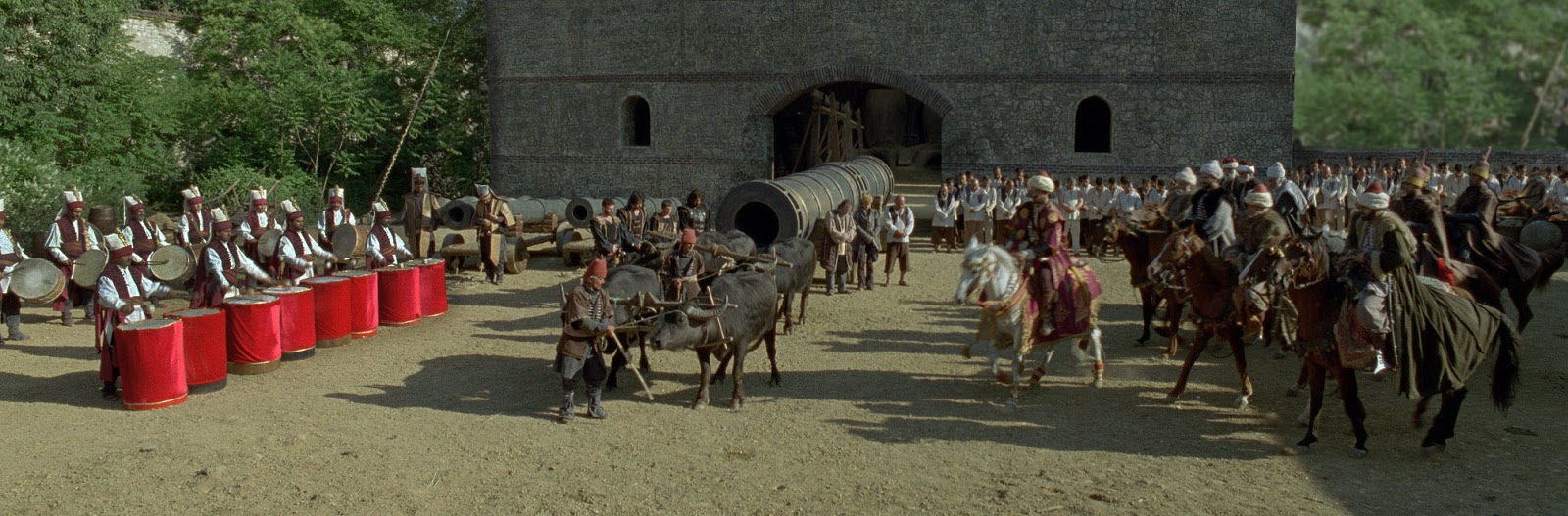
Most particularly Mehmed was at heart a redleg. His real passion and innovation was cannon, and the Ottoman foundries were alight in the winter and spring of 1452-53. Perhaps the single most retold story of 1453 is that of "Urban" (or Orban), the Hungarian master craftsman who came to Mehmed saying that he could build a cannon that would "blast the walls of Babylon". Mehmed commissioned this artificer to produce the guns for the Rumeli Hisar and then even larger cannon for the siege of the imperial city itself, including a sort of "supergun" to top everything else.
This thing, the so-called Basilica cannon was the Paris gun or Schwerer Gustav of its day. It was about 26 feet long with a diameter of about 8 feet and fired a stone round that weighted some 1,200 pounds. It was as much a pure terror weapon as anything; "...the reverberation (of the cannon firing) was heard for a hundred stadia, and the ball hurtled through the air for a mile, then buried itself six feet deep in the earth." (Runciman, 1965)
At the end of March, 1453, when the Ottoman troops were assembling and the units marching off to the east, when the Ottoman fleet entered the Bosphorus to close the strait and isolate the city, this monster and the other 70-odd cannon were loaded onto their transport wagons and the draft oxen goaded into motion to begin the slow journey through the road of Thrace to their positions outside the walls of Constantinople.

The Ottoman recon and security screen first appeared outside Constantinople on 2 APR. The garrison sortied and took a slap at this point element but the Ottoman follow-on forces began to arrive and the defenders pulled back inside the walls and buttoned up; the bridges over the land-wall moat were broken and the gates closed. Emperor Constantine ordered deployment of the great metal chain boom that stretched across the opening from the Bosphorus Strait into the estuary called the Golden Horn that ran along the north side of the city. The north end of this boom was located in the Genoese colony of Pera, something we'll talk more about in a bit.
We've talked about the defenders' numbers; too small to really man the walls everywhere. Given the obvious threat to the west the bulk of the defenders were along the Theodosian Walls.
The image below is from the Wiki entry and it's labeled in French, but the names should be clear enough to help you follow along:

The Byzantine regulars and the Emperor himself were posted along the Mesoteichion, the low point where the walls spanned the river Lycus. To the imperial right, from the crest of the Myandrion ridge all the way to the end of the Theodosian walls and from there along the projecting Blacharnae-palace section Italian troops held the walls, as they did - interspered with second-line Byzantine troops - from the Lycus valley down to the seawalls at the south end of the land-walls. The commanders of the defense seem to have tried to intermix Byzantine, Venetian, and Genoese troops along the land-walls so as to reduce the nationalist friction between the otherwise-often-fractious allies.
The defending force was also too small to hold both sets of Theodosian walls, so the defenders were initially posted either along the lower outer wall or even along the breastwork at the inside edge of the foss. Presumably a scratch garrison was posted in the towers of the outer wall to provide fire support for the defensive line.
The sea-walls were even more lightly held, by a mixed bag of Venetians, Genoese, Catalans, even monks drafted into the service and the Ottoman pretender Prince Orhan and his household guard.
Runciman (1965) says that "Two detachments of reserves were kept...one...stationed in the Petra quarter, close behind the land walls, with a supply of mobile guns, and the other...near the Church of the Holy APostles, on the central ridge."
The besiegers ringed the landward side of the city as well as the north shore of the Golden Horn. Regular Ottoman troops formed the first line of circumvallation; Thracian units from the Lycus north, Anatolians south to the Marmora coast. A strong detachment held the north shore of the Golden Horn and the area outside Pera. The bashi-bazook irregulars were encamped in a broad arc to the rear of the regulars.
The Ottoman fleet was based north of the city, along the west side of the Bosphorus, but patrolled the length of the strait east of Constantinople to isolate the city from the seaward side.

Along with the battering during the first week of the siege the Ottoman fleet tried their luck at breaking the Golden Horn boom without success; this is said to be because the Venetian and Genoese ships were taller and sturdier, their weapons heavier and more effectively used, and the general standard of seamanship higher in the Latin and Byzantine vessels than the Ottoman. And initial probe on 9 APR was seen off quickly and a stronger attack on 12 APR was also beaten back.
On land the opening bombardment lasted only two days, though several areas of the outer wall and breastwork were brought down and part of the foss filled in; particularly north of the Lycus. But the defenders worked hard to repair the damage, setting up palisades and makeshift fighting positions. "Men, and women, too, from the city came every night after dark with planks and barrels and sacks of earth." (Runciman, 1965). Mehmed ordered the artillery repositioned; this was done and the bombardment resumed 12 APR.
The big Basilica cannon quickly proved that even in the 15th Century superguns are usually more impressive in the concept than the execution. By 7 APR the barrel was showing dangerous cracking, and the cannon was out of battery - either burst or simply too damaged to fire - for nearly a month. Big and loud? Yes. Actually useful as a weapon? Not so much.
That was largely the story with the rest of the Ottoman cannon artillery as well. While it is true that the gunpowder cannon meant the end of masonry wall fortifications, in 1453 cannon artillery was simply too unfinished a weapon to destroy a fixed fort by itself. The cannon were too slow to fire and too prone to damage in firing; throughout the siege of Constantinople the defenders were able to repair breaches in the walls before the besiegers could take advantage of them.
But the bombardment did degrade the walls, the rubble generated did help fill in the foss, and the projectiles and the equally-lethal stone shrapnel produced by the damaged walls killed and wounded defenders. The Ottoman redlegs weren't quite the King of Battle...yet. But they were clearly headed the right way.

The besiegers did manage to storm two small castle works, one north and one south of the city itself. The garrisons that were not killed in the storm were impaled, just to show the defenders of the main walls who was the baddest Turk in Thrace.
In the evening of 18 APR the Ottoman regulars, including Janissary troops from the Kapu Kulu, tried an assault on the Mesoteichion sector; it was repelled after four hours of fighting. Two days later the defenders' morale was raised some more, as four ships - three Genoese galleys and a Byzantine supply transport - fought through the Ottoman blockade into the Golden Horn. The same problems the Turkish fleet had run into trying to force the chain-boom hit them here; smaller, less-well-armed vessels and less experienced crews. The Byzantine transport also had Greek fire projectors - remember that proto-napalm stuff from the Siege of 717? - that played holy hell with the Ottomans. Mehmed was furious. He broke the Turkish admiral, Baltoghlu, and set about thinking of a way to deal with the damn Bible-banging sailors.
Taking the Golden Horn: 20 APR to 28 APR
Here's how Runciman (1965) describes it:
"Mehmet had spent the day at the Double Columns (the Ottoman fleet base). His ingenious mind had worked out the answer to his problem. It was probably an Italian in his service the suggested to him that ships could be transported overland.Between 20 and 22 APR the Ottoman engineers oversaw construction of a wood and metal trackway across the Pera ridge from the Ottoman harbor on the Bosphorus to a small creek inlet along the Golden Horn called the Valley of the Springs (now called the Kasımpaşa).
The Venetians in one of their recent Lombard campaigns had...carried a whole flotilla on wheeled platforms from the river Po to Lake Garda."

Beginning on 22 APR some 70 Ottoman vessels made the trip across the ridge.
"In every boat the oarsmen sat in their places, moving their oars in the empty air while the officers walked up and down giving the beat. Sails were hoisted...(f)lags were flown, drums beaten and fifes and trumpets played while ship after ship was hauled up the hill, as if it were a fantastic carnival." (Runciman, 1965)The surprised defenders couldn't marshal a response for nearly a week; finally early in the morning of 28 APR a small flotilla under a Venetian commander; two transports, two galleys, and three small craft - sailed from the Byzantine fleet anchorage near the north city walls towards Pera and the new Ottoman fleet base. The expedition destroyed an Ottoman galley but lost a Venetian one as well as one of the light ships and about 90 crewmen before being driven off.
The Ottoman fleet allowed the besiegers to build a pontoon bridge across the upper reach of the Golden Horn as well as several floating batteries that could range the north sea-walls. Although they still held both ends of the chain boom the defenders had lost control of the Golden Horn.

Alarms and Excursions: 29 APR to 28 MAY
The month between the loss of the Golden Horn and the final assault was a very siege-like sort of month; the besiegers tried to break in the the defenders tried to stop them. Every day the Turkish gunners would give the defenders their daily "hate". The Ottoman fleet would patrol the waters to the north, south, and east. The defenders and their families would try and find food, and sleep, and worry. Interspersed into this gray tale of misery were moments of sheer terror and death. I'll try to give you the short version here.

29 APR to about 5 MAY - Phony war; very little ground action. The defenders send out a small ship to seek help on the night of 3-4 MAY. Infighting between Venetians and Genoese - the Byzantine Emperor has to personally intervene to quash the quarreling. Emperor Constantine is also said to make approaches to the sultan for surrender on terms, but the Ottoman terms (unconditional surrender with the sultan's guarantee of personal safety for the inhabitants, the Byzantine Emperor to become a political prisoner) were not acceptable.
7 MAY - Night ground assault on the Mesoteichion. Ottoman regulars unable to force the stockade-barrier along the ruin of the breastwork in three hours of fighting.
12-13 MAY - Night ground assault at the junction of the north end of the Theodosian walls and the Blachernae suburb. Walls not badly damaged in this area and assault quickly recalled.
16 MAY - Byzantine countermine (engineered by Scottish mercenary Johannes Grant) destroys Ottoman mine in the Blachernae sector near the Caligarian Gate. Byzantine sappers burn wooden mine props - possibly with Greek fire - and collapse mine killing Ottoman miners in collapse.

21 MAY - Countermine destroys Ottoman mine near Caligarian Gate in Blachernae sector
23/24 MAY - Countermine in the Blachernae sector leads to underground melee, capture of Ottoman miners. Interrogation of captives produces locations of remaining Ottoman mines. All are countermined and destroyed. Ottomans abandon further mining attempts.
23 MAY - Ship sent out on 3/4 MAY returns; no relief force underway or reported planned.

The Fall of Constantinople - 29 MAY Supposedly the Imperial negotiators and the emissaries of the Sublime Porte met for the last time on 25 MAY. The Ottoman conditions had not changed, and neither had the position of the Byzantine Emperor. The following day Mehmed met with his council to announce that a general assault would take place as soon as the logistical and tactical arrangements could be made. Those preparations were completed the next day, and the Ottoman Army took Monday 28 MAY to prepare - spiritually and physically - for the attack.
That began at 0100 - 1:00 am - Tuesday, 29 MAY 1453 with storming parties advancing all along the land walls as well as in ships along the north and south sea-walls.
The first wave against the land walls was composed of the bashi-bazouk irregulars. Runciman (1965) says that because of their indiscipline "Mehmet placed behind them a line of military police armed with thongs and maces, whose orders were to urge them on..." with less than gentle persuasion, one suspects. Behind the MPs was a third line of Janissary infantry with swords; if persuasion failed then cold steel would solve the problem.
The focus of the attack was the Mesoteichion sector in the Lycus valley as being the most stormable; the foss must have been nearly filled with rubble (and stone projectiles and, most likely, corpses), the breastwork and outer walls largely knocked to pieces and the gaps filled with palisades and probably punji-stake-like obstacles.

None of the other Ottoman assaults had made any purchase. Both seaward-side attacks had been desultory and easily seen off. The ground assault on the Blachernae sector in the northwest from land and sea had been pressed with more vigor but had no more success.
The Kapu Kulu regiments went in around dawn. For about an hour the Janissary and household units made little or no headway against the defenses. But at some time in the early morning something happened.
Ducas says it was at the junction between the Theodosian walls and the Blachernae, and Runciman (1965) describes it thusly:
"At the corner of the Blachernae wall, just before it joined the double Thodosian wall, there was, half-hidden by a tower, a small sally-port known as the Kerkoporta. It had been closed many years before; but old men remembered it. Just before the siege it had been reopened, to allow sorties into the enemy's flank. But not someone returning from a sortie forgot to bar the little gate behind him. Some Turks noticed the opening and rushed through it to the courtyard....The Christians who were just outside the gate saw what was happening and crowded back to retake control of it...In the confusion some fifty Turks were left inside the wall..."Where, according to Ducas (by way of Runciman (1965) they should have been mopped up except Giustiniani took that moment to get mortally wounded.
The condottiero was hit by a gunshot (or a crossbow bolt) in the chest (or the shoulder or leg) - it depends on which source you believe. What- and where-ever the wound was, it clearly hurt like a bastard, because Giustiniani told his boys to drag him away. Supposedly when one of his dog-robbers went to ask for the key to the gate through the inner wall Emperor Constantine himself returned to plead with the guy not to slope off but without success.
The sight of their commander being hauled off panicked the Italian troopers and they bolted, leaving whatever Byzantine regulars to hold the breach in the outer wall. Mehmed saw this confusion and yoicked his Janissaries forward again. There's a war story about a giant Janissary named Hasan - and I'm sorry, but all I can think of is this:
- hacking his way through the palisade only to die opening a breach in the defenses. The defense of the Mesoteichion fell apart; the Janissaries were inside the wire and to stay was death.

Plus of all the sources only Ducas has this Kerkoporta story. I know that the "weight of opinion" can be so much bullshit, but...you have to wonder why nobody else caught this little detail.
Here's what I think. I think that the Kapu Kulu assault bumrushed the Mesoteichion defenses and broke them. I think that possibly a handful of defenders figured they might try and escape in the confusion and ran out this little postern door. I think that then - after the defense was already beaten - a handful of Ottoman troops got in this gate and ran the ol' crescent banner up the flagpole on the inner wall. So the little gate had a part - but not a critical or even a very important one - in the fall of the imperial city.

Somewhere, among the hundreds of other Christian troops who went down under swords, axes, spears, arrows, gunshots, or clubs, the last Byzantine Emperor, Constantine, died. Several stories are told of how and where, but all that mattered is that the ruler of Byzantium died with his empire. Mehmed II was now, in fact, the Qaysar-i Rum; the Emperor of Rome.
The sultan had promised his troops the traditional three days of sack accorded the assault troops taking a defended fortress. The resulting loot, murder, and rape, while traditional as well, is not particularly edifying or worth detailing. In fact the rapine is said to have effectively concluded by the evening of 29 MAY. Runciman (1965) says that of the city's some 50,000 inhabitants some 4,000 were butchered. Most of the remainder were enslaved. Only about 500 of the garrison survived as slave-prisoners. Aside from a handful that escaped by sea the remaining 7,000-odd were dead.
No records remain of the Ottoman losses. Assuming the usual 3 to 1 ration of attacking casualties as many as 20,000 soldiers were probably shoveled into mass graves, or lived out their lives as cripples, blinded, maimed, or with old scars that ached in the winter's cold.
Tursun Bey says that when Sultan Mehmed rode through the deserted imperial palace that evening he was heard to murmur "The spider weaves the curtains in the palace of the Caesars; the owl calls the watched in Afraisaib's towers."

The Outcome: Decisive Ottoman victory
The Impact: Several of the secondary sources I have read on this engagement point out that the real impact of the fall of Constantinople wasn't the collapse of Byzantium. That entity was a dead empire walking and had been moribund since the early 13th Century; the center of "Christendom" had moved to the West, to the new powers of France, Spain, and the Holy Roman Empire. No, it was, rather, the arrival of the Ottoman Empire as the new power in Islam and competitor of the West.
The Muslim outbreak from the Arabian peninsula - in the form of the Umayyad Caliphate we've already met outside the gates of Constantinople - provoked the Western crusades. Those, in turn, produced the long struggle between the Byzantine/Western Christian powers and the Umayyads, Ayyubids, Mamluks, and the Seljuk Turk Muslims as the eastern forces slowly ground down the Byzantines and exhausted the crusading enterprise. Now it was the Ottomans' turn.
But for now, expedience ruled over religious sentiment. The Western kings had their own disputes to attend to, the Western merchants lucrative trade with the Ottoman ports. The crusading spirit was, indeed, as dead as the last of the Paleogoi.
One internal Ottoman political impact of the victory at Constantinople was that it enabled Mehmed to defenstrate his conservative advisors, many of whom he'd inherited from his father Murad. Into their places came the Ottoman New Men "...nearly all of them aggressive converts to Islam, men without vested interests and wholly dependent on the Sultan's favor, and all of them eager to urge their master on to further conquests..." (Runciman, 1965).

The Orthodox cathedral in Constantinople was now a mosque, but an Orthodox patriarch still reigned, and the One True Church was now centered in Moscow and St. Petersburg. Holy Russia did not forget its place as the New Rome, and the wars that would come between the Tsar and the Sultan were in large part because of this.
The sultan wanted his prize to reflect his magnificence. He spent much time and monies rebuilding the city now called Istanbul. By Mehmed's death in 1481 the population - less than some 50,000 on 2 APR 1453 - had returned to nearly 200,000; by the middle of the 16th Century it had reached the half-million residents of the height of its Byzantine glory. The new Ottoman capital had eclipsed the crumbling metropolis of the Byzantine, the star and crescent flew over an empire more powerful and rich than had flown the imperial eagle.
Touchline Tattles: I wish I had something whimsical or entertaining to tell about the Fall of Constantinople. I don't. The story that all the chroniclers tell is one of a sort of Romantic tragedy, the fate-burdened death-ride of the Byzantine emperor and his people.
The closest I can come is from that film I mentioned, Fetih 1453. Since, as you've probably noticed, there's not a lot of "drama" in the story of the siege and fall of Constantinople (I mean, it's a hell of a story but it's about events and people doing things - "human interest", not so much). And there's definitely no romance, unless you reach back to the history of Maria the Naughty Nun. So. The makers of the flick invented a person - "Ela" - and made her the daughter of Orban the cannon-maker and a very winsome daughter they made her, too...

And, of course, our boy Hasan has to go to his rendezvous with death on the morning of 29 MAY, leaving poor Ela with nothing but memories and her daddy's big ol' cannon.
Proving, of course, that when all else palls we will always love our wars and lechery.


