Showing posts with label nature. Show all posts

Tuesday, October 27, 2026

A Failure of Imagination

A friend gifted me the book The Hour of Land, by Terry Tempest Williams.


It's an impassioned work of unabashed love for the wild places, in this particular case the wild that has been bounded within the national park system of the United States. The book includes Williams' exposition of, ruminations on, and adoration for thirteen national parks, ranging from Gettysburg battlefield to the Gates of the Arctic, as well as her advocacy of, as she describes it;

"...a different kind of conversation so that our public lands are seen as out public commons, instead of the seedbed of rancor and violence."

Williams, as a writer, explodes off the page in bursts of passion, poetry, and enthusiasm. She very clearly inspired by these places, and the other untamed lands she describes. "Language and landscape are my inspiration." are her very first words, and through the pages her devotion to the preservation, not just of these delineated spaces but of all the unpaved, unlogged, unmined, unbuilt places, shines like a good deed in a weary world.

It is also a very, very sorrowful work.

Because Williams' invocation of "conversation" and "collaboration" as central, as essential, to the integration of these beloved wild places into the national imagination, the lives and works and beliefs of the people of the United States, is a painful reminder of the complete and utter popular failure of the "environmental movement" in the 20th Century United States.

In my lifetime I've seen three great public or popular movements fail. 

Each one began with promise, with hopes of a better nation, dreams of a better people. Each one died in recrimination, dispute, and disunion, leaving the nation, instead, a more bitter, more divided, more impoverished, and more angry place.

Perhaps the most fraught and difficult of the three was also the most ambitious; civil rights. 

The failure to truly re-found the United States as a nation of equal justice under law, to undo the centuries-long legacies of the "original sins" of the founding - genocide and slavery (and the racial hatred that underlay them both) - has left all the marks that the acts that sprang from those beliefs unchanged, and the damage and destruction they spawned as toxic and divisive as ever.

Or increasingly more so. 

We the People are who we are because in many ways we are still the people our forefathers were. Their strengths are still our strengths...but their evasions, and cowardice, and wrongdoing are still deeply ingrained within us, too, and much of our present Troubles spring from the forehead of our past misdeeds.

That, frankly, is too fraught and difficult to encompass in a blog post. I want to return to it.

But not today.

The second was Occupy. 

For perhaps four years - from the Great Recession of 2008 to the final desuetude and dispersal of the "Occupy Wall Street" and associated encampment/protests in 2011 - there seemed to be a genuine opportunity to really, seriously consider whether it was a good idea to return the United States to the economic, political, social, and moral ethos of the original Gilded Age.

I wrote several posts about the failure of that opportunity; here, here, here, here, and, finally, here. 

I can't really describe the loss that this failure means any better than I did thirteen years ago:

"Occupy lost it's momentum and has already faded into insignificance.

Which in my opinion will be remembered as a tragedy. The Occupiers had one burning insight; that from the mildly benign oligarchy it had been from 1932 to the late 1970s the U.S. is rapidly becoming a predatory toxic oligarchy through the rapaciousness of its oligarchs. This insight was lost in the foolish cacophony of noise the Occupiers generated and the criminally negligent reportage of the courtier press. I believe that we will one day regret that we did not pay more attention to the rise of the modern aristos.

The result has been a continued slide back to the rampant inequality and social division of the Gilded Age, with the concurrent erosion of the sort of stodgy bourgeois middle-class attitude of the "rest" of the U.S. public as it sees it's decent-wage jobs, it's pensions, it's influence, and it's security ever more crammed down and eroded away. Combine that with the overwhelming sense that gold now makes the rules and that the reopening of government to massive inflows of cash has made individual voting almost meaningless and you get a public that seems to me daily more vulnerable to a demagogue, a "man on horseback" that promises to make those changes that they can't."

And, of course, now He Has Risen:

We've already talked way too much about the ignorant bastard. 

This, then, is the third "great failure". 

The inability of the American environmentalists - to lump everyone from John Muir through Edward Abbey and Teddy Roosevelt to Tempest Williams in a basket with that label - to convince the American public that the preservation, protection, and expansion of those parts of their own nation (let alone other people's nations, or parts of the world that aren't "nations" in the Westphalian meaning of the term) which aren't already paved, built-over, drilled, mined, logged, farmed, or in other ways "no longer truly wild" is important. A critical public good. An imperative that should be among the first and most important considerations of any and every piece of public business.

Williams published this work in 2015, after nearly eight years of the Obama presidency, in a moment of what I'm sure felt like a triumph for environmentalism, but now feels like a high water mark, the socio-political equivalent of the copse of trees at the crest of Cemetery Ridge where the environment and its defenders found that the battle had not only not been won, but that they were not just going to lose but in many ways would be routed and destroyed.

Williams just can't see that coming. 

Instead, Williams name-checks all the lineages that run through the literature and history of the United States environmentalism ("environmentally-concerned", or whatever you want to call people whose ideal is "let's not just fucking pave everything, okay?"); Muir and Abbey who we've already mentioned, Wallace Stegner, August Wilson, Rachel Carson, Wendell Berry, scientists like John Wesley Powell, politicians such as Roosevelt and Sally Jewell and Lady Bird Johnson and Barack Obama, wealthy philanthropists like John D. Rockefeller, as well as dozens of individual activists, public commentors, leaders of everything from native tribal groups to "monkey-wrenching" eco-warriors such as someone named Tim DeChristopher, who briefly gimmicked a BLM oil and gas lease auction in 2008.

She does this to try and center the wild places, and those who love and protect them, deep in the heart of the American story. The intent, clearly, is to make a case for the centrality of that, and them, and a rallying call for the public to join her. To start that "different kind of conversation" with the people she calls out from the other side. The Cliven Bundys, the Dick Cheneys, and the George W. Bushes.

Trump? Holy Hell did she not see that fat fucker coming. 

The prose is beautiful, the descriptions lovingly crafted, the care and hope luminous...and all it does is kindle a bright light that shines past her, casting the immense and nearly complete shadow of failure of her cause to create a response, even the most tepid and cautious response, from the damned U.S. public.

Couple of things first, though. 

Through the tales Williams' scholarship (or historical knowledge, or whatever you want to call it) or lack of same or, worse, evasion thereof, bugged the shit out if me. It's deeply uneven, sometimes lacking, and in several places it's apparently willful blindness is frankly unsettling.

The one that really jumps out at me is Williams' hagiography of the Rockefeller clan.

This crew is tongue-bathed twice - more than anyone mentioned outside of Abbey, perhaps - once for the old man, John "the public be damned" D's gift of the properties that became a large piece of Acadia National Park in Maine, the other for a similar donation of land by his son and grandson in an area near Yellowstone NP that became "Grand Teton NP".

The rapacious economic life of the plutocratic sonofabitch is never really dragged into the light, and the Gilded Age greed that piled up the cash that bankrolled him, his progeny, and their philanthropy isn't so much as mentioned during the discussion of, say, the carriage roads his wealth carved into Mt. Desert Island and that now are such a symbol of Acadia.

The other is the gloss sprayed over Cesar Chavez' rule of the UFW, eliding entirely the weird Syanon power games he demanded of his staff, as well as Chavez' personal inability to resist putting his chayote in women who worked for him. 

That's a problem.

Because there aren't "heroes" in the fictional sense in real life. There's just people. Flawed ones who can do great science, or make great art. Kind, loving ones who can go to work and do horrific things to others they don't see as "us". To write a paean to Rockefeller, or Chavez, and fail to accept and acknowledge their darknesses? 

At best that's poor writing. 

But that failure pales beside the greater misunderstanding of how completely Williams, like so many of the other mid- and post-mid-century environmentalists, misunderstood how people are.

Which goes back to the genesis of this post, the oddball comment on the previous one, about how the real reason that the global "public" didn't and doesn't rise up in righteous anger at the plutocrats, oligarchs, corporations, and bureaucrats that have and are enabling anthropogenic climate change is because of some black-helicopter/conspiracy-theory brainwashing and/or propaganda and/or bribery and/or something else utterly bizarre and nefarious.

The wild lands? Why aren't all the Good People of Earth defending them? After all, these are, Williams insists, sacred spaces. Liminal. Transcendent. Deeply entwined in humanity, links between that humanity and every other living thing. 

We the People - all people - need these wild, unbroken lands.

And that has been the "message" of environmentalism ever since I was a kid in school singing along with Woodsy the Owl.


Woodsy was one of the more public "faces" of what I understand is now often referred to as "the second US environmental movement", the rapid growth in the public presence of concern for what at the time (the Sixties and Seventies) felt like a cascade of horrific bad news about the poisoning of the soil, air, and water across the country.

That the industrialization of the United States had generated a hell of a lot of nasty shit is hardly surprising. That's what the mines and factories and farms did; took materials and made (or grew) other things from them, and then (since the people who owned and ran those factories and farms weren't in business to make the place nice if it cost them money to do that) dumped whatever shit they couldn't use or sell.

Into the nearest hole in the ground. Or lake. Or river. Of, well, fuck, in some poor sonofabitch's backyard if there was nowhere else.

The fun that all the things that the factories and mines and farms gave to Americans meant that they (mostly) ignored all the toxic shit that was in the country all around them.

But the 1960s the bill for all this started to come due.

Rivers caught fire. Toxic air started choking people. Toxic soil, or toxic substances barely covered with soil (Love Canal says hi!) started poisoning people. Drill rigs blew out and vomited crude all over pretty beaches where rich people liked to play.

And, finally, all this nasty shit made people - ranging from the poor powerless schlubs who'd had to live in this toxic stew to the wealthy and powerful and politically connected - begin to worry.

The first "Earth Day" was April, 1970.

The rest of the Seventies were a big time for "environmental" legislation and action in the U.S., which included introducing kids like me to Woodsy and his tree-hugging pals. That's how I remember the "environmental movement"; a singing dancing cartoon character who told me that I needed to pack my trash out of the woods and recycle my pop cans. 

What was going on around me while I was too young to understand it was a mad-minute-decade of environmental actions by the federal government.

The Clean Air Act had been passed a decade earlier (1963). But in the Seventies we got:
The Clean Water Act (1972)
Establishment of the U.S. Environmental Protection Agency (1970)
Resource Conservation and Recovery Act (1976)
Comprehensive Environmental Response, Compensation, and Liability Act (1980)
Establishment of human health and safety rules and organizations like OHSA (1970)
Endangered Species Act (1973)
Safe Drinking Water Act (1974)
Surface Mining Control and Reclamation Act (1977)

And then in January 1980 all that effectively came to a halt, because...


...yeah. That fucking guy.

Reagan's election meant the beginning of a now-forty-plus-year era when all the powers that hated the limits and restrictions and costs that required them to not buy, borrow, steal, or shit all over the non-paved (and much of the developed!) parts of the U.S. were back in the saddle with the Hollywood cowboy.

It's instructive to note that the bespectacled little gonif behind Reagan is the poster boy for the GOP's rape-the-Earth-First religion; James Watt, Ronbo's Secretary of the Interior, who saw his job as shoveling as much of the Interior to his and Ronnie's and every GOP cracker's pals as fast as he could.

(Oh, here's a funny paleoGOP/Watt anecdote. His greedy ass got canned because in September 1983 he stood up in front of the business boys of the US Chamber of Commerce and said "I have a black, a woman, two Jews and a cripple. And we have talent." That, in 1983, would get you fired. In 2026? Fuck, you'd probably bag a Presidential Medal of Freedom...)

So after 1980 the environment and environmentalism was on the outside, fighting a defensive battle. When Democrats would get power the wild land partisans would push back...only to lose ground again when the GOP got back in.

From that point the only way to prevent that would have been for the goddamn U.S. public to have been so thoroughly Woodsy-fied that any public attempt to reduce or evade environmental protections would have produced a massive electoral disaster for the authors.

That didn't, and hasn't, happened.

Why?

Here's my theory.

First, on "the environment" the public in general is now, and was, very much as the current voting patterns define it, and that set the task the environmental movement needed to accomplish. About a third is okay with environmental rules and law, anywhere from hardcore Earth First to "well, I'm driving a Prius and I recycle, so yay. me, right?". 

Another third is some form of "drill, baby, drill", ranging from the practical users-of-land-for-commercial-gain - everyone from workaday miners to ranchers to real estate developers - through the politically "conservative/Wise Use" types through to the pure wingnut "solar-is-for-pussies" and Bundyesque public-land-thievery goofballs. 

And there's some remnant lump in the middle, that's too ignorant to understand and too lazy and/or stupid to learn about the issues.

Meaning that to make environmentalism partisan-voting-proof you'd need to assemble and sustain a solid block of both the left and middle thirds, and probably need to peel off some of the more reasonable of the land-users.

Second, the mainstream U.S. environmental movement didn't succeed in doing that. Largely, I think for several reasons.

One is that the public at large wasn't, and isn't, emotionally (or economically, or politically) invested in the preservation, let alone expansion, of the wild lands. We as a society, and most people as individuals, live in towns and cities. To even get to those wild places, like the national parks treasured by Williams, takes time, effort, and money that many Americans don't have, or don't prefer to spend on a day gazing at or hiking Yosemite Valley as opposed to, say, hitting the rides at Disneyland.

Many people vaguely like the idea of scenic mountains and forests. But the connection is pretty vague for most of us. We don't live there and, frankly, most people find true wilderness kind of scary. Even the manicured "wilderness" of the national parks can seem inhospitable to a society that thinks of food as something that comes from the Safeway and shelter as a two-story townhouse.


Park Service studies suggest that something like 95% of visitors to Yellowstone never wander more than a half-mile or so from their car or RV.

But even many of us who do make that escape don't share the emotional level of commitment needed to push preservation of the environment to the front of the political business line. As a geologist, as a birder, as a GI, I've spent many, many days in the "outdoors", ranging from backlots to truly wild places. Many of the things I do, much of what I love, depends on keeping those places as unaffected by human civilization as possible.

And yet, I don't feel any of the "magic" that Williams describes and that is a large part of similar nature writing. To me the "outdoors" is a combined living room, kitchen, playroom, bedroom, and toilet. It's just a place; a beautiful place I love to visit...but that transcendent joy, that sense of living in those places? I don't feel it. That isn't a good lever to move me, and, I assume, many of those like me. Show me real, practical, everyday benefits? Sure! But pulling the "emotion" string? No.

That makes "wilderness" as a political good a hard sell. Because...

The other is that, like Williams, many of the most impassioned and visible defenders of the wild land are deeply invested in those places, and don't seem to understand precisely how difficult a sell that is to those who are not. The tone of The Hour of Land feels as though Williams believes that just by describing these places, their beauty and power, the readers will be energized to fight for them, to, let's not kid ourselves, make some kinds of sacrifice for them, and that's the really big ask.

Truly preserving the wild lands, the endangered species, means that industrial civilization has to take, or be forced to take, a step back. Everything from CAFE standards to hydropower dams to stuff as silly as paper-versus-plastic drinking straws means that someone, sometime, will have to be forced or encouraged (or a bit of both) to relinquish some thing or activity they want or want to do. 

The reality of that makes it simple for anti-environmentalists like Reagan and Watt and the Bushes and Trump to sell that uncommitted third-of-the-public that "those whacky tree-huggers" want to take your plastic straws, hamburgers, coal-roller, airplane travel, snowmobiles...whatever they can sell as something that would be limited by solar power or roadless areas or transgender...okay, well, whatever the "Left" finds appealing.

And, since as noted above, few outside the hardcore enviro faction have that deep emotional connection for the "wild places", whether it's Bears Ears or the local park, that's a damn difficult hill to fight on.

(And here I note that a huge part of the 2026 problem - compared to 1970 - is that environmentalism is hindered by its own success.

In 1970 many Americans knew of some sort of revolting, dangerous, dirty, generally-fucked-up mess made by business or farming or industry. Rivers were on fire, for fuck's sake! The LA basin was a choking cloud of "smog" as tailpipe gases and industrial emissions combined to make breathing difficult.

Now? When was the last time you saw anything like that? The legacy of the environmental regulations of the Sixties and Seventies means that in the Twenties We the People just don't think of "environmental protection rules" as things that keep our air breathable and water drinkable.

So we, as a society, as a nation, aren't particularly arsed to defend them when somebody who can make a buck fucking up the air, water, or soil comes around with a bagful of cash to buy some government.)

 
And here we are.

The current crop of fascist and Nazi-adjacent MAGAts is exceptionally vile on "the environment"...but as a matter of degree, not of basic beliefs. As we've discussed, the notion that the world around us is here for humans to grab whatever we can however we can, regardless of how fucked up that leaves whatever the grabbers leave behind them has been a fairly broad "conservative" ideal since...well, since at least the days of John D. Rockefeller and Drew Carnegie and Companies, if not all the way back to 1492.

I mean...the white folks that arrived in the hemisphere weren't here to set up drum circles and meditate on the beauty of nature, right? 

In the words of the song...

"The great nations of EuropeHad gathered on the shoreThey'd conquered what was behind themAnd now they wanted moreSo they looked to the mighty oceanAnd took to the western seaThe great nations of Europe in the sixteenth century
Hide your wives and daughtersHide your groceries tooGreat nations of Europe coming through."

Is there any way out of this?

Sure.

Is it quick, or simple, or easy, or cheap, or painless?

No.

And, if the past forty-odd years have taught us anything, it's damn deadly difficult to get humans in a group to do anything important if it's long, complex, difficult, expensive, and punitive...even when they're not a mob of greedy bastard.

So...yeah. There are days when, even though I'm not utterly hopeless, I just feel like...


...we are soooooooooooo fucked. 

Monday, May 25, 2026

Decoration Day 2026


As is my wont this day, I left North Portland early to visit Willamette National Cemetery and spend some time with my Army brothers.

It was...well, you know what it was, because I do this every year, and if you're one of the few people still reading this (and, yes, that "few" is my own fault for being a Bad Blogger and not posting more content. I get it.) you've read these Memorial Day posts and know where I go and what I do.

The big burying ground was its usual serene and manicured self. The visitors were sparse, as always in the early morning, although a bit more numerous in the newer, outer areas, where more of the dead from what I think of as "my generation" of wars are buried.

Still vastly out-buried by the crowd from the mid-Twentieth-Century wars, mind. As the generation born in the 1920s and 30's goes down to the grave in hastening numbers the space for my people, the younger troops from Iraq and Afghanistan (and the other farcical imperial adventures like my own Caribbean vacation of 1983 or Panama in 1989), is grossly over-filled with our parents or grandparents.

So much so that I was almost shocked to find someone who was actually killed in Iraq, a Marine staff sergeant whose luck finally ran out on his third tour in June of 2007. 


I took the time to look him up; when he bought the farm he was working as a bomb-disposal guy, presumably hunting for IEDs. His obit said he'd joined as a 17-year-old kid who had wanted to be a rodeo bull rider and Marine, had volunteered for the 2336 MOS after a bunch of embassy guard tours, and had ended up in Anbar Province where some anonymous muj had built for him a bull he couldn't ride.

As always, I poured out a beer to him and all my brothers; not gone, just marching far away, and explaining that I'd be there soon; sooner than I'd hoped, anyway. 

And, as always, I apologized, for not being a better citizen and keeping them from wasting years or their lives in pointless wars in distant places because I'd let the lies and foolishness and stupidity and evil of my "leaders" go unpunished. 

I mourned for them, and for myself, that the ideals and illusions they and I had been raised on - of our country and our people - had turned out to be nonsense, a tissue of credulous fables spun around promises We the People had never fought and worked hard enough to redeem.

 
And then I left. 

Down the green and shining hill, up onto the freeway that took me back through the busy outlands of southeast then northeast Portland to the patch of grown-over waste ground that is now the Whittaker Pond greenspace, where I took up my binoculars and spent a quiet hour looking and listening.

To the sounds of wind and water. To the hushed noises of business and traffic. To the quiet life of the city around me, doing it's daily business through wars and rumors of wars.


And then I went home.

Don't get me wrong.

I'm still incandescent with rage at the wreckage the parcel of greedy fools led by a bloated moron has done to my nation. I'm still fulminating because of the betrayal of people like me, soldiers and sailors and airmen and marines - and all those we have been and will be sent to kill and maim - who have been and will be carelessly tossed in harm's way for a bump of the Dow or some AI-slop social media shit.

But I'm still here. 

Not dead yet.

And as I promised my brothers; if I can summon the sheer gall and anger to be there to piss on all their graves, every one of the sonsofbitches?

I will.

Until then?

Here's to us.
Who's like us?
Damn few,
And they're all dead.

------- 

As always on this day; this.

Friday, April 03, 2026

Whooo?

It's suddenly early summer here in North Portland, so I drove up to the north end of North to see if there were any fun new birds showing up to enjoy the weather.

New? No, but I did find these two, a couple of new local residents, along the path to Smith and Bybee Lakes;


Great Horned Owl(lets). This one was a better photo op - the other owlet was tucked in tight next to a nearby tree trunk and screened by branches. So here's the other brother (or sister).

Both were still fairly downy, suggesting that they were no more than a day or two out of the nest. The parents were, or a parent was, probably nearby but were more experienced at hiding. Didn't see 'em.

I'm kind of foolishly pleased with this picture, because I don't have a good "birding camera", i.e. one with a telephoto lens to get up close to birds that, like the owlets, are uninterested in providing good snapshot poses. I have a cheap little phone camera, which when tried captured only a dark blob on a dark tree limb.

So I took my binoculars - and I do have good binos, Swarovski 8x42s, since while I'm not a bird photographer I am a birder and good optics are kind of a basic must-have for that - and held the phone camera up to one of the eyepieces.

It took a good bit of fiddling to get the camera and eyepiece lined up, and that doesn't even count the finger-stretch needed to push the "shutter" button, but the result is...pretty damn good. Particularly given what I had to work with.

 Other than that just the usual suspects. Looks like migration hasn't really reached us yet.

Wednesday, May 05, 2021

In which I am become Titania, Queen of the Fairies

"And on old Hiems' thin and icy crown
An odorous chaplet of sweet summer buds
Is, as in mockery, set: the spring, the summer,
The childing autumn, angry winter, change
Their wonted liveries, and the mazed world,
By their increase, now knows not which is which..."

~ Midsummer Night's Dream, Act 2, Scene 1 

(Maxine has become the Garden Goddess this spring, and this chaplet of sweet spring dandelion buds is her work. Very nice, sweetie.)

Monday, August 08, 2016

Missy Takes A Day Out

"I want to go to Silver Falls, Daddy!"

I have no idea why the Small One remembers going to this place, deep in the bosky dells of Marion County, in the lesser foothills of the Cascades. But she did, and her mom didn't want to drag herself down the long road southeast from Portland, so Sunday was a Daddy and Daughter Day Out, on the road to Silver Falls State Park.

So after a lazy morning the Girl and I started our adventure making sushi for lunch.

Yes. Sushi. The Small One is quite the sushi-chef.

She wields her makisu 巻き簾, the bamboo rolling-mat with the precision and flair of the true itamae-san as she crafts her tempura shrimp-rolls (her favorite).

Perhaps it's her small fingers, or, just perhaps, it's her love of the sweet savor and delicate crunchiness of the tobiko that leads her to sprinkle it liberally inside her makizushi.
The rolls are carefully sliced (that's Daddy's job...) and packed in the cooler, and the goodbyes are said; effusive to the relieved Mother, curt to the deliberately indifferent Brother, and we squeeze into the little Honda for the long ride.

And it IS a long ride; down through Portland and onto the freeway. South through the surprisingly heavy Sunday traffic choke-points of the Terwilliger Curves, Tigard, Wilsonville, and the Boone Bridge, before finally escaping to the relatively speedy stretch south of the Willamette River where the broad flatlands stretch away, green with summer and dark with a cloudy morning's rain.

The Girl keeps up a stream of chatter because...well, because she's a little chatterer. She enjoys her own silliness, exclaims little-girl affection for random farm animals that would intimidate her if encountered up close. She scoffs at her older brother's idleness in front of a video screen and hopes for an adventure in the woods ahead.

Off the freeway at the greedy sprawl of Woodburn, then east, then south along the faded strip of Highway 99 until we reach the left turn for Silverton. From there it is truly into the undeveloped lands of the east edge of the Willamette Valley.

The valley itself is, to my eyes, an unappealing square flatness of farm field and copse. Southeast of Woodburn, however, the land rises into pleasant undulation towards the cloud-wrapped mountains beyond.

The road itself loses its drab linearity and winds, dips, and climbs in an entertaining fashion, made all the more pleasing by not being blocked by sluggish tractors or gear-grinding heavy trucks. The Girl and I sail through the woods and fields and are passing through the faux-Teutonic hamlet of Mount Angel in short minutes.

Small One is perplexed, then amused, by my insistence that the wooded hilltop east of the town is occupied by actual monks, and laughs at the fakey-German gimcracks as we pass through.

But her laugh is on me when we stop at the IGA grocery outside Silverton to pick her up a bottle of water. It turns out that today is the culmination of "Homer Davenport Days" in the little town and she gleefully predicts a "Tulip Festival", crowing with delight at the prospect of a Furious Daddy.
("Tulip Festival", by the way, is family shorthand for "some unforeseen event that creates incandescent rage in the parent", after the time my father the Master Chief was driving my family to our annual vacation in upper western Michigan and got stuck in the middle of some sort of Holland, Michigan celebration.

Of course, in those pre-Internet days he, and we, had no idea that this was a thing until the traffic on the little road through town - this being the late Sixties the idea of a highway or bypass up the east side of Lake Michigan was an arrant fantasy - slowed, and then slowed, and then stopped and sat.

So we sat. And sat. In a dark green station wagon. In the August heat. For several hours. While my father, normally a man of moderate temper and inexpressive mien, grew more furious by the moment.

By the time the traffic began to move and we crept through the festive town my father would have cheerfully nuked Holland, Michigan, and all its inhabitants into a glowing slag and danced gleefully upon the ruin.

Ever since then the prospect of seeing the top of the paternal parent's head fly off in rage has been the sincere wish of both children, and Missy was practically chortling in hope.)
Sadly for The Girl, the Tulip Festival (or Homer Day, or whatever...) was confined to a side street and we sailed through Silverton practically without a check and up into the close-set woodlands and rising hills above us.

Reaching the north end parking lot we find that we're not the only people who decided to visit that day; the lot is full, and we have to look around for an alternative. That turns out to be a gravel side road with a broad shoulder where we leave little Stinky the Honda and walk back to find our path for the day.


That turns out to be, first, "Little North Falls", a pretty box-canyon headed by a pinnate rush of cold, clear water. We admire the pools in the slickrock at the base and the size of the trees felled and boulders moved by the winter floods.


The Girl finds water striders dimpling the glassy surface and makes little wavelets to make them skitter away. I stop to take pictures of the passage of the winter's kolks; the sudden holes in the basalt filled with grindstones where dark gray-green crayfish scuttle into the shadow when we loom over them.


A young couple has, in "defiance of municipal regulations", brought their small white terrier with them to the falls. The little creature is, in violation of normal terrier mores, hesitant about rushing around sniffing and detecting, perhaps because of the water-slick rock.

My own little creature is, as is her wont, entranced. While she found having an actual dog somewhat of a nuisance as a pet she enjoys other people's dogs and is coo-ish and enticing towards this one which, however, is only mildly curious in return about the small cozening human. Perhaps this has something to do with the Small One's lack of food.
From there it is back to the bridge over Silver Creek and then down the trail to "North Falls"; this is what the Girl remembers, though she is dismissive of the small plume of falling water.

"It was a LOT bigger last time!" she declares.

Indeed, the plume is much diminished from the earlier spring when we last visited. The crowds are somewhat larger, however, and I force myself not to make an irked sound as we pass the self-impressed boobs using some sort of scribing tool to etch their little piece of eternity into the rock ceiling.

Missy wants to lob a rock into the fall, so we carefully pick out a spot where we can see all the way to the plunge pool and she lets fly; the palm-sized projectile flies about a quarter of the way out to the cascade before arcing down into the swordfern and vinemaple.

Still; Missy is well pleased with herself, and skips on down the trail to where it meets Silver Creek some quarter-mile or so further on.

There she entertains herself mightily plonking rocks in the water, launching clover petals, and using the swagger stick I picked up to riffle the cold waters not long removed from the snowfields of the High Cascades.


We share this little slackwater with a Filipino family, whose youngest son is rampaging through the water soaking his clothing and generally ignoring the requests, imprecations, and demands of his female relatives with squalling defiance. I foresee a difficult adolescence for Young Master, whose expectation of similar indulgence from the larger world is likely to go as unfulfilled as the Silver Creek channel is today.

The Girl is ready to continue on, but I know the capability of those short legs better than their owner does, so I turn us backward, heading the short way towards the north parking lot. We circle back under North Falls, casting another stone along the way and pausing to ooh and ah at the tree casts, the cylindrical voids in the overlying basalt ceiling formed by millions-year-old trees that were buried in the flowing lava.

These piers are empty, hollow columns rising into the darkness overhead unlike the tree-cast I once told you about. But they, too, to me seem fraught, empty yet full of the vanished forest and the uncountable years.

The Small One is only mildly impressed.

She is more excited retelling another, more recent Family Legend, this one the story of Daddy and Mommy and Pre-Mommy and the Boring Little Brown Bird* ("Mommy was mad because she wanted Thanksgiving Dinner more than the Boring Bird!")

She pockets the two smooth stones she picked up along the creek, momentos of her adventurous day.

The drive home is unremarkable outside the appalling tie-up the begins south of the Aurora exit and continues grinding along in fits and starts painfully slowly almost to North Wilsonville before, suddenly and inexplicably, dissipating.

The Small One is weary from her hike (and a brief hop to our Powell's bookstore for some new stories to read...) and remains in the back seat reading about kitten Chi's newest shenanigans rather than take the few steps into the store we stop to get her brother's much-needed XBOX accessories.


But she is again chatty and excited when we get back home, informing her mother (and her brother, if he cared enough to listen) all the excitement we shared in the Oregon Wild. She bounces off into her back room with her new book in hand.

And returns a quarter hour later, flops down backwards on the parental bed, and announces with a sigh and a voice heavy with the pain of bottomless ennui:

"I'm bored."


*(The official version of the story of "Mommy, Daddy, Pre-Mommy and the Boring Little Brown Bird" ("Oregon's First Louisiana Waterthrush") is told in the first article in above-linked issue of Oregon Birds, the publication of the Oregon Birding Association (then the Oregon Field Ornithologists).

For some reason I find it richly amusing that the citation for the initial sighting of Oregon's first (and, so far as I know, only) record of this species is shared by my current wife, my ex-wife, and me. My children, for some inexplicable reason, do not find this nearly as entertaining)

Sunday, November 02, 2014

The Short Sobs of the Violins of Autumn


The violins of autumn don't get much of a solo around here. More like a two-bar bridge and then it's off to the drizzling continuo of winter rain. "Fall color" lasts from about 2:45 to 4:50 on November 1 every year; after that the rains knock all the bright leaves down to where they form a glutineous mass in every catchbasin and a slimy coating on level ground.

I still love the autumn. But the Northwest version isn't the sort of thing that inspires poets and balladeers. It's just the introduction to the Dark Ages of winter, and much as we try and enjoy it the pleasure is fleeting.

Monday, February 04, 2013

Where the Wild Things Aren't

Speaking of wilderness, and since the small predators that live among us are on my mind (Little Cat has been doing nastily worse over the past week) I note in passing the summary of this "research" that appeared in the N.Y. Times:
"...the domestic cat as one of the single greatest human-linked threats to wildlife in the nation. More birds and mammals die at the mouths of cats, the report said, than from automobile strikes, pesticides and poisons, collisions with skyscrapers and windmills and other so-called anthropogenic causes."
(Cautionary note: the full article is likely behind the NYT paywall...)


While the Fire Direction Center has housed two of these fearsome predators for over ten years and as such has seen tangible proof of the moggies' ability to take various furred and feathered prey, I'm still not sure that I buy this story of the domestic cat as Death, the Destroyer of Worlds.


For one thing, it goes a long way towards absolving us hairless monkeys for all the other things we do that are tremendously effective in destroying wild animals. As Erik Loomis notes; humans in general are the single worst thing for wildlife on the living Earth. "Worse than land mines, worse than nuclear meltdown."

Perhaps the single greatest "story" of the last 200 years of life on Earth has been the emergence of humans as something beyond the global apex predator. Cats, dogs, tigers, sharks...all have to do their killing retail. We can literally reshape the earth. We level mountains, fill in canyons, we seem to be changing the global climate.

I'm not trying to argue against the conclusion that people need to neuter their pets, need to stop dumping them into fields and streets, should really keep them inside, or not keep them at all if "inside" is just too damn small for an animal to live comfortably (or if they are simply left outside in a yard bored out of their doggie skulls.

What I am saying is that the Great American Public - 95% of Joe and Molly Lunchpail (rising to 99.8% if they have any sort of Tea Party membership card somewhere on their person or a Romney sticker on their car) - is dumber than a goddamn stump about scientific facts in general, and this sort of "reporting" does them no favors.

Remember this when your Uncle Alex, the teabagging appliance salesman, tells you for the zillionteenth time how Global Warming isn't the problem, feral cats are the problem.

Friday, February 01, 2013

Cold rain

The recent dearth of posting is because I've been up in the foothills of the Olympic mountains on a job...


It's a pretty spot, and the project - building a footbridge for the Park Service - is a trifle less grubby than the usual sort of "7-Eleven" and "filling station" projects that make up the working week of a private geotech, but sadly the part we're involved in hasn't gone well and is likely to end up in litigation. Well, shit.


This week the normal outdoors adventure was enhanced by about two to three feet of old snow on the trail into the site. This stuff was the worst of Northwest snow; wet, slushy on top when it wasn't glazed with ice, heavy, and dirty with needle- and bark litter. In several places it had corniced over the narrow trail and there was a certain...thrill of uncertainty...whether one was walking on two feet of old, rotten melting snow over the trail or two feet of old, rotten melting snow over...nothing.


And the weather, too, managed to be the worst of the Pacific climate; cold but not cold enough for snow. So you got a steady misting rain but never warmed up above the forties. The wet raingear and the chill air combined to suck the heat out of you; I had no less than five layers on, including a heavy snow parka, on Monday and found myself shivering like a vibrating string all afternoon. Brrrr.


This week's work went as planned. But that well is poisoned already, and all factions are whetting their legal knives. It made the slippery walk to and fro each day seem a little longer and colder.


And I'm due to return next week to test the anchors installed in this one.

I hope the weather turns either warmer or colder by then. The feeling of hunching miserably under a cold rain is all too reminiscent of too many bad days I spent in the field in my youth.

Tuesday, January 15, 2013

Red Rock Country

My friend Maia has a post up about her family's recent trip to the red rock country of Colorado around Moab. Which reminded me of the time I spent there back in the Nineties. My ex-wife and I went on a Sierra Club "service trip" which involved working as volunteers for the National Park Service. In our case, removing and rebuilding fence along "Dry and Rocky Mesa" in Arches National Park.


In case you were wondering, the guy on the left is me. I loved that old desert night parka. Wish I knew what the hell had happened to it. I wish I knew what the hell had happened to that cocky young guy, too. Well, I know what happened; just wish I'd treated his body a hell of a lot better when it worked like it did when he looked like that.

Anyway, Arches N.P. was a hell of a beautiful place, and I'll have to post about my time there. For now how about just a savor of the dry and rocky silence of the redrock desert on a chilly, raw Northwest day?

Tuesday, October 30, 2012

Work and Worry

If I seem downcast in my posting lately it's partly because the Rains have arrived in force. I always have a tough couple of weeks getting used to the cold, wet, and dark.
If there's another thing it's because I have a job that is going very badly on me, and one that involves a great deal of walking around on my bad hip. So I get up very early to drive a long way, then walk a mile or two with my hip aching like a Congressman for a lobbyist's wallet, and then everything at the job goes wrong and everyone is pissed off at everyone else.
Don't get me wrong; walking a mile through the beautiful Northwest woods is still better than a kick in the face and a toxic waste dump in downtown Gresham. But don't tell me that when my ass is aching and not just because the client took another bit out of it.

What a fuckin' fuckstory, as my old pal James used to say.

Sunday, April 29, 2012

Un dimanche après-midi à l'Parc des Donnezsur

Hmmm. I think I wanted to take a moment from all the angst and provide a post with no meaning beyond the sensual;
That, and every so often I take a genuinely good picture; I just love this snapshot of our Overlook Park on a sunny Sunday.

For all our troubles and toil, the world is often a lovely place. It is unfortunate that we are often to harried and busy to stop and notice that. I hope you have a moment today to do so.

Thursday, June 23, 2011

Chinook

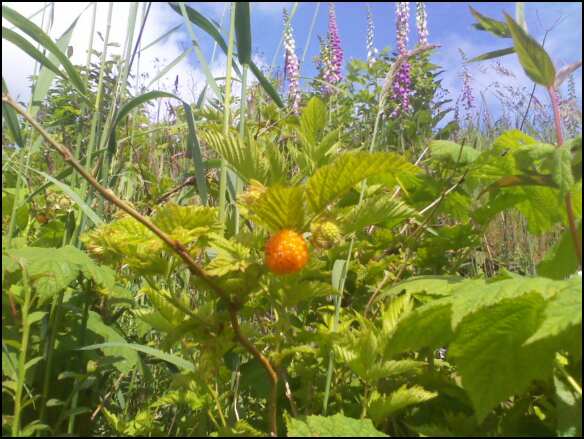
Just back from two days drilling at the Coast. A few showers (it's the Coast, after all...) but mostly just some good days' work in the mountains by the sea.And, as you can tell, the salmonberries are ripening. And that's always a good thing.

Tuesday, June 21, 2011

One Mean Mother

"And God blessed them, and God said unto them, Be fruitful, and multiply, and replenish the earth,""...and subdue it: and have dominion over the fish of the sea,""...and over the fowl of the air, and over every living thing that moveth upon the earth."Aah...

Wait!

What?

(h/t to Pharyngula)

Wednesday, June 08, 2011

Ugh. Gods angry. Need virgins, stat.

Is it any wonder we all once worshiped the Sun?A reminder that for all our hubris, we're a pretty puny lot, really.

Friday, March 11, 2011

Half a word

Every so often the Earth likes to remind us that for all our hubris we're still just hairless monkeys with homicidal tendencies. And that for REAL destruction, Mother Earth is one BAD motherfucker.And the quote of the day so far (from Nancy Nall): "I wept because I had three inches of new, wet snow in my driveway, and then I met a man who had 12 feet of Pacific Ocean in his."

Monday, February 21, 2011

Let The Fire Fall!

Back in the Sixties the concessionaire that ran the hotel at the top of Hosetail Falls in Yosemite National Park used to do this thing where his staff would set up this big ol' bonfire at the top of the Glacier Point cliff. As dark was falling they'd light this sucker up, get a good hot blaze going, and then...well, let's let this guy take up the story:
"At 9:00 each evening in Camp Curry, the crowd which had gathered for the nightly campfire program, would fall silent. A man would call out to the top of Glacier Point "Let the Fire Fall!", and a faint reply could be heard from the top of the mountain. Then a great bonfire of red fir bark would be pushed evenly over the edge of the cliff, appearing to the onlookers below as a glowing waterfall of sparks and fire."
This went on from the 1870s until 1968, when the Park Service came to the realization that horsing burning logs off a cliff in a wildland national park wasn't, well, very "wild".Or natural. And stopped doing it. There are people who have been grousing about this ever since.

But the thing is that it turns out that under the right conditions Yosemite's Horsetail Falls can do the same thing or better:
"If there's enough water and if the sky's clear enough to get a sunset, the setting sun will be at an angle to the falls and this causes it to glow. It's rare to get such great conditions - a lot of water and decent sky. It's pretty wild to see because, at first, you can barely make out the waterfall. As the sun starts to set, it glows yellow a bit and then, all of a sudden, it lights up and looks like lava."
Gorgeous, isn't it?But isn't that just like fucking Nature?

Instead of giving us a good show when WE want it, it makes us wait and wait and wait and wait until everything is just right before doing something spectacular. And sometimes it never does it at all.

No wonder more people go to Disneyland.

Friday, December 17, 2010

Why I Love Geology 3: Dry Falls

Intriguing bit of history courtesy of the UK Daily Mail.Seems that in the late 1960's the U.S. Army Corps of Engineers was tasked with investigating cliff retreat along the smaller, American-side fall at Niagara. This is reported to have come about because of one journalist, a Mr. Cliff Spieler of the Niagara Falls Gazette.

Mister Spieler wrote about the large rock falls in 1931 and 1954 that had created a large talus pile at the bast of the American falls, and that a combination of continued rockfall and headward erosion could "kill" the falls. This caught on with the American public, and in late 1965, the U.S. and Canada set up an International Joint Commission. Two years later, the American Falls International Board recommended damming the Niagara River above the falls in order to conduct geotechnical analysis of the falls.The United States Army Corps of Engineers (USACE) – Buffalo District was assigned the project, and from June 9, to November 25, 1969 no water flowed over the American falls for the first time in nearly 12,000 years.

The USACE drill crews cored the sedimentary rock that formed the falls, scaled loose materials off the rock face, and installed several instruments, including extensometers, in suspected areas of weak rock. After a long period of preparation people were allowed into the dry riverbed, where they gathered coins tossed into the immense wishing well over the decades and just gawked at the scenery.Geologists scampered all over, measuring, sampling, performing dye tests and mapping joint and fracture patterns.Among the huge rock debris at the base of the falls were man-made debris and the bodies of a man, a deer, and
"the badly decomposed body of a woman jammed head first amongst the rocks about half way up talus bank. The woman was clad in a red and white horizontally striped jersey or dress and a narrow gold wedding band with the inscription “forget me not” on the inside."
No record of what the deer was wearing.

After Thanksgiving, 1969, the water was set free and has flowed over the falls ever since.

After five months of work including 46 core borings totaling 4,882 feet, mapping, probing, installing piezometers to measure water pressure on rock joints, extensometers to measure rock movements, and a further six years of study and opinion polling the IJC concluded that:

It was technically feasible to remove the talus but was not considered desirable.

The Falls could but should not be stabilized by artificial means

And that while the two flanks of the American Falls and the Goat Island flank of the Horseshoe Falls were sufficiently unstable to warrant remedial action a statistically minor element of risk from unpredictable rock movement would remain and must be accepted by the viewing public.So nothing more was ever done.

And the American falls still flow.