Showing posts with label The Army I Knew. Show all posts

Friday, February 03, 2023

It's all about meeeeeee!!! (considering "The Army I Knew")

So just curious.

For a long time I ran a series of posts I called "The Army I Knew". It was a frankly personal recollection of my Army days, from the Regulars of the Eighties, to - I think - the Army Reserve of the late Eighties/early Nineties. IIRC I stopped when I'd gotten off active duty and had been assigned to a USAR hospital unit.


(Just looked it up - yep, the final post in the series is this one, about the technical side of that particular hospital, a "MUST" gimmick that was very Sixties but still around in the USAR like a lot of other antiquated hardware...)

Anyway.

Is there any interest in following this path? Specifically, I would have posts about:

1. A USAR heavy engineer unit outside North Philadelphia. I wrote about one of the adventures of the GIs-vs-turkey-hunters here back in 2015.
2. From there to the old 104th Division (Training) here in the Pacific Northwest, and spending a couple of years under the hat. It was an interesting look at the whole idea of "Reserve drill sergeants".
3. From THERE to the Oregon Army Guard - as a hat I was involuntarily reclassified as an 11C - mortarman - and would have been expected to go to war as a mortar section sergeant of FDC, and at that time I knew about mortar operations what a cow knows about church, so a lateral transfer to a Guard infantry unit. From there to...
4. A Guard artillery unit. For the simple reason that I was too old and to cunning to walk around with a goddamn mortar on my back, and when the ORARNG went fully to the light MTO&E I wanted to ride to battle. and then my final duty station,
5. The Oregon Guard west-side training post, Camp Rilea, where I retired.

I have no idea if there is any sort of readership for this stuff. I don't really have stories about me as much as about the time and places I lived through. 

That Army - the Reserve and Guard of the Nineties and early Oughts - is as vanished as Ninevah and Tyre. The War on Terror destroyed them as throughly as it did Fallujah and Ramadi. 

The reality of deploying very eighteen months to three years meant that the old-school-post-Vietnam guardsmen, the "two-days-a-month/two-weeks-a-year" guys like me, couldn't hang on to both a real civilian job and a USAR/ARNG slot. Despite the law, your civilian employer couldn't keep you if you were constantly vanishing to go play whack-a-muj every year and a half...so the reserve component units (so far as I can tell) largely became a mix of students and young guys without a career and more-or-less-professional-soldiers who picked up odd jobs between deployments.

But...it IS also truly ancient and minor history. There's nothing important or of social value there. It's just a reminiscence of a time that now seems long ago and far away. I time that, all in all, I enjoyed living through. But not one that I'm sure has any entertainment value to anyone who hadn't.

So.

Thoughts?


Wednesday, January 11, 2023

Down, boy

Since I just posted the cat story thing...

In the Eighties I was posted to a location in the U.S. Southeast. It, like almost all U.S. Army posts, had housing for married soldiers. 

In said housing was a happy family; mom, dad, kiddos, dog, the usual.


So you know, these little military neighborhoods make “Nextdoor” seem like an idyll of placid indifference. You’re ALWAYS being looked at; by the neighbors, by your chain-of-command, by the post commander’s organization. There's a gajillion eyes on you and your family.

So it was not hard to imagine that at some point someone; a neighbor, a superior, one of the neighborhood busibodies, noticed that one day the kids were playing in the yard with Spot and the next day…

...no Spot.

The authorities were called in, and, you guessed it; Spot was found neatly dressed out in the freezer.

That's how everyone came to find out that post and Army regs, and state law, forbade you from mistreating your dog. Or abandoning your dog. Or otherwise abusing and being mean to your dog.

But nothing in the law said you couldn’t EAT your dog.

I’ll be the dinner parties on that street were a bit subdued after that, though.

Wednesday, January 20, 2016

The Army I Knew: M*U*S*T

If you remember, last time we heard from young Doc Chief was in the winter of 1987 when I had reported to my Army Reserve unit, a combat support hospital in Lancaster, Pennsylvania.

In 1987 the 99th Combat Support Hospital (USAR) MTO&E was what was known as a "MUST" unit.


The acronym stands for "Medical Unit, Self-Contained, Transportable", and stood for the physical type of facility that was used to house the patients in the wards as well as all the medical, surgical, lab, and administration of the hospital.

The heart of these things were long rubberized half-pipes that were inflated and then supported by compressed air, sort of like ginormous kiddie pools laid out on their sides. Here's how it is described in the Wiki entry for "combat support hospital":
"MUST...contained all necessary functions to provide care for 250 beds, including 2 intensive care units, 8 medical wards, emergency room, 4 operating rooms, orthopedic room, laboratory, X-ray and pharmacy. It consisted of hard containers which housed the operating rooms, laboratory, X-ray, and pharmacy. Inflatable shelters were used to provide double wall insulated areas for the patient care areas of the hospital.

These "inflatables" required a power system called a Utility Pack (also known as a U-Pack or power station) to provide utility services. The U-Pack provided electricity, heating, air conditioning, compressed air, vacuum, and hot (and) cold (running) water. At 250 beds the hospital required 8 U-Packs. Each consumed 30 gallons of jet fuel per hour. After several years of using inflatables they were abandoned in the mid 1980s, largely due to the weight of the inflatables, and the amount of fuel required just to keep the tents from collapsing."

The other problem that this entry doesn't mention is that, just like the kiddie pool, the inflatable "buildings" would DEflate if you put a hole in them by, say, shooting rockets or mortars at them.

Can't imagine how THAT'd happen, eh?

The MUST system was more than twenty years old when I met it, and had been deployed to Vietnam with somewhat mixed results, including the whole "collapses when holed by shrapnel" thing.
(Nice little article about one of the Vietnam MUST units here at the 25th ID page, by the way, and here's a link to the 45th CSH page that provides some PDF documents by Garrett, the MUST system manufacturer...)
By the late-ish Eighties these things were almost out of the RA inventory; the DEPMEDS system of hard shelters was first fielded sometime around 1984.

What was true then (and is probably still true today ) is that the USAR was the poor, raggedy-ass, neglected-when-forgotten-and-beaten-when-remembered stepchild of the regular Army.

Without the powerful lobby that the state National Guard organizations had and have the Reserve had to make do with and mend whatever hand-me-downs they got from the regulars. The MUST system was one of these hand-me-downs and remained in place for at least as long as I served with the 99th CSH and probably much longer.

I have to say that I thought the the MUST was actually sort of ingenious, in a Sixties-Space-Age-y-Tang-and-dehydrated-meal kind of way.

The ORs, labs, and other technical facilities had their own containers that would travel and arrive ready to go. The containers had a pair of wheeled dollies that you'd shove up against the ends, lock in place, and then raise the container off the ground ready to roll, a very neat gimmick.
The ward units were, even in peacetime and stateside, something of a nightmare and that was without the whole "collapses when holed by shrapnel" thing.
Hard to move, physically demanding to set up, and once inflated a bit of a maintenance headache, but for all of that they had a couple of huge, immense, unbelievably, incredibly wonderful advantages.

They were usually warm.

And dry.

And clean; it's hard to express what an amazing feeling it was to go "to the field" and remain clean.

I had been living a bit of a pampered life as a medic in Panama, running the Evacuation Section and having a six-wheeled house to live in. The line medics lived like grunts, which means like domestic livestock only without the pampering.

But the notion of sleeping on a cot, and taking a daily shower with actual hot water? That was unspeakable luxury, and one that I'm not embarrassed to say that I took to like a Republican presidential candidate to wog-bashing, hippie-punching, and slut-shaming.

So for all their drawbacks I got okay with the MUST gimmick most quick smart.

The thing that was harder to adapt myself to were...well, the "soldiers" of the Army Reserve circa 1987.

Because at the time it was unusual for prior-service people to come out of the regular Army and want to keep serving part-time. Most guys who ETSed just wanted to be actual civilians again; it wasn't that we worried about going to war, as Reservists and Guardsmen do now. Most of us had just had our fill of playing soldier and wanted to grow our hair and beards and lie around getting fat.

There was little in the way of institutional memory from Vietnam left in the USAR by the late Eighties and there was little in the way of new-hewn experience coming in from the Regular army, so the vast, seething primordial mass of USAR soldiers of the day were, very often, "soldiers" only in the sense that they kept tree-colored clothing somewhere in their closet to wear once a month.

Don't get me wrong; they were good people. They wanted to serve, and they wanted to soldier; that alone set them apart from most Americans of the time, who could have cared less - the Army just wasn't the sort of place where an ambitious, real up-and-comer, sort of person could be found in January 1987. The ones who DID want to soldier went on into active duty.

Many of the people who made up the Reserves had gone to nothing more than the Basic and Advanced Individual training - the same I had gone through back in 1980 - and it showed. They wanted to soldier; they just just didn't know how to soldier.

The only net positive about the USAR's combat support hospital staff - for me, anyway - was that about half of them looked, and as often as not smelled, far better than my former battle buddies.

Because they were women.

The notion of serving along with female troops wasn't really a problem for me.

For one thing, I didn't expect them to look like this:

We'd had female medics in Division, and I'd had a lot of female pals in the maintenance outfit of the 210th Aviation Battalion in Panama. Good troopers, most of them.

I expected female troops to soldier and was seldom disappointed. It sure didn't hurt that they were both less-inclined to dick-wave and more-inclined to bathe and wash their uniforms regularly than the hairy-chested types I'd been serving with.

The Reserve female troops, though, had the same problems their male counterparts did; most of them had only the sketchiest idea of what actual soldiers did and how they did it.

I wasn't Sergeant Rock, exactly - I'd scampered off Active Duty just to get the fuck out of the Pearl of the Pacific, remember - but I sure as hell could tell that these people weren't exactly ready for prime time.

As an E-5 buck sergeant I had barely clambered onto the lowest branch of the NCO tree. In an infantry unit I would have been considered capable - barely - of supervising three or four privates...but under the constant supervision of my squad leader from his august dignity of E-6 staff sergeant and the benign (but ruthless) authority of my E-7 platoon sergeant.

But in the land of the blind, or the Eighties U.S. Army Reserve, the one-eyed man - or the prior-service buck sergeant - is king.

And so it was that I found myself in a very peculiar position of having the least rank but the most actual military knowledge and understanding of any of the NCOs in the 99th CSH, and in the completely unauthorized but ridiculously-badly-needed position of "Assistant to the Chief Wardmaster".

(Next; The Unspeakable in Pursuit of the Untrainable, or, (seriously, no shit for-real-this-time, I promise) Lucy in the Sky With Diamond Earrings)

Saturday, January 09, 2016

The Army I Knew: DEROS

When last seen, young SGT Chief was in the dank jungles of Panama, serially attempting to preserve the honor of winsome REMFs, fighting a neverending battle against mildew, or firing flaming balls of asswipe across the greensward.
As I mentioned in the previous installment of this series, the enticement of NCO school was part of the cunning plan of my then-superiors to try and keep me around. Unfortunately for them, there was a hitch in their re-up giddyap.

My DEROS.

In case you're not familiar with the term, it stands for Date Eligable for Return from OverSeas. Any soldier (or airman; I think the zoomies use the same acronym) who is deployed gets one. How long the tour determines the DEROS, and in my case my initial DEROS was based on a "short tour" of 18 months which would come due late in December of 1986.

However. During my tour conditions in Panama were getting less-fun for both the United States and Panama. General Noriega, the then-caudillo of Panama and the guy who had ditched my Hootch Jump School graduation, was feeling the heat from the gringos now that the amount of Bolivian marching powder skating north through his joint was more irritating than his looking the other way whilst we screwed with his Nicaraguan pals was helpful.

It was getting harder to find suckers volunteers willing to come serve a year and a half in the tropical paradise. So the Army did what the Army does when it can't find eager dupes young American heroes willing to get stuck in for God and Country; it involuntarily extended our tours.

We (who were already posted there) now had to do a full 3-year "long tour" if we re-enlisted...regardless of what we wanted to re-up for. So if I re-upped for, say, sputum-sucker school (otherwise known as "91 X-ray", a whites-wearing, barracks-living REMF hospital job highly coveted by line-dog medics tired of living out of a rucksack) I'd have to do another 18 months in the Xanadu of the Isthmus. With an increasingly unpleasant citizenry that was getting increasingly willing to show me how little they liked to have me in their crib.

My alternative was to ETS. Drop the mike and walk off. Pull the pin. Get out of active service.

So, in December 1986, I did.
I want to stop here for a moment and mention something that was odd about the Regular Army of the 1980s

First of all, though, I need to talk about Vietnam.

So, here's the thing. You remember that back in the Sixties and early Seventies there was this thing called a "draft", right? Where you got to go be a soldier whether you wanted to or not and, if you were unlucky, got an all-expenses-paid year-long trip to the land of formaldehyde beer, pretty girls in ao dais, and irascible locals who would try and kill you?

OK. So the thing is that if you were one of those guys what you probably wanted most from Vietnam was out. And - short of a horrendous wound - the only way to get out was to get to the end of your time in service - your ETS - and so you damn sure kept track of how many months, weeks, or days you had left. There were even special calendars to help you, many of them designed to remind you of one of the big reasons you wanted to go back to the Land of the Big PX...
When you got down to about 90 days left or so you could officially call yourself a "short-timer" or just "short". This was usually announced as a barking cry of joy when, for example, you passed an officer. Instead of the usual "All the way, sir!" or "Wolfhounds, sir!" you'd back "Short, sir!" whilst snapping off your brightest sniper-pointer salute.

Not surprisingly, officers and senior NCOs hated the whole "short-timer" business and spent a tremendous amount of time and effort hunting it down to try and kill it.
So the funny thing is that, hard as they tried, the Army powers-the-were couldn't put the kibosh on the business. The short-time enthusiasm persisted into my Army of the 1980s...which is frankly odd when you think about it. We weren't getting shot at. Hell, we were all genuine volunteers; nobody had a real reason to rush for the door. You'd think that the shorttime countdowns and "Short!" giddiness would have died along with the draft.

But no. I and most of the guys I knew counted down our last days, yelped "Short!" when our names were called, gleefully informed anyone who asked that we were so short that we had to roll our socks down to take a shit, and ostentatiously took our boots out to the powerline outside the barracks on our last night to hang there as reminders that another inmate had made it over the wall.

So in the Eighties it was an oddity, a bizarre relict of a war, and an Army, long gone.

But I sometimes wonder. With the reality of endless deployments and stop-loss and repeated tours, I wonder if short-timer syndrome has returned to the GIs of today and the boots hang again on the wires outside the barracks..?

I returned to the States from sunny Panama to a freezing-ass cold winter, without a job and without any real skills. I had a degree in geology that I hadn't used in years and enough medical training to be hired as an assistant ass-wiper in any of the finest nursing homes in eastern Pennsylvania. Oh, and because of the peculiarities of the M782 Gama Goat ambulance I was fair at wrenching on diesel engines.

So I got a job working in a Ford tractor shop and - since my pay wrenching on Dearborn's products wasn't exactly princely - signed up to put in a weekend a month in the U.S. Army Reserve.

Those of you who are unfamiliar with the U.S. of the 1980's may find this amazing, but at the time the Army Reserve (or USAR) really was a "reserve". USAR units would drill two (or two-and-a-half, mustering in Friday evening and getting released Sunday afternoon...) days a month and then two weeks a year for annual training, usually in the summer hence "summer camp". Occasionally units would get deployed to, say, Honduras for annual training and spend some time supporting some sort of U.S. foreign policy there.

But the notion that these units, and these reserve soldiers, would end up in a war, an actual, shooting war short of WW3 or the Second Korean War?

Unpossible!

So it was with a sort of holiday getting-off-work feeling that I drove up the road to Lancaster, Pennsylvania, to my new unit of assignment; 99th Combat Support Hospital, 79th ARCOM.

Here's a funny thing; the unit I was joining is still there, at the Reserve Center on Ranck Mill Road in Lancaster. It's not part of the 79th ARCOM anymore; the old ARCOMS have been converted into "Regional Support Commands" and the RSC for the 99th is now the 99th RSC (which must be fucking confusing...). But the CSH is still there.

Although probably not as it was when I arrived in the winter of 1987.

I must have looked like a freak. I hadn't bothered to do much upkeep on my BDU uniforms in tropical Panama, where we got to strut around in our OD jungle fatigues, so I wore a pair of OG 507s under my BDU field jacket. And although I did have a BDU cap it had been used only for fieldwork, so it was fairly dingy and adorned with a pair of luminous "ranger eyes" and my nametag on the back.

I was as hardbitten and salty as only a young buck sergeant can be. So far as I was concerned, I was a real loose cannon, a firey furnace ready to chew up steel rails and piss out iron filings, and I was going to be the baddest-ass medic this little rural Reserve hospital had ever seen, and I walked in the doors of the Ranck Mill Reserve Center with a chip on my shoulder the size of a surfboard.

Next: Lucy in the Sky With Diamond Earrings

Saturday, February 15, 2014

The Army I Knew: Panama, Part 2, or, Hootchie Mamas, Push-buttons, and Peace Brides

So if you recall we left young SP5 Chief getting off the aircraft down in Panama in the late autumn of 1985, having asked the Army to send him to Japan or Italy and ending up instead assigned to HHC, 2nd Battalion (ABN)(LT) 187th Infantry when the old 3rd Battalion, 5th Infantry was reflagged as a jump outfit.


Another time I'll talk about what I did during my time there. But tonight I want to talk about who I met there.

The Americans were the usual gang of nice kids, assholes, hardasses, goofballs, tough professionals, ambitious careerists, weirdos, manics, and wild men you find in any military outfit.

It was the Panamanians that were new to me.

They locals came in two basic varieties (like all people): men, and women. The men I'll talk about in the next installment; tonight I want talk about the women.

The women I knew mostly as business girls (since prostitution was one of the major commercial activities of Panama City and probably had been ever since de Lesseps showed up with a bunch of horny Canal diggers) or as girlfriends, or wanna-be girlfriends, of my fellow GIs.
(Here's an odd fact; many of the working girls in Panama were Colombian. One of them claimed that she was, like many of her competitors, working in Panama to pick up enough money for a dowry after which she was going to return to Colombia and settle down. I have no idea if this was true, if she believed it to be true, or whether it was the sort of bullshit a working girl thinks a john wants to hear. But that was her story, anyway)
The working girls were part of the scenery in the GI clubs down on Calle J, "J Street"; the Ancon Inn, the Ovalo (or Ovalvo, I honestly don't recall which; we called it the "Oval-Oh"), the Buffalo Bar, where a chunky young woman once offered me the use of her body for five dollars (and where I recall I gave her the five and recommended she value her favors more dearly if she wanted others to do the same), and the bizarrely-named "Blue Goose" near the edge of the city.

(This photo of the Ancon is from the Sixties, BTW: it looked considerably dumpier when I knew it.)

At this point I should mention one of the freakish parts of this pay-for-play side of Panama was the "push-button".

Here's a very sweet little post about one foreign couple's adventure in a Panama push-button.(
I want to stop here and recommend this blog, Along the Gringo Trail, for anyone interested in modern Panama. Clyde and Terry really do a nice job of describing my old home station, and they seem like fun people, besides. Well worth the visit, and you can say I said so)
Here's another one that's a little less polite.

The bottom line on these places is that they're the Panamanian equivalent of a Japanese ラブホテル (rabu hoteru), a "love hotel", a place where a couple - living in a place where typically all four generations share a shotgun shack and everyone from abuela to the littlest niños know when anyone in the family sneezes, farts, or scratches their ass - could go to knock off a piece in the afternoon or spend a couple of hours romantically entwined.

You basically drove into a garage and pushed a button to close the door. Then you got out of your car and opened a door and there was a room. With a bed.

There was a slot for payments, and usually a sort of small alcove where you could get food or drinks. You did your business, picked up the phone, someone invisible totted up your bill, you payed, they opened the garage door and you drove away.

While I've got you here I should tell you the story of Doc Pollo and the Pushbutton.

One of the 2/187th medics had a sort of salt-lick scheme for Panama dating that involved fried chicken.


I don't know if this is racist or sexist or what but it was a fact: Doc Pollo used to run down to the local Kentucky Fried Pollo (and, yes, that was the actual name; it was your regular U.S.-type Colonel Sanders KFC complete with the red-and-white face of the goateed old cracker on the sign and the greasy fried chicken inside) and pick up a bucket and then go stand on a corner downtown.

He'd take off the paper lid and waft the aroma of the stuff all around and within ten minutes he'd have half a dozen cuties hovering around him. The lucky girl would receive her first wing and she, the wing, the rest of the chicken, and Doc Pollo, would be bundled into his little Ford for a drive to the nearest pushbutton.


One afternoon Doc promised an infantry pal that he'd demonstrate his special catch-and-release methods, and the buckets of chicken were purchased, the designated cuties selected, and the two bold paratroopers and their ladies retired to adjoining garage-suites in the "Fuente de Amor" pushbutton.

Story goes that Doc and his bride-for-three-hours chose to snack first and were reclining on the mattress nibbling and sipping when they heard the first distant cannons of the other couple's 1812 Overture.

The two of them paused, greasy fingers pressed to their smiling lips, as the thunder in the next room rose to a crescendo when Doc Pollo sat up, grinned at his paramour, dropped a half-eaten drumstick back into the bucket, and seized the headboard and started hammering it against the wall.

"Oh, baby!" he roared "Yeah, baby! Do it! Harder! Faster! Wider! Bigger! Ride me like a wild mustang, my mad angel of lust!"

The angel stared at him for a moment in pure incomprehension, suddenly snorted with laughter, and began pounding on the mattress shrieking "Aieeee! Mi caballero! Martillo me como un clavo, mi jinete loco de las llanuras!"

They kept up this din for a couple of minutes, until the noise from the adjoining room had stopped. Then Doc and his giggling chicken-lover slowly subsided.

In the quiet they could hear some scuffling around next door and a faint "What the fuck they doin' over there..?"


Things were calm for a while after that and slowly the couple in the other room began working up a head of steam again.

But when the noises indicated that the two alpinists had almost summited the Matterhorn of Love Doc Pollo and his galpal began their pounding clamor of simulated insane monkey sex.

Again, the noises from the other side of the wall ceased and Doc and his partner quieted down.

This time the only comment from the other rooms was a heartfelt "GodDAMN!"

According to Doc Pollo this alternating attempted-concupiscence and simulated-rodeo-sex went on several more times, until he and his chica finished their chicken and, growing bored with their game, decided to sate an entirely different hunger.

But he says the driving the girls back to their corner, driving back to post, and even for a couple of days after that when he and his pal would run into each other every so often the other GI would just give him this...look.


Aside from the casual encounters with the women of Panama interested in GIs either just for fun or for profit there were other ladies who had more long-term interests in mind.

These were the girls who were the girlfriends, or wives, or wanna-be-wives.

I'm sure that many of these peace-brides probably loved their GI husbands and married them for love. But it's hard not to suspect that at least some of them married for a passport, a ticket to the Land of the Big PX, an escape from the grinding poverty that was life for most Panamanians.

The one of these peace-brides I knew well during my time in Panama was engaged one of my medics, a very sweet kid we nicknamed "Diesel" because he forgot that the M151 quarter-ton jeep ran on Mogas, the Army's version of gasoline, unlike the M792 GAMA Goat ambulance that ran on diesel fuel. He put the latter into the former with predictable results.
(This is the cartoon version of the two of them from something called "Raiders of the Lost Parts" that I drew when I was station in Panama. Have I posted this yet? No? I should; it's very strange.)
Diesel was a sweet, kind of simple kid from rural North Carolina; Panama was the furthest he'd ever traveled outside the town of his birth. He was decent, kind, and not especially clever - as you can imagine from the whole diesel-in-the-jeep thing - and he was completely enthralled by his unparalleled romantic good-luck.

This luck consisted of a drop-dead gorgeous Panameña named Noris; I kidded her by calling her General Norisiega after the pock-marked caudillo of Panama of the time, and she was also razor-sharp, witty, ingenious, and intelligent.

I could no more see her as the wife of a small-town kid from Cornhole, North Carolina than I could see her as the Dragon Queen of Bhutan.

Their entire relationship seemed founded on the fact that they could barely speak to and, thus, get to know each other.

She spoke no more than scattershot English and Diesel spoke no more Spanish than a GI could; cerveza, por favor, gracias, but the two of them rubbed along in their fashion. She was affectionate, and attentive when he needed attention, and whatever they needed and couldn't get from each other they seemed to find amongst their several friends; his platoon buddies and her local pals.

I liked them both dearly but, frankly, didn't think that they had a hope in hell of making it to their tin anniversary.

The few times I spent alone with her General Norisiega seemed to be aware of the the unspannable gap between the two and slightly apologetic about it. But she also seemed determined to make them work and I don't know, or know if she knew, whether this was because of Diesel himself or the opportunity he presented her, or perhaps even a little of both.

The one little vignette of them I still remember, and the one that I want to leave you with, is of Noris driving around Panama in Diesel's Subaru.

This rig was one of those ridiculous early-Eighties "Brat" things that always seemed to me to symbolize the most gooberish qualities of the cars of the time, right up there with the AMC Gremlin and the Ford Pinto.


Apparently her driving combined all the caution of a demolition derby competitor with the sedate pace of a carjacking.

Poor Diesel, strapped into the passenger seat as his novia seemed determined to see how far she could bury a utility pole between the front seats, would bark with fear as she feathered around the trench-like streets of Panama Viejo at speed.

He didn't know how to tell her to suave - "slow down" - or frenos - "brake" - and what little more of her language he knew had been driven completely out of his head by sheer terror.


All he could do was every so often punctuate his panic with screams of BREQUES! BREQUES! - pronounced "bray-kays" - which, so far as I know, in Spanish means absolutely nothing.


Next: The Men of Panama, or, Salto al Pino!

Thursday, January 30, 2014

The Army I Knew: Panama

In the middle Eighties I was getting bored with the Army, where I was, and what I was doing.


I'd been at Ft. Bragg since the early part of the decade, and had been at the 82nd Airborne for most of that time. I'd roamed around Area J playing medic, jumped onto Sicily DZ with the rest of the battalion,
(and even the 3rd Brigade from time to time; I never saw a Division-level mass tactical jump and, so far as I know, there has never even been one since something like 1944, probably because to jump the whole Division with artillery and the band and everybody would have taken every single transport aircraft in the Military Airlift Command...)
been to Egypt and even frolicked through a splendid little sort-of-Special-Olympic-war in Grenada
(where hardly anyone got hurt and everybody got medals just for showing up)
and, frankly, was developing a very pronounced been-there, done-that attitude.

I needed to change my scenery.


In the U.S. Army this isn't all that simple. You can't just send your resume out to other units looking for a better gig, it's kind of frowned on. Your options are pretty much limited to 1) waiting until your enlistment runs out and then re-enlisting for a specific post or unit somewhere, or 2) putting yourself down on a list as willing to accept a "levy".

A levy - in the Army of 1984 - meant that if the Army needed bodies somewhere you could be sent to that somewhere.

When you placed yourself on the levy list you got to state your "choice" of where you'd like to be levied to. This was fundamentally no different than publicly announcing that if you were to be selected by the Army to be paid to have sexual congress with someone you wished to have said congress with (insert name of fantasy object here) and just about equally effective at gaining you the object of your desire.

As I recall, my three choices (in order) of levy destinations were: Japan, Germany, and Italy.

I got Panama.


What I didn't know - because I was too stupid and self-centered to bother to look around and find out - was that the U.S. Army was in the process of reconfiguring its units assigned to Southern Command - USSOUTHCOM - which at that time was still home-stationed out of the Army posts located in what-had-been-until-1979 the Panama Canal Zone, a strip of honest-to-Jesus-God-Bless-the-You-Ess-Ay that ran right across the nation of Panama and enclosed the canal itself, the defense posts around it, and even the drainages of the waters required to operate the locks.

(See the yellow on the map above? Those were roughly the military posts around the Canal when I arrived in 1984. The Army had Fort Sherman and Fort Davis on the Atlantic side to the northwest, Ft. Clayton and Ft. Kobbe southwest of the Big Ditch on the Pacific side to the southeast. As I recall Ft. Gulick had already been abandoned as had all the former coastal batteries such as Fort Randolph and Fort Grant - nice slide show of images of the old coastal gunsites and their post-handover conversions here, if you're interested - and a number of other service installations such as Albrook AFB on the Pacific side and Coco Solo Naval Base on the Atlantic Side)

Oh, and speaking of oddball Panama stuff...here's kind of a fascinating little site all about the "Coins of Panama" which include a ton of military "tokens" (a sort of scrip that seems to have been common in Panama during the pre-WW2 era) along with some very cool photos of the old installations. A bit of a fun fifteen minutes for a slow evening.

To give you a quick bit of background on the place I was going - the Big Deal was that the U.S. was in the process of turning the Canal and all its appurtenances over to the Republic of Panama.

I suspect that practically nobody today - outside real tinfoil-hat Teatards and related paleoimperialist National Greatness "conservatives" - remembers the Carter-Torrijos Treaties of 1977, but back in the Eighties the Treason of Turnover was a huge big fat hairy deal. Carter was still a dirty word in the former Zone and in the lexicon of the Reaganauts and their even-more-whackadoodle compatriots on the loony Right.

Every Bircher and lapel-flag-waver hated that we had "given" the Canal and all its appurtenences to the dirty greasers with the burning intensity of one thousand suns, conveniently ignoring that "we" had strongarmed the thing away from said dirty greasers back in T.R.'s day and that, in an anticolonial time, the notion of trying to cling to a piece of extraterritorial real estate reeking of Ragtime Era colonialism just wasn't really sensible.

Yeah, like that made a difference. Even back then, arguing sane foreign policy with radical reactionaries was like trying to teach German irregular verbs to a cat...

But regardless, "Given back" we had, and even as the Army was preparing the instruments to transfer my ass down to the tropical paradise it was devolving its holdings in Panama back to the Panamanians and reconfiguring the Army stationed down there.

Y'see, starting back in the Sixties the Army had a full infantry brigade stationed in the Zone, the 193rd BDE. It was the full-meal deal; three infantry battalions (including a mech battalion, 4th of the 20th Infantry, at Fort Clayton) and an FA battery, engineer and MP companies, an aviation battalion, you name it.

That wasn't the end, either; the Army had pantsloads of ash-and-trash all over Panama, including a Special Forces battalion (3rd/7th SFGA) and, briefly, the "School of the Americas", although this rascal departed as I arrived taking with it its reputation as a place where you could get instruction on how to torture people you didn't like.

Or not - with the Escuela de las Americas, who knew? Like the snake-eaters, if they told you what really went on there they'd have to kill you.

The important outfit in all this congeries for me, anyway, was the infantry battalion stationed at Ft. Kobbe, on the southwest bank of the Canal on the Pacific - the Panama City - side.


Now at the time I put myself down on levy this outfit was the 3rd Battalion 5th Infantry. The 5th is a hell of an old regiment as U.S. Infantry outfits go. It dates back to before the War of 1812 and has fought pretty much everywhere the United States has fought.

Various Indian tribes, Mexicans, Southern traitors, Filipinos, Germans, Koreans, Viets, Iraqis, and Afghans...the 5th U.S. Infantry has gone to their exotic foreign lands and killed them all. For over 150 years the "I'll Try" boys played no favorites. If the U.S. decided you needed killing the 5th was on the job.

3rd of the 5th had been a straight-leg infantry outfit in Panama through the Sixties and Seventies, but in the Eighties the entire brigade was being converted over to a "Light" brigade MTO&E and the plan was to convert the 3/5th Infantry into an airborne unit.

Why?

Well, there had been a jump unit there until 1968, one of the 508th battalions. This unit was broken down into a straight-leg outfit and reflagged as 3/5th...but one company, A/3/5, was retained as an airborne infantry outfit.


These characters called themselves "Moatengators" and were, in my strictly personal opinion, in-fucking-sufferable. According to them they invented the airborne infantry, perfected it, and were its ultimate practitioners and as such the epitome of studly cool. I suspect that when the word went around that the Army was looking to reconstitute the 3/5th as the 187th Infantry (Light) (Airborne) the boys of Alpha Company figured that they were going to be King Shits of Turd Hill, the "original airborne" of Ft. Kobbe, Panama.

So it had to be pretty damn deflating when suddenly all these jokers from Ft. Bragg started to show up who seemed to actually know where the jump doors in a C-130 were and everything and who were less than impressed by a hundred or so tropical static-line hangers whose drop zone was about the size of a first-class postage stamp and whose idea of a "mass tactical" jump meant that you had another guy drifting around the sky within a couple of hundred feet of you or so.

And, as it happened, one of those jokers was me.


(Next: Paracaidista!)

Friday, January 03, 2014

Monkey Meat

In the Eighties the main post exchange for the whole Pacific side was located at Corozal on Fort Clayton.


(The image above is well before my time, by the way, but the funny thing is that the PX really didn't look that different in 1985, something of a tribute to the way the U.S. Army tried its damndest to remain inside the Leave-It-To-Beaver-Father-Knows-Best world of the late Forties and Fifties to early Sixties that had been its heyday).
Inside it was in every way an unremarkable PX, no different from any Stateside version. Which was the idea, of course. Heaven forfend that the GI families or GIs themselves whould actually have to encounter, you know, foreigners in the foreign country they were stationed in.

Outside, however, was Panama, red in tooth and claw.

And meat.

Specifically, there always seemed to be a street vendor on the approach road with his rolling barbacoa stand and his skewers of what were universally known as monkey meat.

Nobody actually knew - at least, nobody I knew actually knew - what animal this meat originally belonged to although there was lots of pointed and imaginative speculation. The seller, when you asked him, usually claimed it was beef.

All you had to do was taste it to know that whatever the hell it was it surely wasn't beef.

Cat was a popular guess, as was iguana.

One critter that we should have probably suspected but didn't was coatimundi; there were assloads of them around Panama, they are slow and easy to catch and probably produce fairly innocuous meat.

I myself wasn't sure if it wasn't really monkey until I went to the then-Panamanian Army's "jungle school" and had actual monkey and, no, it wasn't monkey.

Whatever it was, though, was spicy and savory and went well with fried plantains and cold beer.

Which, I suppose, is really the moral of this little story if a moral you're looking for.

Sunday, November 17, 2013

The Army I Knew: Grenada 6, or, We Were So Much Older Then...

Thirty years ago a much younger me, a medic with the 82nd Airborne Division, spent a month or so "liberating" the island of Grenada from the evils of Communism.


As we read in Parts 1 through Part 5, young Doc Chief had no idea what the hell was going on around him, assuming that because everyone and everything looked so warlike that he was involved in an actual war that, like the wars he had read about, was being planned and executed by people who knew how to do those warlike things.

But, as we've also read, the war was, like many other wars, compounded of good and bad guesses, correct assumptions and mistakes, and the people in charge of it were in many ways unprepared, or poorly trained, or just confused.

And as a result people died, as they tend to do in wars when their leaders are unprepared, or poorly trained, or confused.

Luckily for those of us who survived the first couple of days everyone stopped shooting quickly. But as it happened my outfit remained on Grenada for nearly a month, doing this and that, showing The Flag and supporting what passed for a post-invasion "reconstruction".

I wrote about this in a letter to my parents sent in November, and so the following account in blockquotes is from my younger self, Specialist Doc Chief; where necessary I will add my current observations or comments in normal text.

Now what happened, younger me?
Monday 31 October

We rode in helicopters ("airmobled") north to a soccer field west of the large town on the northeast of the island, Grenville. The move into town was quite bonhomious - smiling and waving. We set up shop on a knob crowned by a weird-looking castle that seemed to be a sort of cistern. That night we went into Grenville and set up checkpoints to sieve out the PRA or Cubans fleeing for their hides.

We found nothing.

The next morning, Tuesday, 1 November...

...a nice lady brought us coffee and biscuits.

We moved up to a home not far from the cistern (which had overflowed during the night and drenched out rucks) which we called the White House, for its general grandeur compared to its neighbors.

Thar night we suffered our first casualty, a kid who shot himself in the leg with his own .45.

That day we did our first valley-hunting, walking up and down the roads, showing the flag and asking for Cubans or weapons caches. No luck."
And we never DID have any luck.


The bottom line is that the folks in Grenada wanted what most people everywhere want; to be left alone to do what they can to make a living, make a life, and a life for their friends and families.


They hadn't wanted to be kicked around by Gairy's goons. They hadn't wanted to be kicked around by Bishop's, or Cooard's, thugs. They didn't want to be kicked around - not that we did much kicking, really - by Uncle Sammy's minions, either.

The "war" was something that, like most sensible people, they wanted little or no part of. So they didn't want any trouble with, or from, us. We spent the rest of the month doing nothing of military value.

And that was lucky for me, because I was a mess in Grenada.

I had too little raw courage and too much imagination to be a good grunt, and I was too young to have learned the sort of self-discipline and dignity that would have allowed me to control my fear and harness my imagination.

That, and I was too much in love with myself and my own life at 26; I couldn't imagine anything so precious as to be worth risking it.

I may well have been one of the few old soldiers more willing to take risks than I was as a young soldier. But, then, as a young soldier I was only worried about myself; as an old one I had soldiers who needed me to be calm and think clearly to preserve their lives rather than be frightened for my own.


Of the remaining month or so probably the most worthwhile thing I did was work in the little medical clinic in the tiny town of Happy Hill, north of the capital of St. Georges.


Like most people in the world, the people of Happy Hill were very poor, and what little medical care they could find was on the level that most poor people get. Which is to say, poor. They had a doctor that traveled in once every couple of weeks, but most people couldn't afford him.

One of the few good things that Grenadians had to say (to our faces) about the Cubans and their Grenadian clients was that they had brought actual doctors and nurses to everyone, not just the handful of wealthy plantation owners and businessmen in St. Georges.

Nurse Joan was overjoyed to see us.


Nurse Joan - that's her on the left, the slim little woman standing next to the wall in the photo above - had been the sole constant caregiver in the little Happy Hill Clinic. She had provided what she could but knew, as only someone who knows how little she has, what she lacked and how her people suffered from that.

But suddenly the rich Americans were everywhere; medics helping with minor surgery, our physician's assistant, Chief Schrum, providing actual surgery and dispensing medicines that no one in Happy Hill had ever even seen, much less been provided. I think we all liked working in the Happy Hill clinic; the people were hard-working and solid, and we loved Nurse Joan for her goodness and caring.

On the back of the photo above - that she sent along after me after I had left - she wrote "Friends that will never be forgotten."

But as American soldiers always have, everywhere they have visited, one day the big camo-colored truck whined and bellowed up the steep road to Happy Hill and we were gone.


What now?

Thirty years later, what did we do, all of those sailors and Marines and soldiers transported to the Spice Island at such expense to slay Grenadians where they ran and to chase the evil Cuban imperialists out?

Certainly we didn't remove the airfield that was such a threat to lilypad Soviet troops throughout the Caribbean. In a twist of fate that I hope amuses the shade of old Mo Bishop and his bullet-riddled pals in their lost grave somewhere near Fort George the old Ranger drop zone is now officially the Maurice Bishop International Airport.


Most Grenadians are still poor.

Most of them still work either as small farmers or as menials in the tourist industry. Capitalism has given Grenada what its given pretty much everyone else; lots of nice things to buy but as often as not - and more often for those of us not born to the purple - a pretty scary chance of not being able to afford to buy them.

It's hard to say that the 1983 invasion did any harm and may well have done some good - in cold, geopolitical terms. But in human terms it did real harm. I did real harm, and all my buddies in the 82nd.

Could Bishop and Cooard done better? Maybe not. But that's not the point; we - Ronnie Reagan, Fast Eddie Trobrough, and I - didn't give them the chance. We decided that we knew better than the people in Grenada. So we went in and took that decision away from them.

As a Grenadian commentor notes, the U.S. rolled back the things that the New Jewel Movement did for the vast majority of the people of Grenada. It's all fine and dandy to have a bunch of Americans come work in you clinic...but it's better to have a real clinic, and a real doctor. And real work, and real rights that don't depend on the bounty of some autocrat.

With the cold light of hindsight its obvious that the events of 1983 had nothing to do with "liberation" or helping anyone, other than helping the Cold Warriors "fight the Commies"

Given the pre-invasion events I suspect that it's also likely that the ramshackle Cooard-Austin "government" might well have fallen within years, or even months, leaving Grenada where it is today more-or-less only without the people dead these thirty years.

A 2012 study of pre- and post-invasion Grenada concludes in part:
"The U.S. attempt to make Grenada a model for modernization did not necessarily fail. But it produced mixed results. The political democracy the U.S. hoped to encourage resulted in ineffective governance. Significant advancements in the island’s infrastructure and social services occurred, but many of these were unsustainable after U.S. aid ended in the early nineties. In part, the Cold War was over. But the U.S. no longer saw Grenada as the model it could have been, and there was little to no foreign investment from American or western businesses. The Grenadian government did not have the budget, nor the expertise, to prolong many of the U.S.-implemented development programs."
Sound familiar?


Thought so.

The only positive thing I can think of is from the standpoint of the U.S. Army; the messes we made and the people we killed in ignorance or error forced us to look hard at ourselves.

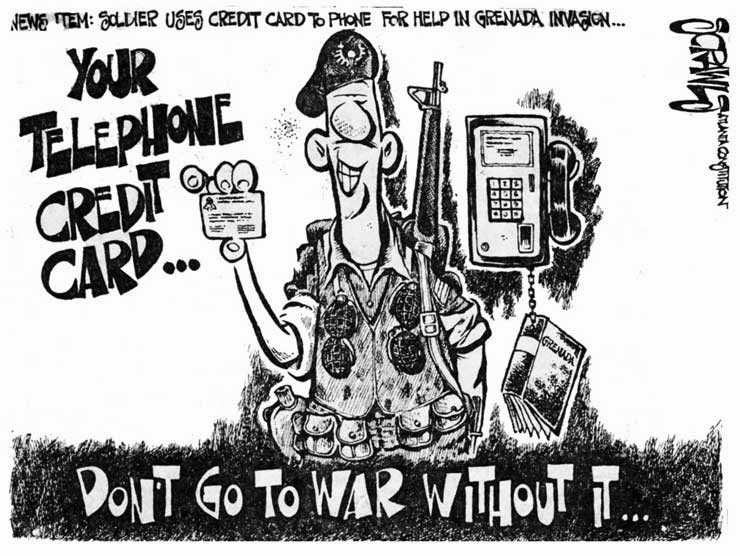
And there were a LOT of errors. The story about the guy who had to make a credit card call to Fayetteville to get fire support?

It was true.

It wasn't as depicted in what may well be the worst American war movie ever filmed (Heartbreak Ridge, for those of you lucky enough not to have suffered through it...) but rather during the siege of the SEAL team forted up in Government House, where the salty soldiers couldn't contact the FM radios in the orbiting Army helicopters on their Navy UHF sets.

One of the squids called Ft. Bragg, reached the Operations center there with the target coordinates. The TOC relayed the coordinates to the naval task force off Grenada that dispatched a destroyer or frigate to fire the mission.

The goatscrews at Richmond Hill and Calivigny Point, the overall sluggish and pawky performance of the 82nd (the then commander, MG Trobrough - known to some of the more cynical of us as "Fast Eddie" - retired with his two stars. Traditionally command of the 82nd was a ticket-punch for fast-track star warriors; retiring as a major general suggests that his superiors thought that Grenada showed that he and his unit weren't really ready for Prime Time), the failures ranging from poor tactical decision-making to over all grand tactical and operational planning...all of that suggested that serious problems remained within the U.S. Army and the post-Vietnam armed forces.

A scathing review of the internal shortcomings of the Army forces as well as the even worse shortcomings that affected cooperation between the services resulted in the changes that are collectively termed the "Goldwater-Nichols" reforms:
"The 1986 act formally elevated the chairman of the Joint Chiefs to the position of being the president’s top military adviser. It strengthened the authority of the existing regional war-fighting joint commanders over all the troops assigned to them. To improve relations among the branches of the military, it also mandated that any officer aspiring to become a general or admiral must serve at least one tour of joint duty working with another branch of the service."
The resulting changes produced the military force that was - until the seemingly-endless deadlocks in Iraq and Afghanistan - widely considered unbeatable, the last remaining superpower of armed forces.


Was young Doc Chief part of a triumph?

No, not unreservedly. Democracy and the "free market" have proceeded to provide Grenada with their usual mixed blessings. Counterfactuals are always chancy, and there are more than enough examples from Eastern Europe and the Soviet Union to suspect that a communist Grenada might have been poorer but less inequal and "unfair" than the present one.

The armed forces of the United States proved tragically amateurish and poorly prepared even for the shambolic resistance it faced on Grenada, and killed or maimed people that should not have died or lost limbs. The overall political calculation involved in ginning up the invasion seems...poorly thought through, at best. The hard lives of the Grenadians were made harder.

Looking at the long arc of history Hurricane Ivan seems to have been more terrible to Grenada than anything humans - American, Cuban, or Grenadian - devised in the autumn of 1983. But, still...


I think that trying to put Grenada 1983 in perspective I can't help but see it as a lot of sound and fury signifying...if not nothing, then at least not very much.

About 89 people died who wouldn't if Bernie Coaard hadn't been an asshole and Ronnie Reagan hadn't needed to kick some Commie ass.

Another 600 or so suffered injuries great or small.

Some buildings were wrecked, some machines destroyed. A government that was already in the process of self-destructing was overthrown. Some needed changes were made to the U.S. armed services.

In the United States alone 42,584 people died in traffic accidents in 1983.

And young Doc Chief came home having seen just enough of war to know he didn't really want to see any more.

And that's not a very good attitude for a professional soldier.