Showing posts with label Panama. Show all posts

Saturday, January 09, 2016

The Army I Knew: DEROS

When last seen, young SGT Chief was in the dank jungles of Panama, serially attempting to preserve the honor of winsome REMFs, fighting a neverending battle against mildew, or firing flaming balls of asswipe across the greensward.
As I mentioned in the previous installment of this series, the enticement of NCO school was part of the cunning plan of my then-superiors to try and keep me around. Unfortunately for them, there was a hitch in their re-up giddyap.

My DEROS.

In case you're not familiar with the term, it stands for Date Eligable for Return from OverSeas. Any soldier (or airman; I think the zoomies use the same acronym) who is deployed gets one. How long the tour determines the DEROS, and in my case my initial DEROS was based on a "short tour" of 18 months which would come due late in December of 1986.

However. During my tour conditions in Panama were getting less-fun for both the United States and Panama. General Noriega, the then-caudillo of Panama and the guy who had ditched my Hootch Jump School graduation, was feeling the heat from the gringos now that the amount of Bolivian marching powder skating north through his joint was more irritating than his looking the other way whilst we screwed with his Nicaraguan pals was helpful.

It was getting harder to find suckers volunteers willing to come serve a year and a half in the tropical paradise. So the Army did what the Army does when it can't find eager dupes young American heroes willing to get stuck in for God and Country; it involuntarily extended our tours.

We (who were already posted there) now had to do a full 3-year "long tour" if we re-enlisted...regardless of what we wanted to re-up for. So if I re-upped for, say, sputum-sucker school (otherwise known as "91 X-ray", a whites-wearing, barracks-living REMF hospital job highly coveted by line-dog medics tired of living out of a rucksack) I'd have to do another 18 months in the Xanadu of the Isthmus. With an increasingly unpleasant citizenry that was getting increasingly willing to show me how little they liked to have me in their crib.

My alternative was to ETS. Drop the mike and walk off. Pull the pin. Get out of active service.

So, in December 1986, I did.
I want to stop here for a moment and mention something that was odd about the Regular Army of the 1980s

First of all, though, I need to talk about Vietnam.

So, here's the thing. You remember that back in the Sixties and early Seventies there was this thing called a "draft", right? Where you got to go be a soldier whether you wanted to or not and, if you were unlucky, got an all-expenses-paid year-long trip to the land of formaldehyde beer, pretty girls in ao dais, and irascible locals who would try and kill you?

OK. So the thing is that if you were one of those guys what you probably wanted most from Vietnam was out. And - short of a horrendous wound - the only way to get out was to get to the end of your time in service - your ETS - and so you damn sure kept track of how many months, weeks, or days you had left. There were even special calendars to help you, many of them designed to remind you of one of the big reasons you wanted to go back to the Land of the Big PX...
When you got down to about 90 days left or so you could officially call yourself a "short-timer" or just "short". This was usually announced as a barking cry of joy when, for example, you passed an officer. Instead of the usual "All the way, sir!" or "Wolfhounds, sir!" you'd back "Short, sir!" whilst snapping off your brightest sniper-pointer salute.

Not surprisingly, officers and senior NCOs hated the whole "short-timer" business and spent a tremendous amount of time and effort hunting it down to try and kill it.
So the funny thing is that, hard as they tried, the Army powers-the-were couldn't put the kibosh on the business. The short-time enthusiasm persisted into my Army of the 1980s...which is frankly odd when you think about it. We weren't getting shot at. Hell, we were all genuine volunteers; nobody had a real reason to rush for the door. You'd think that the shorttime countdowns and "Short!" giddiness would have died along with the draft.

But no. I and most of the guys I knew counted down our last days, yelped "Short!" when our names were called, gleefully informed anyone who asked that we were so short that we had to roll our socks down to take a shit, and ostentatiously took our boots out to the powerline outside the barracks on our last night to hang there as reminders that another inmate had made it over the wall.

So in the Eighties it was an oddity, a bizarre relict of a war, and an Army, long gone.

But I sometimes wonder. With the reality of endless deployments and stop-loss and repeated tours, I wonder if short-timer syndrome has returned to the GIs of today and the boots hang again on the wires outside the barracks..?

I returned to the States from sunny Panama to a freezing-ass cold winter, without a job and without any real skills. I had a degree in geology that I hadn't used in years and enough medical training to be hired as an assistant ass-wiper in any of the finest nursing homes in eastern Pennsylvania. Oh, and because of the peculiarities of the M782 Gama Goat ambulance I was fair at wrenching on diesel engines.

So I got a job working in a Ford tractor shop and - since my pay wrenching on Dearborn's products wasn't exactly princely - signed up to put in a weekend a month in the U.S. Army Reserve.

Those of you who are unfamiliar with the U.S. of the 1980's may find this amazing, but at the time the Army Reserve (or USAR) really was a "reserve". USAR units would drill two (or two-and-a-half, mustering in Friday evening and getting released Sunday afternoon...) days a month and then two weeks a year for annual training, usually in the summer hence "summer camp". Occasionally units would get deployed to, say, Honduras for annual training and spend some time supporting some sort of U.S. foreign policy there.

But the notion that these units, and these reserve soldiers, would end up in a war, an actual, shooting war short of WW3 or the Second Korean War?

Unpossible!

So it was with a sort of holiday getting-off-work feeling that I drove up the road to Lancaster, Pennsylvania, to my new unit of assignment; 99th Combat Support Hospital, 79th ARCOM.

Here's a funny thing; the unit I was joining is still there, at the Reserve Center on Ranck Mill Road in Lancaster. It's not part of the 79th ARCOM anymore; the old ARCOMS have been converted into "Regional Support Commands" and the RSC for the 99th is now the 99th RSC (which must be fucking confusing...). But the CSH is still there.

Although probably not as it was when I arrived in the winter of 1987.

I must have looked like a freak. I hadn't bothered to do much upkeep on my BDU uniforms in tropical Panama, where we got to strut around in our OD jungle fatigues, so I wore a pair of OG 507s under my BDU field jacket. And although I did have a BDU cap it had been used only for fieldwork, so it was fairly dingy and adorned with a pair of luminous "ranger eyes" and my nametag on the back.

I was as hardbitten and salty as only a young buck sergeant can be. So far as I was concerned, I was a real loose cannon, a firey furnace ready to chew up steel rails and piss out iron filings, and I was going to be the baddest-ass medic this little rural Reserve hospital had ever seen, and I walked in the doors of the Ranck Mill Reserve Center with a chip on my shoulder the size of a surfboard.

Next: Lucy in the Sky With Diamond Earrings

Thursday, December 24, 2015

Watches of the Night

It was a practice in Headquarters Company, 2nd Battalion (Airborne) (Light) 187th Infantry Regiment - stationed in the tropical paradise of Fort Kobbe, Panama - for the unmarried sergeants to volunteer to take holiday duty for the wedded guys. So that's why I found myself standing on the landing outside the dayroom of the HHC barracks Christmas Eve day dressed tastefully in holiday-green tropical fatigues and a santa-red beret being violently abused by a Panamanian taxi driver.

It seems that one of our American heroes had, in an excess of Christmas cheer, commandeered the driver's services to motor all around Panama Viejo attempting to find a shapely little elf who would supply a Christmas stocking that he could fill.

Not surprisingly, given his slobberingly drunk condition, the only attentions he could find came from ladies who expected to receive green, folding presents in return, which struck our young hero as more than a little Grinchy.

This seeker of the true Spirit of Christmas imbibed some Chistmas spirits and then resolved to return to his only REAL family, his buddies at HHC 2/187, only to find on arrival that one of Santa's little ho-ho-hoes had lifted his wallet during his importunations. Or he had left it on the bar. Or whatever.

The upshot was, anyway, that he now had nothing to give the infuriated driver whose worn taxi now reeked of cheap perfume and drunken G.I. Worse yet, he turned out to be nimble as a monkey - even drunk - and had shinnied up the mango tree in front of the barracks and was hiding in the branches lobbing the occasional overripe fruit at both the driver and the taxi windshield.

The street in front of the barrack reeked of mango juice and the combined noise of a furious taxi driver and an intoxicated arboreal G.I. This, in turn, drew a small crowd of pre-Christmas revelers, who took turns abusing both parties and shying additional fruit at the taxi when the driver wasn't watching.

I managed to pay off the driver, scatter the crowd and talk the monkey-boy out of the tree just as one of my other single friends came sauntering down from his post as battalion staff duty NCO.

"I see life in the slums is still exotic and vigorous, even on Christmas Eve" he sneered.

SGT Chief: "Little you know about it, lolling about up there at Battalion as you do. It's like a freakin' Jerry Springer show down here, you know. Oh, and a Merry Christmas to you, too, jackass."

BN SDNCO: "Yeah, well, lucky for us that the first Christmas happened in Bethehem, not Fort Kobbe, eh?"

SGT Chief: "Why's that?"

BN SDNCO: "'Cause where the hell'd you find three wise men and a virgin around here..?"

It was an old joke but I was still chuckling as I ran back up the stairs to the dayroom to share warm Coke with the three guys watching football.

This year, as they have for the past fourteen years now, American soldiers are preparing for a holiday in faraway places much less entertaining and far more hazardous than my Panamanian Christmas Eve nearly three decades ago.

I'm sure that they share many of the same feelings I did then: loneliness, regret, some pride in a hard job well done in demanding circumstances, but mixed with others I didn't; fear of death or wounding, anger and grief at lost friends, hope that their own homecoming will be soon and safe.

As do I.
And to you all; Merry Christmas, Joyous Solstice, Happy Kwanzaa...whatever, where-ever, and however you celebrate, may the light of love and laughter be with you though these long nights and on into the sunlight of tomorrow.

Saturday, July 26, 2014

The Army I Knew: Panama Part 4, or, The Wild, The Innocent, and the Howler Monkeys

I mentioned in the last post that I wanted to tell the story about the howler monkeys.


It was late in the afternoon of my relatively brief active-service career. Whilst children may set to tormenting the cat infantry battalions try and find ways to get their young first- and second-termers to "go career"; re-up for a long term assuming they're any good. The dirtbags are welcome to take three and out; the guys who look like they might make good senior sergeants get offered treats - cakes and ale, or, in my case, NCO schools.

Other than Panamanian jump school that was pretty much all USSOUTHCOM had to offer. We'd been to the Jungle School at Fort Sherman - kind of a gag, since we all lived in Panama so getting our "banana boat" patch wasn't exactly a thrill. Everything else was a TDY school - in other words, we'd have to actually fly away somewhere and live there for a while and the Army would have to pay for it - and the Army of the late Eighties wasn't okay with that.

So I was offered a slot at the lowest level of the professional noncommissioned officer school system; Primary Leadership Development Course, PLDC, then taught at the NCO Academy at Fort Sherman.


Let me back up here for a moment.

The U.S. Army has had pretty twisted relationship with formal schooling for sergeants.

Prior to the Sixties there really wasn't any. You learned to be a sergeant like you learned any other trade; by apprenticing under a master craftsman - a platoon sergeant when you were a young stud, then a first sergeant when you were a platoon daddy. When the Army created the "Super Sergeants" - sergeants major - in the Fifties they were expected to be the master of all masters, the big Daddy Rabbit to all the little bunnies. It didn't turn out that way - the star warriors turned out to be fixated on haircuts and whose company area wasn't policed tightly enough - but that was the idea.

Well, Vietnam kind of fucked over the U.S. Army's sergeants. The best of them got tired of spending every couple of years getting shot at by angry Asians and got out. The remainder...well, they weren't the best of them.

As officers often will, the officers that ran the U.S. Army assumed that if you have a people problem that you can fix it by throwing "education" at it. So beginning in the late Sixties the Department of the Army began tinkering with the idea of a school for sergeants to unfuck their NCO problems.

To make a long story short, by the time I got in in 1980 the Army had a three-level NCO school system - but one that was actually divided laterally within the Army, as well.

When you were a corporal (or a specialist 4th class) you went to PNCOC; the Primary NCO Course. IF you were a "real" soldier - an infantryman, artilleryman, or a tankerish sort of guy (that is, had an armor or cavalry MOS).

If you were a support puke, a REMF, an ash-and-trash in-the-rear-with-the-gear type you went to something called PLC, Primary Leadership Course. Because you weren't a noncommissioned officer, right? You were some sort of "specialist", not a hard-stripe, ass-kicking sergeant.

As I remember this nonsense continued up the next step; there was a BNCOC for combat-arms guys and a BLC for the soft-stripers. You went there as a buck sergeant or a specialist 5th class to move on up to E-6.

Finally the segregated drinking fountains stopped at platoon sergeant, and all the E-6s, hard- and soft-stripe, went to ANCOC.


By the time I made E-5, though, the Army had rethought all this separate-but-equal schooling along with the whole idea of "soft-stripes" above the troop level in general. One aspect of it was the conversion of everyone above the grade of E-4 to a hard stripe. I've written about this; I really liked being a Spec-5, having an "umbrella for my bird", of being able to tell the First Shirt when he came mooching around the barracks late on Friday looking for a "...hard-charging NCO for a simple, easy little detail tomorrow morning..." that I wasn't an NCO but, rather, a sort of uniformed consultant, a military frittilary whose job it was to add a soupçon of tone to what would otherwise have been a vulgar brawl.

The other was the merging of the NCO Schools. PNCOC and PLC were the first to merge into PLDC. BLC was then disappeared in favor of BNCOC. By the late 1980s everyone, ladidadi and everybody, went to PLDC if they wanted to get, or keep, their stripes.

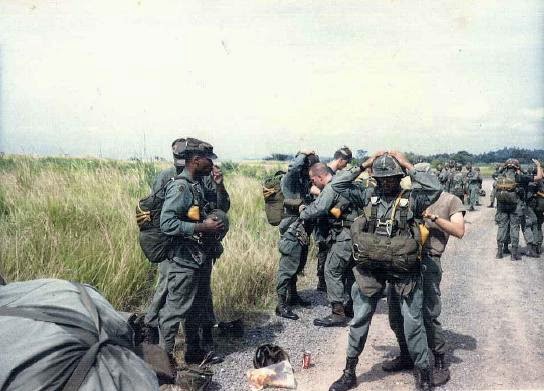
And so it was that, in the late summer of 1987, I tossed my A-bag and battle-rattle into the back of a deuce-and-a-half heading northwest across the rutted highway that crossed the spine of the isthmus to attend that august institution of military scholarship, the 193rd Infantry Brigade NCO Academy Primary Leadership Development Course, Class 87-11.

I don't really have much to say about the course itself. It was just your generic Army "leadership" school, which means that the class material included some worthwhile notions, a fair bit of wishful thinking, and quite a bit of check-the-block flufflepuff that we warriors for the working day, proletarian scum that we were, memorized, recited, and forgot. Come to think of it, I can't remember any of the actual program of instruction other than the Brigade Song.

Which wasn't actually part of the POI, mind you, but a bizarre obsession on the part of the sergeant major who was the commandant of the whole magilla.

This joker had developed an obsession with military minutia as do nearly all sergeants major but instead of facial hair, or uniform insignia, or vehicle appearance (all of which I've had smages obsessed with) the Commandant was all wrapped around teaching us to sing the Brigade Song. It is a tribute to the man's obsession that to this day - nearly thirty year's later - I can remember the words to a fair bit of this musical atrocity.
"Our brigade serves our land,
Serving her Proud;
Bayonet Brigade, our flag will wave.
For our God and Country tell it out loud,
Our traditions we'll save!"
Every day at the noon meal we had to mark time in the chow line roaring out this ballad so that we'd be able to knock the critics dead at our graduation. Sergeant York help the student leadership if their tenure was marked with a substandard rendition of the 193rd Infantry Brigade Song; they'd have been better off caught sitting on a pile of Peruvian marching powder with a stack of kiddie porn.

The only two other things I remember about PLDC at Fort Sherman were the old-school tropical barracks and the saluting gun outside the billets.


The barracks were the only billets in Panama I ever encountered that really WERE old-school in that they lacked air-conditioning. They were still as they had been build back in the Thirties (or Forties), without windows of any sort. Instead the immense apertures in the exterior walls were filled with mesh screening as God and General Gorgas had intended, and the interior partitions were just that, partitions; cubicle-like half-walls with open spaces below the ceiling.

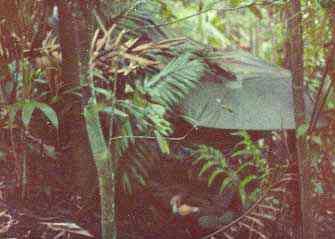
For those of us living in the 1980s this was like a ginormous electric fan; no matter how you looked at it, it either sucked, or blew. We hated the eternal humidity, we hated the constant stickiness and heat. My personal hate was the mildew. Everything mildewed, but especially any sort of slick surface, especially the spit-shined boots and low quarters we were required to keep neatly lined up underneath our racks. Every morning I'd wipe off the fine film of green slime that had accumulated overnight, pursing my lips and making little "eew! eew!" noises. Every night I'd do the same before laying down on the floor to sleep.

This wasn't because of the heat, but because it helped us "manage our time" better. Taking a half hour to make our bunks tightly enough to satisfy the cadre would have eaten into the little time we had to prepare for classes. So the very first night before the class officially began we made up our racks foot-bindingly tight and from then to the final night of the course slept on our foam mats and poncho liners on the floor.

The most ironic thing about this was that, for the first time in my almost-two-years in Panama, I actually got acclimated to the heat.

The last week of the course we had a storm sweep in off the Caribbean. For a full day and night it poured and the temperatures dropped out of the low nineties (with 100% humidity) to the middle eighties (with perhaps 60-70% humidity).

Wrapped in our thin poncho liners on a narrow foam pad over the concrete floor we froze. I woke some time in the early morning hours shivering and couldn't get back to sleep. Finally I raided my wall locker for the Goretex jacket I had never worn since the day I stepped off the aircraft at Howard AFB, wrapped it over the poncho liner, and was able to catch another four hours of sleep or so before first call.

The gun?

Our billets and the classrooms were on one side of the long rectangle of tropical barracks and associated buildings (store- and arms-rooms, originally, tho one of them had been converted to a small PX Annex complete with the usual barber shop and boot-shine stand) that formed the main "Fort Sherman" post area. The center of this rectangle was a huge grassy field that had presumably been the battalion parade field/PT area back when there had been an infantry battalion home-stationed there. Along one side of it, outside our billets, was a small brick platform that supported two flagpoles and one of those old M1 75mm light or "pack" howitzers that seem to have ended up all over the place as static displays and saluting pieces. You can just barely make out the flagpoles in this picture taken back in 1986. Trust me, the little cannon is down there somewhere.


Part of our job as future sergeants major of the Army was to provide a color guard for this set of flags. The drill was pretty simple: six bodies, two for each flagpole, a gunner, and the HMFIC, guard commander, NCOIC, whatever you wanted to call the person who was in charge of the whole farrago.

So every evening the color party would form up outside our billets and march over to this hardstand. The two pairs on flag detail would go to their flagpoles, the gunner would load a blank round in the cannon, and the NCOIC would stand in imperial dignity supervising his little empire.

The recording of the Panamanian anthem would play (a long brass band piece that had several wild trumpet solos in it; if you want to hear it there's a Youtube video here) and the soldiers at the pole with the Panamanian flag would lower it. Then the music for Retreat would play. At the end of Retreat the NCOIC would wag a finger and the gunner would fire the salute, then the guys on the U.S. flagpole would crank down the Stars and Stripes as "To The Colors" would play.
(I should note that this was always one of my favorite moments in the Army day. The old bugle calls are...well, everybody "gets" the National Anthem, unsingable old drinking song that it is. But "Retreat" and "To The Colors" are a sort of private Army thing, and everything on post stops for them. Cars come to a halt on the post roads, strollers stand still, and the high, clear, cold notes float out over the evening sky. There's even a perfect sort of ritual series of movements in coming to a stop, going to parade rest for "Retreat" and then coming to attention for the salute to the colors. Even more than Taps, to me this little ceremony always symbolized the peaceful ending of another duty day.)
After the last note of "To The Colors" the color parties would fold their flags, the gunner would fall in juggling his spent casing, everybody would march off smartly, and that was that.

Except the evening that I was scheduled to be the NCOIC.

Because as it turned out, one of my old battalions from Ft. Bragg was going through the Jungle School ("Jungle Operations Training Center", to give it it's right name) that cycle. I had wandered over and hob-nobbed with my old aid station pals the previous day and might have mentioned having the flag detail the next evening. And, knowing those characters as I did, I should have suspected something. But I was wrapped up in school business and failed to be as suspicious as I should have been.
The other fail was on the part of the guy detailed as my gunner. The drill is that he's supposed to look down the barrel of the saluting gun before locking the blank round in place. He didn't.

When I charged into my old aid station that night the guys swore, swore that the idea was that the roll of toilet paper was supposed to disintegrate into confetti to produce a sort of festive effect. They had had no idea that to keep the inside of the barrel from caking solid with rust in the tropical climate that the post maintenance people has slathered the inside with GAA, the thick grease the Army uses to lubricate pretty much anything. And it was this glop that had soaked into the roll of asswipe they had slipped just inside the breech in the predawn darkness, turning it into a dense, dank, greasy projectile.

The result was pretty impressive, in an utterly fucked-up, sword-and-sandal-movie, flaming-catapult-projectile sort of way.

My little detail marched out and took their positions. The brassy Panamanian anthem played and the stars-and-rectangles Panamanian flag came down. The bugle sounds of "Retreat" floated out over the warm evening, the traffic around us came to a halt in the golden sunlit street. I flicked a finger and the gunner pulled the lanyard...

...and a spinning wad of flaming bog-roll vomited forth from the muzzle of the little cannon and soared out across the parade ground.

I stared at the gunner and the gunner stared back at me, we both stared at the color parties who stared back at both of us, and the burning ball of shit paper hit the grass, bounced once, and rolled quickly to a stop, flames licking up from it rather cheekily.

It was the giggling from the JOTC billets that clued me to the culprits as I marched out across the greensward to stomp out the little flames slowly spreading away from the greasy mess. And they were still giggling when I burst into the JOTC visiting-unit aid station later. Apparently I had provided some serious quality entertainment and my old buddies refused apologize for helping me provide it.


Anyway, I promised that this one would be about the howler monkeys, right?

Okay. So, here's the thing. Part of the PLDC program of instruction - the "POI" - is a short field problem. It isn't really much, as field problems go, but keep in mind that everybody goes to PLDC; salty old grunt medics like yours truly, aviation electronics repair people, headquarters clerks...young men and women who go to the field fairly regularly alongside those who never went closer to the jungla than riding the post shuttle bus past little patches of scrub between the head shed at Fort Clayton and the Corozal PX.

So we had several soldiers in our PLDC class who had NEVER stepped off the pavement from the moment they hit the runway at Howard Air Force Base. Until they got out of the LCM into the JOTC training area for our little field problem.

I have to be upfront with you; I hated the goddamn Atlantic side jungle.

Panama is, as you can imagine, very different on the different sides of the isthmus. The Pacific side - which is where my post at Fort Kobbe and Empire Range, where we typically went to the field - is generally higher and drier. The jungle is thick, but it also tends to be dominated by wooded hillsides and the forest floor is actually relatively open.

The Atlantic side is a nasty low-lying thicket full of impenetrable underbrush dominated by the World's Most Worthless Fucking Tree, the black palm.


This living boobytrap is a horrible object festooned with three-inch spikes all around its trunk. Touching it - or, worse, running into it face-first as you might whilst moving through the jungle at night - is akin to shoving a fistful of needles into your flesh. Worse; the spines of black palm are brittle and will break off under your skin. One of the things I learned early on in Panama was how to remove black palm spikes from GI hands, arms, legs, and faces.

The Atlantic side is wild with these fucking things, along with every other jungle nasty.

Oh, yeah. And howler monkeys.
"When you travel to Panama, it is easier to hear howler monkeys than to see them. With their roars, they mark their territory and communicate with their troop, thanks to a distinctly configured upper airway that allows the species to project its booming voice long distances."
The howlers aren't really "nasty" (unless you happen to blunder into a treeful of them hootched up for the night, at which point you will likely be strafed with monkey shit) but they are hellaciously noisy. The booming sound of a howler is like nothing else you'll ever hear. Listen:


The howlers are another bug - or feature - of the Atlantic side. Their morning and evening howls are pretty much standard issue for field problems in the JOTC training area. You get used to them after a while, but their noises are still extremely bizarre.

As it happened I was the patrol leader for the first phase of the field problem. Our operation was a simple one; load the landing craft and putt around the Fort Sherman lagoon to the training area. Once there, we moved into the jungle and set up a "patrol base" for the night. I'd done this about a gajillion times one way or the other, so pretty much all I had a to do was make sure that I put some other field-experienced people in my squad and team leader positions. That worked slicker than water off a cat's ass, and by just before nightfall we were all tucked into a nice hilltop with our LP/OPs out and digging Ranger graves for the dark.

That was when the howlers started going off.

I was walking the perimeter checking that everyone had their fields of fire sorted out and were getting their positions dug when I noticed three bodies huddled together where there should have been two. When I got closer I could make out who they were: one was Sergeant Molloy, one of our Main Post commandos, a PAC clerk from the SOUTHCOM head shed at Fort Clayton, a pretty, dark-haired woman whose trepidation at venturing into the wilds of Panama had been evident since before we left the cantonment area, and two guys from my own battalion's antitank platoon.
The two guys were huddled next to the PAC clerk, their heads leaning in towards hers and clearly talking six to the dozen. The young PAC sergeant, on the other hand, was hunched down with her huge eyes gleamingly visible in the growing dark. I'm not the most perceptive of leaders but even I could figure out that some damn thing was going on.

I walked over and pulled SGT Miller - the TOW team leader - up and strolled him away towards the inside of the perimeter.

"Okay, big sarge," I said, trying to make out his expression beneath the camo facepaint and the bad light, "what the hell's going on over there?"

"Nothing, seriously, doc. Just talkin'."

"About..?"

"Ummm..." I gave Miller the stinkeye and he shrugged.

"Just remember, slick, I'm the one that gets to give you a gamma globulin shot in the ass every time we go to Honduras and think before you speak again."

"Wellll...we're just explaining to Shannon about the Panamanian Womb Worm."

"The...the what?"

"You know that thing, doc...I thought everybody knew about that dreaded parasitic pest you find here in the Atlantic-side jungle, the one that invades the female reproductive system and lays it's eggs there? Right? The one that always roars before it attacks..?"

"What the fuck are you talking about?"

"Just explaining to Shannon that, like, the only safety from this horrible thing is to make sure there's something blocking its attack, like, well, you know, something there to keep the Worm out, like...ummm...well...you know..."

I stared at the face opposite me in the darkness and shook my head.

"Look, Romeo. Here's what I know. I know I don't care so much that you're trying to use the goddamn monkeys to get into that poor girl's BDU pants. But I DO care that you're trying to use the goddamn monkeys to get into her pants on my watch. You want to get some sort of sad monkey tail off of that gal you need to wait until tomorrow when you, her, and the goddamn monkeys are the next patrol leader's problem. Goddamn. I'm shifting you two over to Blackie's position, and you send Blackie over to hers, and you're all gonna soldier on like good little soldiers and forget trying to get busy in my patrol base. You got me?"

The boys grumbled but complied, and SP4 Black, who was a nice shy kid without the slightest notion of using the local wildlife to con a frightened girl into slipping into his sleeping bag, laid down next to the young clerk to pull security for her while she slept.

Not that she DID sleep. I was walking the perimeter some time in the early morning hours when I stopped behind her and could see her head swiveling in the darkness like it was on gimbals. I knelt down quietly and hissed to let her know I was there; her entire body jerked like I'd touched her with an electric wire.

"You OK, Sergeant Molloy?" Her eyes in the dark were still as wide as searchlights.

"Yeah...but...the guys said...they said..."

"Look, sergeant, the guys were bullshitting you. They were trying to scare you into sleeping with them by telling you tall tales about the jungle. Those noises are monkeys. Just fucking monkeys. The worst thing they'll do is throw their shit at you. And sleeping with Sergeant Miller or Specialist Prosowicz ain't gonna stop them from doing that."

The two glittering eyes in her dark face seemed to grow brighter as they narrowed and anger replaced fear.

"Those...those...those bastards!"

"Yeah. So you go ahead and wake up Blackie and get some sleep. Got it?"

Even in the pitch dark under the triple canopy I could see without seeing it a look that boded Miller and Prosowicz no good at all. Somebody - two somebodies - were due for a solid kick in the nuts the next time they came macking on young Sergeant Molloy.


From somewhere on the slopes above us a howler monkey roared in the darkness
"Sing our song as we march along!
Looking good! Feeling strong!
Hup-two-three, we're infantry, One-Ninety-Third!
Cutting edge, Bayonet Brigade!"

Monday, July 21, 2014

The Army I Knew: Panama, Part 3, Police, Parachutes and The Porcupine Dance

When last heard from young Doc Lawes was exploring the magic and mystery of that tropical paradise, the then-American outpost of Panama.


I mentioned in the earlier post that to a GI in Panama most Panamanians were female; girlfriends, wives, or business girls for rent down on Calle J, "J Street", the red-light district of Panama City.
BTW, here's an interesting piece of Panamania...well, interesting to me, anyway. Technically the name for the metropolis in the country of Panama is "Panama City" just like the one in the Florida panhandle. But I never heard anyone outside of the U.S. military use the term; to the Panamanians I met the place was called "Panama". The larger entity was usually called "la pais", the country (or the nation) whenever that was needed. Panama, when you heard the term from a local, meant the city which, like a lot of other places in the world, sorta-kinda WAS the nation. In Panama you were either in Panama - the City, The Big Mango - or you were some sort of backcountry rube, barely above the level of some sort of howler monkey that could dress itself. Which reminds me - I really need to tell you my howler monkey story. Maybe later in this post)
The thing is that most Yankee soldiers didn't really, well...need Panamanian men for the (ahem) sort of things they needed Panamanian women for. So me, and a lot of my fellow troopers, pretty much didn't interact with Panamanian guys outside of the brothers, fathers, and male pals of our Panamanian arm-candy.

Or as Panamanian cops and soldiers.

The cops we loathed.

To us Panamanian coppers were like nasty cartoon-version Latin American cops; cocky, impressed with their own power, brutally casual with the use of it, and always on the lookout for a little touch on the wallet. Back in 2011 I wrote a post one about the "policeman in Arrijan" about this, the tendency for the local policia to treat visiting gringos as ATMs.

For an American soldier, used to the idea that cops are public servants paid middle-class wages, the experience of being mulcted by some jumped-up hootch in a skin-tight uniform and a ridiculous pointy-ass officer's hat (the classic Panama cop wore a peaked cap with an exaggerated front and rear peak and a deep "saddle" in-between. These confections were referred to as "saddles" and were the object of intense GI ridicule) was somewhere between shocking and infuriating.

But worse than the grift was the Panamanian copper's job as enforcer of public peace in the J Street bars, which often took the form of beating up on GI heads when the boys went large a bit. The policia seemed to take a disproportionate enjoyment of these opportunities, and the experience of waking up hung-over and bruised in the Balboa DENI station was one that most American soldiers wanted to avoid like the Black Syph.

I should note here that - though, obviously, we didn't see it that way - to a certain extent the taraddidles the Panamanian cops played on our skulls were payback.

Prior to 1982 the positions were reversed, and it was the locals who got a beating from the Canal Zone cops.
According to most Panamanians I talked to these jokers were the flip side of the Panama cop coin, a bunch of cheerfully brutal bastards who seemed to live for the opportunity to bust some hootchie mama and papa heads. Just as in my day you got busted for driving-while-gringo back in the Zone days you could get your ass thrashed for driving-while-hootch through Balboa, or Corozal, or past the Albrook gate. Lots of local residents remembered that and I'll bet the ones under the saddle did, too. I don't know if, had I been a tough, cocky Panamanian kid - the sort you would have tended to flip shit at the gringo cop who stopped me and my pals - who'd gotten his ass beat more than once by these uninvited visitors, I could have resisted the impulse to play a little catch-up.

Whatever the reason, the Panama cops and the GIs from Fort Kobbe cordially hated each other.

The other male Panamanians were knew were the soldiers.

In the 1980s Panama had an actual army. It wasn't called an "army", Ejercito in Spanish, it was called a "defense force". But the Fuerzas de Defensa de Panamá was an army in fact if not in name.

Well, sorta.

Even as a simple buck sergeant the PDF guys looked like a pretty sad act to me. As it turned out - when the U.S. and Panama had a little semi-war two years after I left the joint - they were a pretty sad act. The guys just sucked at soldiering, which shouldn't have been really surprising since, like most Third World "armies" a really competent army was more dangerous to the joker on the throne than to the neighbors (who, being Colombia, Costa Rica, and Nicaragua, weren't exactly the Waffen SS...) so the best idea wasn't to have a really competent army. And Panama didn't.

Their "elite" units like Battalion 2000 (pronounced "battaiyon dough-mil") looked the part. They had all the right weapons and equipment. But all you had to do was spend some time in the field with them to get the strong sense that these guys just weren't in it for the adventure, or to be good soldiers. Their field discipline was poor. They showed white lights at night and chattered to each other when they were supposed to be silent. They didn't like to dig in, and their security tended to be casual at best.
They also suffered from the chronic problem of armies in low-tech countries in that a lot of the toughest guys tended to be from the little backass villages where machinery was fairly unusual, or broken, or both. So the troopers tended to be rough with their weapons and equipment and often broke, through hard use, little maintenance, or both, a lot of what they were issued.

Every year we would get together with one of their infantry outfits for the "Transistmica", a cross-Panama road march along the putative-highway of the same name. This thing was an unimpressive two-lane road, sections of which would have shamed a dirt-poor Cracker County, Mississippi, road crew; gatored and rutted with ginormous potholes the size of small craters. But it was what we had, and we tromped along it with our battle-rattle on, sweating and stinking vilely in the tropical heat.

We might not have been the 3rd U.S. Infantry but the Panamanians were a fucking disaster, a straggling shit-show of bitching and moaning, dangling their steel pots off their rifles, and generally shambling along like the walking dead. You can tell a lot about soldiers by how they march, and what their marching said about the PDF was fairly uncomplimentary.

So in general the sorts of run-ins that male GIs tended to have with male Panamanians tended to reinforce the stereotypes and bad ideas each had about each other. Got it?


The only other close encounter of the Panamanian guy-kind I had was in their Airborne School, El Escuela de Paracaidismo.

First, let me explain something.

A lot of U.S. soldiers are badge-hunters.

Second, I probably need to explain that.

Soldiering is an odd "profession". Soldiers don't get things like big offices, or company cars (unless they're unit commanders and get to tool from their digs at the battalion head-shed to the O-Club in their HQ-1 quarter-ton jeep, but that's for the salaried classes, anyway). Grunt soldiers spend their twenty or thirty years out living in the woods and carrying their house on their back, like a snail.

But they do get to wear stuff on their uniforms, and the best "stuff" are various emblems of the high-speed been-there-done-that schools and qualification courses.

For example, there's an Army school that teaches you how to go into some piece of ground and set up a parachute drop zone, and (in the words of the Wiki entry):
"...learn how to navigate dismounted, establish and operate a day / night helicopter landing zone, establish and operate day / night parachute drop zones (DZs), including computed air release system (CARP) DZs, ground marked release system (GMRS) DZs and Army verbally initiated release system (VIRS) DZs, conduct sling load operations, provide air traffic control (ATC) and navigational assistance to rotary wing (RW) and fixed wing (FW) airborne operations. All training and airborne operations will be conducted in accordance with FM 3-21.220 (Static Line Parachuting Techniques and Training) and FM 3-21.38 (Pathfinder Operations)"
So, pretty much, Pathfinder School lets you do all the cool shit paratroopers and helicopter infantry do AND you get the bitchin' sweet winged torch bling badge in the picture up there on the left to wear on your chest.

Hooah!

Back in the day you got to wear all this shit on your fatigues, too, so you could strut around every day wearing all your badass badges and devices and wings and looking...well, badass. Badges are sort of the ultimate "been-there-done-that" marker. You walk into the joint with a couple of combat badges, and an Expert Infantrymen's Badge, and a drill sergeant pumpkin patch and that's a way of announcing "Yep. Been around. Seen Stuff. Done Shit." without having to talk yourself up.

Mind you, badge-hunting can be complete bullshit, too, and often is. For example, the U.S. Army had several Jumpmaster Schools back in the 1980's, including the original one at the Benning School for Boys, one at Ft. Bragg run by XVIII Airborne Corps, as well as one run by the 7th Special Forces Group in Panama (and, I think, one run by the then-509th Infantry in Vincenza, Italy for USAREUR, but I'm not real sure about that).
The Benning school was notoriously difficult, and something like two-thirds of the students had to recycle through it to pass. Bragg was considered easier than Benning but still a tough school. Panama - which was the one I attended - was notoriously lax, and I watched several in-air screwups
(such as the SF officer who made a complete pirouette whilst making his door checks, thus routing his static line completely around his neck - the officer was so spun up that he didn't notice this error which would have, had he exited the aircraft or fallen out the open troop door that way, popped his head off like a bottlecap off a bottle of beer. The blackhat instructor gently reached up and unwrapped the yellow fabric line without his missing a single jump command and he drove on. You get the idea.)
go through that would have immediately no-goed a Benning student. So the sort of jumpmaster that made it through the Benning School and the one that made it through the Panama school? Might be totally different skill levels.
I should tell you my JMPI story here.

Jumpmaster Personnel Inspection, or JMPI, is a graded task at the jumpmaster school, as well it should be. Inspecting a paratrooper's parachute, harness, and equipment is literally a life-or-death task; a small fault with that kit - a frayed static line, a mis-fastened Capewell canopy release - can kill as surely as a bullet.

The jumpmaster student is presented with three rigged jumpers; two without combat equipment (for a so-called "Hollywood" jump) and the third with full battle-rattle, rucksack, and weapons container. He (or she) has to inspect all three within a certain time limit, identifying all the faults in the equipment or rigging.

But - here's the thing. The "clock" doesn't stop until the student pats the last jumper on the butt indicating that all three have been inspected. So you can, in theory, "catch" a gig on a jumper you've already inspected providing you haven't cleared all three.

The Panama JMPI was, like the Panama course, different. You had to not just note and call out the gigs but identify them correctly by name; for example, if the jumper had a Capewell unfastened you had to tap it and announce "Canopy quick release not fastened." or if his lowering line was attached to the wrong thing you had to say "Lowering line terminal loop not connected to H-harness."

Well, the day of my JMPI I felt sharp as a knife. I flew through the first Hollywood jumper, tapping the gigs and calling them out, finishing in about a minute, well ahead of the time I'd need to get all three in five minutes fourty seconds. I got to the second guy and, working my way down, saw an obvious problem. One of the elastic bands that span the outside of the reserve parachute cover had been run over, and not under, the ripcord handle, locking it down. It was impossible to miss, and I didn't miss it.


The problem was that, to save my life (and my passing grade) I couldn't remember the technical term for the elastic-band thingie. "Elastic band"? That wasn't it. It opened the reserve 'chute cover, so..."reserve opening band"? I couldn't stop and think about it, so I hurried on, catching and calling out the rest of the second Hollywood jumper's gigs as the upstairs room in my head was frantic with a mental librarian flipping through FM 3-21.220 trying to remember the name of the goddamn elastic band. Spring opener? Springy-thingie? I knew it was something like that, my fucking brain seemed to have it right at the edge of memory, but the connection between brain and mouth wasn't working, and I was halfway through with the combat-equipment guy.

Done with the front and barking "Turn!" I ran my hands down the guy's helmet, checking that the "rabbit-ear" straps lay flat and were correctly fastened and the foam crash pad was secured to the back of the helmet. Down to the top of the main 'chute pack tray, trace the static line from the metal hook at the end down, down, down through the S-turns along the back of the 'chute pack. Elastic spring? Opening spring? Reserve opening band? What the FUCK was the name of that thing?

I was down to the end of the static line, checking that it was correctly attached to the deployment bag. All that was left were the leg straps and, goddamn it, I still couldn't remember...

"Bend!" I barked, and the combat guy bent at the waist so I could check and make sure that his leg straps weren't twisted or frayed. They weren't. I was out of options, and nearly out of time. I lifted one hand to slap him on the ass when the inside of my skull lit up like a pinball machine. I bellowed...

"PACK OPENING SPRING BAND MISROUTED OVER RESERVE RIPCORD GRIP!"

...and passed JMPI.
But the point is that I got my jumpmaster ASI at the laziest school in the Army.


Now I like to think that I put the work in and that I was a good jumpmaster. The point is that, though, given the school and how it was run, I could have been a semi-lazy sorta-careless kinda-dirtbag and still passed. So just having the school didn't mean shit, really. Context was everything and there's no way to tell from the badge what the context is.

Still...a lot of GIs love badges, and the cooler and more exotic the badge the better.

Foreign jump wings were among the coolest of the cool badges.


When I was at Bragg there were Canadian and German jump wings embroidered on many a manly chest, largely because the 82nd commonly went to Europe during the big REFORGER exercises and got to jump with the Fallschirmjäger and the Canadians were close by and liked to hunt our parachute badge, too, so we tended to have a fair number of exchanges with them.

Occasionally you'd see British wings, which were considered extra cool because you got to jump out of an actual county-fair/circus-type hot-air balloon when you went to their jump school (which may have been true back in the day but isn't now and doesn't appear to have been for some time. Might still have been around in the Eighties, though.)

The green beanies had lots of chances to roam around Central and South America going to other people's jump schools but for us line dogs, not so much. The only real option was the PDF jump school out at Fuerte Cimarron east of Panama City.

I was getting short, and my battalion was waving goodies under my nose hoping to re-enlist me (the fools, not knowing that what I mostly wanted from the Army by that time was out...). That's how I found myself on the 44-pax bus jolting down the Pan-American Highway to what was affectionately known as "Hootch Jump School".

The actual "jump school" part was kind of...no, strike that. The "jump school" part WAS a joke. It was Fort Benning's Basic Airborne Course only in Spanish. We didn't do their "Ground Week", since we were all paratroops already, but we did their "Tower Week" so we got to run through their 34-foot tower with their new meat. Their cadre were a sort of knockoff-Blackhat, complete with the pissy attitude, and all the actual training equipment was a humidity-wilted, poverty-dingy copy of the Fort Benning originals so the differences were all in the little details.


For example, the Panamanians had decided that every time a bunch of trainees moved anywhere (at the double-time, just like Back Home...) they would do so to the rapid chanting of the Spanish word for "Airborne", paracaidista. So Panamanian Tower Week was conducted to the background noise of a bunch of wanna-be Panamanian (and about twenty American) paracaidistas chanting "...paracaidistaparacaidistaparacaidista..." like some sort of sweaty Buddhist monks attending the most belligerent lamasary on Earth.

The other unique Panamanian thing was the punishment exercise.

The U.S. Army is a great believer in correction through exertion. Failure to meet the standard - ANY standard - is usually met with a demand for pushups. These, apparently, strengthen not just the arm and shoulder but the brain muscle. Punishment exercise; fuck up, pushup - got it?

But you can't do pushups in a parachute harness, the reserve 'chute gets in the way.

So when you were 'chuted up at Ft. Benning you did something called the "knee bender" which involved just that; bending and straightening the knees. It was more tiring that it sounds, and the cry of "Beat yer boots!" is one that I suspect every old jumper still despises. We had a blackhat that used to love to trick the students waiting to go up the 34-foot tower; "Hit it!" he'd shriek, and we'd all have to go into our exiting-the-aircraft tuck bouncing in place bellowing "One thousand! Two thousand! Three thousand! Four thousand!"

From there the next "point of performance" was "check canopy" - your imaginary parachute had (hopefully) opened and you raised your arms and scanned above you, checking to make sure that you had no blown panels or snapped suspension lines or - worse - a partial malfunction such as a "Mae West" double-breasted parachute caused by suspension lines looping over the 'chute.

But this character would shout "Check canopies!" and then, when we did just that, would giggle hideously and shriek "I didn't say "check canopies", you idiot legs, I said "Check can o' peas! Beat yer boots!"
The Panamanian version of this sonofabitch was a lean brown corporal we called "Smiley" because of his lurking smirk that burst into sunshiney radiance when he caught his students in some infraction, real or imagined.

"¡Noooooo! ¡Noooo!" he would croon whenever he found some reason, or no reason, to punish us and would cry "¡Dies Salto al pinos! ¡Ya!" (Ten porcupine jumps! Go!)

As noted, Salto al pino was supposed to mean "porcupine jump" though the briefest look at the Spanish-English dictionary tells us that pino means pine tree and "ten pine tree jumps" is just ridiculous, even for Smiley.

So I have no idea what the hell the name for the goofy thing was, but whatever it was, as an exercise, it sucked. Not so much because it was hard, but because it was exceptionally stupid-looking.

Whatever it meant in English a salto al pino in practice involved leaping up with your feet together and your arms extended horizontally in front of you and kicking forwards with your legs straight out whilst chanting the unbiquitous paracaidista! The idea was supposed to be to touch your toes to your palms and, frighteningly, a handful of the more flexible guys could actually do that. I couldn't so, like everybody else, I just bounced around popping my legs upwards ten times sweating and chanting "Paracaidistaparacaidistaparacaidista!" with a sort of resigned irritation.

You have to imagine this not just as someone jumping around with their arms out straight but a dozen grown men leaping about like a bunch of spastic morons with their arms and legs extended and flailing. I didn't really appreciate the humor while it was happening, but in retrospect I can get the kick Smiley and his pals got out of watching a bunch of neatly ranked soldiers dissolve into a ridiculous hopping, bouncing, paracaidista-chanting Porcupine Dance. We must have look like compete fucking nimrods.

So Panamanian Tower Week was really just a question of putting up with Smiley and his sense of humor, having to look like a dork porcupine-jumping, and running through some equipment drills we'd already done elsewhere, before, and better.

The next week, however, really was different.

First of all, Panamanian "Jump Week" involved Panamanian jumpmasters who took a casual PDF-style approach to things like JMPI. The disinterested once-over we got from the local cadre unnerved us so much that those of us who had jumpmaster qualifications took to inspecting each other on the down-low, since openly disrespecting the local JMPI earned you ten more porcupine or whatever-the-hell-pino-was-supposed-to-mean jumps.

Doing our own inspection wasn't all that difficult since the 'chutes the Panamanians had were old U.S. T-10 harnesses. We were told by our officers that the 'chutes themselves had been packed by our own riggers, which reassured us no end as you can well imagine.
The next "different" thing was the aircraft, some sort of Spanish light transport called an "Aviocar", which reminded me nothing so much as some sort of aluminum CONEX with wings. The Wiki entry says that
"...during the late 1960s, the Spanish Air Force was still operating the already outdated three-engined Junkers Ju 52 and two-engined Douglas C-47, unpressurized and non-turbocharged piston-powered aircraft. CASA developed the C-212 as a more modern alternative using the lighter and more reliable turboprop engine, with the first prototype flying on 26 March 1971."
I'm willing to agree that it was probably better than a Ju 52 but by how much I'm not really sure. It took off OK and we were getting out halfway, so I didn't really give a shit how it landed. But the whole thing seemed to be made out of tinfoil and bailing wire after the solidity of the U.S. Air Force's C-130s and C-141 transports and frankly gave me the shivers.

We loaded up, half a dozen GIs, fifteen or so Panamanian cherries, and two "jumpmasters", whose primary duties so far as I could tell were 1) to lead the cherry jumpers in a singalong (supposedly to get their paracaidista on so they wouldn't refuse to jump), and 2) actually guiding the pilots onto the drop zone.

No pussy stuff like safety officers or wind speed indicators here, mind you, just a relatively flat cow pasture - complete with real cows - and a clear flight-path in from the Gulf of Panama at 1,500 feet AGL. With one of the jumpmasters crouching in the troop door with his head outside shouting;

"¡Derecha! (Right!) ¡Poquito mas!(A little more!) ¡No, no, izquerda! No, no, left! ¡Mas izquerda! (More left!) ¡Chingada tu madre, MAS izquerda! (Goddamn it, WAY fucking more left..!)

To an American soldier conditioned to the standard of "training safety" the whole Panamanian airborne business was more than half past weird and a quarter to scary. But a static line parachute jump is a static line parachute jump; you hook your static line up to the anchor cable overhead and step off out into the air.

Oh. Except I forgot to mention - in an Aviocar, the anchor cable? It's on the fucking floor.

This presented a very weird obstacle, specifically, the deployment bags and static lines didn't fly up out of the way of the end of the ramp (or up above the troop doors, had we been going out the side doors instead of off the ramp); instead they streamed out the back of the ramp, twisting and bobbing in the prop wash. They looked like a terrific way to get tangled up and die from a "cigarette roll", a canopy that fuses together as it slides past something abrasive.

Except, of course, that it didn't, and I didn't. I stepped off and enjoyed the strange floating drift that cushions the first three or four seconds before you reach the end of your rope, so to speak, and the 'chute pulls out of the D-bag and opens. And then it was just a matter of steering away from the largest of the bushes, and the barbed wire fences, and the cows (which stood around looking very bored suggesting that this wasn't the first time they'd been DZ support for the PDF).

I landed fairly decently and rolled out of my parachute next to the filthy hooves of a very large, very brown, very stanky cow, who greeted my arrival with a celebratory gray-green eruption of the vilest liquid cow shit you can imagine. Fortunately the nasty beast was facing towards me at that moment. But you can picture the scene.
That was Jump Week.

Repeat five times and ¡Felicitaciones, Yanquis! You're now paracaidistas.

The "graduation" ceremony was held at the airfield there at Cimarron; we and the Panamanian cherries all got out of the truck and formed up. Some character in a glittery PDF outfit stood in front of us and made a brief speech, and then we all got our new wings pinned on. We later heard that old Cara de Piña himself, Manuel Noriega, the caudillo of Panama, was usually present at these jump school graduations - paratroopers being sexy and manly and all that - but that tensions being what they were in the autumn of 1987 he decided to skip playing pin-the-wings-on-the-Yanquis.

As soon as the little ceremony ended, though, Corporal Smiley and his buddies took off like they were on fire. And they were, in a sense. Because the Panamanian trainees were right behind them, jumping over bushes and through canebrakes, dragging them down and hauling them in struggling knots of a dozen or so trainees around each thrashing cadre member, down to the cow pond off the end of the runway to heave them in and get revenge for all those porcupine jumps.

I stuck around long enough to see Smiley carried past, still fighting amid the cluster of jubilant cherries, and was smiling as I headed for the 44-pax. From the direction of the pond I could hear...

"¡Nooooo! ¡Nooooooooo!"

...and a splash.

Anyway, today Panama has, like Costa Rica, done away with its army. Nobody earns their Alas Panamenas, their Hootch Jump Wings, from the jump school there anymore. No trainees jump out of the rickety Aviocars over cow pastures near Panama City, and Fort Cimarron itself got pasted pretty hard in the '89 invasion. It looks to me like the old Escuela de Paracaidismo was pretty well flattened.


I have no idea what happened to the guys there. Presumably some died. Some must have cut and run, others were captured, or wounded, and eventually let go as we let go all of the Panamanian guys who got caught fighting against Uncle Sammy...well, all except one. Was Smiley one of the dead? The wounded? Or did he run away? Did he end up like his old school, or did he live on to become an old soldier in the soldierless world of modern Panama?

Today, if he still lives, old Smiley must be as gray as I am; perhaps he, too, walks with a limp, only perhaps his hip is stiff from a piece of American steel still stuck in there somewhere. Who knows. Maybe he still hangs out in his little apartment in Panama Viejo, just down the road from where he was the cocky little smirking bastard who was the terror of the trainees.

I wonder if every so often - maybe when his hip is really giving him hell - old Smiley thinks back to the days when he used to make the Yanquis dance his Porcupine Dance.

I'll bet he wishes he had made us dance that dance a hell of a lot harder.

Saturday, February 15, 2014

The Army I Knew: Panama, Part 2, or, Hootchie Mamas, Push-buttons, and Peace Brides

So if you recall we left young SP5 Chief getting off the aircraft down in Panama in the late autumn of 1985, having asked the Army to send him to Japan or Italy and ending up instead assigned to HHC, 2nd Battalion (ABN)(LT) 187th Infantry when the old 3rd Battalion, 5th Infantry was reflagged as a jump outfit.


Another time I'll talk about what I did during my time there. But tonight I want to talk about who I met there.

The Americans were the usual gang of nice kids, assholes, hardasses, goofballs, tough professionals, ambitious careerists, weirdos, manics, and wild men you find in any military outfit.

It was the Panamanians that were new to me.

They locals came in two basic varieties (like all people): men, and women. The men I'll talk about in the next installment; tonight I want talk about the women.

The women I knew mostly as business girls (since prostitution was one of the major commercial activities of Panama City and probably had been ever since de Lesseps showed up with a bunch of horny Canal diggers) or as girlfriends, or wanna-be girlfriends, of my fellow GIs.
(Here's an odd fact; many of the working girls in Panama were Colombian. One of them claimed that she was, like many of her competitors, working in Panama to pick up enough money for a dowry after which she was going to return to Colombia and settle down. I have no idea if this was true, if she believed it to be true, or whether it was the sort of bullshit a working girl thinks a john wants to hear. But that was her story, anyway)
The working girls were part of the scenery in the GI clubs down on Calle J, "J Street"; the Ancon Inn, the Ovalo (or Ovalvo, I honestly don't recall which; we called it the "Oval-Oh"), the Buffalo Bar, where a chunky young woman once offered me the use of her body for five dollars (and where I recall I gave her the five and recommended she value her favors more dearly if she wanted others to do the same), and the bizarrely-named "Blue Goose" near the edge of the city.

(This photo of the Ancon is from the Sixties, BTW: it looked considerably dumpier when I knew it.)

At this point I should mention one of the freakish parts of this pay-for-play side of Panama was the "push-button".

Here's a very sweet little post about one foreign couple's adventure in a Panama push-button.(
I want to stop here and recommend this blog, Along the Gringo Trail, for anyone interested in modern Panama. Clyde and Terry really do a nice job of describing my old home station, and they seem like fun people, besides. Well worth the visit, and you can say I said so)
Here's another one that's a little less polite.

The bottom line on these places is that they're the Panamanian equivalent of a Japanese ラブホテル (rabu hoteru), a "love hotel", a place where a couple - living in a place where typically all four generations share a shotgun shack and everyone from abuela to the littlest niños know when anyone in the family sneezes, farts, or scratches their ass - could go to knock off a piece in the afternoon or spend a couple of hours romantically entwined.

You basically drove into a garage and pushed a button to close the door. Then you got out of your car and opened a door and there was a room. With a bed.

There was a slot for payments, and usually a sort of small alcove where you could get food or drinks. You did your business, picked up the phone, someone invisible totted up your bill, you payed, they opened the garage door and you drove away.

While I've got you here I should tell you the story of Doc Pollo and the Pushbutton.

One of the 2/187th medics had a sort of salt-lick scheme for Panama dating that involved fried chicken.


I don't know if this is racist or sexist or what but it was a fact: Doc Pollo used to run down to the local Kentucky Fried Pollo (and, yes, that was the actual name; it was your regular U.S.-type Colonel Sanders KFC complete with the red-and-white face of the goateed old cracker on the sign and the greasy fried chicken inside) and pick up a bucket and then go stand on a corner downtown.

He'd take off the paper lid and waft the aroma of the stuff all around and within ten minutes he'd have half a dozen cuties hovering around him. The lucky girl would receive her first wing and she, the wing, the rest of the chicken, and Doc Pollo, would be bundled into his little Ford for a drive to the nearest pushbutton.


One afternoon Doc promised an infantry pal that he'd demonstrate his special catch-and-release methods, and the buckets of chicken were purchased, the designated cuties selected, and the two bold paratroopers and their ladies retired to adjoining garage-suites in the "Fuente de Amor" pushbutton.

Story goes that Doc and his bride-for-three-hours chose to snack first and were reclining on the mattress nibbling and sipping when they heard the first distant cannons of the other couple's 1812 Overture.

The two of them paused, greasy fingers pressed to their smiling lips, as the thunder in the next room rose to a crescendo when Doc Pollo sat up, grinned at his paramour, dropped a half-eaten drumstick back into the bucket, and seized the headboard and started hammering it against the wall.

"Oh, baby!" he roared "Yeah, baby! Do it! Harder! Faster! Wider! Bigger! Ride me like a wild mustang, my mad angel of lust!"

The angel stared at him for a moment in pure incomprehension, suddenly snorted with laughter, and began pounding on the mattress shrieking "Aieeee! Mi caballero! Martillo me como un clavo, mi jinete loco de las llanuras!"

They kept up this din for a couple of minutes, until the noise from the adjoining room had stopped. Then Doc and his giggling chicken-lover slowly subsided.

In the quiet they could hear some scuffling around next door and a faint "What the fuck they doin' over there..?"


Things were calm for a while after that and slowly the couple in the other room began working up a head of steam again.

But when the noises indicated that the two alpinists had almost summited the Matterhorn of Love Doc Pollo and his galpal began their pounding clamor of simulated insane monkey sex.

Again, the noises from the other side of the wall ceased and Doc and his partner quieted down.

This time the only comment from the other rooms was a heartfelt "GodDAMN!"

According to Doc Pollo this alternating attempted-concupiscence and simulated-rodeo-sex went on several more times, until he and his chica finished their chicken and, growing bored with their game, decided to sate an entirely different hunger.

But he says the driving the girls back to their corner, driving back to post, and even for a couple of days after that when he and his pal would run into each other every so often the other GI would just give him this...look.


Aside from the casual encounters with the women of Panama interested in GIs either just for fun or for profit there were other ladies who had more long-term interests in mind.

These were the girls who were the girlfriends, or wives, or wanna-be-wives.

I'm sure that many of these peace-brides probably loved their GI husbands and married them for love. But it's hard not to suspect that at least some of them married for a passport, a ticket to the Land of the Big PX, an escape from the grinding poverty that was life for most Panamanians.

The one of these peace-brides I knew well during my time in Panama was engaged one of my medics, a very sweet kid we nicknamed "Diesel" because he forgot that the M151 quarter-ton jeep ran on Mogas, the Army's version of gasoline, unlike the M792 GAMA Goat ambulance that ran on diesel fuel. He put the latter into the former with predictable results.
(This is the cartoon version of the two of them from something called "Raiders of the Lost Parts" that I drew when I was station in Panama. Have I posted this yet? No? I should; it's very strange.)
Diesel was a sweet, kind of simple kid from rural North Carolina; Panama was the furthest he'd ever traveled outside the town of his birth. He was decent, kind, and not especially clever - as you can imagine from the whole diesel-in-the-jeep thing - and he was completely enthralled by his unparalleled romantic good-luck.

This luck consisted of a drop-dead gorgeous Panameña named Noris; I kidded her by calling her General Norisiega after the pock-marked caudillo of Panama of the time, and she was also razor-sharp, witty, ingenious, and intelligent.

I could no more see her as the wife of a small-town kid from Cornhole, North Carolina than I could see her as the Dragon Queen of Bhutan.

Their entire relationship seemed founded on the fact that they could barely speak to and, thus, get to know each other.

She spoke no more than scattershot English and Diesel spoke no more Spanish than a GI could; cerveza, por favor, gracias, but the two of them rubbed along in their fashion. She was affectionate, and attentive when he needed attention, and whatever they needed and couldn't get from each other they seemed to find amongst their several friends; his platoon buddies and her local pals.

I liked them both dearly but, frankly, didn't think that they had a hope in hell of making it to their tin anniversary.

The few times I spent alone with her General Norisiega seemed to be aware of the the unspannable gap between the two and slightly apologetic about it. But she also seemed determined to make them work and I don't know, or know if she knew, whether this was because of Diesel himself or the opportunity he presented her, or perhaps even a little of both.

The one little vignette of them I still remember, and the one that I want to leave you with, is of Noris driving around Panama in Diesel's Subaru.

This rig was one of those ridiculous early-Eighties "Brat" things that always seemed to me to symbolize the most gooberish qualities of the cars of the time, right up there with the AMC Gremlin and the Ford Pinto.


Apparently her driving combined all the caution of a demolition derby competitor with the sedate pace of a carjacking.

Poor Diesel, strapped into the passenger seat as his novia seemed determined to see how far she could bury a utility pole between the front seats, would bark with fear as she feathered around the trench-like streets of Panama Viejo at speed.

He didn't know how to tell her to suave - "slow down" - or frenos - "brake" - and what little more of her language he knew had been driven completely out of his head by sheer terror.


All he could do was every so often punctuate his panic with screams of BREQUES! BREQUES! - pronounced "bray-kays" - which, so far as I know, in Spanish means absolutely nothing.


Next: The Men of Panama, or, Salto al Pino!