Until now Ael and I have been largely disagreeing in the comments. But our disagreement is so fundamental to the issues we're looking at now - and, particularly, looking at in the light of the coming U.S. election - that I think it's worth taking a post to discuss them.
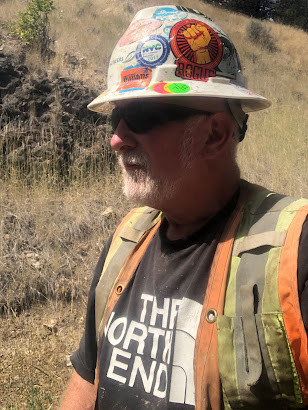 |
| Portrait of the Artist Losing His Dainty Freshness, John Day, Oregon, 8/18/20 |
Ael summed up his salient point well in this comment on the "Election Eve" thread:
"...a return to Obama style "Hope and Change rhetoric and fuck all else" won't cut it.
There is rising anti-elitist anti-corporate sentiment in the land.
If a populist insurgency fails in the Democratic party, I am afraid of what it might become in the GOP."
So, first; let me say that I couldn't agree more with his fundamental premise; that the social, economic, and political "playing field" in the current United States is viciously, irremediably skewed against anyone not in a two-yacht family.
The brutal fact is that we are effectively an oligarchy, or a plutocracy, if you will. The "people" - the mass of the citizens - do not, in fact, rule either in and by themselves, or through their elected representatives.
Things that the vast majority of the citizens of this nation like and want to be the things that shape their lives; equal opportunity, freedom from the terror of sudden illness or unemployment rendering them helpless, homeless, and hopeless...a more equitable society, in short...are always put aside in favor of the things that the wealthy citizens of the nation want and like.
The problem is that, right now, there's no way past or through or around that.
First, because the first-past-the-post electoral system always produces two large parties. Unless one of them is dying, as the Whigs did before the Civil War, a third (or more) parties simply splits the vote of that side of the political spectrum and allows the "other side" to win.
Second. because our electoral system is drowned, drenched, soaked in money. You cannot get elected in the U.S. without insanely huge amounts of money.
Which means that either you have to be insanely rich, or you have to court the insanely rich...or you have to mobilize literally millions of un-rich people to pay you and keep paying you.
The result?
The rich have access to political power in a way that everyone else does not.
That's why American politics never bothers to debate the value of tax cuts but has a conniption at the thought of using taxes to reduce inequity.
And that's baked in to the American political system.
Remember these guys?
None of them were poor. None of them were landless. None of them were Black or Asian or Latino or born to the tribes that had lived here before the Vikings (and, obviously, none were women).
They set the system up to over-represent rich white guys. And it's worked well that way ever since.
The story of this nation, the promise of the nation, was that although when they wrote that "all men are created equal" they didn't expect those other men - and women - to take them at their words. And that American history has been a long, hard, fight to make those lofty words reality for those "others".
For much of it's history, though, the United States has been what it is now; an open oligarchy.
Three periods were largely responsible to making some changes in that - the "Progressive" era, from roughly the turn of the 20th Century until the First World War, the New Deal era, from 1932 until the Second World War, and the Civil Rights era, from the 1950s to about 1980.
Right now we're embedded in a Second Gilded Age. The first one was disrupted - not ended, exactly, but broken up and forced to admit some of those "other" people - by the Progressives and the New Dealers. Those left outside by those movements - that is, non-white Americans - had to fight again in the second half of the Twentieth Century to try and gain some of that admission.
But the Empire struck back with the election of Reagan, and the country has been sliding back into economic and political feudalism ever since.
The coalition that frustrated the plutocrats in the first two eras - muckraking journalists, true Leftists - socialists and communists - and labor unions, and noblesse oblige aristos like the Roosevelts - is as gone as the Gibson Girl and the I.W.W.
Instead we're left with a dire dichotomy
The result of the hard graft of the wealthy to own one of the two parties has resulted in a GOP that is, frankly, irredeemable. Just lost. Gone. Entirely given over to everything from embryonic fascism to crony capitalism to really lunatic gabba-gooberosity, stuff like QAnon.
But the other big party is still largely in thrall to it's wealthy donors, and to the fear that if they move to hard to the left they will face the wrath of the now-massively-overpowered financial businesses, big banks, and corporate power.
And, frankly, the problem is that to dismantle the resurrected Gilded Age would, indeed, require what amounts to a revolution.
And that's not a metaphor. It would be, in fact, an economic and social (and political) overturn of the status quo.
Wealth would have to be massively taxed. Capital flight - the ability of large corporate organizations to move their wealth out of the U.S. - would have to first be viciously crushed and then policed with a savage intensity. Financial crimes would have to be investigated and punished with the dispatch and ruthlessness we now use on selling weed or sticking up gas stations. Prisons would have to bulge with banksters and grifters and other financial fraudsters.
In other words, the American public would have to start seeing the wealthy and "business" the way they now see government; as a large, unaccountable, dangerous threat.
And this would have to be done by a million tiny uprisings, tens of thousands of pamphlates, YouTube video after YouTube video, in classrooms and townhalls and community groups. The danger, frankly, is that a "populist" uprising is a fantastic risk of becoming either a dictatorship of the proletariat or a Man on Horseback. There's a reason that the French Revolution produced Napoleon and the Russian, Lenin.
The optimist in me wants to believe that there's a way this can be done. That there's a genuine way for the American people to reclaim those high-flown words written back at the close of the 18th Century.
The realist in me looks around and sees nothing but ignorant armies clashing by night. I don't see the American public as capable of that sort of patient, remorseless, brutally focused action, or as willing to make the sort of sacrifices that action would demand.
And, thus, I'm reminded again why I don't want to write about American politics. The way to political hell is already before us, broad and smooth; a descent into madness on the Right, a timidity and fear of violent revolt on the Left.
The way up is hard and narrow, and requires not simply one person but millions to be willing to walk it, to be willing to work and fight and suffer and, yes, perhaps, die, in that journey.
That's an immense ask.
And I'm not sure - not just if the American people are willing to answer, but - whether I even want to ask if of them for my dread that my worst fears will be horribly confirmed.
For me?
I'll fight.
That's what as a citizen I have to do.
But I fight without much hope.