Forty years ago yesterday (May 13, 1980) as Dick Waitt records in his 2014 work In the Path of Destruction, the Washington State Department of Emergency Management and other agencies including the U.S. Geological Survey were forced by public pressure to open up large portions of the forest lands around the then-unquiet Mount Saint Helens volcano that had been off-limits since the end of April.
(then-Governor Dixy Lee Ray had signed an order establishing a "red zone" around the volcano on 30 APR 1980 that turned out to be, in fact, grossly undersized - something like 50 of the 55 to 60 people who died in the eruption on 18 MAY were outside the original "red zone" - see below).
But that wasn't enough for the people who made their living in the woods, or who had cabins or houses near the volcano, or who just wanted to go back into the forest to mine or pick mushrooms or whatever.
Saturday, 17 MAY, something like 50 vehicles drove into the area that had been closed to bag up their stuff. The eruption took place at 8:32am, before the second planned caravan enetred the blast zone at ten, and since it was a Sunday the active logging tracts were empty.
Still, somewhere in the vicinity of 55 people were killed.
That ain't Pompeii...but, then, we knew more than they did back in the First Century, and knew how damn deadly dangerous these stratovolcanoes were. The volcanoligists of what eventually became Cascades Volcanoes Observatory warned the State of Washington that this monster could do all sorts of unpredictably deadly things. And the state government listened...until people grew bored and restless and demanded to "reopen" the woodlands around an actively erupting volcano. We learned a hard lesson about the power of convergent margin tectonics and nature in general.
As a geologist I find it kind of interesting to reflect on that, just at the moment.
Why?
Oh...y'know. No reason.
Just a thought.
Showing posts with label volcanoes and volcanism. Show all posts
Thursday, May 14, 2020
Friday, February 12, 2016
A long time ago in an island arc not so far away...
I think this is an artifact of a 33-40 million year old earthquake that occurred in the old island-arc off Oregon that is now the Coast Range.
The lower (left in the picture) material was a coarse grained pyroclastic sand, probably deposited as an ash-flow in the shallow seas around the old island chain. At the time what is today's Oregon Coast Range was an offshore chain of volcanic islands, very like the modern Japanese home islands. These rascals huffed and puffed a lot of volcanic ash into the air and from thence into the Eocene seas off what is today the Pacific Northwest.
You can see that a layer of gray silt was deposited above it, but you can also see that the silt is broken in the middle and the orange sand has pushed right through it.
On top of the silt (to the right) the sand has flowed out onto the surface of the silt, making a layered mound; these things are called “sand blows” or “sand volcanoes” and are a typical surface feature of liquefaction during strong earthquakes.
Just my interpretation, mind you; if you have two data points and two geologists you will typically get eight working hypotheses. Still...one hopes that the Eocene building codes were being stringently enforced.
Oh, and what do you get if you have one data point and one engineer?
A regression line calculated to four significant figures.
just sayin'.
Labels:
geology,
Oregon history,
volcanoes and volcanism,
work
Thursday, November 01, 2012
Diktytaxitic
I was wrapping up for the day today when this word popped into my head.
FYI, one of the things I love about geology is the language. We are a very "wordy" science; the original geologists back in the Victorian times spent most of their time describing stuff. It's only lately that we've gotten more quantitative like, well, real scientists.
Anyway, our basalts - and we have LOTS of basalts around here - tend to have this; it's...well, in Fuller (1931) this word describes "Microscopic (<2.0 mm), irregular intercrystalline voids and outlined by crystal faces of adjacent groundmass minerals" which simply means that the rock has lots of teeny holes in it, like this one: The little white things, like the small triangular space at the bottom center? Holes. Voids; small spaces in the rock made during cooling from the hot hellbrew (magma, or lava in this case...)
Here's what it this "diktytaxitic texture" often looks like in hand:
Cool stuff, basalt.
Anyway, now you know about "diktytaxitic". Good luck next time you play ScrabbleTM!
Labels:
geological terms.,
geology,
rock,
volcanoes and volcanism
Thursday, July 12, 2012
Boring and more boring
I couldn't just leave you with the story of Mount Tabor; the Boring Lavas are all over my city, and they are, like, the kewlest pre-Holocene underburden EVAH!
First of all, there's The Great Mystery, which is;
We have no fecking idea WHY the things erupted in the first place, why they started when they did, and why they (at least apparently) stopped.
Now the Pacific Northwest is volcano Disneyland. No argument there. The only thing you really need to know about plate tectonics is that there are three basic types of ways that the ginormous shell-bits that clad the outside of the Earth interact.
There's places that the plates are moving apart - these are spreading centers or divergent margins, and they are where new crust is made. Most of them are along the bottom of ocean basins, which is why they're often called "mid-ocean ridges".
They have pantsloads of volcanism but their earthquakes are typically small. Iceland sits right across one, but there is no active spreading center in or nearer the continental U.S. than the Gulf of California.
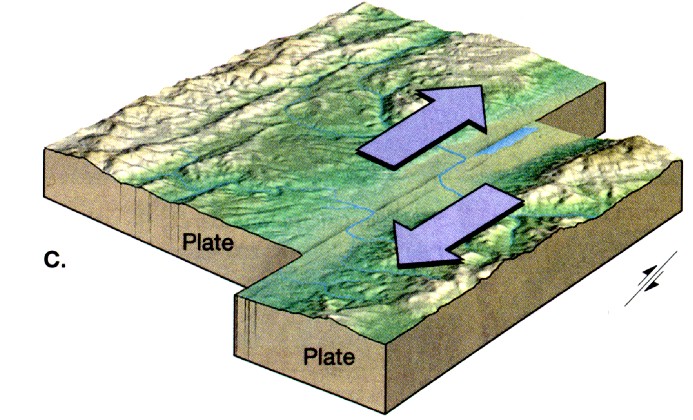
There are places where the plates move past each other - these are transform boundaries and you probably know of one right off the top of your head. The San Andreas Fault Zone is a monster transform margin, with Southern Californa (which is really part of the Pacific) moving northwest relative to North America.
These sorts of margins - despite what the movies will tell you - almost never have volcanoes. Instead, as you probably already know, too, they have huge earthquakes.
But here in the Pacific Northwest we live next to the third kind of plate margin - the one where the plates are moving together. This is called a convergent margin and comes in two flavors. Where continent meets continent you get the world's biggest head-on, and the rocks pile up into a big ol' heap; think the Alps, or the Himalayas.
Where continent meets ocean, like it does off the Oregon and Washington coast, you get some big-ass volcanoes - "stratovolcanoes" - the biggest and meanest of the breed. These things are second only to what are called "calderas" for explosive power, and they tend to get real vindictive to those living around them. Ask ol' Harry Truman, the lodgekeeper of Spirit Lake. Oh, wait, you can't - Harry's buried under several million metric tons of Mount Saint Helens that exploded all over his cranky old ass back in May, 1980.
But the other part of the deal is that these rock plates are also ramming together. They tend to get stuck for long periods when nothing happens.
But then they move.
And it's real wrath of God stuff; buildings fall over, the dead rising from their graves, dogs and cats living together.
Ginormous earthquakes, possibly the largest on Earth.
So. Okay, my family lives in Natural Disaster Central.
But getting beyond that; the thing is that we pretty much understand how we get the big stratocones. The ocean crust gets shoved down into the hot mantle, melts, mixes with and melts granite continent crust as it rises and erupts as a mixture of ocean basalt and continental granite - we call the stuff andesite, and there's tons of the stuff all over the Cascades.
And I've told you about the Columbia River Basalt, the incredible thickness of flood basalt that forms much of the bedrock everywhere around the Portland area.
But the Boring Lavas are very different.
First of all, as John Allen said, that
But - again - the big mystery is - why here?
Cascade volcanism is directly related to the tectonics of convergent margins. We think the CRBs are the product of a superheated geyser of magma from deep in the mantle - a "hotspot" or mantle plume.
But the Borings?
Their location and rock type suggest they're related to convergent tectonics, but that's like saying the Mitt Romney is a cluelessly entitled gasbag because he comes for a family of rich Mormons - it's a condition, not an explanation. Don Swanson admitted he was pretty baffled:
But, honestly?
We're not really sure.
We're also not sure of why they started erupting - about 2.7 million years ago - and why they stopped - in some cases, less than 300,000 years ago.
The big Cascades peaks; Hood, St. Helens, Rainier, Shasta - are all about a million years old. The older rocks, the so-called "Western Cascades" that underlie the big stratos, predate the subduction of the Pacific rise at the western edge of the old Farallon plate at about 40 million years ago and shut off about 5 million years ago, near the end of the Pliocene.
So what happened 2.7 million years ago to kick-start the Boring Lavas?
We have no idea.
Either.
But we do know that the Boring Lavas provide us with some of our most beautiful scenery and our most attractive places, from Mount Tabor to Elk Point high atop Sylvan Hill, from Larch Mountain in the east to Bob's Mountain up north.
One of the best places to see the Lava is, not surprisingly, down deep in the earth; in the Oregon Zoo/Washington Park station of the west side MAX light rail line.
Here the Tri-Met designers placed a portion of one of the rock cores that Portland geotechs L.R. Squier drilled back in the Nineties for the tunnel that runs through the West Hills; it does a wonderful job of showing you not just the Boring Lavas themselves but their relationship to the older, and younger, rocks and sediments that make up the bones of our Portland earth.
There's a couple of terrific blog posts about this trolley stop; here's a great one, by the delightful Dana Hunter over at En Tequila Es Verdad, complete with a full-contact geologic discussion of the B-5 core on display. Dana utterly rocks the rocks, too - she's a manic for geology, and her blog has a ton of other great geo stuff for your delectation.
Here's another, from the blog Subway Nut; Jeremiah Cox, the blogger, is more into the actual train station than the geology, but his pictures of the core there are incredible...
And most splendid of all, here's the U.S. Geological Survey's cross-section through the West Hills; it's amazing, and - like many of the wonders in life - the pink parts are the best.
In this case they're the fantastically convoluted layers of Boring Lava over on the east flank of the Hills. Here's the explanation of where they came from, when, and what they look like...
There's not too many places that can actually enjoy having volcanoes in their downtown, just another reason why Portland is the goddamn greatest People's Republic on the North American Plate.
Viva los Erupciones!
First of all, there's The Great Mystery, which is;
We have no fecking idea WHY the things erupted in the first place, why they started when they did, and why they (at least apparently) stopped.
Now the Pacific Northwest is volcano Disneyland. No argument there. The only thing you really need to know about plate tectonics is that there are three basic types of ways that the ginormous shell-bits that clad the outside of the Earth interact.
There's places that the plates are moving apart - these are spreading centers or divergent margins, and they are where new crust is made. Most of them are along the bottom of ocean basins, which is why they're often called "mid-ocean ridges".
They have pantsloads of volcanism but their earthquakes are typically small. Iceland sits right across one, but there is no active spreading center in or nearer the continental U.S. than the Gulf of California.
There are places where the plates move past each other - these are transform boundaries and you probably know of one right off the top of your head. The San Andreas Fault Zone is a monster transform margin, with Southern Californa (which is really part of the Pacific) moving northwest relative to North America.
These sorts of margins - despite what the movies will tell you - almost never have volcanoes. Instead, as you probably already know, too, they have huge earthquakes.
But here in the Pacific Northwest we live next to the third kind of plate margin - the one where the plates are moving together. This is called a convergent margin and comes in two flavors. Where continent meets continent you get the world's biggest head-on, and the rocks pile up into a big ol' heap; think the Alps, or the Himalayas.
Where continent meets ocean, like it does off the Oregon and Washington coast, you get some big-ass volcanoes - "stratovolcanoes" - the biggest and meanest of the breed. These things are second only to what are called "calderas" for explosive power, and they tend to get real vindictive to those living around them. Ask ol' Harry Truman, the lodgekeeper of Spirit Lake. Oh, wait, you can't - Harry's buried under several million metric tons of Mount Saint Helens that exploded all over his cranky old ass back in May, 1980.
But the other part of the deal is that these rock plates are also ramming together. They tend to get stuck for long periods when nothing happens.
But then they move.
And it's real wrath of God stuff; buildings fall over, the dead rising from their graves, dogs and cats living together.
Ginormous earthquakes, possibly the largest on Earth.
So. Okay, my family lives in Natural Disaster Central.
But getting beyond that; the thing is that we pretty much understand how we get the big stratocones. The ocean crust gets shoved down into the hot mantle, melts, mixes with and melts granite continent crust as it rises and erupts as a mixture of ocean basalt and continental granite - we call the stuff andesite, and there's tons of the stuff all over the Cascades.
And I've told you about the Columbia River Basalt, the incredible thickness of flood basalt that forms much of the bedrock everywhere around the Portland area.
But the Boring Lavas are very different.
First of all, as John Allen said, that
"as compared to the Yakima, (Boring Lava) is gray rather than dark gray to black, and the jointing is generally massive or blocky rather than columnar or brickbat. Still more characteristic of the Boring Lava, as seen in thin section, is the meshwork of minute plagioclase laths (polotaxitic texture) commonly with open spaces between the laths (diktytaxitic texture). The Boring Lava contains olivine, rare in Yakima Basalt, and there is a very distinct geochemical difference between the two types of lavas" (Allen, 1975, Volcanoes of the Portland Area, Oregon: State of Oregon, Department of Geology and Mineral Industries, The ORE-BIN, v.37, no.9, September 1975)Boring vents tend to be either "shield volcanoes" or cinder cones rather than flow basalt like the CRB or stratified cones like Cascade volcanoes.
But - again - the big mystery is - why here?
Cascade volcanism is directly related to the tectonics of convergent margins. We think the CRBs are the product of a superheated geyser of magma from deep in the mantle - a "hotspot" or mantle plume.
But the Borings?
Their location and rock type suggest they're related to convergent tectonics, but that's like saying the Mitt Romney is a cluelessly entitled gasbag because he comes for a family of rich Mormons - it's a condition, not an explanation. Don Swanson admitted he was pretty baffled:
"The setting of the basalt field is puzzling and not understood. The vents lie well west of the crest of the Cascades, and those such as Kelly Butte, Mount Tabor, and the vents in the Portland Hills are in and even west of the Portland basin." (Swanson and others, 1989, IGC Field Trip T106: Cenozoic Volcanism in the Cascade Range and Columbia Plateau, Southern Washington and Northernmost Oregon: American Geophysical Union Field Trip Guidebook T106)They do seem to be related to fault lines or fractures in the Portland Basin, where magma can leak through. They might be a sort of "forearc" volcanism, similar in nature to the small spreading basins that sometimes form between the subduction trench and the volcanic arc it generates.
But, honestly?
We're not really sure.
We're also not sure of why they started erupting - about 2.7 million years ago - and why they stopped - in some cases, less than 300,000 years ago.
The big Cascades peaks; Hood, St. Helens, Rainier, Shasta - are all about a million years old. The older rocks, the so-called "Western Cascades" that underlie the big stratos, predate the subduction of the Pacific rise at the western edge of the old Farallon plate at about 40 million years ago and shut off about 5 million years ago, near the end of the Pliocene.
So what happened 2.7 million years ago to kick-start the Boring Lavas?
We have no idea.
Either.
But we do know that the Boring Lavas provide us with some of our most beautiful scenery and our most attractive places, from Mount Tabor to Elk Point high atop Sylvan Hill, from Larch Mountain in the east to Bob's Mountain up north.
One of the best places to see the Lava is, not surprisingly, down deep in the earth; in the Oregon Zoo/Washington Park station of the west side MAX light rail line.
Here the Tri-Met designers placed a portion of one of the rock cores that Portland geotechs L.R. Squier drilled back in the Nineties for the tunnel that runs through the West Hills; it does a wonderful job of showing you not just the Boring Lavas themselves but their relationship to the older, and younger, rocks and sediments that make up the bones of our Portland earth.
There's a couple of terrific blog posts about this trolley stop; here's a great one, by the delightful Dana Hunter over at En Tequila Es Verdad, complete with a full-contact geologic discussion of the B-5 core on display. Dana utterly rocks the rocks, too - she's a manic for geology, and her blog has a ton of other great geo stuff for your delectation.
Here's another, from the blog Subway Nut; Jeremiah Cox, the blogger, is more into the actual train station than the geology, but his pictures of the core there are incredible...
And most splendid of all, here's the U.S. Geological Survey's cross-section through the West Hills; it's amazing, and - like many of the wonders in life - the pink parts are the best.
In this case they're the fantastically convoluted layers of Boring Lava over on the east flank of the Hills. Here's the explanation of where they came from, when, and what they look like...
There's not too many places that can actually enjoy having volcanoes in their downtown, just another reason why Portland is the goddamn greatest People's Republic on the North American Plate.
Viva los Erupciones!
Wednesday, July 11, 2012
Still small voice
The late summer light spread long and golden, stretching the shadow of the baskets far across the small red composite court tucked in the hollow of the hillside. The court, and the park around it, rose out of the quiet Center neighborhood of Portland, far from the tireless players of the North and Northeast. It wasn't busy even at the busiest times.
Today, near sunset, it was almost empty, just a single aimless shooter drifting from side to side, throwing up shots at random. The tall douglas-firs softened the noise from the play area up the hill so only the flat slap of ball on court bounced off the walls of the little canyon.
A long arching airball thudded into the lawn behind the north basket and rolled along the slope down to the wire fence, with the bricklayer in slow pursuit. He caught it just as it rolled under the wire and his lip curled in mild annoyance as he regarded the scurf of brittle black grit that clung to one side of the hard rubber. The grit felt sharp under his palm as he flicked it free. One tiny fragment caught under a nail, the rough rock wedging between nail and quick, and the young man swore without heat, turning his hand over to examine the irritant.
Unlike the rest of the hillside grit, which was black or red and cindery, this little piece was a pale yellow-white. The player stood silent for a moment, puzzling over the unusual bit of sand that seemed to glow pale in the slanting evening light.
--------
Eight years of experience told the big female teratorn that the dead camel was a safe meal. The cold morning light showed that the haunches and most of the exposed flanks were gone, haggled away probably by whatever had killed it; smilodon, most likely.
It wasn't just the pattern of the damage to the camel's corpse, but where it lay in the little clearing; not in the fringing brush but close, and without the signs of a long chase and catch.
The teratorn, had it been capable of recognizing what passed for its thoughts, would have felt them as a sort of smug satisfaction in its ability to recognize the leavings of the large North American predators of her time - the western edge of North America roughly one million years before today.
She knew that a lion or a pack of direwolves wouldn't have left the carcass until it was dismembered and reduced to tatters, while a short-faced bear would probably have dragged it further away into the thickets down by the sullen stream that flowed across the short-grass prairie. Bears were like that; greedy.
Only the big saber-tooth cats tended to pull down their prey from ambush and gorge on it where it fell. And only the smilodon, of the big cats, hunted the grasslands of the big valley alone. If the cat had gone it was sated, and unlikely to return. The teratorn flapped over to the camel carcass and took an experimental peck at the ragged flank.
Mmmmmm. Delicious. And a simple, easy snack compared to her usual diet of small animals and birds. The teratorn, thirty pounds of hard muscle and sinew under her dark gray-black feathers, was an opportunist; usually a predator herself but not above scavenging an easy meal. Nothing like fresh-killed ca...
She cocked her head, listening.
There it was again.
Something odd had been making noises in this little clearing for - although the teratorn had no concept of time - the past several days. Something like nothing she had ever heard before; a hissing, cracking sort of noise. Sometimes the sound had followed a nasty cloud that seemed to rise out of the ground, hot and choking. Sometimes the ground would shake, and a sound very like the thunder that followed the storm clouds that grew over the high hills to the east and west would make the teratorn jump and skrawk. Those things - which had nothing to do with food or fear - were forgotten almost as soon as they ended.
But now the teratorn heard that odd sound again. It seemed louder, closer. The big bird flapped its wings and mantled up as it would against a larger predator, or a rival. But there was nothing there, nothing it could see.
The bird settle back on the camel, still too nervous to feed. Its red eyes kept scanning the edges of the clearing, as if willing whatever was making her uneasy to appear.
Then with a sound like a vast cloth tearing the ground alongside the dead camel ripped open, and a stinking gray cloud rolled up into the hot summer air.
The teratorn cried out her disgust; what fresh hell was this? Honestly, an ice age was getting so an honest bird couldn't eat in peace! Disgustedly, the big animal crow-hopped several times, flapping, and took heavily to the air, rowing off towards the river and the mountains to the west.
Well, shit, she would have thought if she had had the words, maybe there's a fat rodent over there who's looking to have lunch with me.
Left behind her the fissure grew steadily, both longer and wider. A louder roar, like the sound of a huge boiler chuffing, announced the beginning of the eruption proper. A thick cloud of ash rolled out of the ground, hidden in the cloud glowing fragments of lava that cooled nearly instantly, falling back onto the grass as shattered black cinder.
A new blast flung the camel's body up and to the side, dismembering what the saber-tooth had not. Within moments a random volcanic bomb arced down onto the shattered bits, shattering them still further.
Within an hour the animal had been reduced to fragments of meat and bone and buried in hot cinder; by nightfall the entire clearing was a smoking, steaming black pile taller then the trees at the edge of the grassland.
Sometime around midnight that night a brilliant orange-red tongue of lava lapped out of the central crater and flowed down the side slope out into the thicket down by the creek.
In seconds the low-growing sycamores and willows candled, and the lava exploded as it crossed the watercourse, the shattered glass fountaining into crystalline drops that hundreds of thousands of years later the people of an island not yet formed would call "Pele's tears".
--------
The teratorn returned about a week later, hoping to find something delicious in the camel meadow. She drifted on the cold wind off the immense glacier to the east; had she had the ability to form her thoughts into words they would have expressed disgust; what the hell good was that big goddamn pile of dead rock down there now?
Because the meadow had become a mountain; a hot, black cinder cone hidden in smoke by day, coruscated with fire-fountains at night. The teratorn ghosted past overhead, her eyes weeping in the acrid smoke. Sod that for a game of predators, she would have thought (if she could have), dipped a smoke-gray wing and arced gracefully away riding the chill wind back to the mountains.
The little mountain took over a year to grow almost 1,000 feet above the plain around it. Several small basalt flows emerged from low on the flanks, or from the summit crater, but the growth was mostly through the steady rain of pumice and cinder, cooling from the fire-fountains as it fell pattering down the flanks.
When the layers of cinder grew thick enough the sides of the little mountain fell away in rough slides of angular fragments ranging from grains of sand to rough oblong "breadcrust bombs" formed from large dollops of magma shot out of the vent. The cinder cone grew steadily for another six months, one of the many smoking mountains in the broad valley floor, until, after nearly two years the crater coughed nothing but ash for a week.
A small cinder shower erupted ten days later but was followed by two weeks of silence, wispy tendrils of steam the only hint that the little mountain had not stopped growing. Another small eruption shook the cone a month later. A slightly larger one that autumn. A desultory shower of stone and ash two years later, staining the winter's white cover a dirty gray.
Then, nothing.
--------
Three years later the teratorn miscalculated her distance in pursuit of a damnably agile rodent, near that would one day become known as West Linn, and shattered most of her left wing on a cedar limb. She was furious when the wing, which had been working just fine before, refused to move without tearing pain, and was still furious when she died several days later of thirst and system shock.
What a fucking hosejob, she would have thought had she been able to think, as she settled into a motionless heap of dulling feathers.
Ten years later the cinder cone had developed a scurf of green; a scattering of tiny redcedars and douglas-firs with patchy grasses and small shrubs between them. The cold, dry weather made this forestation a slow business, and then the flood came.
Sometime in the early morning hours of what would become the month of June a massive wall of water, 400 feet high, erupted out of the narrow gorge of the Columbia River to the east and swirled up over all but the highest part of the crater rim. The waters were a mud-brown roiling sea of icebergs and enormous logs, and they stripped off most of the greenery as well as a portion of the loose cinder slopes. The enormous lake they formed drained over more than a year, and left a sloppy mess of yellow silt over the lower slopes of the volcano.
During the next 500,000 years this flooding happened over and over again; perhaps as many as two hundred times. Each time it tore a little off the flanks, or the top, of the cinder cone. Towards the end of the flood cycle - about 20,000 years ago - the shape of the edifice had been much reworked, and its height reduced almost in half, just over 500 feet above the plain around it.
And every flood mantled the little mountain with the silty loess off the great glacial plain to the east. Each time the intervening years softened and gentled the morass, turned the mud into soil, the soil into grass, trees and shrubs. Animals returned, lived, died, and their offspring lived after them.
If a living human had walked across the valley, had climbed the rubbly flank of the now-seamed and weathered mountain she might have seen other smoke pillars; to the west, to the south, to the southwest. This impossible person might have seen more; broad flows of molten lava erupting to form low "shield" volcanoes that are today Mount Sylvania to the southwest, Larch Mountain to the east, and Mount Scott and Mount Talbert to the southeast.
And still the slow years spooled away. The Firstcomers passed by, hunting for the great beasts of the Ice Age Northwest; the mammoth, the rhino, the horse, the camel. Some of these people came and stayed, to become the Multnomah and Calapooya, the Chinook and the Clackamas.
The next wave of humans came afterwards, with their steel and their diseases, their iron trusses and concrete and glass. They cut roads up into the side of the little mountain, sank metal tanks into it, built their homes around it, threw up lights and fences, built a little ampitheatre and a tiny basketball court made of the nubbled fragments of thousands of ground-up sneakers.
They turned what was left of the little mountain into a park; a place for people to play, trimmed and tamed, landscaped, neatened and straightened.
All so that on a lingering summer evening a young man from an expensive house nearby could suck his teeth with impatience and flick away the fragment of camel bone that was all that remained of a past that lay beneath him, tiny remnant of a world shattered and buried on a cold morning long, long ago.
"And after the earthquake a fire, but the Lord was not in the fire: and after the fire a still small voice." I Kings 19:11-12
(Mount Tabor still rises above the east Portland plain, the only known Quaternary volcano within the city limits of a major city. It is a lovely place, well worth the visit, and a reminder that much as the rocks are the bones of the Earth often those bones lie unquiet beneath the skin, and for all our hubris our power to mitigate theirs is very fraught indeed.)
Wednesday, November 24, 2010
Why I Love Geology 2: 007
Okay. So we've established that geologists are generally cool people who do cool things.
But did you know that we're also secretly the world's sexist spies?
Yep. As shown here in that cinematic triumph, Dante's Peak:I love everything about this movie, starting with the name; Dante's Peak - Dante's Inferno, get it? Subtle as a hammer to the face?
Oh, yeah.
The odd thing about this flick is that it is clearly meant to drag up the 1980 eruption of Mt. St. Helen's. You've got the small town (supposedly Washington but actually filmed in Idaho) literally in the shadow of the great volcano, all the flannel-and-latte trappings that the rubes associate with the Great Northwest, at least after David Lynch got through with them, and even a Harry Truman like-a-look in "Grandma Ruth" refusing to leave the upper slopes of Dante's hell-Peak because she knows "this ol' mountain won't hurt me..."
Riiiiiiiight, Grandma.
But does anyone other than me think that the entire notion of making a "Mt. St. Helen's" movie in 1997 was totally whack? Seventeen years after the eruption that made the national news wasn't exactly "ripped from today's headlines". I suspect that most people sorta-kinda remembered the events of May seventeen years earlier, but how did that help sell this flick? I suspect that the long remove from the historical event helped sink this turkey at the box office.
Geologically it's not a complete wash. The volcano does go from dormant to Plinian eruption within weeks rather than months, as is the actual case. And, no, entire mountain lakes don't really turn to acid, or hot springs suddenly boil skinny-dippers to death.
And you have Linda Hamilton, all craggy-beautiful, stone-washed wholesome, and foofily serious as the mayor of this fictional small town as well as the proprietor and sole barista of the local coffee spot, acting all intent in a sort-of-spacey disaster-movie fashion to provide both the required local viewpoint and the Love Interest.
Why a love interest in a flick about volcanic death, you ask?
Because the hero hunka-hunka burnin' volcanologist who comes to the rescue is none other than Double-Oh Seven. Bond. James Bond.
Seriously. James Bond, U.S. Geological Survey. Pierce Brosnan; the late-Nineties Bond himself, bustles onto the scene in his whompin' cool U.S.G.S. SUV (complete with snorkel for driving through rivers - you knew that all federal geologists are issued these, right?) to bark warnings to the ignorant hicks (producing much alarmed headshaking) and argue with complacent superiors (to be first reprimanded and, after the inevitable eruption, ruefully deferred to). Oh, and to conduct a "romance" with Linda the mayor/barista, naturally, although from the weak decaf they brew together it seems that Mister Kiss-kiss-bang-bang has left his Walther in his other pants and that Sarah Connor is still looking for Mr. Right rather than Mr. Right Now.
But he's fucking James Bond, people. And he works for the U.S.G.S.!
How cool is that?
So to review; cool flaming volcano death, parboiled naked hootchie, Linda Hamilton necking with James Bond, acid lakes, lattes, driving government vehicles through raging rivers.
Let's face it; geology is just flat-out, stomp-down, shake-your-moneymaker cool, and that's all there is to it.
But did you know that we're also secretly the world's sexist spies?
Yep. As shown here in that cinematic triumph, Dante's Peak:I love everything about this movie, starting with the name; Dante's Peak - Dante's Inferno, get it? Subtle as a hammer to the face?Oh, yeah.
The odd thing about this flick is that it is clearly meant to drag up the 1980 eruption of Mt. St. Helen's. You've got the small town (supposedly Washington but actually filmed in Idaho) literally in the shadow of the great volcano, all the flannel-and-latte trappings that the rubes associate with the Great Northwest, at least after David Lynch got through with them, and even a Harry Truman like-a-look in "Grandma Ruth" refusing to leave the upper slopes of Dante's hell-Peak because she knows "this ol' mountain won't hurt me..."
Riiiiiiiight, Grandma.
But does anyone other than me think that the entire notion of making a "Mt. St. Helen's" movie in 1997 was totally whack? Seventeen years after the eruption that made the national news wasn't exactly "ripped from today's headlines". I suspect that most people sorta-kinda remembered the events of May seventeen years earlier, but how did that help sell this flick? I suspect that the long remove from the historical event helped sink this turkey at the box office.
Geologically it's not a complete wash. The volcano does go from dormant to Plinian eruption within weeks rather than months, as is the actual case. And, no, entire mountain lakes don't really turn to acid, or hot springs suddenly boil skinny-dippers to death.

Although the dummies should really know better; anytime you get naked in a disaster/slasher flick, you're gonna die. Horribly. You know that. Grow a brain, people, and keep your damn skivvies on!But there's some reasonably-close-to-accurate stratovolcano geology, and the final pyroclastic explosion is pretty damn cool.
And you have Linda Hamilton, all craggy-beautiful, stone-washed wholesome, and foofily serious as the mayor of this fictional small town as well as the proprietor and sole barista of the local coffee spot, acting all intent in a sort-of-spacey disaster-movie fashion to provide both the required local viewpoint and the Love Interest.
Why a love interest in a flick about volcanic death, you ask?
Because the hero hunka-hunka burnin' volcanologist who comes to the rescue is none other than Double-Oh Seven. Bond. James Bond.
Seriously. James Bond, U.S. Geological Survey. Pierce Brosnan; the late-Nineties Bond himself, bustles onto the scene in his whompin' cool U.S.G.S. SUV (complete with snorkel for driving through rivers - you knew that all federal geologists are issued these, right?) to bark warnings to the ignorant hicks (producing much alarmed headshaking) and argue with complacent superiors (to be first reprimanded and, after the inevitable eruption, ruefully deferred to). Oh, and to conduct a "romance" with Linda the mayor/barista, naturally, although from the weak decaf they brew together it seems that Mister Kiss-kiss-bang-bang has left his Walther in his other pants and that Sarah Connor is still looking for Mr. Right rather than Mr. Right Now.
But he's fucking James Bond, people. And he works for the U.S.G.S.! How cool is that?
So to review; cool flaming volcano death, parboiled naked hootchie, Linda Hamilton necking with James Bond, acid lakes, lattes, driving government vehicles through raging rivers.
Let's face it; geology is just flat-out, stomp-down, shake-your-moneymaker cool, and that's all there is to it.
Labels:
bad movies,
geology,
movies,
volcanoes and volcanism,
Washington
Monday, April 19, 2010
Tuesday, November 03, 2009
Marcus loves Spendusa
How old is the human inclination to write or carve on the things around them? Did homo habilus scratch what passed for their initials on the rock they sat on waiting for something edible to wander by? Did the Sumerian loiterers scrawl "Ubi does it with sheep" on the mud walls of ancient Sumer?
Those of us hung out on Tiger Island in Honduras back in the summer of 1986 sure did. The graffiti in the wooden one-hole latrines got so expansive and so crude that the when the company first sergeant visited he required us to paint over the inside of the shitters. Mind you, the only paint we had was black, and the result made it difficult to locate the actual aperture of the one-holer, leading to some...accidents.
Certainly the archaeological record seems to show people have always had a penchant for scribbling on their walls...or other people's walls...or whatever is stationary and handy. The website "AD79" has a section entirely devoted to the graffiti uncovered in the ancient city of Pompeii.
It's fascinating.
The Roman sense of humor seems to have been pretty...basic. The fellow who wrote "Weep, you girls. My penis has given you up. Now it penetrates men’s behinds. Goodbye, wondrous femininity!" seems to have been a good example of the 1st Century south Roman wit. Some of his lads contributed gems such as "Restitutus says: 'Restituta, take off your tunic, please, and show us your hairy privates" and "I screwed the barmaid".
Some of the stuff they scrawled seems pretty thoughtful: "No young buck is complete until he has fallen in love.", or "Learn this: while I am alive, you, hateful death, are coming.", or "Love dictates to me as I write and Cupid shows me the way, but may I die if god should wish me to go on without you."
And some of it is perfect as an example of what happens when you have nothing but time, boredom and something to write with: "It took 640 paces to walk back and forth between here and there ten times".
For a rather fascinating look into the daily trivia of life twenty centuries ago, stroll on over to "The Writing On The Wall" at 79AD.
"O walls, you have held up so much tedious graffiti that I am amazed that you have not already collapsed in ruin."
(Oh! Wait! I almost forgot - while you're checking out the Roman words of wit, take a detour over to "SPQR Blues", a "soap opera with swords and sandals" for some of the best webcomic art, Roman adventure and Alphonse Mucha Pompeiian ladies on the Internets. Terrific! Great work, and you can tell the artist I said so.)
Those of us hung out on Tiger Island in Honduras back in the summer of 1986 sure did. The graffiti in the wooden one-hole latrines got so expansive and so crude that the when the company first sergeant visited he required us to paint over the inside of the shitters. Mind you, the only paint we had was black, and the result made it difficult to locate the actual aperture of the one-holer, leading to some...accidents. Certainly the archaeological record seems to show people have always had a penchant for scribbling on their walls...or other people's walls...or whatever is stationary and handy. The website "AD79" has a section entirely devoted to the graffiti uncovered in the ancient city of Pompeii.
It's fascinating.The Roman sense of humor seems to have been pretty...basic. The fellow who wrote "Weep, you girls. My penis has given you up. Now it penetrates men’s behinds. Goodbye, wondrous femininity!" seems to have been a good example of the 1st Century south Roman wit. Some of his lads contributed gems such as "Restitutus says: 'Restituta, take off your tunic, please, and show us your hairy privates" and "I screwed the barmaid".
Some of the stuff they scrawled seems pretty thoughtful: "No young buck is complete until he has fallen in love.", or "Learn this: while I am alive, you, hateful death, are coming.", or "Love dictates to me as I write and Cupid shows me the way, but may I die if god should wish me to go on without you."
And some of it is perfect as an example of what happens when you have nothing but time, boredom and something to write with: "It took 640 paces to walk back and forth between here and there ten times".For a rather fascinating look into the daily trivia of life twenty centuries ago, stroll on over to "The Writing On The Wall" at 79AD.
"O walls, you have held up so much tedious graffiti that I am amazed that you have not already collapsed in ruin."
(Oh! Wait! I almost forgot - while you're checking out the Roman words of wit, take a detour over to "SPQR Blues", a "soap opera with swords and sandals" for some of the best webcomic art, Roman adventure and Alphonse Mucha Pompeiian ladies on the Internets. Terrific! Great work, and you can tell the artist I said so.)
Labels:
archaeology,
history,
Rome,
volcanoes and volcanism
Monday, June 22, 2009
Out with the bad air...
Incredible: Sarychev Peak in the Kuril Island chain, northeast of Japan, on June 12.
From MSNBC: "The main plume appears to be a combination of brown ash and white steam, according to a NASA statement. The vigorously rising plume gives the steam a bubble-like appearance. The surrounding atmosphere has been shoved up by the shock wave of the eruption. The smooth white cloud on top may be water condensation that resulted from rapid rising and cooling of the air mass above the ash column. This cloud is probably a transient feature, which the eruption plume is starting to punch through."
Volcanoes, the OJ Simpson of nature - powerful, sexy, fascinating, but you trust them and they'll flat-out kill your ass.
From MSNBC: "The main plume appears to be a combination of brown ash and white steam, according to a NASA statement. The vigorously rising plume gives the steam a bubble-like appearance. The surrounding atmosphere has been shoved up by the shock wave of the eruption. The smooth white cloud on top may be water condensation that resulted from rapid rising and cooling of the air mass above the ash column. This cloud is probably a transient feature, which the eruption plume is starting to punch through."Volcanoes, the OJ Simpson of nature - powerful, sexy, fascinating, but you trust them and they'll flat-out kill your ass.
Labels:
geology,
nature,
volcanoes and volcanism
Subscribe to:
Posts (Atom)