Showing posts with label books. Show all posts

Tuesday, October 27, 2026

A Failure of Imagination

A friend gifted me the book The Hour of Land, by Terry Tempest Williams.


It's an impassioned work of unabashed love for the wild places, in this particular case the wild that has been bounded within the national park system of the United States. The book includes Williams' exposition of, ruminations on, and adoration for thirteen national parks, ranging from Gettysburg battlefield to the Gates of the Arctic, as well as her advocacy of, as she describes it;

"...a different kind of conversation so that our public lands are seen as out public commons, instead of the seedbed of rancor and violence."

Williams, as a writer, explodes off the page in bursts of passion, poetry, and enthusiasm. She very clearly inspired by these places, and the other untamed lands she describes. "Language and landscape are my inspiration." are her very first words, and through the pages her devotion to the preservation, not just of these delineated spaces but of all the unpaved, unlogged, unmined, unbuilt places, shines like a good deed in a weary world.

It is also a very, very sorrowful work.

Because Williams' invocation of "conversation" and "collaboration" as central, as essential, to the integration of these beloved wild places into the national imagination, the lives and works and beliefs of the people of the United States, is a painful reminder of the complete and utter popular failure of the "environmental movement" in the 20th Century United States.

In my lifetime I've seen three great public or popular movements fail. 

Each one began with promise, with hopes of a better nation, dreams of a better people. Each one died in recrimination, dispute, and disunion, leaving the nation, instead, a more bitter, more divided, more impoverished, and more angry place.

Perhaps the most fraught and difficult of the three was also the most ambitious; civil rights. 

The failure to truly re-found the United States as a nation of equal justice under law, to undo the centuries-long legacies of the "original sins" of the founding - genocide and slavery (and the racial hatred that underlay them both) - has left all the marks that the acts that sprang from those beliefs unchanged, and the damage and destruction they spawned as toxic and divisive as ever.

Or increasingly more so. 

We the People are who we are because in many ways we are still the people our forefathers were. Their strengths are still our strengths...but their evasions, and cowardice, and wrongdoing are still deeply ingrained within us, too, and much of our present Troubles spring from the forehead of our past misdeeds.

That, frankly, is too fraught and difficult to encompass in a blog post. I want to return to it.

But not today.

The second was Occupy. 

For perhaps four years - from the Great Recession of 2008 to the final desuetude and dispersal of the "Occupy Wall Street" and associated encampment/protests in 2011 - there seemed to be a genuine opportunity to really, seriously consider whether it was a good idea to return the United States to the economic, political, social, and moral ethos of the original Gilded Age.

I wrote several posts about the failure of that opportunity; here, here, here, here, and, finally, here. 

I can't really describe the loss that this failure means any better than I did thirteen years ago:

"Occupy lost it's momentum and has already faded into insignificance.

Which in my opinion will be remembered as a tragedy. The Occupiers had one burning insight; that from the mildly benign oligarchy it had been from 1932 to the late 1970s the U.S. is rapidly becoming a predatory toxic oligarchy through the rapaciousness of its oligarchs. This insight was lost in the foolish cacophony of noise the Occupiers generated and the criminally negligent reportage of the courtier press. I believe that we will one day regret that we did not pay more attention to the rise of the modern aristos.

The result has been a continued slide back to the rampant inequality and social division of the Gilded Age, with the concurrent erosion of the sort of stodgy bourgeois middle-class attitude of the "rest" of the U.S. public as it sees it's decent-wage jobs, it's pensions, it's influence, and it's security ever more crammed down and eroded away. Combine that with the overwhelming sense that gold now makes the rules and that the reopening of government to massive inflows of cash has made individual voting almost meaningless and you get a public that seems to me daily more vulnerable to a demagogue, a "man on horseback" that promises to make those changes that they can't."

And, of course, now He Has Risen:

We've already talked way too much about the ignorant bastard. 

This, then, is the third "great failure". 

The inability of the American environmentalists - to lump everyone from John Muir through Edward Abbey and Teddy Roosevelt to Tempest Williams in a basket with that label - to convince the American public that the preservation, protection, and expansion of those parts of their own nation (let alone other people's nations, or parts of the world that aren't "nations" in the Westphalian meaning of the term) which aren't already paved, built-over, drilled, mined, logged, farmed, or in other ways "no longer truly wild" is important. A critical public good. An imperative that should be among the first and most important considerations of any and every piece of public business.

Williams published this work in 2015, after nearly eight years of the Obama presidency, in a moment of what I'm sure felt like a triumph for environmentalism, but now feels like a high water mark, the socio-political equivalent of the copse of trees at the crest of Cemetery Ridge where the environment and its defenders found that the battle had not only not been won, but that they were not just going to lose but in many ways would be routed and destroyed.

Williams just can't see that coming. 

Instead, Williams name-checks all the lineages that run through the literature and history of the United States environmentalism ("environmentally-concerned", or whatever you want to call people whose ideal is "let's not just fucking pave everything, okay?"); Muir and Abbey who we've already mentioned, Wallace Stegner, August Wilson, Rachel Carson, Wendell Berry, scientists like John Wesley Powell, politicians such as Roosevelt and Sally Jewell and Lady Bird Johnson and Barack Obama, wealthy philanthropists like John D. Rockefeller, as well as dozens of individual activists, public commentors, leaders of everything from native tribal groups to "monkey-wrenching" eco-warriors such as someone named Tim DeChristopher, who briefly gimmicked a BLM oil and gas lease auction in 2008.

She does this to try and center the wild places, and those who love and protect them, deep in the heart of the American story. The intent, clearly, is to make a case for the centrality of that, and them, and a rallying call for the public to join her. To start that "different kind of conversation" with the people she calls out from the other side. The Cliven Bundys, the Dick Cheneys, and the George W. Bushes.

Trump? Holy Hell did she not see that fat fucker coming. 

The prose is beautiful, the descriptions lovingly crafted, the care and hope luminous...and all it does is kindle a bright light that shines past her, casting the immense and nearly complete shadow of failure of her cause to create a response, even the most tepid and cautious response, from the damned U.S. public.

Couple of things first, though. 

Through the tales Williams' scholarship (or historical knowledge, or whatever you want to call it) or lack of same or, worse, evasion thereof, bugged the shit out if me. It's deeply uneven, sometimes lacking, and in several places it's apparently willful blindness is frankly unsettling.

The one that really jumps out at me is Williams' hagiography of the Rockefeller clan.

This crew is tongue-bathed twice - more than anyone mentioned outside of Abbey, perhaps - once for the old man, John "the public be damned" D's gift of the properties that became a large piece of Acadia National Park in Maine, the other for a similar donation of land by his son and grandson in an area near Yellowstone NP that became "Grand Teton NP".

The rapacious economic life of the plutocratic sonofabitch is never really dragged into the light, and the Gilded Age greed that piled up the cash that bankrolled him, his progeny, and their philanthropy isn't so much as mentioned during the discussion of, say, the carriage roads his wealth carved into Mt. Desert Island and that now are such a symbol of Acadia.

The other is the gloss sprayed over Cesar Chavez' rule of the UFW, eliding entirely the weird Syanon power games he demanded of his staff, as well as Chavez' personal inability to resist putting his chayote in women who worked for him. 

That's a problem.

Because there aren't "heroes" in the fictional sense in real life. There's just people. Flawed ones who can do great science, or make great art. Kind, loving ones who can go to work and do horrific things to others they don't see as "us". To write a paean to Rockefeller, or Chavez, and fail to accept and acknowledge their darknesses? 

At best that's poor writing. 

But that failure pales beside the greater misunderstanding of how completely Williams, like so many of the other mid- and post-mid-century environmentalists, misunderstood how people are.

Which goes back to the genesis of this post, the oddball comment on the previous one, about how the real reason that the global "public" didn't and doesn't rise up in righteous anger at the plutocrats, oligarchs, corporations, and bureaucrats that have and are enabling anthropogenic climate change is because of some black-helicopter/conspiracy-theory brainwashing and/or propaganda and/or bribery and/or something else utterly bizarre and nefarious.

The wild lands? Why aren't all the Good People of Earth defending them? After all, these are, Williams insists, sacred spaces. Liminal. Transcendent. Deeply entwined in humanity, links between that humanity and every other living thing. 

We the People - all people - need these wild, unbroken lands.

And that has been the "message" of environmentalism ever since I was a kid in school singing along with Woodsy the Owl.


Woodsy was one of the more public "faces" of what I understand is now often referred to as "the second US environmental movement", the rapid growth in the public presence of concern for what at the time (the Sixties and Seventies) felt like a cascade of horrific bad news about the poisoning of the soil, air, and water across the country.

That the industrialization of the United States had generated a hell of a lot of nasty shit is hardly surprising. That's what the mines and factories and farms did; took materials and made (or grew) other things from them, and then (since the people who owned and ran those factories and farms weren't in business to make the place nice if it cost them money to do that) dumped whatever shit they couldn't use or sell.

Into the nearest hole in the ground. Or lake. Or river. Of, well, fuck, in some poor sonofabitch's backyard if there was nowhere else.

The fun that all the things that the factories and mines and farms gave to Americans meant that they (mostly) ignored all the toxic shit that was in the country all around them.

But the 1960s the bill for all this started to come due.

Rivers caught fire. Toxic air started choking people. Toxic soil, or toxic substances barely covered with soil (Love Canal says hi!) started poisoning people. Drill rigs blew out and vomited crude all over pretty beaches where rich people liked to play.

And, finally, all this nasty shit made people - ranging from the poor powerless schlubs who'd had to live in this toxic stew to the wealthy and powerful and politically connected - begin to worry.

The first "Earth Day" was April, 1970.

The rest of the Seventies were a big time for "environmental" legislation and action in the U.S., which included introducing kids like me to Woodsy and his tree-hugging pals. That's how I remember the "environmental movement"; a singing dancing cartoon character who told me that I needed to pack my trash out of the woods and recycle my pop cans. 

What was going on around me while I was too young to understand it was a mad-minute-decade of environmental actions by the federal government.

The Clean Air Act had been passed a decade earlier (1963). But in the Seventies we got:
The Clean Water Act (1972)
Establishment of the U.S. Environmental Protection Agency (1970)
Resource Conservation and Recovery Act (1976)
Comprehensive Environmental Response, Compensation, and Liability Act (1980)
Establishment of human health and safety rules and organizations like OHSA (1970)
Endangered Species Act (1973)
Safe Drinking Water Act (1974)
Surface Mining Control and Reclamation Act (1977)

And then in January 1980 all that effectively came to a halt, because...


...yeah. That fucking guy.

Reagan's election meant the beginning of a now-forty-plus-year era when all the powers that hated the limits and restrictions and costs that required them to not buy, borrow, steal, or shit all over the non-paved (and much of the developed!) parts of the U.S. were back in the saddle with the Hollywood cowboy.

It's instructive to note that the bespectacled little gonif behind Reagan is the poster boy for the GOP's rape-the-Earth-First religion; James Watt, Ronbo's Secretary of the Interior, who saw his job as shoveling as much of the Interior to his and Ronnie's and every GOP cracker's pals as fast as he could.

(Oh, here's a funny paleoGOP/Watt anecdote. His greedy ass got canned because in September 1983 he stood up in front of the business boys of the US Chamber of Commerce and said "I have a black, a woman, two Jews and a cripple. And we have talent." That, in 1983, would get you fired. In 2026? Fuck, you'd probably bag a Presidential Medal of Freedom...)

So after 1980 the environment and environmentalism was on the outside, fighting a defensive battle. When Democrats would get power the wild land partisans would push back...only to lose ground again when the GOP got back in.

From that point the only way to prevent that would have been for the goddamn U.S. public to have been so thoroughly Woodsy-fied that any public attempt to reduce or evade environmental protections would have produced a massive electoral disaster for the authors.

That didn't, and hasn't, happened.

Why?

Here's my theory.

First, on "the environment" the public in general is now, and was, very much as the current voting patterns define it, and that set the task the environmental movement needed to accomplish. About a third is okay with environmental rules and law, anywhere from hardcore Earth First to "well, I'm driving a Prius and I recycle, so yay. me, right?". 

Another third is some form of "drill, baby, drill", ranging from the practical users-of-land-for-commercial-gain - everyone from workaday miners to ranchers to real estate developers - through the politically "conservative/Wise Use" types through to the pure wingnut "solar-is-for-pussies" and Bundyesque public-land-thievery goofballs. 

And there's some remnant lump in the middle, that's too ignorant to understand and too lazy and/or stupid to learn about the issues.

Meaning that to make environmentalism partisan-voting-proof you'd need to assemble and sustain a solid block of both the left and middle thirds, and probably need to peel off some of the more reasonable of the land-users.

Second, the mainstream U.S. environmental movement didn't succeed in doing that. Largely, I think for several reasons.

One is that the public at large wasn't, and isn't, emotionally (or economically, or politically) invested in the preservation, let alone expansion, of the wild lands. We as a society, and most people as individuals, live in towns and cities. To even get to those wild places, like the national parks treasured by Williams, takes time, effort, and money that many Americans don't have, or don't prefer to spend on a day gazing at or hiking Yosemite Valley as opposed to, say, hitting the rides at Disneyland.

Many people vaguely like the idea of scenic mountains and forests. But the connection is pretty vague for most of us. We don't live there and, frankly, most people find true wilderness kind of scary. Even the manicured "wilderness" of the national parks can seem inhospitable to a society that thinks of food as something that comes from the Safeway and shelter as a two-story townhouse.


Park Service studies suggest that something like 95% of visitors to Yellowstone never wander more than a half-mile or so from their car or RV.

But even many of us who do make that escape don't share the emotional level of commitment needed to push preservation of the environment to the front of the political business line. As a geologist, as a birder, as a GI, I've spent many, many days in the "outdoors", ranging from backlots to truly wild places. Many of the things I do, much of what I love, depends on keeping those places as unaffected by human civilization as possible.

And yet, I don't feel any of the "magic" that Williams describes and that is a large part of similar nature writing. To me the "outdoors" is a combined living room, kitchen, playroom, bedroom, and toilet. It's just a place; a beautiful place I love to visit...but that transcendent joy, that sense of living in those places? I don't feel it. That isn't a good lever to move me, and, I assume, many of those like me. Show me real, practical, everyday benefits? Sure! But pulling the "emotion" string? No.

That makes "wilderness" as a political good a hard sell. Because...

The other is that, like Williams, many of the most impassioned and visible defenders of the wild land are deeply invested in those places, and don't seem to understand precisely how difficult a sell that is to those who are not. The tone of The Hour of Land feels as though Williams believes that just by describing these places, their beauty and power, the readers will be energized to fight for them, to, let's not kid ourselves, make some kinds of sacrifice for them, and that's the really big ask.

Truly preserving the wild lands, the endangered species, means that industrial civilization has to take, or be forced to take, a step back. Everything from CAFE standards to hydropower dams to stuff as silly as paper-versus-plastic drinking straws means that someone, sometime, will have to be forced or encouraged (or a bit of both) to relinquish some thing or activity they want or want to do. 

The reality of that makes it simple for anti-environmentalists like Reagan and Watt and the Bushes and Trump to sell that uncommitted third-of-the-public that "those whacky tree-huggers" want to take your plastic straws, hamburgers, coal-roller, airplane travel, snowmobiles...whatever they can sell as something that would be limited by solar power or roadless areas or transgender...okay, well, whatever the "Left" finds appealing.

And, since as noted above, few outside the hardcore enviro faction have that deep emotional connection for the "wild places", whether it's Bears Ears or the local park, that's a damn difficult hill to fight on.

(And here I note that a huge part of the 2026 problem - compared to 1970 - is that environmentalism is hindered by its own success.

In 1970 many Americans knew of some sort of revolting, dangerous, dirty, generally-fucked-up mess made by business or farming or industry. Rivers were on fire, for fuck's sake! The LA basin was a choking cloud of "smog" as tailpipe gases and industrial emissions combined to make breathing difficult.

Now? When was the last time you saw anything like that? The legacy of the environmental regulations of the Sixties and Seventies means that in the Twenties We the People just don't think of "environmental protection rules" as things that keep our air breathable and water drinkable.

So we, as a society, as a nation, aren't particularly arsed to defend them when somebody who can make a buck fucking up the air, water, or soil comes around with a bagful of cash to buy some government.)

 
And here we are.

The current crop of fascist and Nazi-adjacent MAGAts is exceptionally vile on "the environment"...but as a matter of degree, not of basic beliefs. As we've discussed, the notion that the world around us is here for humans to grab whatever we can however we can, regardless of how fucked up that leaves whatever the grabbers leave behind them has been a fairly broad "conservative" ideal since...well, since at least the days of John D. Rockefeller and Drew Carnegie and Companies, if not all the way back to 1492.

I mean...the white folks that arrived in the hemisphere weren't here to set up drum circles and meditate on the beauty of nature, right? 

In the words of the song...

"The great nations of EuropeHad gathered on the shoreThey'd conquered what was behind themAnd now they wanted moreSo they looked to the mighty oceanAnd took to the western seaThe great nations of Europe in the sixteenth century
Hide your wives and daughtersHide your groceries tooGreat nations of Europe coming through."

Is there any way out of this?

Sure.

Is it quick, or simple, or easy, or cheap, or painless?

No.

And, if the past forty-odd years have taught us anything, it's damn deadly difficult to get humans in a group to do anything important if it's long, complex, difficult, expensive, and punitive...even when they're not a mob of greedy bastard.

So...yeah. There are days when, even though I'm not utterly hopeless, I just feel like...


...we are soooooooooooo fucked. 

Sunday, March 19, 2023

Things you didn't know you needed to know


So you probably didn't know that your white blood cells are actually microscopic buxom chibis that work by hitting pathogens with teensy little rocket propelled grenades. 

I know, right? In hindsight is seems so obvious.

Apparently this little character is from an anime, はたらく細胞BLACK (Hataraku Saibō Burakku), "Cells at Work! Code BLACK" in which the protagonists are anthropomorphized cells including our little RPG-shooter.

That may be the most Japanese thing I've heard in a loooooong time.

Friday, December 30, 2022

Some things I liked about 2022

This is a blatant rip-off of the post John Scalzi did over at Whatever.

If you're gonna steal, steal from people who you know do good work.

Right?

Anyway, I've never done one of these "year-in-review" sorts of posts before. Mostly because I've been looking forward rather than back; work-life tends to make you do that. You're pushing to stay ahead of the bill-collectors and corporate reviews and colonoscopies (okay, well, maybe not colonoscopies; those, like the occasional sudden sneeze, just sort of catch you) and all the other trouble in the world.

But this last year was different.

For one thing, I finally stopped being a wage-slave and having to strain to look forward.


Being a geologist-for-hire was a huge part of who I am - who I was - for thirty years. I did science for a living and put in a lot of long, hard days outside doing it. Shit, if you go to this website my front-page bio even says that: "...analytical by training and doggedly hard-working by necessity..." That was me.


Now?

Well...I'm still who I was then. Still analytical, still liberal, still...well, actually more judgemental, but that may have to do with the appalling tidal wave of reactionary shitheels that you can't swing a cat without smacking or so it seems.

But I've already gone into that. This is supposed to be about things I LIKED in 2022.

So. 

Retirement. 

I've liked being retired. At least so far.

I liked the lab work, soils testing, the sort of bench-chemistry-index-testing science we learn in school.


I liked the analysis, the puzzle-solving, the looking at the ground and the soil and the landforms and trying to figure out what was going on.

But because the bulk of my work was dirt-nanny stuff? Nagging asshole contractors to do what they low-bid and are trying to slime out of? That's the daily bread of most of earthwork engineers, and sweet baby Jesus how it sucks. Sucks the fun right out of all the other stuff.

So. NOT having to do that? I like that. And it makes up some for no longer having the disasters and lab and analysis to do.

So retirement? I liked that.


The Portland Japanese Garden

As you can probably tell from the photo essays, I love the Garden; the peaceful order, the quietly tended "nature". The colors, the light, the shape and the weight of it.

Membership in the Garden lets me get in early, when the City around it is still and the pathways are empty. I get to stroll and think, watch and reflect, and I like that a lot.

And speaking of Japan...

Anime and Manga

For some reason this past year I've been sinking deeper into the world of Japanese graphic art, whether in written form as manga - 漫画 - or animeアニメ . 

The Girl shares my enjoyment of the animated form; over the last year together we've enjoyed the big-screen versions of a couple of Studio Ghibli classics - The Cat Returns and Howl's Moving Castle - along with perhaps the most visually gorgeous film I've ever seen, Belle.

The story? Oh, just the old "beauty and the beast" chestnut. Fun enough, and the story of Suzu, the "belle" of the title, her friends and family, is genuinely sweet and moving. But that's not the main reason to watch.

It's the graphics.

Amazing.

My taste in the dead-tree forms runs all over the place, from dystopian futurism like Ghost In The Shell to sweetly adorable yuri romances. I think I've mentioned my fondness for the goofy adventure/military/fantasy Gate: Where The JSDF Fought. 

Rory Mercury?

Yow.

My favorite from 2022, though?


Sweat and Soap.

It's a weird, weird, deeply weird premise; the female lead, Asako, has "hyperhidrosis" - meaning she sweats more than she thinks is "normal" - while the male lead, Koutarou, has an incredible sense of smell which he normally uses in his job as soap designer but which leads him to Asako...who smells delicious! At least to him.

I picked it up purely out of curiosity; the storyline seemed odd but the artist (Yamada Kintetsu) has a nice clean style and I'm a sucker for that.

But that didn't catch me. 

What caught me was how it turns out to be a true, sweet, and moving love story.

True in the sense that these fictional people are deeply flawed, as are we all, and that they meet and become a couple in a very weird way...but one that finds goodness and joy even in their own and each others' flaws.

It's just gentle and kind and very, very romantic.

And speaking of romance...

First Night With The Duke

I follow a shockingly large number of comics at the "Webtoon" site, but this was far and away the most delightful; a goofy, funny, exciting, bizarre little story about an ordinary Korean girl who wakes up inside the romance novel she's reading but not (as is the usual form of these "isekai" (異世界) stories) as the heroine or the villainess.

She's just "Ripley", a minor character at the party scene where Zeronis - the titular Duke and a classic manga "dark and dangerous" hero - is supposed to meet the heroine and fall for her.

Instead Ripley gets plowed and ends up in bed with the Duke, who becomes obsessed with her instead of the woman he's supposed to fall for.

Oh, it's waaaayyyy more complex than that. There's fake deaths, and mad suitors and actual love and it was just big crazy fun. I'm sorry it's over, and I'm hoping that maybe the author will release an English language version, because I'd love to re-read it; it was my Top Romance Story of 2022.

And speaking of even more romance...


Everything Everywhere All At Once

I've been a Michelle Yeoh fanboi ever since her Hong Kong action days. But she, and this wildly inventive film, were perhaps the best thing I've seen at the movies not just in 2022 but for many years.

She's, well, everything all at once; mom, wife, diva, artist, businesswoman, savior of the world...while all the time being the same struggling everyday person just trying to get through one more day that we all are.

It's action and adventure and comedy but y'know what?

It's really a love story.

Yeoh is a woman who is tired. She's tired of herself, her husband, her daughter, her dumpy little laundromat that is her whole life. She's tired of struggling through every day just to find another just like it. And she is terrified to find that there's worse; the actual no-shit end of the world - worlds! - that only she - tired and beat up and struggling - can save.

And she does. Because deep down, she loves herself, her husband, her daughter...she loves the whole world enough to fight to save them all.

It's an epic performance in a terrific flick. 

It won't win Best Picture and she won't win Best Actress. 

It's too weird, and she's not diva enough.

But they should.

The Portland Thorns

God but this was a fun season. Winning the title was pretty awesome; I liked that, duh. But getting to write and think about the team and the league and the game was a hell of a lot of fun, too.

And we might just be getting a new owner and a new front office, after a pretty rugged couple of years from the old regime, and I'm liking that.

Oh, and I love this photo; it's from the post-match celebration. The player in the circle is Olivia Moultrie, who's still in high school and 1) can't drink, and 2) is clearly embarrassed at the grownups. Yeah, Livvy, grups can be pretty cringe-y.

Mary Bennett

One of the most fun things I've read - as a no-pictures-just-words book - this year has been the three volumes of the "Secret Life of Miss Mary Bennett" series, beginning with the first Pride and Prejudice-based story of the middle Bennett sister finding work as a spy for the Regency government and continuing with the next two.

The fun part about these is that the author doesn't try to heroine-up her protagonist by making her more witty or clever or smart or attractive. Yes, she's the "heroine"...but she's also the same socially awkward, pedantic, prosy middle Bennett sister we meet in Jane Austin's novel.

Cowley makes that plausible; being drab, plodding, and detail-oriented might make you a crashing bore at an afternoon tea but a damn good undercover agent.

Mary is more than just that, though. Crowley shows us how her exposure to the bigger world outside of Longbourne helps Mary grow. She learns that she has actual skills, that she doesn't have to push herself forward to show them to others. Indeed, as a confidential agent she has to learn to conceal what she knows and does!

By the third book - where she has to "learn" to kiss to sweeten up a possible source or beguile an enemy agent - she's become genuinely thoughtful and even a bit wise. Does she still manage to find a way to work a moralizing quote into a romantic moment?

She's Mary Bennett! Of course she does!

But this Mary can have a romantic moment, and even enjoy it fully and intelligently.

There's supposed to be two more of these coming; I can't wait.

What else?


I still like this furry butthead. He's a good cat. Or, as my Bride describes him, he's "good at being a cat".

And I still love my family, my home, and my hometown.

So all in all, it was a pretty decent year. There were a lot of things I liked.

Tomorrow I want to talk about the next year, though.

Wait, wait..!

I can't go on without recommending...

 Lore Olympus

Rachel Smythe's post-modern take on the ancient Hades-Persephone tale.

It's funny, clever, sexy, all with the wonderful graphics that pulled me in the first time.

Plus it's an absolutely heartwarming love story.

(Can you tell I'm a sucker for a love story?)

Anyway...go, read it. It's tons of fun.

Friday, August 27, 2021

On the nightstand...

 ...is my palate-cleanser from the turgid prose of Rick Atkinson's The British Are Coming; perhaps the most peculiar, wonderful, bizarre, and intriguing train-wreck of a manga adaptation of an anime I've ever come across: Gate: Where The JSDF Fought.

I dunno, but this may possibly be the most manga-y manga I've every read.

(And to out myself as an otaku, I kinda love manga; I've read every tankobon volume of Kimetsu no Yaiba (鬼滅の刃) and everything from the hardcore old-school mecha stories like Shin Seki Evangelion (新世紀エヴァンゲリオン ) to fluffy romances like Our Teachers Are Dating...)

But this one is...reeeeeally special.

Start with the worked-out premise of an interdimensional gate between worlds.

But then add a bizarre mashup of Tolkiensque fantasy - dragons and trolls? - with Romans (sorta...) and a buxom imperial princess called - I shit you not - "Pina Co Lada". 

Have these mooks invade Tokyo and tear the living hell out of a bunch of innocent Japanese civilians...

(Don't forget to pitch in a whole bunch of gratuitous violence and nudity...)

 ...and then respond to all this with a sort of Japanese Army (sorry..."Self Defense Force") fanservice where the JGSDF proceeds to send an expeditionary force into this fantasy world so we can enjoy antitank weapons against fire-breathing dragons and Japanese recon infantry against Roman legionaries and the boys and girls of the Rikujō Jieitai as heroes...

...plus Rory Mercury, who is so beyond the rest of this weird shit that I leave you to the mercy of Wikipedia.

The whole thing is an absolute hoot, and I hope the outfit that's publishing this thing will continue to put out these in tankobon formate all the way to the end of the original anime run.

If only Atkinson had found a way to write in a loli-goth death goddess into the Battle of Long Island his stuff might work better. I'm just gonna have to call that a serious failure of imagination.

Saturday, June 26, 2021

The Maltese Cat

 I was at loose ends the other night - just finished my last book, didn't have a new one in view, and wasn't interested in the offerings of the tube - and I was pulling over the shelves beside the bed and came across my old 1898 volume of The Day's Work.

It's not the first edition, unfortunately, but the second, and was picked up in a rumpled old used bookstore along the coast, I think, had before and has since then seen a lot of wear. The spine is broken and the pages are hanging on by the threads of the sewn binding. I've cared for it gently, but it's not in great shape.

And...it's an...odd little book.

There's thirteen stories within it and they're all rather slantendicular and many are paranormal, ranging from the truly weird The Brushwood Boy (where our hero, the stock-Kipling stalwart young infantry officer, meets the woman of his dreams literally in the surrealist dreams which they share) to some Anglo-Indian romanticizing (The Bridge Builders, where a similar British hero - bridge engineer rather than subaltern - is subsumed in a conclave of the talking creatures that represent the old Indian gods his creation has disturbed) to straight-up anthropomorphism in the Jungle Book-style.

Some of them I enjoy more than others (I've never actually managed to struggle through .007 or William The Conqueror Part 1 and my tolerance for his full-throated paeans to colonialism like The Tomb of His Ancestors - as clever and touching a tale as it is, and it is clever, and parts of it are touching -is fairly limited; I've read too many Indian authors to elide the "faithful native" claptrap that comes with Kipling in paint-the-map-red mode.

Though not as impatient as George Orwell was; his takedown of the guy is pretty epic (has ever a writer or poet been dismissed as brutally and summarily as this: "He dealt largely in platitudes, and since we live in a world of platitudes, much of what he said sticks."? Daaaaamn...)

The Kipling I loved as a child and the least harrumph-able are his animal tales. The echoes of imperial hubris are faint in the Jungle Books (although I have my eye on Bagheera, that fusty old colonial mug...) and there's a version in The Day's Work - a story about polo.

I know absolutely nothing about the game other than it's a ballgame played on horseback and supposedly the Argentines are now the bosses of it. I know that to play at any sort of high level today you have to be filthy rich, because it's a horse thing and all horse things are rich now that horses are a luxury good and not a working tool.

Not in the 1890s, though (or more likely the 1880s, the period when the guy was working in British India); a British officer rode to work, and keeping an extra hayburner or three wasn't so much of a big deal.

Hence the story; our hero, the gray polo pony of the title, and his equine teammates are carrying the British officers of an Indian engineer outfit (they're called "pioneers", which were the 19th Century version of combat engineers - the guys who built fortifications and bridges and all that. "Sappers" were the tunnel guys, which was a separate specialty...). They're playing a fancy cavalry (meaning: rich) outfit for the Big Casino, and the story is the story of that game.

That's it, that's the bones. The real meat is in the telling, and that's where our guy Kipling gets to cut loose.

"The question was which pony should make way for the other; each rider was perfectly willing to risk a fall in a good cause. The black who had been driven nearly crazy by his blinkers trusted to his weight and his temper; but Benami knew how to apply his weight and how to keep his temper. 

They met, and there was a cloud of dust. The black was lying on his side with all the breath knocked out of his body. The Rabbit was a hundred yards up the ground with the ball, and Benami was sitting down. He had slid nearly ten yards, but he had had his revenge, and sat cracking his nostrils till the black pony rose.

‘That’s what you get for interfering. Do you want any more?’ said Benami, and he plunged into the game. 

Nothing was done because Faiz Ullah would not gallop, though Macnamara beat him whenever he could spare a second. The fall of the black pony had impressed his companions tremendously, and so the Archangels could not profit by Faiz Ullah’s bad behaviour."

A little over 7,000 words paints a vivid little picture of a place and a time and a day and the people - including the four-hooved people - in it. In that short space Kipling gives you a whole cast of characters, from Lutyens and Macnamara and Powell above the saddles to grumpy Benami and slippery Faiz Ullah and Who's Who snorting through his nose in Australian below.

So buried in this largely-forgotten volume from a now-widely dismissed author is this perfect little gem of a tale; brightly and briskly told, sharply drawn, thoroughly engaging and entertaining even to a reader who, over a century later, knows almost nothing about the subject and the setting.

Goddamn it, that's writing.

That's why it's hard to just toss Kipling into the dustbin of history as just another imperial relic. Yes, he's all the things his detractors, that Orwell, say he is. But, dammit, the man could write when the humor was on him, and he's left us with stories like this. That has to count for something.

As we discussed in the last post here; life is complicated, and sometimes we just have to accept that there is worth to be found in some dark places, and darkness in the shiniest of vistas. Sometimes you have to take in the flaws to accept the value. Or, as the Cat himself says:

"Keep yourselves to yourselves," said the Maltese Cat to his companions. "We don’t want to rub noses with all those goose-rumped halfbreeds of Upper India. When we’ve won this cup they’ll give their shoes to know us."


Worth a look.

Saturday, February 02, 2019

Vestigia militaria

I just finished Andrew Gordon's 1997 The Rules of the Game.

It's a fun read, and does a good job of taking a deep dive into the command culture of the Royal Navy that had such a big effect on the actions of 31 MAY 1916. For what it's worth, Gordon is a "Beatty man" as opposed to Robert Massie, whose Castles of Steel made researching the Scarboro Raid (and the career of HMS Warspite) so entertaining.

Gordon's main point is that the long peace after Waterloo created a culture of rigidity within the RN that was wrapped up in the idea that the fleet actions were supposed to be centrally directed by the admiral in command through strict adherence to maneuvers effected by signals.

That knowing the minutia of the Signal Book became a substitute for understanding what a modern U.S. officer would call the "Commander's Intent". Gordon details actions at Jutland - in particular the Fifth Battle Squadron and its commander, RADM Hugh Evan-Thomas - that demonstrated that this lack of understanding resulted in a lack of initiative, and intelligent actions or reactions to German maneuvers, that cost the RN ships and lives.
I won't go further into Gordon's work except that it's definitely worth a read (as is Massie's, and his earlier volume, Dreadnought, as well).

Here's the utterly different thing, though, that generated this post.

An Army pal of mine recently sent me a link to something about the 3rd U.S. Infantry. Y'know, the guys who do the whole "guarding the Tomb of the Unknown Soldier" and put on the military shows at Arlington and elsewhere? And I'll be the first to admit that as an old NCO and drill sergeant I'm always impressed with the 3USI's showmanship at square-bashing, and how pretty their sliding manual-of-arms looks. It's a sergeant thing, sorry, and there's no real excuse or explanation for it; it's the military version of being a "furry".
But as I was watching the video
(and I have to say that the Army blue overcoat sure is purty. I got in just as the Army 86ed the khaki summer-weight Class A uniform, the last really sharp-looking formal dress we had. After that it was all the hideous AG44/344 polyester abomination and the dreaded "black sack" overcoat that made you look like a Baloney Joe's wino shuffling down to the dumpster for a snack...)
I couldn't help thinking what a beautiful utterly useless military skill all this drill and ceremony is.

Short of falling in and marching from one place to another...what's the point? It's a sort of armed tea ceremony; gorgeous, yes, but completely for show and dressup. For the working day you suck down your tea from a travel mug and move out smartly.

And that's what led me back to Gordon and Jutland.

Because in 1916 the notion of "shiphandling" - whether individual captains and their crew, or flag officers directing squadrons - was literally a matter of life and death. Gordon points out the horrific nightmare of the Fifth Battle Squadron's turn "in succession" under German gunfire that put every ship at exactly the same location as it went through a slow 180-degree roundabout, giving the fire direction officers of the Hochseeflotte the equivalent of a free header.

They knew exactly where to put their projos minutes before the British battleship arrived. It's a tribute to luck and the sturdy construction of the Queen Elizabeth-class that none of the Brits ended up as a crap-ton of their battlecruisers did, as homes for North Sea groundfish and hazards for trawl-nets.

But now?

Aircraft and missiles have made the possibility of a mass fleet daylight gun action utterly impossible.

Individual ship captains and their bridge staff still need to be good at shiphandling. And flag officers still need to know how to arrange and move their squadrons. But that sort of "line-ahead-to-line-abreast" dance? It seems to be as utterly archaic and vestigial a skill as the ability to file from the left or move from column to line does for a modern infantryman.
No higher purpose here, just the rumination that time and tide changes things that we think of as immutable.

Had you told an infantryman of 1850, or a naval officer of 1916, that the skills that were essential to their profession would be as dead as the dodo in a century they'd have thought you were nuts.

But they were, and here we are.

Saturday, December 06, 2014

Spit Spot

By purest happenstance the Bride and I watched Saving Mister Banks last night.
To get the film itself upfront let me say that we both enjoyed it and Tom Hanks' and Emma Thompson's work as the two central characters Walt Disney and P.L. Travers despite the reality that both portrayals were, shall we say, less than full realizations of the actual people portrayed.

And that the story itself played more than a little loose with the truth. We weren't watching it as a documentary but as an entertainment and as an entertainment it succeeded.

But I'm not here to review the film. For one thing, I certainly couldn't do better on the subject than Lance Mannion already has, so if you're interested in more about the film, the actors, and the Disney-Travers imbroglio itself let me direct you to his two posts on the subject, here, and here.

For another, what I wanted to talk about is what the film made me think about the peculiar relationship between books and films - specifically children's books and children's films - and the relationship between them both and the adults whose children encounter them.

I've talked about my general approach to cinematic adaptations of beloved books when discussing the ongoing Peter Jackson adaptation of The Hobbit. I'm just not a purist about the whole business of "book versus film". Perhaps it has something to do with having tried to write both "literary" stories, plays, and screenplays. They're very different, and the sorts of things that work well on the printed page often fail disastrously on a stage or a screen. Perhaps its just that there are very few books I'm "passionate" about to the point of being seriously arsed if someone changes bits and pieces of them to make a flick out of them.

Whatever the reason I just don't have much trouble with a screenwriter, or director, or playwright, making changes - even big changes - in a book or story to adapt it for the screen or stage.

But I do look at the results this way.

Making those changes make the resulting play, or film, a different work, and sometimes a very different work.

So the film version of The Hobbit isn't "The Hobbit", a story written by J.R.R. Tolkien. It's a film by Peter Jackson that contains many likenesses and ideas from the Tolkien story, but it's not the same story. It's "based" on the story. It may have a few, or many, critical differences. You can be pleased, or disappointed, by characters or scenes or dialogue or storylines added or dropped (get me going some time on the whole Disappearing-Faramir-Eowyn-Romance business from the Jackson Return of the King segment of his Lord of the Rings cycle) and your love or loathing for the film adaptation may well be affected by that pleasure or disappointment.

But it seems foolish to me for the reader or viewer to be incensed by the changes existing. It's a film, it's not the book. It's going to be different. You can like or loathe the sort of changes, but not that there ARE differences. Difference is as certain to follow a film adaptation of a book as the night the day and railing at them is cursing the darkness - and the candle for not being the sun - instead of appreciating the candle for what it is.

Now.

That said, I can understand an author being arsed enough to forbid giving permission for her or his work to be adapted for the screen, in that there WILL be those changes. The author has only two choices after selling the rights; to be in charge of overseeing those changes (as, for instance, J.K. Rowling is said to have been with the Harry Potter series), or to be so un-wedded to their work as to be unconcerned how it is changed and how it affects their written work.

Because there's a very great danger that the film version, being louder and brighter and more kinetic than the written version, will become the work itself, the commentary will become the canon, and copy will eclipse the original in the minds and hearts of the viewers.


That happened to my own spawn with the film version of Cressida Cowell's How To Train Your Dragon.

They luuuurvvvved the movie. Loved it, loved it, loved it. They watched the much-lesser television series with drooling enchantment and dragged me off to see the second installment of the film at the movie house; fortunately I enjoyed both films well enough to find them tolerable and in places genuinely enjoyable. But something in me prickled at the thought of leaving the porch-monkeys there.

Being a bookish sort of daddy I thought that we should go to the well, so I picked up a copy of one of Cowell's "Dragon" books (it was the fourth in the series, How To Cheat A Dragon's Curse, if I recall correctly) and announced that this was the next in the "Bedtime Story" series.
[Let me insert here that the Small One loves to be read to at bedtime. She reads well enough one her own and could read the sort of young adult/middle reader/"chapter books" we choose. It's not the stories, it's the act of reading; the selection of the book, the cuddling together on the grownups' bed, the reminder of where we left off the evening before...and then the performance art of reading the story, with Daddy acting out the voices of the characters and Little Missy asking all sorts of pointless questions that Daddy will invariably answer with the caustic reply "Why don't we read the story and find out?" applied over the rim of his reading glasses. It's a sort of performance art, and Missy loves it well beyond the value of the stories themselves, and I have to admit I enjoy it, too.]
The result?
Disaster.

"Ewww! I hate this book!" "Its sooooo boring!" "I hate that Toothless!" (this was The Boy, who never really got past the fact that in the book his beloved film version giant-black-cat-like dragon was a petulent little serpent about the size of a fox terrier)

We never got past page fifty or so; the kiddos just flat-out refused. For them the film version was the "real" story, the canon; the genuine, original story was for them a sort of poor reworking of what they'd seen on the screen.

Whatever Cressida Cowell got from selling the rights to her story, what she didn't get was the affection of my kids for it but the complete opposite; they now consider her work an inferior version of the film.

After seeing Saving Mister Banks the first thing I did was go to the computer and reserve a copy of Mary Poppins, She Wrote, Valerie Larson's biography of Travers...and the original Mary Poppins.

Because, you see, I've never read the book.

The only "Mary Poppins" I know is Julie Andrews, singing and dancing cheerfully through the primary-colored Disney version of the story. Mannion has read the Travers book and loathes it, but I'm not sure whether my taste will run with his. But now I'm curious to find out what Travers was protecting.

Because she was protecting it, and not from her fantastic fears or her daddy-issues, but from what it has become since 1964; a piece of incunabula, something more spoken of than read, the lost source of what became the great river of Disney-Poppins merchandising. From the coating of sentimentality that the Magic Kingdom lays over everything like sweet venom. From Julie Andrews sunnily playing the character Travers wrote like this:

"What did I say?" said Mary Poppins in that cold, clear voice that was always a Warning.

That isn't - as Hanks' Disney claims in the film - "letting the story finish itself". That's a whole different person in a whole 'nother story. And I suspect that Travers knew, complex soul that she was, that now that she'd sold her soul for 5% of the gross that she was going to have a very, very difficult time living with that.

Monday, February 17, 2014

A'maelamin*, get me rewrite!

Came across a - to me, anyway - fascinating little piece of literary trivia over at Mannion's site today the sheds some rather different light on the whole issue of J.R.R. Tolkien's work and the Peter Jackson adaptations that I've been sorta-reviewing here (for Part 1 of The Hobbit) and here (for Part 2).


If you remember, The Boy and I pretty throughly enjoyed Jackson's first installment; good Middle-Earth thud and blunder and some clever character development, in particular Martin Freeman's Bilbo Baggins.

The second film, however, seemed to go off-track quite a bit more, especially in the roaring under-the-Mountain action sequence at the end and, as I observed particularly, in Jackson's insistence in making the Ring the Ring from Lord of the Rings instead of, as I saw it, a pretty gimmick for Bilbo to sneak around and trick others. Regarding that I said:
"I see Bilbo as Ringbearer as completely different. He's a bit of a wideboy, indeed, to him the Ring is nothing more than a nifty gimmick he uses to turn invisible to steal stuff. It's a burglar's tool to him, and he uses it as nothing more than a tool.

He spends the years between The Hobbit and the opening of The Fellowship of the Ring using it to duck local busybodies and prank his neighbors.

That's how he manages to stay free of the corruption of the Ring; he treats it like a shiny gold lockpick.

He's not a hero, not hungry for power. He's a retired wideboy, a former-burglar in slippers with his pipe, and his comfort, and his gold gimmick to play tricks and outdeal people. A tragic hero? A Boromir? An Isildur?

Not our Bilbo."
Hmmm.

Well, as if to prove that no matter what we think we know we never know as much as we think we know, Mannion's post has a bit of incunabula that suggests that Tolkien himself was a little more like Peter Jackson that I knew. He cites Corey Olsen's work Exploring J.R.R. Tolkien's The Hobbit (which I now absoultely HAVE to read...) as showing that the old professor himself ended up making the Ring more like the Ring from Lord of the Rings and, in the process, Gollum more like Gollum from Lord of the Rings, as well.


I apologize for quoting so extensively from Mannion's work, but this entire bit is pretty important to get the sense of Mannion's argument. The emphasis in bold in the following, however, is mine:
"In the original version of The Hobbit Tolkien published 1937, Bilbo doesn’t steal the ring from Gollum or trick him out of it. According to Corey Olsen, in Exploring J.R.R. Tolkien’s The Hobbit, Gollum gives it to him as the prize for winning the game of riddles. And it is a prize. Tolkien himself didn’t know the ring the Ring because he didn’t know yet what he was going to do with it when he got down to writing the story that became The Lord of the Rings.

When Tolkien set down to write The Lord of the Rings as a sequel to The Hobbit...(h)e wanted...some link that he could establish between the story of The Hobbit and the later story, some seed that he could take from The Hobbit and grow into a new story.

The link he decided on was Bilbo’s magic ring, but in the process of developing the story of The Lord of the Rings, he decided that Bilbo’s ring would be much more than just a very useful invisibility ring. That change in the nature of the ring did not conflict with all of The Hobbit** but it did require a significant reconsideration of the “Riddles in the Dark” chapter, and of the character of Gollum in particular.

When Tolkien sent his publisher some corrections to the text of The Hobbit in 1950, therefore, he made some very important changes to his original depiction of Gollum, making him much more like the [wicked and miserable] Gollum that we read about in The Fellowship of the Ring and finally meet in The Two Towers.

Thus, though the story of Bilbo and Gollum’s meeting was published twenty years before The Fellowship of the Ring, I think it is fair to say that the Gollum in The Hobbit, as it now stands, is actually based on the Gollum of The Lord of the Rings, and not the other way around."
Howboutthat?

**[Note: I'd argue that while changing the ring from a shiny gimmick to the Great Ring of Power doesn't really change the Tolkien Hobbit it does change the Jackson Hobbit due to the relative importance to the whole Necromancer storyline in the latter.

In the original the Necromancer is a very shadowy figure that primarily functions as a way to get Gandalf out of the story so that Thorin & Co. can get captured first by the spiders of Mirkwood and then by the sylvan elves.

The film version makes the Necromancer the Phantom Sauron Menace and an important plot point, so you can't really have the One Ring being the One Ring and not introduce that to the story of the Hobbit. You can argue that as such it distorts the story - in fact, you can argue that it distorts the story past the ability of the original to sustain the distortion - but you can't really argue that its not appropriate to make the change...]


So perhaps Jackson's interpretation isn't quite as wrongheaded as it seems to me; Tolkien himself retconned the original meeting between his two characters, the hero and the villain (or perhaps the tragic victim, depending on how you see ol' Slinker/Stinker...), to make his older story hew closer to his larger work.

At the very least it makes me willing to think a little harder about all of that.

Now.

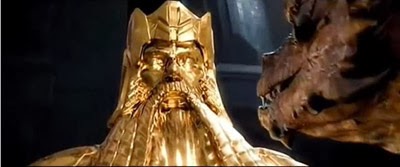
The whole giant-dissolving-molten-gold-dwarf-statue bit?


THAT still sucked ass.

*[A'maelamin: Elvish for "beloved"; in other words, "Darlin' get me rewrite!"]

Monday, December 30, 2013

There and Back Again, Again

Last year I - well, "reviewed", I suppose, is the right term - the first Peter Jackson installment of The Hobbit.


If you recall from that (and you probably don't; I think that post has been viewed something like eight times total...) I rather liked Jackson's version, noting that the one question I had was how he was handling the overall "tone" of the story. Here's what I said then:
"The one thing that did irk me a bit (as a writer, tho, rather than a parent) is that I don't think that Peter Jackson really has a handle on what "tone" he wants to set for this series.

Lord of the Rings is Middle Earth as drawn by Victor Hugo; stern, tragic, monumental - and Jackson got that perfectly; his flicks are ol' Prof. Tolkien's "yea, verily" language in film.

But The Hobbit is Middle Earth as drawn by A.A. Milne with a touch of Georges Feydeau; confiding, jolly, romping, and a trifle twee - a children's book written by an Oxford don in the arch style of the kid's books of his day.

They're very different."
With the second installment The Desolation of Smaug Jackson clearly thumps down on the "yea, verily" side of the question. There's no gray here; this is not The Hobbit. This is The Phantom Nazgul Menace, the prequel to the Lord of the Rings.


Now I'm not entirely opposed to that, OK?

I'm not some sort of Tolkien purist and I can enjoy these films as films, as one man's vision of Middle Earth, without feeling the need to bitch about every departure from the Canon. Because the Canon itself is far from perfect.

Lance Mannion - who wrote a fine review of this film - sums up some of the issues with The-Hobbit-as-written:
"The Hobbit was written for children but to be read by grownups who believe children need to be and want to be protected from life’s harsher realities.

The narrator’s jolly, confiding, chummy tone is meant to fool adults listening to themselves as they read out loud at bedtime that the story they’re telling won’t give the kids nightmares. They hear The Hobbit as a merry little fairy tale about a funny character with pointed ears, furry feet, and a pot-belly who goes on a treasure hunt and has some comical adventures along the way before coming home, safe and sound and rich, to live happily ever after in his snug little house in the ground in that cheerful and protected place with the comfortingly bucolic name the Shire and name that insists this is a place where nothing scary ever happens.

Children listening aren’t fooled. They know better.

The Hobbit is about what Terry Pratchett says all the old stories are about, sooner or later.

It’s about blood."
And y'know what?

That's fine. It's one artist's interpretation of another, and I can work with that. I can enjoy "Peter Jackson's The Hobbit" alongside J.R.R. Tolkien's The Hobbit. One is different from the other, but much as I enjoy Tolkien's work it's not without flaw (get me going on the whole pointlessness-of-the-entire-Tom-Bombadil-episode-in-The-Fellowship sometime...) or without the possibility of improvement by others' hands.

And while I was initially not particularly pleased with Jackson's treatment of the entire captive-of-the-Sylvan-elves segment and the inclusion of the character of Legolas in a story that seems well-off without him, Mannion makes some good points about that as not at all a bad emendation. I'll reserve judgement on that bit, then, until the final installment.

However.

A couple of Jackson's choices seemed a trifle ripe to me; several minor and one that seems to me to be a very large misunderstanding of both the story and its main character that, in turn, does significant damage to the story and Jackson's telling of it.

First, the small stuff:


Evangeline Lilly's Tauriel character and her budding romance with Aiden Turner's Kíli. Call me a cynic on this one. Lilly and Turner both do adequate work with their characters in this film, but unless Jackson plans to simply rewrite the casualty list from the Battle of Five Armies we already know where this one is heading; both these two might as well be showing their pictures of each other around to their pals in their respective squads, "Tauriel" being the Sylvan Elvish and "Kíli" the Dwarvish for "deadmeat".

Call me a curmudgeon, too. It kinda irks me that after the Eowyn-Faramir romance, one of my favorite bits of byplay from the Lord of the Rings, got cut out of Jackson's version he manufactures this hot-hot-hot-elf-on-dwarf romance out of whole cloth knowing that it's gonna end about as badly as any romance can.


The entire sequence between Smaug and Bilbo (and then Thorin & Co.) in Erebor. In the original Bilbo's conversations with Smaug are one of the better pieces of writing that Tolkien ever did, from Bilbo's slippery verbal fencing with the great wyrm to his discovery of the weakness in Smaug's armor (and subsequent role in the dragon's fall...) to the not-laughing-at-live-dragons as Bilbo dashes back up the secret passage. I was anticipating a terrific, ominous, creepy scene complete with the verbal talents of Martin Freeman's Bilbo and Benedict Cumberbatch's Smaug while the delightfully-scary CGI dragon looms over Bilbo and us.

Well, what I got was, frankly, a fucking mess.

Mannion had the same issue I had with the Smaug character. Instead of the dangerously cunning serpent - all the more dangerous for holding that immense power in check as he riddles with Bilbo - we got a standard-issue D&D dragon complete with standard-issue voice. The dangerously cunning serpent is reduced to a thug.

Meh.

But worse yet was the completely unnecessary extended chase-scene between the dragon and Thorin & Co that followed. That was a complete fucking clusterfuck, a Warner-Brothers-cartoon level piece of idiotic slapstick and action-movie thud-and-blunder culminating in perhaps the most moron-grade "special effect" I've ever seen - the dissolving-molten-gold-giant-dwarf-statue thing.

From beginning to end that entire bit was a disaster.

First, because as a sequence it was loud, incoherent, and useless. And, second, because it overwhelmed and undercut the earlier Bilbo-vs-Smaug scenes, poorly conceived as they were.

Bad, bad piece of filming; one of the worst I've seen from Jackson yet.

As for the remainder of the changes, well, like I said; I'm fine with the notion that this isn't "The Hobbit" but Peter Jackson's take on the original work. I wasn't pleased with what he did with the Beorn sequence, or the fight against the spiders in Mirkwood, but his version wasn't entirely discreditable to my mind and I can live with what he filmed. I would have done things a little differently, but I could tolerate his vision.

Same-same the orc-fight during the barrel escape from the Elvenking's halls; not what I would have done with the scene but not entirely unworkable.

But.

This episode of the film series introduces one theme that, I thought, was a complete misunderstanding of the entire Hobbit-LotR cycle and a big, big, mistake.


That's how Jackson treats Bilbo's relationship to The Ring.

Now this is not a universal opinion. For example, it seems from his review that Mannion actually likes Jackson's version a trifle better:
"We know Bilbo kept the ring. What we maybe didn't know or maybe only suspected or knew in our hearts but didn't want to believe is that Bilbo didn't make a mistake because he didn't know better. Jackson is showing us that Bilbo knew and kept the ring anyway.

Right away after he finds it in An Unexpected Journey, Bilbo senses there's something odd and disturbing about the ring. In The Desolation of Smaug it's dawning on him he needs to get rid of it. Since we already know he's not going to, we know that what's ahead in There and Back Again is Bilbo's moral failure. The hero-hobbit is going to fail to resist the temptation the hero-king Isildur failed to resist, the temptation the hero Boromir will fail to resist, the temptation Aragorn can only resist by letting Frodo continue to suffer on his and everyone else's behalf. With what he's doing with Bilbo, Jackson's effectively gone back in time to set up the need for the Fellowship and the need for its being Frodo who carries the ring.

This is what really makes The Desolation of Smaug more than a bridge between An Unexpected Journey and There and Back Again. It's the chapter in which the plot of The Lord of the Rings really gets underway."
But that's where Mannion and I disagree and what I see as Jackson's biggest screwup. I don't see that Bilbo keeps the ring because he's a hero, because (as Mannion says) the adventuresome Tookish side of him is coming out, and he's drawn to the sense of Power and Danger he feels from it.

I think he keeps the ring because he doesn't feel it.

It's the shrewd, hardheaded Took in him, the guy who finds that he thoroughly enjoys getting the better of other hobbits (and dwarves, elves, and dragons, come to that) by trickery.

Frodo as Ringbearer is Christ-with-his-cross; I agree - he is as Mannion describes him, a saint and martyr. He feels the power and dread of the Ring intensely and is ground down by it as he's drawn into it.

But I see Bilbo as Ringbearer as completely different. He's a bit of a wideboy, indeed, to him the Ring is nothing more than a nifty gimmick he uses to turn invisible to steal stuff. It's a burglar's tool to him, and he uses it as nothing more than a tool.

He spends the years between The Hobbit and the opening of The Fellowship of the Ring using it to duck local busybodies and prank his neighbors.

That's how he manages to stay free of the corruption of the Ring; he treats it like a shiny gold lockpick.

He's not a hero, not hungry for power. He's a retired wideboy, a former-burglar in slippers with his pipe, and his comfort, and his gold gimmick to play tricks and outdeal people. A tragic hero? A Boromir? An Isildur?

Not our Bilbo.


I understand why Jackson gives Bilbo a Frodo-esque frisson of horror in his handling of the Ring, why he shows us the Lidless Eye (And, incidentally, why he makes Smaug a sort of super-orc, a minion of the Dark Lord in this film, instead of just a big ol' dragon greedy for loot and furious with competition); he's using the theme of the One Ring to make The Hobbit into a genuine prequel to his LotR films.

But to my mind that diminishes The Hobbit.

And that's too bad. The Hobbit is a genuinely great story in its own right; a dark and bloody tale of adventure and war, of heroism and cowardice, of high intentions and low cunning, of vaunting ambitions and blind groping around in the dark.

I want Jackson to make that book into a movie; I want him to respect the story for its own worth, to do it justice on its own terms.

But by making the Ring in The Hobbit into what it will become in The Lord of the Rings, into the Great Matter that is the center of the greater story, he makes what is on its own a damn good little story smaller and lesser; in my opinion in this Jackson shows a lack of understanding, and lack of respect, for his own source material.


And that's a damn shame.