Last year I - well, "reviewed", I suppose, is the right term - the
first Peter Jackson installment of
The Hobbit.
If you recall from that (and you probably don't; I think that post has been viewed something like eight times total...) I rather liked Jackson's version, noting that the one question I had was how he was handling the overall "tone" of the story. Here's what I said then:
"The one thing that did irk me a bit (as a writer, tho, rather than a parent) is that I don't think that Peter Jackson really has a handle on what "tone" he wants to set for this series.
Lord of the Rings is Middle Earth as drawn by Victor Hugo; stern, tragic, monumental - and Jackson got that perfectly; his flicks are ol' Prof. Tolkien's "yea, verily" language in film.
But The Hobbit is Middle Earth as drawn by A.A. Milne with a touch of Georges Feydeau; confiding, jolly, romping, and a trifle twee - a children's book written by an Oxford don in the arch style of the kid's books of his day.
They're very different."
With the second installment The Desolation of Smaug Jackson clearly thumps down on the "yea, verily" side of the question. There's no gray here; this is not
The Hobbit. This is
The Phantom Nazgul Menace, the prequel to the
Lord of the Rings.
Now I'm not entirely opposed to that, OK?
I'm not some sort of Tolkien purist and I can enjoy these films as films, as one man's vision of Middle Earth, without feeling the need to bitch about every departure from the Canon. Because the Canon itself is far from perfect.
Lance Mannion - who wrote
a fine review of this film - sums up some of the issues with The-Hobbit-as-written:
"The Hobbit was written for children but to be read by grownups who believe children need to be and want to be protected from life’s harsher realities.
The narrator’s jolly, confiding, chummy tone is meant to fool adults listening to themselves as they read out loud at bedtime that the story they’re telling won’t give the kids nightmares. They hear The Hobbit as a merry little fairy tale about a funny character with pointed ears, furry feet, and a pot-belly who goes on a treasure hunt and has some comical adventures along the way before coming home, safe and sound and rich, to live happily ever after in his snug little house in the ground in that cheerful and protected place with the comfortingly bucolic name the Shire and name that insists this is a place where nothing scary ever happens.
Children listening aren’t fooled. They know better.
The Hobbit is about what Terry Pratchett says all the old stories are about, sooner or later.
It’s about blood."
And y'know what?
That's fine. It's one artist's interpretation of another, and I can work with that. I can enjoy
"Peter Jackson's The Hobbit" alongside J.R.R. Tolkien's
The Hobbit. One is different from the other, but much as I enjoy Tolkien's work it's not without flaw (get me going on the whole
pointlessness-of-the-entire-Tom-Bombadil-episode-in-The-Fellowship sometime...) or without the possibility of improvement by others' hands.
And while I was initially not particularly pleased with Jackson's treatment of the entire captive-of-the-Sylvan-elves segment and the inclusion of the character of Legolas in a story that seems well-off without him, Mannion makes some good points about that as not at all a bad emendation. I'll reserve judgement on that bit, then, until the final installment.
However.
A couple of Jackson's choices seemed a trifle ripe to me; several minor and one that seems to me to be a very large misunderstanding of both the story and its main character that, in turn, does significant damage to the story and Jackson's telling of it.
First, the small stuff:
Evangeline Lilly's Tauriel character and her budding romance with Aiden Turner's Kíli. Call me a cynic on this one. Lilly and Turner both do adequate work with their characters in this film, but unless Jackson plans to simply rewrite the casualty list from the Battle of Five Armies we already know where this one is heading; both these two might as well be showing their pictures of each other around to their pals in their respective squads, "Tauriel" being the Sylvan Elvish and "Kíli" the Dwarvish for "deadmeat".
Call me a curmudgeon, too. It kinda irks me that after the Eowyn-Faramir romance, one of my favorite bits of byplay from the
Lord of the Rings, got cut out of Jackson's version he manufactures this hot-hot-
hot-elf-on-dwarf romance out of whole cloth knowing that it's gonna end about as badly as any romance can.
The entire sequence between Smaug and Bilbo (and then Thorin & Co.) in Erebor. In the original Bilbo's conversations with Smaug are one of the better pieces of writing that Tolkien ever did, from Bilbo's slippery verbal fencing with the great wyrm to his discovery of the weakness in Smaug's armor (and subsequent role in the dragon's fall...) to the not-laughing-at-live-dragons as Bilbo dashes back up the secret passage. I was anticipating a terrific, ominous, creepy scene complete with the verbal talents of Martin Freeman's Bilbo and Benedict Cumberbatch's Smaug while the delightfully-scary CGI dragon looms over Bilbo and us.
Well, what I got was, frankly, a fucking mess.
Mannion had the same issue I had with the Smaug character. Instead of the dangerously cunning serpent - all the more dangerous for holding that immense power in check as he riddles with Bilbo - we got a standard-issue D&D dragon complete with standard-issue voice. The dangerously cunning serpent is reduced to a thug.
Meh.
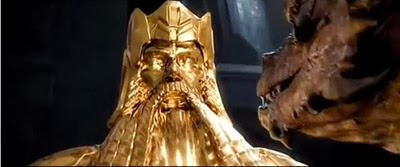
But worse yet was the completely unnecessary extended chase-scene between the dragon and Thorin & Co that followed. That was a complete fucking clusterfuck, a Warner-Brothers-cartoon level piece of idiotic slapstick and action-movie thud-and-blunder culminating in perhaps the most moron-grade "special effect" I've ever seen - the dissolving-molten-gold-giant-dwarf-statue thing.
From beginning to end that entire bit was a disaster.
First, because as a sequence it was loud, incoherent, and useless. And, second, because it overwhelmed and undercut the earlier Bilbo-vs-Smaug scenes, poorly conceived as they were.
Bad, bad piece of filming; one of the worst I've seen from Jackson yet.
As for the remainder of the changes, well, like I said; I'm fine with the notion that this isn't
"The Hobbit" but Peter Jackson's take on the original work. I wasn't pleased with what he did with the Beorn sequence, or the fight against the spiders in Mirkwood, but his version wasn't entirely discreditable to my mind and I can live with what he filmed. I would have done things a little differently, but I could tolerate his vision.
Same-same the orc-fight during the barrel escape from the Elvenking's halls; not what I would have done with the scene but not entirely unworkable.
But.
This episode of the film series introduces one theme that, I thought, was a
complete misunderstanding of the entire
Hobbit-LotR cycle and a big, big, mistake.
That's how Jackson treats Bilbo's relationship to The Ring.
Now this is not a universal opinion. For example, it seems from his review that Mannion actually likes Jackson's version a trifle better:
"We know Bilbo kept the ring. What we maybe didn't know or maybe only suspected or knew in our hearts but didn't want to believe is that Bilbo didn't make a mistake because he didn't know better. Jackson is showing us that Bilbo knew and kept the ring anyway.
Right away after he finds it in An Unexpected Journey, Bilbo senses there's something odd and disturbing about the ring. In The Desolation of Smaug it's dawning on him he needs to get rid of it. Since we already know he's not going to, we know that what's ahead in There and Back Again is Bilbo's moral failure. The hero-hobbit is going to fail to resist the temptation the hero-king Isildur failed to resist, the temptation the hero Boromir will fail to resist, the temptation Aragorn can only resist by letting Frodo continue to suffer on his and everyone else's behalf. With what he's doing with Bilbo, Jackson's effectively gone back in time to set up the need for the Fellowship and the need for its being Frodo who carries the ring.
This is what really makes The Desolation of Smaug more than a bridge between An Unexpected Journey and There and Back Again. It's the chapter in which the plot of The Lord of the Rings really gets underway."
But that's where Mannion and I disagree and what I see as Jackson's biggest screwup. I don't see that Bilbo keeps the ring because he's a hero, because (as Mannion says) the adventuresome Tookish side of him is coming out, and he's drawn to the sense of Power and Danger he feels from it.
I think he keeps the ring because he
doesn't feel it.
It's the shrewd, hardheaded Took in him, the guy who finds that he thoroughly enjoys getting the better of other hobbits (and dwarves, elves, and dragons, come to that) by trickery.
Frodo as Ringbearer is Christ-with-his-cross; I agree - he is as Mannion describes him, a saint and martyr. He feels the power and dread of the Ring intensely and is ground down by it as he's drawn into it.
But I see
Bilbo as Ringbearer as completely different. He's a bit of a wideboy, indeed, to him the Ring is nothing more than a nifty gimmick he uses to turn invisible to steal stuff. It's a burglar's tool to him, and he
uses it as nothing more than a tool.
He spends the years between
The Hobbit and the opening of
The Fellowship of the Ring using it to duck local busybodies and prank his neighbors.
That's how he manages to stay free of the corruption of the Ring; he treats it like a shiny gold lockpick.
He's not a hero, not hungry for power. He's a retired wideboy, a former-burglar in slippers with his pipe, and his comfort, and his gold gimmick to play tricks and outdeal people. A tragic hero? A Boromir? An Isildur?
Not our Bilbo.
I
understand why Jackson gives Bilbo a Frodo-esque frisson of horror in his handling of the Ring, why he shows us the Lidless Eye (And, incidentally, why he makes Smaug a sort of super-orc, a minion of the Dark Lord in this film, instead of just a big ol' dragon greedy for loot and furious with competition); he's using the theme of the One Ring to make
The Hobbit into a genuine prequel to his LotR films.
But to my mind that diminishes
The Hobbit.
And that's too bad.
The Hobbit is a genuinely great story in its own right; a dark and bloody tale of adventure and war, of heroism and cowardice, of high intentions and low cunning, of vaunting ambitions and blind groping around in the dark.
I want Jackson to make
that book into a movie; I want him to respect the story for its own worth, to do it justice on its own terms.
But by making the Ring in
The Hobbit into what it will become in
The Lord of the Rings, into the Great Matter that is the center of the greater story, he makes what is on its own a damn good little story smaller and lesser; in my opinion in this Jackson shows a lack of understanding, and lack of respect, for his own source material.
And that's a damn shame.