I'm jumping a bit ahead of myself here in the "Army Days" series, but I ran across this little cartoon and remembered the story that went with it and wanted to write the post before I forgot again.
OK, so last spring I left you where I had just flunked out of SF School (SFQC Phase 1, to be technical about it). I went from there to the Land of S.F. Medic Rejects; the 82nd Airborne Division.
I do want to post about my early days in Division, but that's a whole 'nother story for another time. And I've already posted SOME of those in the Sinai Stories series. But after I'd been at Bragg for some time I got levied to Panama to fill in the conversion of the sraight-leg 3/5th Infantry to an airborne infantry battalion (the 2nd Battalion of the 187th, if you must know). And I've posted some about that, too.
This post is about part of that time; one of our many deployments to Honduras where we were making scary faces at the commie Nicaraguans, the ones that invaded us in Red Dawn (the original, not the shitty remake with the Norks for bad guys).
One of the places we manned was this island in the middle of the Gulf of Fonseca, Tiger Island. We were just there to pull security for a bunch of NSA guys who were snooping on Danny Ortega's pillow talk.
It was boring as hell, and as medics the worst we had to do was pull a desultory sort of sick call (since there was no real duty to get out of other than pulling guard, which involved sitting on your ass for two hours) and burn out the barrels from the latrines.
In these Halliburtonized days of portapotties and contract cooks you may never have seen a "burnout latrine", but they are as simple as an indoor shitter can be and a big step up from the slit-trench shitholes you have to use when there's real shooting around.
What you do is build a simple plywood frame one-holer only with a trapdoor in the back that opens to a space under the seat. It's tall enough to slide half a 55-gallon drum into it, and that's what you do. That's your turd barrel.
What's critical is that Joe does NOT piss in the barrel but in the piss-tube outside. Urine in the turd barrel makes the turds wet, soggy, and hard to light.
Because that's how you dispose of that used GI chow; you burn it.
You pull the barrel full (or hopefully NOT full - if you're smart you do this every day to keep the volume down) of shit out and replace it with a "clean" one.
You drag the barrel away from the latrine, preferably to a bare spot where you won't catch anything on fire. You pour in a spicy mix of MOGAS and diesel (a blend of about 1:3 or 1:5 is preferred), light it, and then keep adding diesel until the shit burns down to a fine ash.
One hint, though; you've got to stir the turde flambe' as you saute' it because if you don't the more coherent bits, the tootsie roll-variety turd, if you will, just get kinda charred on the outside but retain a gooey center; that's not good, sanitarily speaking.
So you stand over the smoking shit barrel with a long piece of angle iron and stir. Then when the ashes cool you shake them into an empty C-rat case lined with a plastic bag. When the case is almost full you tape it shut and send it out on the supply 'Hook and it goes to the Magic Place where shit-ashes go (in other words I haven't the faintest idea what the hell the Army did with all those cardboard boxes of shit-ash; sold them to the Hondurans, probably, like we did every other fucked-up thing down there...).
And that was that.
The thing is, I didn't mind burning shit.
I didn't love it. Given the opportunity I'd rather have been eating a steak dinner or making love to a beautiful woman. But I was on Tiger Island, I was a medic, and so what I had was burning shit. So I did it.
It wasn't that noisome. The smell was not that much worse than burning diesel fuel, and I had gloves and a long steel pole. It wasn't like I had to roll the stuff up in cigarette papers and smoke it. Fuck it and drive on.
My partner, Doc Sullivan, though, HATED burning shit.
He hated the very idea of it. He hated the act itself, the aroma, the degrading nature of lighting fire to other people's wastes. He loathed every iota of the entire business and was not shy about telling me how he felt.
I don't remember what I said, but I suspect it was something like; "Whatever, deal with it. Christ, it ain't like you gotta EAT it. Ain't nothing but a thing."
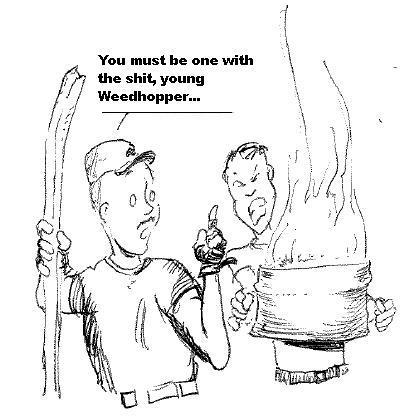
Sully hated my attitude, too. So he began this whole business about me being some sort of mystic sage of shit, a zen-master of crap. He decided that my name should be "Master Poo", from the old television series Kung Fu, and made all these bad jokes about the blind man and the shit barrel. I responded by doing bad Keye Luke impressions:
Doc Sully: I fear the smell of the shit is strong.
Doc Lawes: He who conquers himself is the greatest warrior. Do what must be done with a docile heart.
Doc Sully: What the fuck does that mean, Master?
Doc Lawes: Listen for the color of the sky. Look for the sound of the hummingbirds wings. Search the air for the perfume of the shit on a hot summer’s day. If you have found these things, you will know.
Doc Sully: That makes even less fucking sense that before. Bite me, Master, I don't like to smell the goddamn shit.
I also drew this little cartoon:
And between my humor and zen-like patience, and Sully's bitching, the shit got burned.
And though it was a long time ago and far away, the memory still drifts through my mind like the smoke from a barrel of burning shit.
Because, as Master Po would have said, the same tongue which screams, also laughs.
Showing posts with label war stories. Show all posts
Tuesday, January 08, 2013
Wednesday, November 21, 2012
Achtung - Häschen!
There are things about my mispent youth in the U.S. Army that sometimes lead me badly, badly astray.
My sense of humor is one of them.
For surely, no gently-reared human being should find "Peter Rabbit - Tank Killer" amusing.
For surely, combining the gentle anthromorphic bunny-and-kitten tropes of Beatrix Potter with the savage military nihilism of Sven Hassel would be the act of a brutally psychotic maniac.
And yet, there I was...
...laughing my maniac ass off at this stuff.
My sense of humor is one of them.
For surely, no gently-reared human being should find "Peter Rabbit - Tank Killer" amusing.
For surely, combining the gentle anthromorphic bunny-and-kitten tropes of Beatrix Potter with the savage military nihilism of Sven Hassel would be the act of a brutally psychotic maniac.
And yet, there I was...
...laughing my maniac ass off at this stuff.
(and here you thought I was going to say "...pinned down by a deadly hail of Jap fire.")But if I am a maniac I am also nothing if not a contrary maniac, and that's an entirely different war-story.
Wednesday, October 31, 2012
Battles Long Ago: Dargai Heights 1897
Dargai Heights Date: 20 OCT 1897
Forces Engaged: British Imperial
Five battalions of infantry: one, the 2nd Bn The Derbyshire Regiment of 1st Brigade, First Division, one, the 3rd Regiment Sikh Infantry (Punjab Field Force) of 2nd Brigade, First Division, and three; 1st Bn The Dorsetshire Regiment, 1st Bn, 2nd Gurkha Rifle Regiment, and 1st Bn Gordon Highlanders from 3rd Brigade, Second Division.
Each battalion probably at or near full strength of ten companies of 70 for a total of roughly 3,500 infantrymen.
Four batteries of mountain howitzers (No. 8 and No. 9 Mountain Battery, Royal Artillery, No. 1 (Kohat) Mountain Battery and No. 5 (Bombay) Mountain Battery) firing RML 2.5" Mountain Guns (often referred to by the British troops as "Screw Guns") I have had a difficult time establishing the MTO&E for these units. A typical battery appears to have six cannon, and each cannon appears to have had a crew of between six and eight; note the photograph below:
But the battery itself must have had at least another half-dozen or so troopers acting as ammunition numbers, extra crewmen, odds-and-sods, as well as at least a battery sergeant-major and an officer. So probably about 50-70 redlegs per battery for a force of 24 cannons and 200-250 artillerymen,
At least one source reports the presence of a machinegun detachment but does not identify the unit as such. By 1897 British (that is, Imperial) infantry battalions carried an MG detachment of 2 x 0.45 calibre Maxim machinegun and 20 troops on strength. However, in the order of battle for the Tirah Expedition among the Divisional Troops for Second Division is list a "Maxim Detachment, 16th Lancers", so this may have been the machinegun unit present at Dargai.
So roughly 3,500 infantry, 250 artillerymen, 24 cannon and two machineguns. The commander on the scene was MG A. G. Yeatman-Biggs, Second Division commander; the entire Tirah Expedition force was commanded by MG Sir William Lockhart, GCB KCSI, and isn't he a wonderful picture of late Victorian generality;
Orakzai (اورکزی) and Afridi (اپريدي) Tribal Forces
An undetermined number of Afghan tribal warriors drawn from the two tribes then fighting the British Indian forces. The most likely composition of the defending forces, however, was from one or more of the Orakzai clans, since that tribe then controlled the high ground in the Tirah area. Several sources mention Afridis, and Afghans being Afghans it's hard to believe that with killing in the offing that the eager young men of the tribe could have been held back.
The numbers of defenders are usually simply described as "hundreds" to "thousands". The British attackers, who ended up in control of the Heights, probably had no real idea how many Afghans they were fighting; the tribesmen, no fools they, ran off when it became obvious that the mad invaders weren't going to stop coming on.
But there must have been at least several hundred; anything less than that wouldn't have been able to produce a sufficient volume of fire to have had the effects as described on the attackers.
While as many as 10-12,000 fighters manned the crest of the heights altogether the area of the British assault appears to be a fairly small area - indeed, a single narrow path; more an a couple of thousand guys would have been tumbling out of their sangars like ripe fruit off a plum tree; the British wouldn't have been able to leave their start line without being riddled like Swiss cheese.
So the force actively defending the path up the heights on 20 OCT probably numbered somewhere between 1,000 and 2,500. We have no idea who the "commanders" were; in typical tribal fashion the guys probably coalesced in lashkars around a local hardcase, a religious leader, or a cunning planner in little knots of five to fifty.
A Note On Armaments: At Dargai the British and Indian troopers were armed with issue rifles; the British with the relatively new .303 Lee-Metford bolt action rifle (shown above), the Indian troops with the older Martini-Henry lever-action breechloader.
Many of the Afghans must have been armed with the traditional jezail, the long rifled musket of the high hills around the Durand Line. But one of the nastiest shocks of Dargai, and the Tirah campaign as a whole, was the presence on the battlefield of modern rifles in Afghan hands.
The combination of the Afghan hillman and the modern rifle was a deadly natural. The British found that wog-bashing in 1897 wasn't nearly as much fun as it had been earlier now that the bashees had their hands on modern weaponry.
After the Tirah Expedition concluded the surprise and displeasure at the lack of fun to be had in the Kurrum Valley is evident in the plaintive tone of Queen Victoria's letter to her Viceroy of India: "As we did not wish to retain any part of the country, is the continuation and indefinite prolongation of these punitive expeditions really justifiable at the cost of many valuable lives?"
Sadly, this simple lesson had to be relearned over and over again.
The Sources: Military actions taken by literate industrial nations tend to be well documented, and Dargai is no exception. Written accounts of the actions of the Tirah Expedition and its Afghan opponents appeared almost before the rigor passed off the dead guys; one of the most complete is found here: The Campaign In Tirah 1897-1898 An Account Of The Expedition Against The Orakzais And Afridis Under General Sir William Lockhart, G.C.B., K.C.S.I. based (by permission) on letters contributed to "The Times", written by one COL H. D. Hutchinson in 1898.
Other contemporary British sources include The Indian frontier war being an account of the Mohmund and Tirah expeditions, 1897 (James, L. 1898) and Lockhart's Advance Through Tirah (Shadwell, L.J. 1898)
Secondary accounts include The 1897 Revolt and Tirah Valley Operations from the Pashtun Perspective (Johnson R.A. 2009), an invaluable view from the "other side of the hill", unusual in colonial war, and Michael Barthorp's 1996 The Frontier Ablaze: The North-West Frontier Rising, 1897-98.
Byron Farwell's 1985 Queen Victoria's Little Wars tells the old savage-and-soldier tales with gusto, while perhaps the most entertaining version of the engagement is told in George McDonald Fraser's little story "The Whisky and the Music" told in The General Danced At Dawn, his volume of tales about his times in the Gordons.
More of that later. First, the fighting.
The Campaign: I can't really do a better job of explaining why 60-some thousand British and Indian troops set off into the highlands around the Khyber Pass in the autumn of 1897 that Rob Johnson can, so, here:
So while this was a big one, it was not a new one, or even a really surprising one other than it's size.
The actual fighting of the 1897 "rising" began on 10 JUN, with an ambush of a smal force near Maizar. During this engagement something occurred of the sort of ridiculous criticality that distinguished truth from fiction; fiction would never be this incredible. I'll let Johnson (2009) describe it again:
The rising exploded, and in August all the forts along the Khyber Pass fell, lending immense prestige, as well as lots of modern weapons and ammunition, to the Afridi tribesmen who pulled off that raid. Many of the Orakzai and Afridi clans rushed to join up, either with view of a full-scale victory over the infidels or just hopes of a bit of plunder on the side.
But it's important to see that the tribes weren't just mooks looking for loot. There was an actual plan. The Afridis wanted to push the Brits out of the Khyber Pass and Tirah Valley region, while the Orakzais wanted to drive the British off the Samana Ridge that was the key to their territory.The Khyber plan worked, but the attacks on Samana weren't as successful. One fort, at Sarigari, did fall, but British reinforcements and, as or more importantly, their artillery held the Samana.
The tribes also hoped for support from Kabul, but the Amir Rahman Khan, while offering some rousing anti-British orations to the tribal delegations, did nothing but talk.
His tepid response was designed to prevent looking like a foreign stooge (always dangerous for an Afghan ruler) while finding a pretext for doing nothing. Eventually he "...admonished the tribesmen and ordered them to settle their differences with the British, claiming he had made agreements he could not break...(and that) the tribes had not informed him of their intentions
before the outbreak of violence." (Johnson, 2009)
Although the Amir refused active support he did not prevent the tribes from using eastern Afghanistan to maneuver in and retreat to.
While the Afghan troopers knew the Brits would come at them - they always had before - the real question was how. The Khyber Pass was a high-prestige target and would undoubtedly be attacked, but how would the British approach the home territories of the tribes in arms?
They could attack due west from Kohat along the Khanki Valley.
Or they could strike north up the Mastura River from Peshawar.
But there was another problem; the late summer was upon them, and men had to go home to bring in the harvest. Crops wouldn't wait for the damn Brits. Many of the Afghans left...and for two months the British didn't come.
What the Afghans couldn't know is that the British WERE on their way but were having the devil's own time with logistics. To carry the bag and baggage the British concluded they'd need a baggage animal for every six white troops, every eight native troopers, and every ten camp-followers; something like 20,000 horses and mules and 15,000 camels. Shadwell (1898) has some delightful details on the allocation of pack animals to the force on pages 113 and 114; general officers got a pack mule and a pony, in case you were wondering.
But finally the first Indian pioneers - what we'd call combat engineers - turned up near the Shinwari fort south of the Samana Ridge in October gave the game away; the British were coming, horse, foot and artillery.
At this the tribes convened a jirga in the cillage of Bagh where the leading lights roared for war and jihad against the infidel. That didn't stop a mob from the Orakzai out of Kanki Valley to try and surrender to MG Yeatman Biggs. The general told them that he couldn't take their submission while their buddies were still out looting and raping, so (presumably with heavy hearts) that went back to join the revolt.
The road up from Samana Ridge was overlooked by high ground to the north; the Dargai Heights.
Johnson (2009) quotes "one British officer" (in this case, Callwell 1911) saying that "the natural defile at Dargai not only made a defensive stance far easier, it also afforded ‘excellent cover, naturally provided by the rocks and improved by walls, etc, built up by [the tribesmen]’. Shadwell (1898) gives an even more vivid description:
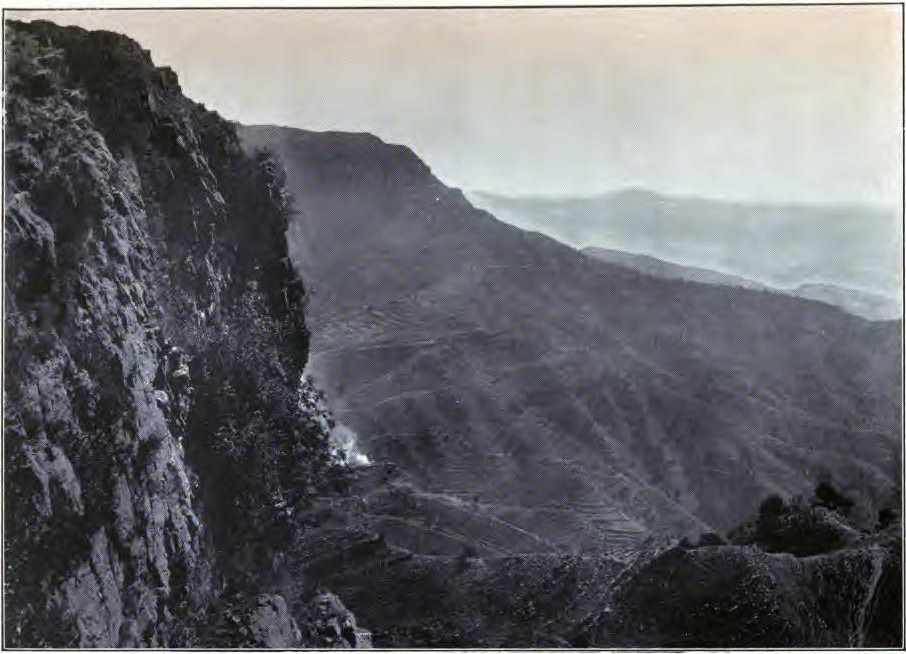
He describes the photo above, noting that "The narrow ridge at the right-hand bottom corner is the saddle over which the rush had to be made on the 18th and 20th..."
Connecting the crest of the spur...and the foot of the cliff there is a narrow neck or saddle one hundred yards long by thirty broad...devoid of all cover and completely exposed to the heights above, this ridge had to be crossed to reach the path ascending to the summit..."
On 18 OCT a force from the Second Division assaulted the heights; the movements of the British troops are in blue on the map above.
The 4th Brigade attacked from the village of Chagru Kotal while the 3rd Brigade swung around to the west. Afghan resistance was light, and the attackers easily took the crest of the ridge, the Afghan defenders falling back before them.
At this time GEN Lockhart made what has to be considered a mistake; he withdrew the force from the heights. In his tame reporter's letter to the London Times he says that the force was too isolated and unsupportable as well as difficult to supply.
All of that may have been true. We have no idea what would have happened if the British had tried to hold the heights.
But the problems that would come of the decision to withdraw were immediate and should have been evident before the last soldier came down off the hills.
The firing of the day's engagement had drawn a crowd; Shadwell (1898) says about 8,000 mixed Afridis and Orakzais were arriving from the nearby Khanki Valley as well as the original defenders of Dargai village returning to snipe at the invaders.
On the way downhill the British force suffered worse than in the attack from this converging force; finally dark and the artillery halted the Afghan pursuit but the Second Division lost 10 dead and 53 wounded in the operation for no tangible gain.
And, then, worse.
Late the following day (19 OCT) MG Yeatman-Biggs sent his commander a telegram from his position at Shinawari. He reported a "large gathering of tribesmen was visible on the Dargai position, and...proposed moving on Karappa, via Gulistan Fort, instead of down the Chagru defile." (Shadwell, 1898).
This move would have effectively turned the Dargai position, but GEN Lockhart "ordered the original route to be adhered to, remarking that, while it would probably be necessary to clear the enemy off the Dargai heights, they would very likely retire, to prevent their line of retreat from being threatened..." (Shadwell, 1898)
MG Yeatman-Biggs shook out his force to recapture the heights of Dargai.
The Engagement: Note - There are several sources for the attack on 20 OCT but the following account is primarily from Shadwell (1898) supplemented by Johnson (2009) for observations from the Afghan side.
The British attack force was organized in three waves. The first unit to assault was the 1/2 Gurkhas, the second "wave" the Dorsets, with the Derbyshire Regiment third. The Gordons were originally tasked with supporting fire.The defense was spread all along the crest and military crest of the Dargai ridge. Shadwell (1898) notes that the defenders didn't make the same mistake as on 18 OCT; the defensive perimeter extended well to the west, where MG Kempster's flanking attack had climbed the cliffs. In the Shadwell account this is supposed to have been due to a cunning ploy by the Second Division intel officer - or "political officer" as they were called at the time - who fed the tribes a false plan, but there is no way to be sure that this was not merely a tactical adjustment to the British attack of the 18th.
Artillery prep began at 1000 hours. The Gurkha attack went forward soon after - Shadwell (1898) is not specific about the time, and the assault appears to have been effectively halted by fire along the saddle or at the base of the steep cliff within a short time of leaving the line of departure.
"Many a brave little Ghoorka bit the dust" is how Shadwell puts it.
Really. No shit. That's what he wrote.
Apparently some time soon after the two British units attempted to reinforce the Gurkha battalion. Both were shot to pieces as they tried to rush the saddle. Most of the British troops were killed in the open space. Neither unit, nor the Gurkha Rifles, could manage to advance up the steep path to the crest.
Johnson (2009) describes it thusly: "As they tried to cross in small groups ‘each clump of men that dashed forward melted away under the converging and accurate fire, and after a time affairs practically came to standstill’. The Gurkhas were pinned down for three hours and 2 other British regiments fared little better."
At some time in the early afternoon - probably about 1500 - BG Kempster was tasked to bring up the division reserves; the Gordons and the 3rd Sikhs. These units were "shot across" the open saddle by an artillery mad minute in which all 24 cannons fired a three-minute rapid fire.
The Gordons and Sikhs managed to make the base of the cliff in a body, probably picking up odd lots of Gurkhas and British soldiers along the way. From there it must have been a mad scramble up the steep path into a nasty rain of rifle fire.
One of the Gordons pipers, a man named Findlater, was shot through both legs at the ankles on the way up. He hauled himself onto a rock and continued playing as his fellow tribesmen attacked. His was the sort of bizarre gallantry that transfixed Victorian audiences; he got a sort of nursery rhyme from the kiddies of Glasgow out of it:
"Piper Findlater, Piper Findlater,
Piped "The Cock 'o the North".
He piped it so loud,
He gathered a crowd,
And won the Victoria Cross."
And so he did, although just to remind us that life isn't like the stories we like to tell about it, he later remarked;
The final rush carried the crest, again the Afghan defenders retired in good order, and the 1/2 Gurkhas and Dorsetshire Regiment were posted to hold the crest while the rest of the attack force sloped off back down to the valley below to police up the dead and wounded and reorganize for the move forward.
A total of 37 attacking infantrymen were killed, with the point element suffering the worst; 1/2 Gurkhas lost 18 officers and men. Another 156 British troops were wounded. The Afghan losses were not counted, but the defenders managed to remove all their dead and wounded before the attack force seized its objective. "Many bloodstains were found on the ground..." is all Shadwell (1898) can come up with, remarking that the women and children commonly dragged off both wounded and killed.
Johnson (2009) sums up the Afghan tactical moves and their effects:
The Tirah Expedition continued on to the northeast the following day.
The Outcome: British tactical victory
The Impact: Minimal. The fiasco at Dargai didn't put a real dent in the Afghan resistance, and the British had other problems to worry about soon. As other military forces in the high hills around the Durand Line have discovered, it is usually the support elements that find it hard to cope with the Afghan and his mountains.
Constant and deadly harassment of supply and transport columns continued. Some of the more notable of these deadly little assaults included:
9 NOV 1897 Elements of the Northampton Regiment separated from supporting units and ambushed while burning some villages around Saran Sar. 20 killed, 48 wounded.
22 NOV 1897 One company Dorsets, one company Sikhs (unit unknown) ambushed while searching for troopers lost in contact. 29 killed, 44 wounded.
19 JAN 1898 36th Sikhs and the King's Own Yorkshire Light Infantry (KOYLI) ambushed while patrolling out of Mamanai. 32 killed, 37 wounded; some of the badly wounded are left behind when the KOYLI retreats and are mutilated.
Now you notice the little item about what happened on 9 NOV?
"Burning villages"?
Yep.
The Brits didn't play that "hearts and minds" bullshit. The way they saw it, counterinsurgency was all about grabbing the insurgents by the balls and twisting those rascals until the rapscallions begged for mercy.
So the primary "job" of the soldiers in the Tirah Expedition, like pretty much every other "column" the British sent into the tribal areas, wasn't fighting tribesmen.
It was burning people's homes and crops. It was throwing stones into their wells to make them useless, it was lifting their cattle, sheep, and goats, it was doing just what the U.S. Army did to the Sioux, and the Cheyenne, the Seminoles, and the Creeks.
It was killing their men, and turning their women and children out in the wilderness to starve.
And it worked; it usually does. Eventually British logistical and numerical strength overwhelmed the tribesmen. In June 1898 negotiation resulted in a payment of 800 rifles and 50,000 rupees from the Afridi. The tribe also committed to dealing only with the Raj, and leaving road- and railway construction unmolested.
A new unit, the Khyber Rifles, was formed to replace the Afridi levies that had guarded the Khyber Pass. The troopers were Afridi but the officers were British, and there would be no more question of who were the Kings of the Khyber.
The British agreed to pay the tribal leaders stipends to keep the agreement, and the peace.
As you probably know, that peace has been most notable by its absence from that day to this.
But in the short term both sides seemed to get what they wanted.
Britain had a brisk little fight that ended in the restoration of British power over the hills around Dargai. The Northwest Frontier was secure for another several years from the threat of Afghan tribesmen working with the Russian Bear. British "honor" had been satisfied, and the truculent tribes "punished" for their fractious behavior. The troops has performed well, even if their leaders had made several critical blunders on the battlefield itself (such as at Dargai) and had, overall, failed to understand and adjust to the new tactical conditions they faced in the Orakzai hills.
The tribes also had reason to be pleased. Johnson (2009) notes that:
The tribes of the high hills then passed into the portfolio of the new government of Pakistan, where they have remained a tumult and a shouting to this very day.
In Dorchester in the county of Dorset the monument to the dead men of Dargai goes largely unvisited and unremarked in the Borough Gardens, the names of the troopers killed on that chilly October day slowly fading from the stone.
The Gordon Highlanders ceased to be in 1994, forced into amalgamation with the other two remaining Highland regiments to form "the Highland Regiment". Currently the 4th Battalion of the Royal Regiment of Scotland preserves what remains of the lineage and battle honors of the old 92nd Regiment of Foot; "Ninety-twa, no' deid yet".
On 8 NOV 2006 a suicide bomber - probably related to one of the Tarkani Pashtuns killed in an aerial attack on Bajaur nine days earlier - killed 42 Pakistani soldiers in the village of Dargai.
Forces Engaged: British Imperial
Five battalions of infantry: one, the 2nd Bn The Derbyshire Regiment of 1st Brigade, First Division, one, the 3rd Regiment Sikh Infantry (Punjab Field Force) of 2nd Brigade, First Division, and three; 1st Bn The Dorsetshire Regiment, 1st Bn, 2nd Gurkha Rifle Regiment, and 1st Bn Gordon Highlanders from 3rd Brigade, Second Division.
Each battalion probably at or near full strength of ten companies of 70 for a total of roughly 3,500 infantrymen.
Four batteries of mountain howitzers (No. 8 and No. 9 Mountain Battery, Royal Artillery, No. 1 (Kohat) Mountain Battery and No. 5 (Bombay) Mountain Battery) firing RML 2.5" Mountain Guns (often referred to by the British troops as "Screw Guns") I have had a difficult time establishing the MTO&E for these units. A typical battery appears to have six cannon, and each cannon appears to have had a crew of between six and eight; note the photograph below:
But the battery itself must have had at least another half-dozen or so troopers acting as ammunition numbers, extra crewmen, odds-and-sods, as well as at least a battery sergeant-major and an officer. So probably about 50-70 redlegs per battery for a force of 24 cannons and 200-250 artillerymen,
At least one source reports the presence of a machinegun detachment but does not identify the unit as such. By 1897 British (that is, Imperial) infantry battalions carried an MG detachment of 2 x 0.45 calibre Maxim machinegun and 20 troops on strength. However, in the order of battle for the Tirah Expedition among the Divisional Troops for Second Division is list a "Maxim Detachment, 16th Lancers", so this may have been the machinegun unit present at Dargai.
So roughly 3,500 infantry, 250 artillerymen, 24 cannon and two machineguns. The commander on the scene was MG A. G. Yeatman-Biggs, Second Division commander; the entire Tirah Expedition force was commanded by MG Sir William Lockhart, GCB KCSI, and isn't he a wonderful picture of late Victorian generality;
Orakzai (اورکزی) and Afridi (اپريدي) Tribal Forces
An undetermined number of Afghan tribal warriors drawn from the two tribes then fighting the British Indian forces. The most likely composition of the defending forces, however, was from one or more of the Orakzai clans, since that tribe then controlled the high ground in the Tirah area. Several sources mention Afridis, and Afghans being Afghans it's hard to believe that with killing in the offing that the eager young men of the tribe could have been held back.
The numbers of defenders are usually simply described as "hundreds" to "thousands". The British attackers, who ended up in control of the Heights, probably had no real idea how many Afghans they were fighting; the tribesmen, no fools they, ran off when it became obvious that the mad invaders weren't going to stop coming on.
But there must have been at least several hundred; anything less than that wouldn't have been able to produce a sufficient volume of fire to have had the effects as described on the attackers.
While as many as 10-12,000 fighters manned the crest of the heights altogether the area of the British assault appears to be a fairly small area - indeed, a single narrow path; more an a couple of thousand guys would have been tumbling out of their sangars like ripe fruit off a plum tree; the British wouldn't have been able to leave their start line without being riddled like Swiss cheese.
So the force actively defending the path up the heights on 20 OCT probably numbered somewhere between 1,000 and 2,500. We have no idea who the "commanders" were; in typical tribal fashion the guys probably coalesced in lashkars around a local hardcase, a religious leader, or a cunning planner in little knots of five to fifty.
A Note On Armaments: At Dargai the British and Indian troopers were armed with issue rifles; the British with the relatively new .303 Lee-Metford bolt action rifle (shown above), the Indian troops with the older Martini-Henry lever-action breechloader.
Many of the Afghans must have been armed with the traditional jezail, the long rifled musket of the high hills around the Durand Line. But one of the nastiest shocks of Dargai, and the Tirah campaign as a whole, was the presence on the battlefield of modern rifles in Afghan hands.
The combination of the Afghan hillman and the modern rifle was a deadly natural. The British found that wog-bashing in 1897 wasn't nearly as much fun as it had been earlier now that the bashees had their hands on modern weaponry.
After the Tirah Expedition concluded the surprise and displeasure at the lack of fun to be had in the Kurrum Valley is evident in the plaintive tone of Queen Victoria's letter to her Viceroy of India: "As we did not wish to retain any part of the country, is the continuation and indefinite prolongation of these punitive expeditions really justifiable at the cost of many valuable lives?"
Sadly, this simple lesson had to be relearned over and over again.
The Sources: Military actions taken by literate industrial nations tend to be well documented, and Dargai is no exception. Written accounts of the actions of the Tirah Expedition and its Afghan opponents appeared almost before the rigor passed off the dead guys; one of the most complete is found here: The Campaign In Tirah 1897-1898 An Account Of The Expedition Against The Orakzais And Afridis Under General Sir William Lockhart, G.C.B., K.C.S.I. based (by permission) on letters contributed to "The Times", written by one COL H. D. Hutchinson in 1898.
Other contemporary British sources include The Indian frontier war being an account of the Mohmund and Tirah expeditions, 1897 (James, L. 1898) and Lockhart's Advance Through Tirah (Shadwell, L.J. 1898)
Secondary accounts include The 1897 Revolt and Tirah Valley Operations from the Pashtun Perspective (Johnson R.A. 2009), an invaluable view from the "other side of the hill", unusual in colonial war, and Michael Barthorp's 1996 The Frontier Ablaze: The North-West Frontier Rising, 1897-98.
Byron Farwell's 1985 Queen Victoria's Little Wars tells the old savage-and-soldier tales with gusto, while perhaps the most entertaining version of the engagement is told in George McDonald Fraser's little story "The Whisky and the Music" told in The General Danced At Dawn, his volume of tales about his times in the Gordons.
More of that later. First, the fighting.
The Campaign: I can't really do a better job of explaining why 60-some thousand British and Indian troops set off into the highlands around the Khyber Pass in the autumn of 1897 that Rob Johnson can, so, here:
"The largest and most serious outbreak of fighting on the North West Frontier during the colonial era was the Pathan Uprising of 1897-8. The revolt was actually a series of local insurrections involving over 200,000 fighters, including Afghan volunteers, and it required over 59,000 regular troops and 4,000 Imperial Service Troops to deal with it; the largest deployment in India since the Mutiny-Rebellion of 1857-8. Its outbreak proved such an unexpected and significant shock to the British that they conducted detailed enquiries after the event.
Various explanations were offered but it is generally accepted that recent encroachments into tribal territory, with fears that the British meant to permanently occupy the region as a prelude to the destruction of their independence and way of life, led to the initial fighting. There were other contributory factors: a perception that the Amir of Afghanistan, Abdur Rahman Khan, would support an anti-British Jihad; rumours that the Christian Greeks had been defeated by the Muslim Turks and that the Christian world was finally in retreat, and local anxieties about women, money-lenders and road-building."But the money was always on the British and the Afghans to fight. They both loved to fight, and they both wanted the other to get the fuck out of their crib. I used Farwell's book to dredge up a list of Afghan Wars for this post over at MilPub back in March of last year. Turns out that there was about one "expedition" or "column" or "punitive action" or "field force" every year or so beginning in the 1830s and running well into the 20th Century; the Third Afghan War was fought in 1919!
So while this was a big one, it was not a new one, or even a really surprising one other than it's size.
The actual fighting of the 1897 "rising" began on 10 JUN, with an ambush of a smal force near Maizar. During this engagement something occurred of the sort of ridiculous criticality that distinguished truth from fiction; fiction would never be this incredible. I'll let Johnson (2009) describe it again:
"The British artillery soon ran out of ammunition in the engagement and was forced to use blank rounds in the hope that this would deter a pursuit. Ironically, this fulfilled a prediction by the more enthusiastic mullahs: they had assured the tribesmen that the British shells would turn to stone and their bullets would turn to water the moment they hit the breast of a true believer. They demanded a Jihad to save the religion and condemned those they appeared to be profiting by association with infidels."
The rising exploded, and in August all the forts along the Khyber Pass fell, lending immense prestige, as well as lots of modern weapons and ammunition, to the Afridi tribesmen who pulled off that raid. Many of the Orakzai and Afridi clans rushed to join up, either with view of a full-scale victory over the infidels or just hopes of a bit of plunder on the side.
But it's important to see that the tribes weren't just mooks looking for loot. There was an actual plan. The Afridis wanted to push the Brits out of the Khyber Pass and Tirah Valley region, while the Orakzais wanted to drive the British off the Samana Ridge that was the key to their territory.The Khyber plan worked, but the attacks on Samana weren't as successful. One fort, at Sarigari, did fall, but British reinforcements and, as or more importantly, their artillery held the Samana.
The tribes also hoped for support from Kabul, but the Amir Rahman Khan, while offering some rousing anti-British orations to the tribal delegations, did nothing but talk.
His tepid response was designed to prevent looking like a foreign stooge (always dangerous for an Afghan ruler) while finding a pretext for doing nothing. Eventually he "...admonished the tribesmen and ordered them to settle their differences with the British, claiming he had made agreements he could not break...(and that) the tribes had not informed him of their intentions
before the outbreak of violence." (Johnson, 2009)
Although the Amir refused active support he did not prevent the tribes from using eastern Afghanistan to maneuver in and retreat to.
While the Afghan troopers knew the Brits would come at them - they always had before - the real question was how. The Khyber Pass was a high-prestige target and would undoubtedly be attacked, but how would the British approach the home territories of the tribes in arms?
They could attack due west from Kohat along the Khanki Valley.
Or they could strike north up the Mastura River from Peshawar.
But there was another problem; the late summer was upon them, and men had to go home to bring in the harvest. Crops wouldn't wait for the damn Brits. Many of the Afghans left...and for two months the British didn't come.
What the Afghans couldn't know is that the British WERE on their way but were having the devil's own time with logistics. To carry the bag and baggage the British concluded they'd need a baggage animal for every six white troops, every eight native troopers, and every ten camp-followers; something like 20,000 horses and mules and 15,000 camels. Shadwell (1898) has some delightful details on the allocation of pack animals to the force on pages 113 and 114; general officers got a pack mule and a pony, in case you were wondering.
But finally the first Indian pioneers - what we'd call combat engineers - turned up near the Shinwari fort south of the Samana Ridge in October gave the game away; the British were coming, horse, foot and artillery.
At this the tribes convened a jirga in the cillage of Bagh where the leading lights roared for war and jihad against the infidel. That didn't stop a mob from the Orakzai out of Kanki Valley to try and surrender to MG Yeatman Biggs. The general told them that he couldn't take their submission while their buddies were still out looting and raping, so (presumably with heavy hearts) that went back to join the revolt.
The road up from Samana Ridge was overlooked by high ground to the north; the Dargai Heights.
Johnson (2009) quotes "one British officer" (in this case, Callwell 1911) saying that "the natural defile at Dargai not only made a defensive stance far easier, it also afforded ‘excellent cover, naturally provided by the rocks and improved by walls, etc, built up by [the tribesmen]’. Shadwell (1898) gives an even more vivid description:
"The village of Dargai lies on the northern side of a small plateau. The eastern edge of this table-land breaks off, at first, in an almost abrupt cliff...but...lower down...shelves away less precipitously. This slope is thrown out from the bottom of the cliff in the form of a narrow and razor-like spur, with the path or track lying along its northern side, well within...range of the cliff-head."The picture from Shadwell's book is shown below.
He describes the photo above, noting that "The narrow ridge at the right-hand bottom corner is the saddle over which the rush had to be made on the 18th and 20th..."
Connecting the crest of the spur...and the foot of the cliff there is a narrow neck or saddle one hundred yards long by thirty broad...devoid of all cover and completely exposed to the heights above, this ridge had to be crossed to reach the path ascending to the summit..."
On 18 OCT a force from the Second Division assaulted the heights; the movements of the British troops are in blue on the map above.
The 4th Brigade attacked from the village of Chagru Kotal while the 3rd Brigade swung around to the west. Afghan resistance was light, and the attackers easily took the crest of the ridge, the Afghan defenders falling back before them.
At this time GEN Lockhart made what has to be considered a mistake; he withdrew the force from the heights. In his tame reporter's letter to the London Times he says that the force was too isolated and unsupportable as well as difficult to supply.
All of that may have been true. We have no idea what would have happened if the British had tried to hold the heights.
But the problems that would come of the decision to withdraw were immediate and should have been evident before the last soldier came down off the hills.
The firing of the day's engagement had drawn a crowd; Shadwell (1898) says about 8,000 mixed Afridis and Orakzais were arriving from the nearby Khanki Valley as well as the original defenders of Dargai village returning to snipe at the invaders.
On the way downhill the British force suffered worse than in the attack from this converging force; finally dark and the artillery halted the Afghan pursuit but the Second Division lost 10 dead and 53 wounded in the operation for no tangible gain.
And, then, worse.
Late the following day (19 OCT) MG Yeatman-Biggs sent his commander a telegram from his position at Shinawari. He reported a "large gathering of tribesmen was visible on the Dargai position, and...proposed moving on Karappa, via Gulistan Fort, instead of down the Chagru defile." (Shadwell, 1898).
This move would have effectively turned the Dargai position, but GEN Lockhart "ordered the original route to be adhered to, remarking that, while it would probably be necessary to clear the enemy off the Dargai heights, they would very likely retire, to prevent their line of retreat from being threatened..." (Shadwell, 1898)
MG Yeatman-Biggs shook out his force to recapture the heights of Dargai.
The Engagement: Note - There are several sources for the attack on 20 OCT but the following account is primarily from Shadwell (1898) supplemented by Johnson (2009) for observations from the Afghan side.
The British attack force was organized in three waves. The first unit to assault was the 1/2 Gurkhas, the second "wave" the Dorsets, with the Derbyshire Regiment third. The Gordons were originally tasked with supporting fire.The defense was spread all along the crest and military crest of the Dargai ridge. Shadwell (1898) notes that the defenders didn't make the same mistake as on 18 OCT; the defensive perimeter extended well to the west, where MG Kempster's flanking attack had climbed the cliffs. In the Shadwell account this is supposed to have been due to a cunning ploy by the Second Division intel officer - or "political officer" as they were called at the time - who fed the tribes a false plan, but there is no way to be sure that this was not merely a tactical adjustment to the British attack of the 18th.
Artillery prep began at 1000 hours. The Gurkha attack went forward soon after - Shadwell (1898) is not specific about the time, and the assault appears to have been effectively halted by fire along the saddle or at the base of the steep cliff within a short time of leaving the line of departure.
"Many a brave little Ghoorka bit the dust" is how Shadwell puts it.
Really. No shit. That's what he wrote.
Apparently some time soon after the two British units attempted to reinforce the Gurkha battalion. Both were shot to pieces as they tried to rush the saddle. Most of the British troops were killed in the open space. Neither unit, nor the Gurkha Rifles, could manage to advance up the steep path to the crest.
Johnson (2009) describes it thusly: "As they tried to cross in small groups ‘each clump of men that dashed forward melted away under the converging and accurate fire, and after a time affairs practically came to standstill’. The Gurkhas were pinned down for three hours and 2 other British regiments fared little better."
At some time in the early afternoon - probably about 1500 - BG Kempster was tasked to bring up the division reserves; the Gordons and the 3rd Sikhs. These units were "shot across" the open saddle by an artillery mad minute in which all 24 cannons fired a three-minute rapid fire.
The Gordons and Sikhs managed to make the base of the cliff in a body, probably picking up odd lots of Gurkhas and British soldiers along the way. From there it must have been a mad scramble up the steep path into a nasty rain of rifle fire.
One of the Gordons pipers, a man named Findlater, was shot through both legs at the ankles on the way up. He hauled himself onto a rock and continued playing as his fellow tribesmen attacked. His was the sort of bizarre gallantry that transfixed Victorian audiences; he got a sort of nursery rhyme from the kiddies of Glasgow out of it:
"Piper Findlater, Piper Findlater,
Piped "The Cock 'o the North".
He piped it so loud,
He gathered a crowd,
And won the Victoria Cross."
And so he did, although just to remind us that life isn't like the stories we like to tell about it, he later remarked;
"I am told that the ‘Cock of the North’ was the tune ordered to be played, but I didn’t hear the order, and using my own judgment I thought that the charge would be better led by a quick strathspey, so I struck up ‘The Haughs o’ Cromdale’. The ‘Cock o’ the North’ is more of a march tune and the effort we had to make was a rush and a charge."Ha! Take that, popular fiction...
The final rush carried the crest, again the Afghan defenders retired in good order, and the 1/2 Gurkhas and Dorsetshire Regiment were posted to hold the crest while the rest of the attack force sloped off back down to the valley below to police up the dead and wounded and reorganize for the move forward.
A total of 37 attacking infantrymen were killed, with the point element suffering the worst; 1/2 Gurkhas lost 18 officers and men. Another 156 British troops were wounded. The Afghan losses were not counted, but the defenders managed to remove all their dead and wounded before the attack force seized its objective. "Many bloodstains were found on the ground..." is all Shadwell (1898) can come up with, remarking that the women and children commonly dragged off both wounded and killed.
Johnson (2009) sums up the Afghan tactical moves and their effects:
"First, and most importantly, the new Pashtun deployments had compelled Lockhart to change his plan to by-pass Dargai. Second, the tribesmen carefully selected (the ground) and channelled them into a specific killing area. Almost all the British casualties occurred in a one small area that could be swept by small arms’ fire. The British had suffered 200 casualties, and, whilst the tribesmen were forced to abandon the Dargai position at the end, they could claim satisfaction at their achievements if not outright victory. The British force had been held up, they had managed to escape with their own forces largely intact and they had carried away most of their own dead and wounded."I consider it unlikely that the Afghan defenders lost significantly more than the attack force, even with the effects of the artillery fire.
The Tirah Expedition continued on to the northeast the following day.
The Outcome: British tactical victory
The Impact: Minimal. The fiasco at Dargai didn't put a real dent in the Afghan resistance, and the British had other problems to worry about soon. As other military forces in the high hills around the Durand Line have discovered, it is usually the support elements that find it hard to cope with the Afghan and his mountains.
Constant and deadly harassment of supply and transport columns continued. Some of the more notable of these deadly little assaults included:
9 NOV 1897 Elements of the Northampton Regiment separated from supporting units and ambushed while burning some villages around Saran Sar. 20 killed, 48 wounded.
22 NOV 1897 One company Dorsets, one company Sikhs (unit unknown) ambushed while searching for troopers lost in contact. 29 killed, 44 wounded.
19 JAN 1898 36th Sikhs and the King's Own Yorkshire Light Infantry (KOYLI) ambushed while patrolling out of Mamanai. 32 killed, 37 wounded; some of the badly wounded are left behind when the KOYLI retreats and are mutilated.
Now you notice the little item about what happened on 9 NOV?
"Burning villages"?
Yep.
The Brits didn't play that "hearts and minds" bullshit. The way they saw it, counterinsurgency was all about grabbing the insurgents by the balls and twisting those rascals until the rapscallions begged for mercy.
So the primary "job" of the soldiers in the Tirah Expedition, like pretty much every other "column" the British sent into the tribal areas, wasn't fighting tribesmen.
It was burning people's homes and crops. It was throwing stones into their wells to make them useless, it was lifting their cattle, sheep, and goats, it was doing just what the U.S. Army did to the Sioux, and the Cheyenne, the Seminoles, and the Creeks.
It was killing their men, and turning their women and children out in the wilderness to starve.
And it worked; it usually does. Eventually British logistical and numerical strength overwhelmed the tribesmen. In June 1898 negotiation resulted in a payment of 800 rifles and 50,000 rupees from the Afridi. The tribe also committed to dealing only with the Raj, and leaving road- and railway construction unmolested.
A new unit, the Khyber Rifles, was formed to replace the Afridi levies that had guarded the Khyber Pass. The troopers were Afridi but the officers were British, and there would be no more question of who were the Kings of the Khyber.
The British agreed to pay the tribal leaders stipends to keep the agreement, and the peace.
As you probably know, that peace has been most notable by its absence from that day to this.
But in the short term both sides seemed to get what they wanted.
Britain had a brisk little fight that ended in the restoration of British power over the hills around Dargai. The Northwest Frontier was secure for another several years from the threat of Afghan tribesmen working with the Russian Bear. British "honor" had been satisfied, and the truculent tribes "punished" for their fractious behavior. The troops has performed well, even if their leaders had made several critical blunders on the battlefield itself (such as at Dargai) and had, overall, failed to understand and adjust to the new tactical conditions they faced in the Orakzai hills.
The tribes also had reason to be pleased. Johnson (2009) notes that:
"They had inflicted considerable losses on the British and exchanged blow for blow in a manner that would accrue them honour and credit. Individuals who had survived the campaign would have been recognised as having demonstrated courage in defence of their lands, peoples and religion.The strange world in which Afghan and Briton alternated between fighting alongside and against each other continued for exactly another fifty years, until Independence in 1947.
The sense that the Pashtuns had actually enjoyed the campaign because it had offered them a chance to enhance their honour was confirmed by a bizarre epilogue to the Tirah Campaign. When General Lockhart set off to leave India in April 1898, a crowd of 500 Afridis including Zaka-Khels mobbed him with cheers and insisted on pulling his carriage to the station. Some vowed to fight alongside the British in the future and promised eternal friendship. To the Pashtuns, this campaign had not been a British victory, but a draw, and, more importantly, honour had been preserved for both sides."
The tribes of the high hills then passed into the portfolio of the new government of Pakistan, where they have remained a tumult and a shouting to this very day.
In Dorchester in the county of Dorset the monument to the dead men of Dargai goes largely unvisited and unremarked in the Borough Gardens, the names of the troopers killed on that chilly October day slowly fading from the stone.
The Gordon Highlanders ceased to be in 1994, forced into amalgamation with the other two remaining Highland regiments to form "the Highland Regiment". Currently the 4th Battalion of the Royal Regiment of Scotland preserves what remains of the lineage and battle honors of the old 92nd Regiment of Foot; "Ninety-twa, no' deid yet".
On 8 NOV 2006 a suicide bomber - probably related to one of the Tarkani Pashtuns killed in an aerial attack on Bajaur nine days earlier - killed 42 Pakistani soldiers in the village of Dargai.
Thursday, November 27, 2008
Doc Luna and the Mountains of Madness
Introductory Note: I feel like storytelling tonight; this is the third in the "Tales from the Sinai" series. If you are confused by the setting or the nature of this post, you might look here for an introduction and explanation. The second story, "Doc Nelscott and the Obscure Object of Desire", is here.
From the first day he came through the door into the battalion aid station his cramped, pointed-toe walk made Doc Luna seem like a stranger even among a whole group of strangers.
We’d been pulled in from all over Division – from all over Fort Bragg – to fill the battalion for the Sinai deployment. I’d volunteered from my first outfit over in Third Brigade; we had medics from the Army hospital over across post and medics from other units we’d never heard of over on Smoke Bomb Hill and even from distant COSCOM, a place a fabled as CloudCuckooLand, where we’d heard of the “Cosmonites”, weird, Army-like hominids that were said to inhabit dwellings they never left, like the so-called “civilians” we were said to be defending, who thought of trees as landscape instead of a combination of dwelling and fortification and dirt as walkway instead of home and building materials.
Most of us had met less than a month before, and had barely learned each other’s names.
But Doc Luna was different.
He was almost silent, for one thing, in a group of medics.
Monosyllabic, at best. Practically mute
Most grunts will tell you that medics chatter like starlings but in truth, starlings are the mimes of the medical trade. Army medics, generally speaking, have never left a person or a place unimproved by talking. Stories, jokes, lies, gossip, and imprecation: there is almost nothing that a medic won’t talk about. Boasting is considered gauche, which means that war stories and sex stories usually have to be edited for time and content, but pretty much any- and everything else is jaw fodder.
But not for Luna.
And it was more than just reticence. Within days a couple of us had encountered the touchy, prideful, almost angry side he hid behind the impassive face. Misheard words became insults; casual avoidance was taken as slight. Before he had the chance to find his place among us he became a figure of mild amusement, then distaste, then distain.
He arrived at the airstrip at Ras Nasrani a man alone in a uniformed crowd.
He idled through the transition period bored and irritable as the rest of us. His personal peculiarities were lost amid the new strangeness of place and people. We forgot to ignore him as we goggled at the distanceless desert that stretched an infinity between the mountainous highlands to the impossibly blue Gulf of Aqaba, at the black tents of the bedu with their begging and herds of scrubby goats,
at the dribble of passersby and tourists that transited the Sinai in the winter; the British officer and his wife, tanned and somehow managing to be horsey even mounted in a dirty Land Rover, the German girls reeking of friendly sex and cigarettes, the odd Eurowhatsit with his Chitrali cap and battered bicycle and ajima-load of bedrolls and bundles.
So it wasn’t until we were parceled out to out first OPs that we got reminder of the oddity that we’d wondered at a bit at first.
Every OP – “observation post” – was a tiny island of humanity in the midst of one of the world’s great rocky deserts. A ring of sharp concertina wire enclosing sandbagged bunkers used typically only by camel spiders and scorpions, a pair of aluminum trailers (one for a dwelling, the other combination kitchen and commo shack), a water tower over a shower stall, a one-hole burn-out latrine.
Each one had a distinct character. The Checkpoints; One-Alpha, Two-Alpha and Three-Alpha, were bustling, busy places full of traffic and activity along the Main Supply Route or “MSR” that ran along the eastern littoral of the peninsula. Others, like OP3-2, were along large wadis that formed the passageways through into the interior and were often visited, or even tenanted by, the Bedouin of the Sinai. Others, like OP3-11 on Tiran Island and Remote Site 3-5 were as isolated as men could be in an age of radio and aircraft; fragile specks of human business in a land of rock and heat and stillness, cold and light and dark and wind.
I hope it was just bad luck that the first OP Doc Luna was sent to was RS 3-5. I’d hate to think that there was a Plan behind that, because to believe that would be to suspect that the Calvinists were right and that we are, indeed, all sinners in the hands of an angry God. Because the remote Remote Site was not kind to Doc Luna.
I liked the Remote Site, liked it's barrenness and the echoing clatter of stones in its canyons, the fossils of oysters and squid telling of the ocean that had once bathed this desolate place. We returned with tales of all-night card games and patrols sneaking down tortured wadis to find Bedu fires years dead.
The squad that came in from RS 3-5 brought with them some disturbing stories. Stories about their medic muttering to himself, glaring at some of the other soldiers, and shouting and fighting in his sleep. Disappearing at random times and then turning up in odd places like inside the food storage bins or inside a vacant bunker. Arguing with the squad leader and refusing some of his orders.
Sergeant Ramon, the medical platoon sergeant, called Luna in and tried to talk to him. The result of the meeting was not promising; Luna accused several of the squad’s soldiers of improbable maliciousness, and spoke bitterly of a secret plot against him. SFC Ramon asked Luna if he wanted to see the commander but received only a shake of the head. Both men parted unsatisfied.
The next deployment in sector passed quietly; Luna was sent to busy Checkpoint 3-Alpha, where he got on well enough. His squad leader returned with only the observation that Luna seemed a trifle over-concerned with the chlorination of the water supply, not a real problem since the checkpoint had an external water source.
On the more distant OPs the potability of the water WAS a real hazard. In many places the water resupply truck visited no more than once or twice a month, and in the black plastic tanks the chance for bacteria to flourish between fillings was ever-present.
The medics’ two most constant tasks on those outlying OPs was to burn out the used Army chow in the half-barrel under the latrine, and to check the chlorine content of the water daily and to add the chemical whenever the level grew riskily low. It was a repetitive chore of delicate brutality, fiddling with tablets and water and the plastic gadget with its color wheel and testing cells, dumping the eye-searing pool chlorine into that hot, echoing black vault. Too much and the GIs wouldn’t drink, no matter how brutal the heat. Too little and the possibility of gut sickness and panicked flight to the reeking latrine was a fear buried in the quiet place of all of our heads.
For all the blister lancing and sunburn anointing, our management of the water was the most constant influence we exerted on the other soldiers with us on the OPs. We were the sommeliers of water; sipping, measuring, testing, judging. Which level of chlorine will go with tonight’s Chili Mac? Should we add a pinch more for a robust “L’eau d’Esther Guillaumes” to accompany the morning’s dried egg omelettes? What flavor of water “carries” well on a long patrol, as opposed to one which “sits” for a more sedentary gate guard lifestyle..?
I spent the next two weeks out on OP 3-11 on “the island” of Jazirat Tiran watching seabirds soar over the Red Sea into the Gulf of Aqaba and patrolling the uninhabited rock with my squaddies wearing nothing but hat, boots, rifle and LBE equipment harness. I heard nothing from the rest of the battalion until I returned to the mainland.
While I was clutching and encouraging the shimmying old Huey to make it out to Tiran Island, Doc Luna rode out with his squad up the wadi to OP 3-3. The troopers said that he seemed no different than ever, perhaps a little more withdrawn, perhaps a little less relaxed, but no one really cared for him, so no one really bothered to notice. He was just there, ol’ Doc Luna, the oddball medic. He scuffed around the OP the first few days with the rest of the guys, squinted into the sun, looked on as the others complained their now-familiar complaints about the heat, the dust and the wind. Ate alone, and in silence.
The third or fourth day several of the squaddies complained about the water. It was nasty, full of chlorine, like pool water, they said. One of the team leaders drew a cup from the tank and reported to his squad leader that the men were right; the water was so chlorinated as to be practically undrinkable.
The squad leader, a soft-spoken young sergeant, found Luna in the bunk-trailer and instructed him to open the tank lid and burn off the chlorine; Luna’s response was a grunt and a glare. The next day the water tasted worse, if anything. The staff sergeant brought one of his team leaders to witness the order he gave to Doc Luna: bring down the chlorine level immediately. No excuses.
What happened next was described to me as a delighted garble of reportage, inference and innuendo. Some of the soldiers claimed that Luna growled like an animal, snapping and shaking his head, muttering curses and threats to the noncommissioned officers and all the soldiers. Others said that he remained impassive but seemed to swell in the threateningly reptilian way. A third group described his face as staring, eyes fixed and jaw clenched as he moved through the OP like a badly-played marionette, ignoring the soldiers idling the hot afternoon away.
What everyone agreed on was that he had gone to the water tank and drawn a 5-gallon jerrycan full of the awful pool water. After filling this, they said that he had taken the chlorine test kit out to the edge of the open helicopter landing area and had carefully laid every cheap plastic piece out on the stones before thoroughly splintering them with one of the orange border boulders. Private Ahlers solemnly reported that the largest single fragment was no bigger than his pinky toe. I could only agree, having no wish to see Ahler’s pinky toe.
Everyone then said that Luna had then clutched his jerrycan to him and stalked back to the billet trailer, where he crawled into his bunk with the can and the K-bar knife he had carried on his LBE. Any and every attempt to address him was met with weird yowls and cries and curses and jabbings of the knife. At last the squad retreated to the TOC trailer to call the sector control and report that their medic had gone ape, gonzo, bugnuts, batshit crazy and cry for help.
Everyone there on OP 3-3 that day had a different picture of the scene when the Dutch military police arrived with the battalion surgeon, the provost marshal and some sort of psychiatric fellow from Al Gorah. I heard of wild struggles, crazed rants and long, babbling soliloquies from the tormented Luna, whispered conversations, hasty conferences until finally the MPs crashed into his bunk and extracted the thrashing, screaming madman in a flurry of arms and legs and fists. Everyone agreed that Luna was finally securely strapped into the white jeep, silent, defeated, head down but his jerrycan still beside him for the journey down to sector control, and from there to the troop medical clinic at South Camp. Rumor went wild from there; he had bitten one of the doctors in the face, he had been “put in one of them Hannibal Lector mask things” as Specialist Goines described it, he had been flown out of the Sinai that very night. Rumor also had other, even more impressive tales that most of us, while agreeing were probably bullshit, were all secretly hoping were true. The madness of one of our fellows had an eerie delight to us, novelty in the midst of boredom, a fearsome but distant danger like a firefight seen from a hilltop far away.
What was true fact is that we never saw Luna again.
I remember sitting at the park bench outside the cheap modular building that Luna and I had shared a fortnight previously and wondering what had happened, why he had come to this time and this place to disintegrate so utterly, who the man had been inside that silent face. Had he always been somehow flawed, fractured inside, just waiting for the wrong combination of people and things and surroundings to fall to pieces? Or was he just like all of us, was his fall the fall that could overcome any of us any time for no reason at all…just the relentless, hopeless erosion of self and sanity, the loss of reason; quick and hopeless, or frantically scrabbling to keep the shattering pieces of his person together?
I had no answer from the evening noise of South Camp, the generators’ humming clatter and the sound of Egyptian pop music from the mess hall kitchen down the other end of the camp. The answer was locked inside the head of the beaten man who flew away, high and northwards in the night sky over the Mediterranean, as the sun went down over the mountains to the west.
From the first day he came through the door into the battalion aid station his cramped, pointed-toe walk made Doc Luna seem like a stranger even among a whole group of strangers.
We’d been pulled in from all over Division – from all over Fort Bragg – to fill the battalion for the Sinai deployment. I’d volunteered from my first outfit over in Third Brigade; we had medics from the Army hospital over across post and medics from other units we’d never heard of over on Smoke Bomb Hill and even from distant COSCOM, a place a fabled as CloudCuckooLand, where we’d heard of the “Cosmonites”, weird, Army-like hominids that were said to inhabit dwellings they never left, like the so-called “civilians” we were said to be defending, who thought of trees as landscape instead of a combination of dwelling and fortification and dirt as walkway instead of home and building materials. Most of us had met less than a month before, and had barely learned each other’s names.
But Doc Luna was different.
He was almost silent, for one thing, in a group of medics.
Monosyllabic, at best. Practically mute
Most grunts will tell you that medics chatter like starlings but in truth, starlings are the mimes of the medical trade. Army medics, generally speaking, have never left a person or a place unimproved by talking. Stories, jokes, lies, gossip, and imprecation: there is almost nothing that a medic won’t talk about. Boasting is considered gauche, which means that war stories and sex stories usually have to be edited for time and content, but pretty much any- and everything else is jaw fodder.

But not for Luna.
And it was more than just reticence. Within days a couple of us had encountered the touchy, prideful, almost angry side he hid behind the impassive face. Misheard words became insults; casual avoidance was taken as slight. Before he had the chance to find his place among us he became a figure of mild amusement, then distaste, then distain.
He arrived at the airstrip at Ras Nasrani a man alone in a uniformed crowd.
He idled through the transition period bored and irritable as the rest of us. His personal peculiarities were lost amid the new strangeness of place and people. We forgot to ignore him as we goggled at the distanceless desert that stretched an infinity between the mountainous highlands to the impossibly blue Gulf of Aqaba, at the black tents of the bedu with their begging and herds of scrubby goats,
So it wasn’t until we were parceled out to out first OPs that we got reminder of the oddity that we’d wondered at a bit at first.
Every OP – “observation post” – was a tiny island of humanity in the midst of one of the world’s great rocky deserts. A ring of sharp concertina wire enclosing sandbagged bunkers used typically only by camel spiders and scorpions, a pair of aluminum trailers (one for a dwelling, the other combination kitchen and commo shack), a water tower over a shower stall, a one-hole burn-out latrine.
I hope it was just bad luck that the first OP Doc Luna was sent to was RS 3-5. I’d hate to think that there was a Plan behind that, because to believe that would be to suspect that the Calvinists were right and that we are, indeed, all sinners in the hands of an angry God. Because the remote Remote Site was not kind to Doc Luna.
I liked the Remote Site, liked it's barrenness and the echoing clatter of stones in its canyons, the fossils of oysters and squid telling of the ocean that had once bathed this desolate place. We returned with tales of all-night card games and patrols sneaking down tortured wadis to find Bedu fires years dead.
The squad that came in from RS 3-5 brought with them some disturbing stories. Stories about their medic muttering to himself, glaring at some of the other soldiers, and shouting and fighting in his sleep. Disappearing at random times and then turning up in odd places like inside the food storage bins or inside a vacant bunker. Arguing with the squad leader and refusing some of his orders.Sergeant Ramon, the medical platoon sergeant, called Luna in and tried to talk to him. The result of the meeting was not promising; Luna accused several of the squad’s soldiers of improbable maliciousness, and spoke bitterly of a secret plot against him. SFC Ramon asked Luna if he wanted to see the commander but received only a shake of the head. Both men parted unsatisfied.
The next deployment in sector passed quietly; Luna was sent to busy Checkpoint 3-Alpha, where he got on well enough. His squad leader returned with only the observation that Luna seemed a trifle over-concerned with the chlorination of the water supply, not a real problem since the checkpoint had an external water source.
On the more distant OPs the potability of the water WAS a real hazard. In many places the water resupply truck visited no more than once or twice a month, and in the black plastic tanks the chance for bacteria to flourish between fillings was ever-present.
The medics’ two most constant tasks on those outlying OPs was to burn out the used Army chow in the half-barrel under the latrine, and to check the chlorine content of the water daily and to add the chemical whenever the level grew riskily low. It was a repetitive chore of delicate brutality, fiddling with tablets and water and the plastic gadget with its color wheel and testing cells, dumping the eye-searing pool chlorine into that hot, echoing black vault. Too much and the GIs wouldn’t drink, no matter how brutal the heat. Too little and the possibility of gut sickness and panicked flight to the reeking latrine was a fear buried in the quiet place of all of our heads.
For all the blister lancing and sunburn anointing, our management of the water was the most constant influence we exerted on the other soldiers with us on the OPs. We were the sommeliers of water; sipping, measuring, testing, judging. Which level of chlorine will go with tonight’s Chili Mac? Should we add a pinch more for a robust “L’eau d’Esther Guillaumes” to accompany the morning’s dried egg omelettes? What flavor of water “carries” well on a long patrol, as opposed to one which “sits” for a more sedentary gate guard lifestyle..?
I spent the next two weeks out on OP 3-11 on “the island” of Jazirat Tiran watching seabirds soar over the Red Sea into the Gulf of Aqaba and patrolling the uninhabited rock with my squaddies wearing nothing but hat, boots, rifle and LBE equipment harness. I heard nothing from the rest of the battalion until I returned to the mainland.While I was clutching and encouraging the shimmying old Huey to make it out to Tiran Island, Doc Luna rode out with his squad up the wadi to OP 3-3. The troopers said that he seemed no different than ever, perhaps a little more withdrawn, perhaps a little less relaxed, but no one really cared for him, so no one really bothered to notice. He was just there, ol’ Doc Luna, the oddball medic. He scuffed around the OP the first few days with the rest of the guys, squinted into the sun, looked on as the others complained their now-familiar complaints about the heat, the dust and the wind. Ate alone, and in silence.
The third or fourth day several of the squaddies complained about the water. It was nasty, full of chlorine, like pool water, they said. One of the team leaders drew a cup from the tank and reported to his squad leader that the men were right; the water was so chlorinated as to be practically undrinkable.The squad leader, a soft-spoken young sergeant, found Luna in the bunk-trailer and instructed him to open the tank lid and burn off the chlorine; Luna’s response was a grunt and a glare. The next day the water tasted worse, if anything. The staff sergeant brought one of his team leaders to witness the order he gave to Doc Luna: bring down the chlorine level immediately. No excuses.
What happened next was described to me as a delighted garble of reportage, inference and innuendo. Some of the soldiers claimed that Luna growled like an animal, snapping and shaking his head, muttering curses and threats to the noncommissioned officers and all the soldiers. Others said that he remained impassive but seemed to swell in the threateningly reptilian way. A third group described his face as staring, eyes fixed and jaw clenched as he moved through the OP like a badly-played marionette, ignoring the soldiers idling the hot afternoon away.
What everyone agreed on was that he had gone to the water tank and drawn a 5-gallon jerrycan full of the awful pool water. After filling this, they said that he had taken the chlorine test kit out to the edge of the open helicopter landing area and had carefully laid every cheap plastic piece out on the stones before thoroughly splintering them with one of the orange border boulders. Private Ahlers solemnly reported that the largest single fragment was no bigger than his pinky toe. I could only agree, having no wish to see Ahler’s pinky toe.
Everyone then said that Luna had then clutched his jerrycan to him and stalked back to the billet trailer, where he crawled into his bunk with the can and the K-bar knife he had carried on his LBE. Any and every attempt to address him was met with weird yowls and cries and curses and jabbings of the knife. At last the squad retreated to the TOC trailer to call the sector control and report that their medic had gone ape, gonzo, bugnuts, batshit crazy and cry for help.
Everyone there on OP 3-3 that day had a different picture of the scene when the Dutch military police arrived with the battalion surgeon, the provost marshal and some sort of psychiatric fellow from Al Gorah. I heard of wild struggles, crazed rants and long, babbling soliloquies from the tormented Luna, whispered conversations, hasty conferences until finally the MPs crashed into his bunk and extracted the thrashing, screaming madman in a flurry of arms and legs and fists. Everyone agreed that Luna was finally securely strapped into the white jeep, silent, defeated, head down but his jerrycan still beside him for the journey down to sector control, and from there to the troop medical clinic at South Camp. Rumor went wild from there; he had bitten one of the doctors in the face, he had been “put in one of them Hannibal Lector mask things” as Specialist Goines described it, he had been flown out of the Sinai that very night. Rumor also had other, even more impressive tales that most of us, while agreeing were probably bullshit, were all secretly hoping were true. The madness of one of our fellows had an eerie delight to us, novelty in the midst of boredom, a fearsome but distant danger like a firefight seen from a hilltop far away.What was true fact is that we never saw Luna again.
I remember sitting at the park bench outside the cheap modular building that Luna and I had shared a fortnight previously and wondering what had happened, why he had come to this time and this place to disintegrate so utterly, who the man had been inside that silent face. Had he always been somehow flawed, fractured inside, just waiting for the wrong combination of people and things and surroundings to fall to pieces? Or was he just like all of us, was his fall the fall that could overcome any of us any time for no reason at all…just the relentless, hopeless erosion of self and sanity, the loss of reason; quick and hopeless, or frantically scrabbling to keep the shattering pieces of his person together?
I had no answer from the evening noise of South Camp, the generators’ humming clatter and the sound of Egyptian pop music from the mess hall kitchen down the other end of the camp. The answer was locked inside the head of the beaten man who flew away, high and northwards in the night sky over the Mediterranean, as the sun went down over the mountains to the west.
Labels:
Army days,
me,
MFO,
Middle East,
Sinai,
war stories
Saturday, June 23, 2007
Mine Clearing: not for the stupid
Yikes! Now there's a scary thought: imagine that lumbering towards you in some E-ring corridor. Talk about a rough beast slouching towards Bethlehem to be born...
--
I had a hard time trying to focus on a think piece for Friday (as you can tell: it's early Saturday and I've been up since 3 - thanks, Miss Lily. I'll remember this come next WinCo run; no more salmony goodness for you, girlfriend - it's turkey gizzard Little Friskies for you, my wench).
--
Thing is my mind kept drifting sideways into memories of my time in the Sinai with the Multinational Force & Observers. Dunno why. Ever had that, where you try and discipline your mind to think about, oh, work, or a chore, or school, and the damn thing keeps haring off after wierd stuff like Turkish drummers, or who invented the steam jenny, or why are there echidnas or what your neighbors look like nude?
--
I mean, there's so much fucked up stuff to talk about. Dick to Congress: drop dead. More dead people. Protection under law: useless fiction or outdated sentimentality? Even Hammerin' Hank isn't safe - some juicer is chasing his record. It's a sad old world out there. And yet for some reason I couldn't focus on any one thing to talk about. My thoughts just seemed a blur of stupid people and bad government.
--
And that's when it hit me.
--
Why I was thinking about the Sinai.
--
When I was in the Sinai with the Multinational Force back in the 80's we were occasionally tasked to support the Egyptian troops stationed there (either their Army or one of their multiple "police" outfits) clear the many mines that have been scattered around that place. The typical mine-clearing detail consisted of an Egyptian "engineer section", usually about 10 privates and a sergeant with an officer along for the ride, and three Americans: a lieutenant, an RTO and a medic.
--
(Here's a couple of typical "tourist police" from another website. They looked like any other soldiers to me, except for their deal where they'd take their boots off and hang them around their necks by the laces. The interpreter at CP-3A explained that this was because when you stand before Allah you have to take your shoes off. Either you're pulling my leg, I replied, or this bad attitude explains a lot about why the Israelis kicked your asses back in '67.)
Their method was simple yet horrifying. They would walk out into the desert (usually the bottom of a wadi where the things had washed in) looking for mines. When they found one they would pick it up and carefully place it in a pile. Once the pile was big enough they'd shove some demo into gaps between the miles, scamper behind their truck and blow the pile. Several times the blast launched a mine or three over the road we were parked on - these were sphincter-tightening moments, especially as the mine pop-up hung in the air and you had to guess: is it...long? ...short? ...in between...awwwwshit!
Several of these "engineer" teams took losses, as you can imagine: stepping on mines, mines landing on them... One in particular impressed me, wherein the Egyptian lieutenant showed his troops how a Russian "shoebox" mine worked.
--
It did.
--
Our lieutenant reported that mine-clearing operations were on hold waiting a "resupply of Egyptians".
--
It occured to me that these fucktards probably thought they had a plan. And that their plan was the best possible plan they could think up.
--
And it made me sad, because if that was true then they were as energetic and hopeless as a squirrel crossing the interstate, and just as doomed. And all of these sad, sorry, fucked up news stories made me think of them. So there's the tie-in. Dick and Dubya, their christopithecine preacher friends, the bloody-handed idiots cutting deals and stranding their workers or constituents or troops down by the jersey barrier facing the oncoming headlights...in the words of PFC Ahlers, Balboa boulevardier and M203-gunner to the stars: "What a freekin' goatscrew...!"
--
--
--
--
I loved the Sinai back in the day, and had some great times then - probably the most useful, certainly the most peaceful thing I ever did in the Army - and I'd like to tell some of them. If nothing else, to tell you the story of these three not-so-wise men.
Subscribe to:
Posts (Atom)